
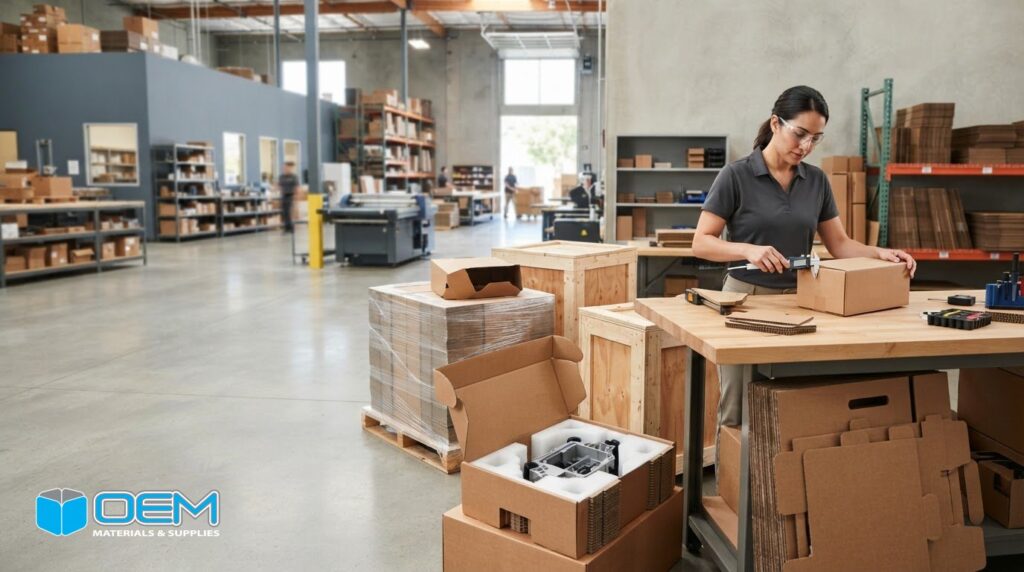
Standard commodity cartons quietly drain industrial budgets through transit damage and inflated freight expenses. Sourcing from a dependable custom corrugated box supplier Los Angeles operations can rely on turns protective packaging into a functional asset rather than an operational bottleneck.
You already know the frustration of managing unpredictable transit delays from out-of-state vendors while bulky pallets of stock boxes crowd valuable Southern California warehouse floor space. When precision parts arrive crushed because a generic container lacked adequate board strength or matched cushioning, your team absorbs the cost of scrap, repackaging, and missed delivery deadlines.
This guide explains how to evaluate, specify, and procure custom engineered corrugated packaging built for regional manufacturing and distribution facilities. We cover practical criteria for choosing structural board grades, consolidating protective foam inserts under one supplier, and using local inventory programs to streamline your supply chain.
Key Takeaways
- Working with an experienced custom corrugated box supplier Los Angeles manufacturers rely on ensures packaging matches exact component dimensions, eliminating transit damage caused by ill-fitting stock cartons.
- Understand how to balance Edge Crush Test ratings and Mullen burst values to select the right board grade and flute profile for your distribution cycle.
- Identify critical supplier capabilities before ordering, including rapid CAD table prototyping, physical drop testing, and precision die-cutting machinery.
- Protect valuable Southern California warehouse floor space by utilizing vendor-managed inventory and scheduled just-in-time delivery programs.
- Lower administrative overhead and handling labor by consolidating custom corrugated containers, protective foam inserts, and shipping pallets under one regional partner.
Industrial Packaging Demands for Los Angeles Manufacturers
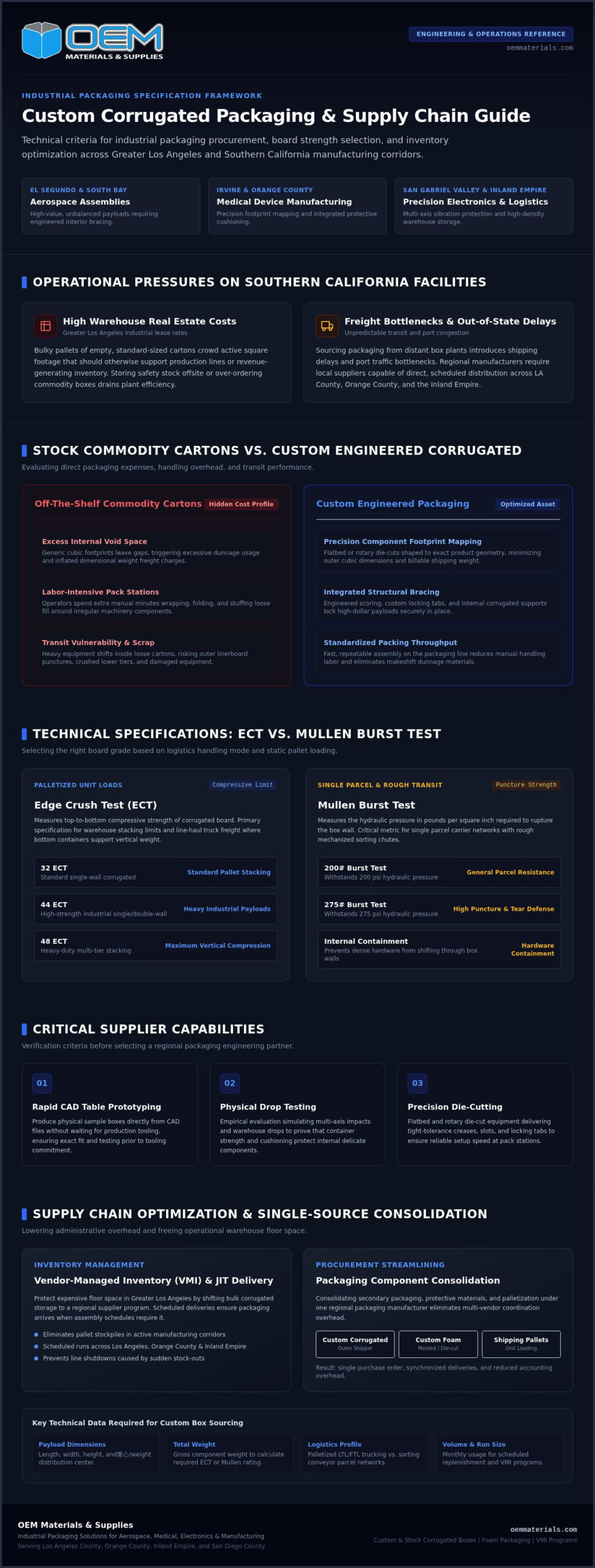
Southern California hosts an extensive manufacturing footprint spanning aerospace assemblies in El Segundo, medical devices in Irvine, and precision electronics across the San Gabriel Valley. These operations build sensitive, high-value payloads with unique geometry and unbalanced weight centers. Partnering with a dedicated custom corrugated box supplier Los Angeles facilities trust provides access to structural designs that stock cartons cannot deliver.
Off-the-shelf packaging forces industrial shipping teams into compromises. When standard box sizes fail to match product dimensions, pack stations rely heavily on loose fill, which inflates labor time and dimensional weight billing. Industrial components require tailored corrugated boxes built from industrial-grade corrugated fiberboard engineered to protect delicate equipment against severe transit vibration, multi-axis drops, and dynamic compression.
Challenges Facing Southern California Supply Chains
Industrial real estate across Greater Los Angeles commands steep leasing rates, making floor-space efficiency critical. Storing dozens of pallets loaded with bulky, empty cartons ties up valuable square footage that could otherwise house assembly lines or active inventory.
At the same time, regional logistics corridors face congestion, tight assembly schedules, and strict supplier lead-time requirements. Relying on remote or out-of-state box plants introduces unexpected freight delays and port traffic bottlenecks. Sourcing through an established regional manufacturer allows plants to schedule dependable deliveries across Los Angeles, Orange County, and the Inland Empire without stockpiling safety inventory.
Stock Cartons Versus Custom Engineered Corrugated
Standard brown boxes appear inexpensive at first glance, but hidden costs compound quickly on the packaging line and during transit.
- Excess Void Space: Standard sizes leave empty internal volume. This requires excessive manual cushioning and triggers inflated parcel carrier dimensional weight fees.
- Assembly Inefficiency: Pack operators spend extra minutes folding, stuffing, and taping makeshift dunnage around irregular equipment.
- Transit Vulnerability: Heavy equipment shifts inside loose stock cartons, increasing the probability of puncturing the outer linerboard.
In contrast, custom engineered packaging uses flatbed or rotary die-cuts with integrated corrugated scoring, tabs, and internal structural bracing. Working alongside an experienced custom packaging design team creates containers mapped precisely to component footprints. This tailored approach locks equipment securely in place, minimizes outer cubic dimensions, and shields high-dollar machinery throughout its distribution cycle.
Technical Specifications: Corrugated Board Grades and Flute Profiles
Specifying industrial packaging requires a balance between tare weight and physical load capacity. Choosing an arbitrary box grade leads to crushed lower tiers on a pallet or unnecessary shipping weight. A qualified custom corrugated box supplier Los Angeles engineering teams consult will examine how your freight moves, stacks, and handles dynamic impacts before recommending a board combination.
Industry packaging standards overseen by organizations like the Fibre Box Association provide two distinct testing frameworks to evaluate strength: the Edge Crush Test and the Mullen Burst Test. Understanding the difference prevents severe transit failures.
Edge Crush Test Versus Mullen Burst Strength
Edge Crush Test (ECT) measures the top-to-bottom compressive strength of a corrugated sheet. This metric dictates pallet stacking limits inside your warehouse and during line-haul trucking. For palletized unit loads, ECT ratings such as 32 ECT, 44 ECT, or 48 ECT determine whether the bottom container maintains its structural integrity under static load.
The Mullen burst test measures the hydraulic pressure required to rupture the box wall, expressed in pounds per square inch (such as 200# or 275# test). This rating indicates puncture resistance and internal containment capability. While parcel networks require high burst ratings to resist rough sorting chutes, stacked unit loads depend strictly on ECT compression limits.
Selecting Flute Sizes for Protection and Stacking
The wave-like corrugation between linerboards, known as the flute, governs vertical stiffness, thermal insulation, and surface crush resistance:
- B-Flute (approx. 1/8″ thickness): Offers higher crush resistance and a flatter surface, making it well suited for interior die-cut pads, structural partitions, and outer printing.
- C-Flute (approx. 11/64″ thickness): Delivers balanced stacking strength and adequate transit shock cushioning, serving as the standard for general shipping shippers.
- Double-Wall Combinations (e.g., BC-Flute): Fuses B and C flutes between three linerboard sheets. This setup is mandatory for heavy industrial payloads like stamped automotive components, industrial pumps, and castings that crush single-wall containers.
Integrating Protective Packaging and Cushioning
Board strength only solves half the protection equation for sensitive components. High-precision medical electronics, polished metal parts, and calibrated aerospace subassemblies also require interior stabilization. Pairing exterior corrugated cartons with engineered custom foam packaging prevents component abrasion, locks fragile parts into fixed cavities, and dampens vibrational harmonics.
Internal corrugated dividers or die-cut partitions can also isolate individual components, eliminating metal-on-metal contact. If your operations team needs help identifying the correct board construction, you can request a technical quote to evaluate your current packaging footprints and load requirements.
Key Capabilities to Look for in a Local Box Supplier
Selecting an industrial packaging vendor demands far more than comparing per-unit prices on a spreadsheet. In an active production plant, late deliveries or inconsistent scoring lines stall shipping docks within hours. A dependable custom corrugated box supplier Los Angeles operations partner with must demonstrate verified technical machinery, structural design engineering, and regional fulfillment infrastructure.
High-performing suppliers build packages aligned with TAPPI industry standards for dimensional tolerances and load performance. Before signing vendor agreements, industrial procurement teams should confirm three operational capabilities.
Engineering Support and Structural Prototyping
Precision manufacturing cannot tolerate trial-and-error box sizing. Reputable suppliers maintain digital CAD plotting tables to cut physical corrugated prototypes directly from your engineering files before tooling expenses begin.
This technical review identifies where box walls can be optimized or reinforced. Engaging specialized custom packaging design services allows packaging engineers to evaluate internal stress risers, test fitments against fragile exterior ports, and conduct preliminary drop testing. The result is a container tailored to your exact payload, avoiding over-engineering and unnecessary material expenditures.
Inventory Management and Warehouse Programs
Industrial space across Southern California remains expensive to lease and maintain. Devoting clean manufacturing floor space to mountains of empty, set-up corrugated boxes wastes capital. Local suppliers resolve this footprint constraint through structured inventory programs.
Establishing a packaging vendor-managed inventory agreement allows your box partner to hold finished inventory off-site in regional hubs. Packaging arrives via scheduled just-in-time packaging delivery timed directly to your production schedule. When unexpected shift increases occur, local warehousing buffers your plant against stockouts without clogging active aisles.
Full Supply Chain Material Consolidation
Managing separate purchase orders for cartons, void fill, cushioning pads, and stretch wrap burdens accounting teams and inflates regional receiving costs. An industrial supplier should provide full material consolidation:
- Matched Unit-Load Components: Sourcing corrugated shippers, engineered foam inserts, plastic pallets, and corner boards under a single release order.
- Administrative Efficiency: Single-vendor accounts simplify vendor onboarding, invoice auditing, and supplier quality audits.
- Reduced Freight Drops: Combining boxes, stretch film, and cushioning onto dedicated delivery trucks slashes local dock fees across multiple regional plants.
Evaluating your vendor based on these total fulfillment capabilities ensures your operation receives dependable packaging protection without inflating internal labor or transport overhead.
Steps to Specify and Source Custom Packaging in Southern California
Procuring industrial corrugated containers requires precise mechanical inputs. While consumer packaging procurement centers on graphic art files, specifying industrial packaging focuses entirely on protective performance and transport survival. Working with a seasoned custom corrugated box supplier Los Angeles engineers depend on starts with mapping your exact handling hazards and structural requirements.
Following a structured three-step specification process prevents costly design revisions and ensures your containers perform reliably on active packaging lines.
Step 1: Document Physical Requirements and Shipping Hazards
Begin by capturing critical physical metrics rather than generic bounding box estimates:
- Dimensions and Mass Distribution: Record exact exterior length, width, and depth, noting any asymmetrical weight concentrations, mounting brackets, or delicate connectors that cannot bear load.
- Dynamic Transport Exposures: Map the distribution chain. Determine if parts ship via full truckload, less-than-truckload (LTL), or parcel networks where sorting hub drops are frequent.
- Pallet Stacking Requirements: Determine the target warehouse stack height, pallet configuration, and static top-load weight each bottom carton must support without creasing.
Step 2: Choose Box Styles and Closure Methods
Carton architecture influences pack-line speed and structural rigidity under load. A Regular Slotted Carton (RSC) offers practical utility and economical material usage for uniform industrial parts. However, high-density metal components often require a Full Overlap Container (FOL). The overlapping top and bottom flaps on an FOL create double the board thickness across opposing faces, significantly increasing puncture resistance and stacking strength.
For sensitive test instruments or subassemblies requiring integrated internal trays, custom roll-end lock die-cuts provide rapid fold-and-pack assembly without requiring extensive tape closures.
Step 3: Calculate Tooling Costs Against Unit Volume
Die-cut containers require an initial physical cutting die made from shaped steel rule embedded in hardwood. While this tooling introduces an upfront fee, it lowers recurring unit costs and yields tighter manufacturing tolerances on repeat production runs.
For short prototype batches or emergency pilot builds, local plants can utilize digital knife-cutting tables to avoid tooling expenses entirely. Providing your supplier with accurate annual usage volumes allows them to source master corrugated sheets efficiently and design batch delivery schedules that keep per-unit costs low. When you are ready to engineer your next production run, you can submit your product specifications to initiate structural design and sampling.
OEM Materials & Supplies: Your Southern California Packaging Partner
Southern California manufacturing facilities require responsive regional support rather than distant brokerage services. OEM Materials & Supplies operates as an integrated manufacturing and distribution partner supporting operations across Los Angeles County, Orange County, the Inland Empire, and San Diego. Operating as a full-service custom corrugated box supplier Los Angeles industrial facilities depend on, we bridge the gap between technical structural design and dependable regional delivery.
Our complete packaging portfolio extends beyond standard cartons to include fabricated foam cushioning, corrugated partitions, heavy-duty shipping crates, and industrial pallets. Consolidating these materials under one vendor streamlines supplier management and lowers overall handling overhead.
Custom Corrugated Manufacturing Capabilities
Production runs must scale efficiently from early pilot testing to recurring high-volume assembly lines. Our converting capabilities include precision single-wall, double-wall, and triple-wall custom corrugated boxes manufactured to tight tolerances.
Every industrial container is built around your product’s specific center of gravity, load-bearing points, and distribution hazards. Whether your facility produces sensitive aerospace guidance equipment, medical diagnostic instruments, or dense automotive castings, our team matches the appropriate flute profile and test ratings to ensure complete transit protection.
End-to-End Contract Kitting and Assembly
Erecting boxes, cutting manual foam pieces, and staging loose dunnage wastes valuable production labor. OEM Materials & Supplies delivers turnkey packaging kits directly to your pack stations. Containers arrive pre-assembled with bonded foam inserts, internal dividers, and edge protectors positioned for immediate loading.
By eliminating manual assembly steps, your warehouse team packs parts faster with fewer errors. Dedicated delivery routes throughout Greater Los Angeles and adjacent industrial corridors align packaging drops with your live assembly line schedules, keeping pack stations supplied without cluttering active floor space.
Request an Industrial Packaging Consultation
Developing an optimized packaging system begins with specific operational data. Our local packaging specialists evaluate your application requirements to design durable, cost-effective shipping containers tailored to your shipping environment.
To start your design review, provide our technical team with your product dimensions, component weights, handling hazards, and projected annual usage. Contact our engineering team today to request a quote and schedule your physical prototype sampling.
Optimize Your Southern California Packaging Operations
Transitioning from generic stock cartons to custom engineered containers prevents recurring transit damage and curbs inflated dimensional freight expenses. Pairing tailored board strength with fabricated foam cushioning protects your sensitive equipment through every phase of the distribution cycle.
Choosing an experienced custom corrugated box supplier Los Angeles manufacturers trust provides your facility with dedicated regional manufacturing and inventory support. OEM Materials & Supplies serves plants across Los Angeles County, Orange County, San Diego, and the Inland Empire. Our vendor-managed inventory and scheduled delivery programs eliminate warehouse floor congestion, keeping valuable square footage dedicated to active production.
Take control of your packaging workflow. Reach out to our packaging team to request a custom corrugated box quote with your component dimensions, shipping weights, and annual usage requirements.
Frequently Asked Questions
What information is needed to get a custom corrugated box quote in Los Angeles?
To generate an accurate technical quote, suppliers need your exact component dimensions (length, width, and depth), individual piece weight, and projected annual usage volume. Providing distribution details like pallet stack height limits, parcel carrier handling, and CAD drawings allows engineers to calculate optimal board grades and cutting die requirements. Sourcing from an established custom corrugated box supplier Los Angeles manufacturers rely on ensures your structural specifications align with your production requirements.
How do I choose between Mullen burst test and Edge Crush Test (ECT) board grades?
Choose ECT ratings if your containers are palletized and stacked inside warehouses, and select Mullen burst ratings if individual boxes encounter rough parcel sorting belts. ECT measures top-to-bottom compressive resistance, preventing bottom-tier box buckling under static warehouse loads. Mullen measures puncture and hydraulic rupture resistance, making it the proper specification for loose freight, heavy hardware, or irregular payloads prone to shifting during transit.
What is the typical turnaround time for custom corrugated box prototypes and production?
Turnaround schedules depend on design complexity, tooling requirements, and raw material availability. Plain CAD table samples and digital knife-cut prototypes are typically produced quickly once dimensional files are approved. Full production runs requiring permanent steel rule cutting dies depend on current manufacturing queues and order volumes. Contacting your local packaging partner directly provides specific production schedules based on your plant’s assembly deadlines.
Can custom corrugated boxes be manufactured with pre-installed protective foam inserts?
Yes, integrated packaging suppliers fabricate custom boxes and pre-install engineered foam cushioning before delivery. OEM Materials & Supplies bonds fabricated polyethylene, polyurethane, or cross-linked foam inserts directly into corrugated cartons or delivers them as complete kitted sets. This eliminates manual insert assembly at your pack stations, shortens packaging cycle times, and guarantees precise dimensional fit for sensitive aerospace, medical, and electronic equipment.
What are the cost differences between stock boxes and custom corrugated packaging?
Total cost differences depend on dimensional weight charges, packing labor, and transit damage rates rather than just unit purchase price. Stock cartons often have lower upfront purchase costs, but they require excess void-fill, increase packing labor, and trigger expensive dimensional weight surcharges. Custom containers optimize outer cube dimensions and integrate interior bracing, which reduces material waste, lowers carrier freight expenses, and curbs scrap.
How does a vendor-managed inventory (VMI) program work for corrugated boxes?
A vendor-managed inventory program allows your custom corrugated box supplier Los Angeles partner to hold finished packaging off-site and release stock as needed. Your team establishes agreed minimum and maximum stocking levels based on production forecasts. The supplier monitors consumption and replenishes inventory directly to your warehouse floor through scheduled local deliveries, preventing stockouts while freeing up high-cost industrial floor space.
Does OEM Materials & Supplies deliver across the entire Southern California region?
Yes, OEM Materials & Supplies provides comprehensive manufacturing and distribution support across Los Angeles County, Orange County, San Diego County, and Riverside County. Dedicated delivery logistics support regional industrial hubs from the South Bay and San Gabriel Valley down through Irvine and the Inland Empire. Scheduled fleet runs ensure local manufacturing facilities receive custom boxes, foam cushioning, and pallet supplies without transit delays.