
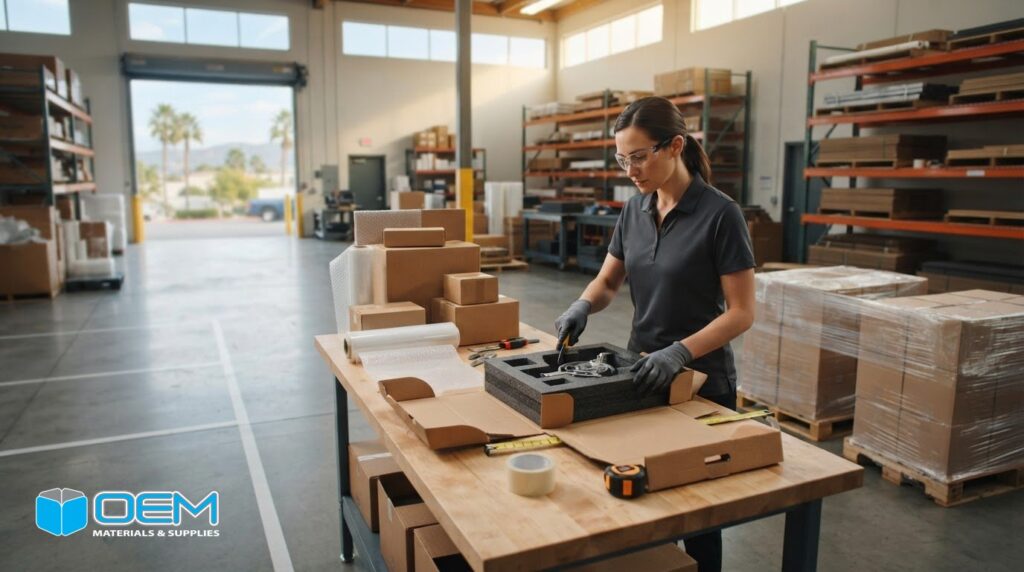
The convenient catalog order that keeps your shipping dock moving might actually be driving up your operational overhead. If you manage procurement or operations in Southern California, you already know the frustration of steep freight surcharges on bulky cartons and stock packaging that consumes valuable floor space. When standard catalog sizes force excess dimensional weight and require extra void fill, finding a dependable local alternative to uline in orange county becomes an immediate priority.
You don’t have to absorb regional shipping markups or sacrifice technical support just to get reliable packaging supplies. In this guide, you’ll discover how partnering with a local industrial packaging specialist helps eliminate freight markups, improve component protection, and streamline floor space. While exact cost reductions always depend on specific variables like component dimensions, materials, and volume, transitioning to engineered foam, custom corrugated boxes, and vendor-managed inventory keeps your production line running lean. We examine the operational advantages of regional manufacturing and how to choose the right packaging partner for your facility.
Key Takeaways
- Working with a local alternative to uline in orange county eliminates regional freight surcharges and provides direct access to dedicated packaging specialists.
- Custom corrugated boxes and engineered foam packaging protect sensitive components precisely, reducing damaged shipments and excess void fill.
- Vendor-managed inventory and scheduled local delivery help facilities reclaim valuable floor space while maintaining steady production supplies.
- Consolidating redundant catalog carton sizes into optimized, standardized packaging designs lowers total landed costs based on part geometry, material selections, and order volume.
Why Orange County Manufacturers Seek an Alternative to National Packaging Catalogs
For industrial manufacturing plants across Anaheim, Irvine, and Santa Ana, relying on massive catalog distributors often creates quiet budget leaks. National distributors advertise vast stock selections, but the true landed cost tells a different story. Bulk packaging is light and space-consuming, making it inefficient to haul through national freight networks. When operations leaders look for a local alternative to uline in orange county, they evaluate the entire cost picture rather than focusing solely on catalog list prices.
Hidden Freight and Bulky Delivery Surcharges
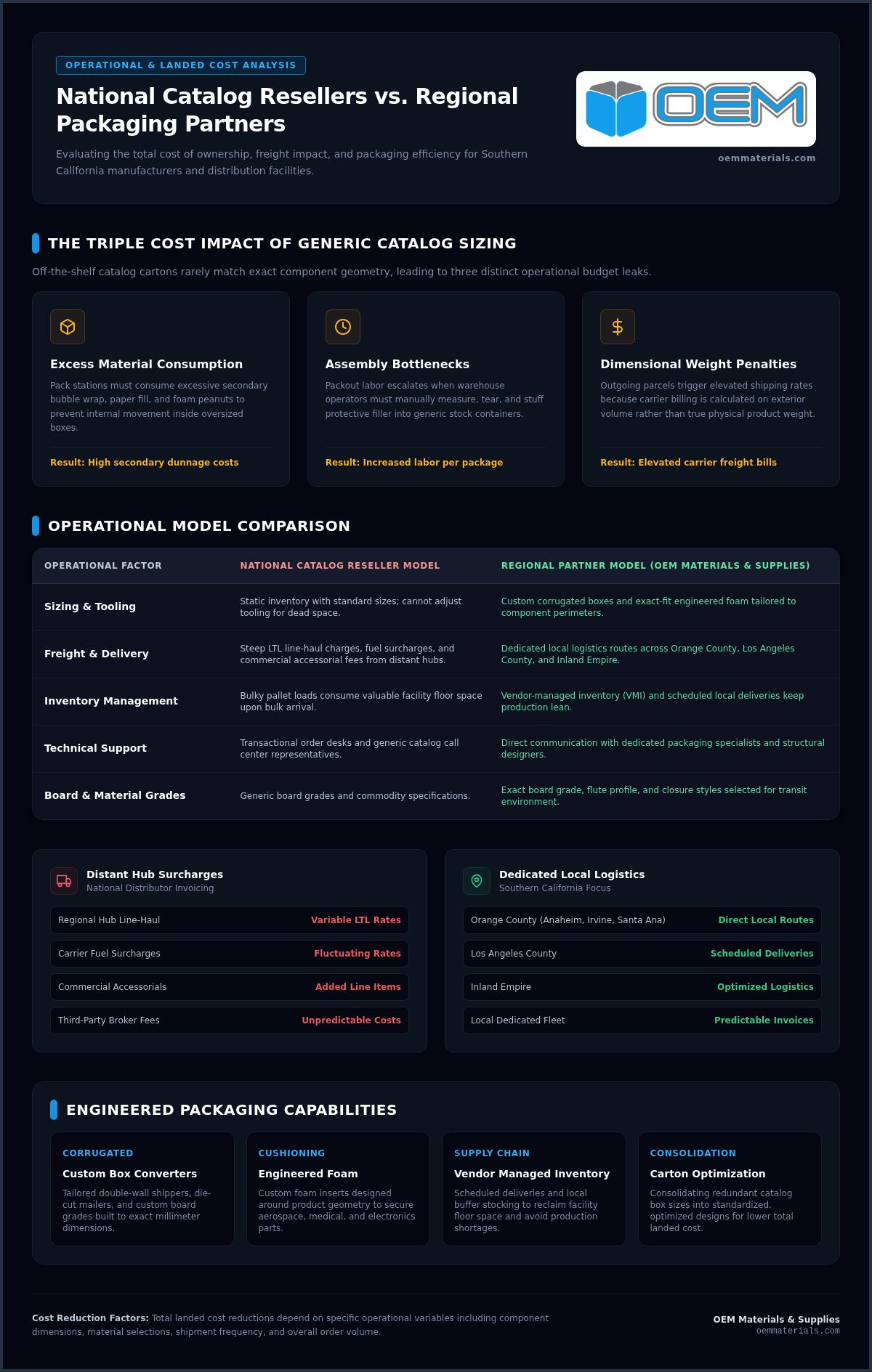
Catalog distributors typically calculate freight charges based on dispatches from large, regional fulfillment hubs. Bulky corrugated bundles and pallet loads trigger steep LTL line-haul charges, fuel surcharges, and commercial delivery accessorials. A nominal per-unit discount on stock cartons often disappears once those freight line items hit the final invoice.
Modern supply chain management strategies prioritize regional proximity to mitigate unpredictable carrier rate increases. Regional packaging partners operate dedicated local logistics routes across Orange County, Los Angeles County, and the Inland Empire. Sourcing from a nearby manufacturer removes third-party broker fees and freight markups, replacing fluctuating freight invoices with predictable, localized delivery.
The True Cost of Standard Sizing
Standard off-the-shelf cartons rarely match the exact geometry of engineered components, medical equipment, or aerospace parts. When forced to use generic catalog dimensions, packing teams must fill the excess interior space. This approach drives up operational costs across three distinct areas:
- Material consumption: Pack stations consume excessive bubble wrap, paper fill, and foam peanuts to prevent internal transit shifting.
- Assembly bottlenecks: Packout labor increases when operators must manually measure, tear, and stuff protective filler into oversized boxes.
- Dimensional weight penalties: Outgoing parcels face elevated carrier charges because billing is calculated on exterior volume rather than actual component weight.
Switching to custom-sized cartons or tailored foam packaging eliminates that dead space. Packing teams place parts into exact-fit enclosures without trial-and-error wrapping. While specific cost reductions depend on product dimensions, material selections, and shipment volume, eliminating excess cubic volume consistently drives down outgoing freight. Procurement teams also secure direct communication with technical packaging specialists, eliminating the friction of dealing with generic catalog call centers.
Catalog Resellers vs. Regional Packaging Partners: Core Operational Differences
Catalog distributors operate primarily as transactional order desks. They stock standardized commodity supplies across massive distribution yards and process part numbers efficiently. However, their model breaks down when your production line requires specialized physical protection, rapid prototyping, or structural adjustments. Choosing a true local alternative to uline in orange county bridges the divide between purchasing off-the-shelf commodities and engineering functional packaging solutions.
Stock Distributors vs. Custom Packaging Manufacturers
Catalog vendors maintain static inventories. If a standard carton leaves three inches of dead space around an aerospace assembly, their system cannot adjust the tooling. You must absorb the extra shipping volume or purchase secondary dunnage to stabilize the shipment. In contrast, regional manufacturers construct production-ready packaging built specifically around the perimeter of your physical product.
Sourcing custom corrugated boxes directly from a regional converter ensures the board grade, flute profile, and closure styles align with the transit environment. Regional plants run exact dimensional batches, whether you need heavy-duty double-wall shippers or high-run die-cut mailers. Tailoring dimensions to the millimeter strips out unneeded paperboard and simplifies palletization patterns.
Integrated Protective Packaging Development
Precision manufacturing sectors throughout Southern California require more than an outer shell. Sensitive electronics, calibrated medical devices, and precision-machined automotive parts demand interior shock absorption tailored to specific fragility ratings. Research and case studies from leading supply chain programs in Southern California consistently highlight the strategic value of local supplier collaboration in reducing supply chain complexity and transit losses.
A regional packaging partner integrates outer containers with custom interior protection through a single engineering workflow. Rather than buying stock boxes from one catalog and loose cushioning rolls from another, operations teams utilize precision-engineered custom foam packaging fabricated from cross-linked polyethylene, expanded polypropylene, or anti-static polyurethane. These multi-density inserts lock critical components into place.
Integrated packaging design offers measurable advantages across manufacturing plants:
- Accelerated prototyping: Local design teams cut physical foam samples and corrugated mockups for immediate fit checks on active assembly lines.
- Drop-tested reliability: Packaging engineers calculate deceleration requirements to avoid brittle material failure under impact.
- Assembly line efficiency: Drop-in foam trays and custom kits allow packing personnel to stage, secure, and seal finished goods in seconds.
If you are re-evaluating recurring freight line items or experiencing product transit damage with stock containers, you can submit part dimensions and annual volumes to request a custom design consultation from a regional packaging specialist.
Evaluating Industrial Packaging Capabilities: What Your Local Supplier Must Provide
Replacing a national catalog distributor requires more than finding someone with corrugated boxes on the floor. An industrial operation needs a manufacturer that balances day-to-day packing consumables with engineered structural packaging. State-level programs like California’s Source Diverse Source Local initiative emphasize that regional procurement builds operational resilience. For manufacturing hubs across Orange County, your regional partner must act as a direct extension of your production line.
Material Breadth and Structural Performance
A capable supplier must support structural testing standards rather than selling unrated containers. Corrugated packaging should be certified using Edge Crush Test (ECT) ratings for pallet stacking strength or Mullen burst testing for puncture resistance during rough parcel handling. Depending on payload weight, board selections range from lightweight B-flute and C-flute single-wall cartons to heavy-duty double-wall or triple-wall boxes.
Beyond corrugated cartons, industrial facilities rely on integrated packing materials to secure pallet loads. Your vendor must supply essential secondary packaging lines:
- Stretch film: Machine-grade and hand-applied stretch film engineered to maintain load containment under lateral transit forces.
- Edge protectors: Heavy-duty laminated paperboard angles that prevent strap crushing and reinforce corner stacking strength.
- Custom wood crates: Heavy-duty timber crates and skids designed to support capital equipment and export machinery.
- Unitized transport bases: Standard and custom wood or plastic pallets matched to specific racking footprints.
Kitting, Assembly, and Cleanroom Readiness
Production efficiency drops when assembly technicians spend their shifts folding boxes, taping inserts, or hunting down loose cushioning. Evaluating a true local alternative to uline in orange county involves auditing their value-added contract packing capabilities. Local partners can deliver complete packaging kits directly to your workstations, staging custom foam inserts pre-glued inside cartons with exact accessory bags attached.
Advanced industries across Irvine Spectrum, Lake Forest, and Cypress require specialized environmental controls. Sensitive electronics assembly operations need dissipative and anti-static ESD foam to neutralize electrostatic discharge during transit. Similarly, biomedical manufacturers require particulate-free corrugated alternatives and cleanroom-compatible liners. A supplier with cross-industry engineering experience understands these cleanliness and surface-protection parameters, ensuring your packaging protects delicate circuit traces and sterile barrier seals without compromise.
Reducing Total Landed Packaging Costs with Local Logistics and VMI
Calculating the true cost of industrial packaging requires looking past the invoice price per carton. In Southern California, the physical footprint needed to stage bulky packaging inventory often carries a hidden penalty. Committing dozens of pallet positions to empty corrugated boxes ties up valuable operational floor space. Working with a dedicated local alternative to uline in orange county allows operations managers to convert that overhead into productive manufacturing space.
Optimizing Floor Space with Managed Inventory
Industrial real estate across Orange County commands a premium, making bulk carton storage economically inefficient. Stacking high volumes of corrugated bundles simply to hit catalog discount tiers drains working capital and crowds out assembly operations. Structured packaging VMI programs solve this bottleneck through automated replenishment systems.
Under a managed inventory framework, packaging specialists track usage rates and maintain defined minimum and maximum stocking levels directly on your facility floor:
- Automated reorder triggers: Consumption data dictates production runs, removing the burden of manual reordering from your procurement team.
- Reclaimed square footage: Facilities store only three to five days of active packing stock on-site, converting bulk storage racks into active revenue-producing lines.
- Stabilized cash flow: Billing occurs upon replenishment or consumption, keeping capital out of idle packaging stacks.
Just-In-Time Delivery Across Southern California
Production schedules rarely stay static. Sudden spikes in assembly output can quickly exhaust existing stock. Relying on JIT packaging delivery gives operations across Anaheim, Irvine, Santa Ana, and Fullerton the agility to respond immediately to workflow shifts.
Local truck routes run daily throughout Orange County, Los Angeles County, and the Inland Empire. When an engineering revision or a rush production order demands custom shipping boxes or heavy-duty foam inserts, regional transport coordinates direct plant drop-offs. This local proximity eliminates the transit delays and regional freight surcharges typical of distant catalog fulfillment hubs. True landed cost reductions depend on your facility volume, specific component dimensions, and raw material requirements, but cutting excess inventory and freight surcharges consistently tightens operational budgets.
To eliminate bulky stock from your warehouse floor, request a custom inventory management assessment tailored to your facility layout and consumption schedule.
Transitioning Your Supply Chain to OEM Materials & Supplies in Southern California
Migrating from an established catalog vendor to a manufacturing partner does not require shutting down packing operations or risking line shortages. A systematic onboarding process ensures cartons, cushioning, and crating transition smoothly into your daily workflow. When choosing a qualified local alternative to uline in orange county, procurement teams gain a methodical implementation that optimizes part numbers before a single delivery truck rolls out.
Conducting a Packaging SKU and Freight Audit
The transition begins with a structured review of your past twelve months of catalog purchasing data. Operations teams frequently discover that order patterns grew organically over time, resulting in overlapping dimensions and unnecessary SKUs. Gathering invoices allows packaging specialists to isolate specific cost drivers across your packaging footprint:
- SKU proliferation: Identifying similar box sizes that can be combined into a single, standardized carton footprint to increase batch purchasing power.
- Freight surcharges: Isolating accessorial delivery fees, dimensional weight penalties, and fuel surcharges applied to bulky corrugated orders.
- Damage claims: Pinpointing fragile components or heavy parts that suffer recurring transit stress due to generic packaging.
Consolidating box dimensions simplifies pack station layouts. Reducing twenty specialized carton sizes down to eight versatile configurations speeds up packout times and lowers inventory management complexity. Packaging engineers examine your actual products to determine optimal structural board grades, ensuring every box meets appropriate burst and crush thresholds without over-packaging.
Prototyping, Validation, and Account Onboarding
Unlike transactional catalog companies that ship stock samples straight from a warehouse shelf, regional engineering partners build custom packaging around physical components. Production teams test structural samples on active assembly lines, ensuring die-cut tabs fold cleanly and parts drop into foam cavities without resistance.
Engineers evaluate drop survivability, vibration damping, and cleanroom compatibility for medical devices or aerospace parts. Once the team approves final structural specifications, minimum and maximum inventory thresholds are established within your local delivery schedule. Connecting directly with OEM Materials & Supplies gives Southern California operations an experienced manufacturing team ready to conduct an on-site packaging evaluation, streamline floor inventory, and protect valuable components throughout transit.
Upgrade Your Southern California Packaging Supply Chain
Transitioning away from one-size-fits-all catalogs protects both your physical components and your operational margins. Partnering with a dedicated local alternative to uline in orange county eliminates distant freight surcharges, prevents transit damage through precision corrugated boxes and custom foam packaging, and frees up warehouse square footage with scheduled vendor-managed inventory. Direct access to technical packaging specialists replaces the friction of generic order desks.
Measurable cost improvements depend on your specific component dimensions, material selections, and annual volume. Backed by Southern California manufacturing facilities and a dedicated regional delivery fleet serving Orange County, Los Angeles County, the Inland Empire, and San Diego County, OEM Materials & Supplies is built to support demanding production lines. Submit your component dimensions, weight, and usage schedule to request a packaging audit and custom quote today. Strengthening your local supply chain starts with a single conversation.
Frequently Asked Questions
Can a local Orange County packaging supplier match Uline catalog delivery speeds?
Yes, local packaging suppliers frequently match or exceed catalog delivery speeds across Southern California. Regional providers maintain delivery fleets and warehouses positioned near major industrial centers in Orange County, Los Angeles, and the Inland Empire. Instead of routing shipments through national parcel networks or third-party freight terminals, a local alternative to uline in orange county schedules direct truck routes, offering scheduled drop-offs and rapid turnaround on routine packaging supplies.
How do freight costs from local packaging distributors compare to national catalog suppliers?
Sourcing through a local packaging distributor significantly reduces or eliminates freight surcharges and pallet line-haul markups. National catalog vendors calculate shipping based on remote fulfillment hubs, often adding accessorial fees and fuel surcharges for bulky corrugated items. Local suppliers utilize dedicated route trucks to deliver packaging directly to your receiving dock. Actual cost savings vary depending on component dimensions, material types, and order volume, but avoiding third-party freight networks protects your bottom line.
Can OEM Materials & Supplies produce custom box sizes that catalog companies do not sell?
Yes, OEM Materials & Supplies manufactures custom corrugated boxes tailored to your exact part dimensions. Catalog suppliers limit buyers to rigid stock dimensions, forcing plants to buy excess filler material. In contrast, custom converters engineer containers with specific flute profiles, board ratings, and closure configurations. Designing cartons around your product geometry minimizes void space, lowers dimensional weight penalties, and enhances structural protection for demanding industrial applications.
What packaging products can Orange County manufacturers source locally?
Orange County manufacturers can source an extensive range of industrial packaging materials locally from a single vendor. The product catalog includes custom and stock corrugated boxes, engineered foam packaging, custom wood crates, cushioning materials, and mailing tubes and cores. Facilities can also order routine shipping consumables such as stretch film, edge protectors, and plastic pallets to maintain smooth shipping dock operations without managing multiple distant suppliers.
How does a vendor-managed packaging inventory program work for manufacturing facilities?
A vendor-managed inventory program tracks packaging consumption on-site and automates restocking based on agreed minimum and maximum inventory levels. A packaging specialist monitors active stock counts on your warehouse floor and schedules deliveries using local transport routes. This setup prevents production downtime caused by packaging stockouts. It also frees up valuable floor space in your facility because you store only several days of packing materials at a time.
Is switching from a catalog supplier to a custom packaging manufacturer complicated?
Transitioning your supply chain to a local partner is straightforward when supported by a methodical onboarding process. Working with a dependable local alternative to uline in orange county starts with a simple packaging SKU audit of your recent catalog invoices. Engineers review your high-volume box sizes, consolidate overlapping dimensions, and provide physical prototypes for testing on active assembly lines before establishing automated replenishment schedules.
Can local packaging suppliers accommodate small production runs alongside high-volume orders?
Yes, full-service packaging manufacturers support both small prototype runs and full-scale production programs. Local engineering teams cut sample cartons and precision foam inserts for testing during new product introductions. Once engineering teams approve the packaging design, production scales seamlessly to deliver high-volume carton runs, pallet loads, and custom packaging kits that align with your plant’s ongoing manufacturing forecast.