
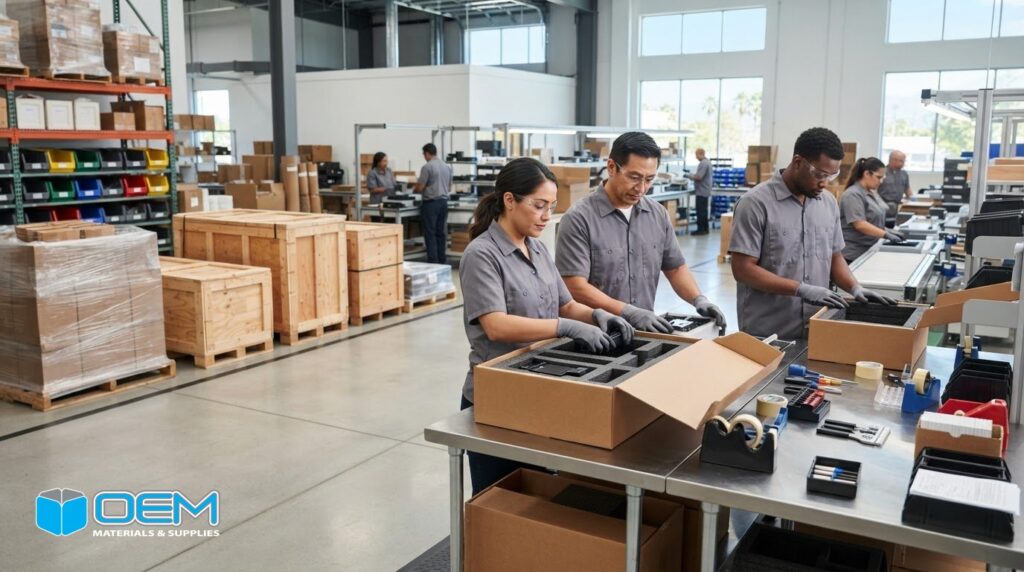
A labor quote alone won’t tell you whether an outside partner can reliably handle your assembly and packaging workflow. When in-house work competes for production capacity, evaluate contract packaging and assembly services southern california buyers consider against the full process: materials, handoffs, inventory needs, and delivery requirements.
It’s reasonable to focus on labor and unit cost, but an incomplete scope can lead to delays, errors, or quotes that are difficult to compare. This guide offers a practical framework for deciding whether outsourcing fits your product and workflow, assessing suppliers on operational criteria, and preparing a request for quote with the details needed for a useful response. Define the assembly tasks, packaging materials, volumes, quality expectations, and logistics so prospective suppliers can respond to the same requirements.
Key Takeaways
- Identify workflow pressures that make outsourced assembly worth evaluating, from labor constraints to inventory coordination.
- Define the product, assembly steps, packaging configuration, volumes, and handoffs before requesting a quote.
- Compare Southern California suppliers by scope, packaging integration, communication, inventory options, and location fit.
- Clarify oversight, component ownership, packaging supply, storage, and delivery responsibilities before launch.
- Use a staged transition to review requirements and confirm instructions and materials before work begins.
When to Use Contract Packaging in Southern California
Buying boxes, foam, or other packaging materials is different from outsourcing the work performed with them. Contract packaging assigns a defined packaging workflow to an outside provider. Outsourced product assembly goes further: a provider performs specified steps to bring components together, potentially followed by packaging. A contract packager may handle functions such as packaging, but the exact scope depends on the agreement.
For manufacturers in Orange County, Los Angeles, San Diego, and Riverside, the key question is operational fit. Suppliers of contract packaging and assembly services in Southern California should be evaluated against the product, task complexity, specifications, volume, and handoffs involved. A straightforward kit with clear work instructions has a different scope from a product requiring specialized production steps. Confirm capabilities before assuming those tasks are included.
What work can an outsourced packaging and assembly partner handle?
OEM Materials & Supplies offers kitting and assembly. Depending on the confirmed project scope, a program may combine specified component assembly with placing the finished item into a packaging configuration. Packaging options may include corrugated boxes or foam packaging. See foam packaging options for one example of a packaging material category.
Define the requested work precisely. Provide the component list, assembly sequence, packaging configuration, labeling requirements, and intended destination. Then confirm which tasks the supplier can perform. Discuss testing, inspection criteria, specialized production, and other quality checks explicitly. Don’t assume they’re included in a general assembly description.
Which operational problems justify evaluating outsourcing?
Outsourcing may be worth evaluating when repetitive assembly or packing draws people away from higher-priority production work, or when output fluctuates beyond the in-house team’s capacity. It may also help clarify a workflow where components, packaging materials, assembly, and shipment preparation are managed separately. Each handoff needs an owner, and material availability can determine whether work is ready to proceed.
For example, a team may have components on hand but lack the packaging materials or labor needed to prepare orders for shipment. A scoped outside program could coordinate defined assembly and packaging steps, subject to confirmed responsibilities and delivery arrangements. It won’t automatically resolve shortages or remove the need for oversight.
Outsourced product assembly is the transfer of specified component-joining or kitting tasks to an external provider under agreed work instructions and responsibilities.
Before comparing Southern California suppliers, assess the actual work rather than requesting a generic labor quote. Suitability depends on what must be assembled, how it must be packed, how much work is involved, and where the process hands off to the next operation.
How to Define the Scope of an Outsourced Product Assembly Program
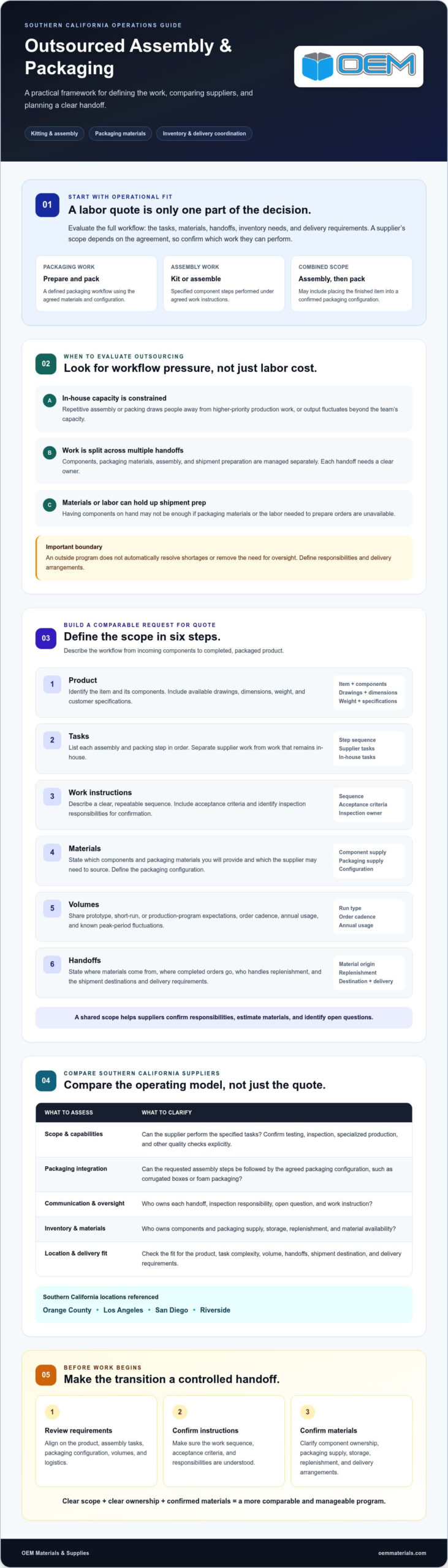
A useful quote starts with a clear description of the work, not just a product name and estimated quantity. Document the workflow from incoming components to completed, packaged product. This gives prospective suppliers a shared basis for confirming responsibilities, estimating materials, and identifying open questions.
Use this sequence to build the scope:
- 1. Product: Identify the item and its components. Include available drawings, dimensions, weight, and customer specifications.
- 2. Tasks: List each assembly and packing step in order. Separate work the supplier would perform from work that remains in-house.
- 3. Work instructions: Describe the required sequence in clear, repeatable language. Include acceptance criteria and identify inspection responsibilities for confirmation with the supplier.
- 4. Materials: Specify which components and packaging materials you will provide and which the supplier may need to source. Include the packaging configuration and relevant design requirements.
- 5. Volumes: Share prototype, short-run, or production-program expectations, order cadence, annual usage, and known peak-period fluctuations. Don’t assume a minimum volume; ask suppliers to confirm what fits their capabilities.
- 6. Handoffs: State where materials come from, where completed orders go, who handles replenishment, and what shipment destinations and delivery requirements apply.
What information should the work instructions include?
Write each assembly and packing step so a supplier can understand the requested process without filling gaps by assumption. Identify supplied components, packaging materials, labeling needs, and customer specifications. Describe how finished goods should be packed and where they need to ship. Confirm acceptance criteria, documentation, and inspection responsibilities with the prospective supplier before treating them as part of the scope. For drug manufacturing arrangements, the FDA’s quality agreements guidance discusses defining responsibilities for covered activities; its application is specific to that context.
How should buyers describe volume and delivery requirements?
Share the expected pattern of demand, not only a single total. Note whether work is a prototype, short run, or ongoing program, and flag seasonal or other peak-period changes. Explain when packaging materials need replenishment and how delivery timing relates to production or shipping schedules. If just-in-time delivery may fit the workflow, review the requirements described in just-in-time packaging services.
Packaging design can affect assembly sequence, material selection, and how the finished product is prepared for shipment. Coordinate those decisions early. OEM Materials & Supplies provides custom packaging design as a service. For a quote discussion, organize product dimensions, weight, annual usage, work instructions, and delivery destinations before you request a quote.
How to Compare Contract Packaging and Assembly Services in Southern California
Compare suppliers against the same defined workflow, not just the quoted task or price. The right fit depends on which steps a supplier can support, how packaging and materials are coordinated, and who owns decisions when plans change.
| Criteria | What to confirm |
|---|---|
| Service scope | Which kitting and assembly tasks are currently supported, and which parts of your project need further review? |
| Packaging integration | Can packaging materials and the requested packing steps be included in the proposed scope? Clarify who supplies each material. |
| Communication | Who is the day-to-day contact? How are instruction changes, schedule updates, shortages, and exceptions communicated? |
| Inventory options | Discuss whether material replenishment, just-in-time delivery, or vendor-managed inventory fits the project, and define responsibilities. |
| Location fit | Confirm service coverage, shipment destinations, and project logistics for your Southern California location. |
Use the same questions for each prospective supplier so answers are easier to compare. The Association for Contract Packagers and Manufacturers (CPA) is an industry resource; supplier fit still needs to be confirmed against your product and scope.
Which questions reveal whether a supplier fits the workflow?
Ask which assembly and kitting tasks the supplier supports, then confirm whether the specific steps in your work instructions are within scope. Assign responsibility for components, packaging, inspection, rework, and shipment release. Agree on how schedule changes, material shortages, and other exceptions will be raised, who approves instruction changes, and how those approvals are recorded.
How should quality control and operational risk be evaluated?
Outsourcing doesn’t eliminate oversight. It changes where work happens, so define who reviews instructions, confirms acceptance criteria, and makes decisions if output doesn’t meet requirements. Ask the supplier to describe relevant documented procedures and inspection steps. Before launch, agree how nonconforming output will be identified, reported, contained, and resolved. Don’t assume a particular certification or specialized control applies unless the supplier confirms it for the project.
Apply these criteria to the same project scope for every candidate. Comparing confirmed responsibilities, communication methods, and location logistics side by side helps reveal gaps before you select a supplier or begin transition planning.
How to Plan a Smooth Assembly and Packaging Transition
A defined scope is the starting point. A controlled transition turns that scope into a working process by confirming materials, responsibilities, instructions, and timing before the first production run. Involve the people who own each part of the workflow, not just the purchasing contact.
Use a staged approach:
- Share requirements: Provide product dimensions and weight, assembly steps, packaging needs, annual usage, target delivery cadence, and known material dependencies.
- Review the scope: Confirm which assembly and packaging tasks are included, which remain in-house, and who owns components, packaging supply, storage, and finished-goods delivery.
- Confirm materials: Identify what each party supplies, how materials are replenished, and how shortages or substitutions are handled.
- Validate instructions: Review the work sequence, packaging configuration, labeling, acceptance criteria, and approval process with the people responsible.
- Schedule the launch: Set a start date only after open questions, handoffs, and communication paths are resolved. Discuss a prototype or pilot if it fits the project, and confirm whether the supplier can support it.
What should buyers prepare before the first supplier discussion?
Bring current work instructions, product dimensions and weight, packaging requirements, annual usage, and the expected order cadence. Explain where the existing workflow creates constraints, such as limited labor availability or dependence on a component that arrives separately. Identify the engineering, purchasing, and operations contacts, plus the person authorized to approve process or instruction changes. Clear ownership prevents decisions from stalling between departments.
How can inventory services support an assembly workflow?
Packaging availability can affect whether scheduled assembly work is ready to proceed. Discuss who monitors stock, sets replenishment triggers, and places or approves orders. OEM Materials & Supplies offers vendor-managed inventory as an option for packaging supply coordination. Define the items covered and responsibilities before relying on the arrangement. Just-in-time delivery can also be considered against actual usage patterns, delivery cadence, and project logistics; plan and confirm it rather than assuming it.
Before launch, document how schedule changes, material shortages, and other exceptions will be communicated, and who decides the next step. If you have product dimensions, weight, annual usage, and a draft workflow ready, request a project quote to discuss the requirements and confirm project fit.
Choosing OEM Materials & Supplies for Southern California Assembly Support
A well-defined scope helps determine whether an assembly partner can support the work as part of a broader packaging workflow. OEM Materials & Supplies provides kitting, assembly, packaging design, and packaging supply services to manufacturers in Southern California and across the United States. The specific tasks, quality checks, volumes, delivery arrangements, and service-area logistics should be confirmed for each project before work is assigned.
An integrated partner may be worth evaluating when assembly tasks and packaging requirements depend on the same components, material availability, or shipment schedule. Coordinating those needs can provide one discussion point for the defined workflow, but it doesn’t guarantee reduced labor, lower costs, or a particular delivery outcome. Project results depend on the product, specifications, materials, volumes, and shipping requirements.
When is an integrated packaging and assembly partner worth evaluating?
Consider a partner that can discuss both assembly scope and packaging when a finished item must be kitted, assembled, and prepared for shipment as connected steps. OEM Materials & Supplies serves aerospace, automotive, medical, electronics, and manufacturing customers. Packaging requirements may call for corrugated boxes or engineered foam inserts, depending on the product and how it needs to be protected. Assess the right configuration against the product dimensions, weight, and shipping needs rather than assuming it in advance.
Manufacturers in Orange County, Los Angeles, San Diego, and Riverside can discuss project logistics with the company without assuming it has a specific local facility or a particular response time. Confirm location coverage, material movement, and delivery responsibilities for your operation as part of supplier review.
What should a request for quote include?
Provide enough detail for the supplier to assess the work, identify missing information, and confirm project fit. A useful request should include:
- Product dimensions, weight, components, and annual usage
- Requested assembly or kitting steps, along with existing work instructions
- Packaging specifications, such as corrugated box or foam insert requirements, if already defined
- Order cadence, delivery locations, and any known schedule fluctuations
- Responsibilities for supplied components, packaging materials, approvals, and shipment handoffs
Include drawings or packaging references when available, and flag any steps or specifications that still need review. This helps distinguish confirmed requirements from open questions that must be resolved before launch. Buyers can use these details to have a more focused discussion with OEM Materials & Supplies.
For a project-specific discussion, request a quote or project consultation with your product dimensions, weight, annual usage, and assembly requirements.
Build a Clear Path to Outsourced Assembly
A successful outsourced program starts with a defined workflow. Specify the product, assembly steps, packaging configuration, volumes, and handoffs before comparing suppliers. Then confirm who owns materials, approvals, quality responsibilities, and delivery coordination. These details help you evaluate suppliers of contract packaging and assembly services in Southern California against the work your operation actually needs.
OEM Materials & Supplies offers kitting and assembly services to manufacturers in Southern California and across the United States. Packaging options include corrugated boxes and engineered foam inserts, selected according to product and project requirements. Confirm the exact tasks, specifications, volume, and logistics for your project with the supplier before moving forward.
For a useful quote discussion, gather your product dimensions, weight, annual usage, assembly scope, packaging requirements, and delivery locations. Request a quote for your packaging and assembly requirements to review your project with OEM Materials & Supplies. A clear request is a practical first step toward determining whether the proposed workflow fits your operation.
Frequently Asked Questions
What are contract packaging and assembly services?
Contract packaging and assembly services assign defined product preparation tasks to an outside provider. Contract packaging may include placing products into specified packaging, while outsourced assembly may include kitting components or performing agreed assembly steps before packing. These services differ from buying packaging materials alone because the provider may perform work using those materials. Confirm the exact tasks, materials, instructions, quality responsibilities, and delivery handoffs included in any proposed scope.
Can a Southern California packaging supplier handle product kitting and assembly?
Yes, OEM Materials & Supplies offers kitting and assembly services to manufacturers in Southern California, including Orange County, Los Angeles, San Diego, and Riverside. Whether a particular project is a fit depends on its components, assembly steps, work instructions, volume, and handoffs. Describe the requested tasks clearly and ask the supplier to confirm which steps it can support. Don’t assume testing, inspection, or specialized production is included unless it’s specifically confirmed.
How do I choose an outsourced product assembly provider?
Choose a provider by comparing its confirmed project scope, packaging integration, communication practices, inventory options, and location fit. Ask who supplies components and packaging, who handles inspection or rework, and who approves shipment release. Also clarify how work instruction changes, schedule updates, shortages, and exceptions will be communicated. For Southern California manufacturers, confirm service coverage and project logistics for the specific delivery locations.
What information should I provide when requesting an assembly quote?
Provide product dimensions and weight, component details, annual usage, and the assembly tasks you want quoted. Include existing work instructions, packaging configuration or specifications, labeling needs, expected order cadence, and shipment destinations. Identify which components and packaging materials you’ll supply and which may need to be coordinated with the supplier. If volumes fluctuate or requirements are still being finalized, explain that so the supplier can identify open questions and confirm project fit.
Can packaging and assembly be managed through one supplier?
Yes, a single supplier may coordinate packaging and assembly when the project scope and capabilities support both. OEM Materials & Supplies offers kitting, assembly, and packaging options including corrugated boxes and engineered foam inserts. Buyers should still confirm each task and assign responsibility for materials, instructions, approvals, storage, and delivery. Coordination through one supplier may simplify communication, but it doesn’t remove the need for clear oversight and agreed handoffs.
Does outsourced assembly work for prototypes as well as production programs?
It can be considered for prototypes, short runs, and higher-volume production programs, depending on project requirements and supplier capabilities. OEM Materials & Supplies supports work ranging from prototypes through high-volume programs. Share expected quantities, assembly instructions, packaging needs, and any anticipated changes between prototype and production. Confirm whether the specific project can be supported at each stage, including any quality checks, approvals, or delivery requirements that apply.
How can vendor-managed inventory support packaging and assembly?
Vendor-managed inventory, or VMI, is an option for coordinating packaging material supply. The buyer and supplier should agree on which materials are covered, who monitors inventory, what triggers replenishment, and how changes in usage are communicated. For an assembly workflow, clear replenishment responsibilities can help teams plan around material availability. VMI doesn’t eliminate the need to share demand information or confirm delivery arrangements for the project.