

Aerospace packaging standards don’t start with choosing a box. They start with identifying the contract, customer, and shipment requirements that apply to the part. When specifications overlap or leave room for interpretation, a packaging decision can expose components to damage, corrosion, contamination, or electrostatic discharge.
Those concerns are familiar to aerospace manufacturers. Protection must match the product and its shipping conditions, and the approved process needs to be clear enough for teams to repeat and document consistently. A package that works for one component or program may not meet another’s requirements.
This guide explains how to identify governing requirements before packaging design begins, then translate them into product-specific materials, protection, and work instructions. It also covers customer and contract specifications, standards that may apply to commercial or defense shipments, and questions to ask a packaging supplier. With requirements confirmed, packaging design, prototypes, and production planning can follow a documented path rather than rely on guesswork.
Key Takeaways
- Start with applicable customer, contract, and purchase order requirements before selecting packaging materials.
- Use aerospace packaging standards as a reference only after confirming they apply to the specific program and shipment.
- Match protection choices to the part’s risks, including impact, vibration, corrosion, ESD, and cleanliness concerns.
- Build repeatability with clear packaging drawings, material details, work instructions, approvals, and revision control.
- Align engineering, procurement, quality, and your packaging supplier on requirements, validation criteria, and approved configurations.
What aerospace packaging standards cover, and why requirements vary
Aerospace packaging standards document how packaging must protect, preserve, handle, and ship a component. They can address material selection, cushioning, moisture or corrosion barriers, cleanliness, and package configuration. Requirements may come from an industry standard, a customer specification, or a program’s approved procedures. A useful background reference for National Aerospace Standards (NAS) can clarify industry terminology, but it doesn’t establish which requirements apply to a particular order.
The part and its journey matter. A machined metal component may need corrosion protection, while an electronic assembly may also require electrostatic discharge controls. Geometry, surface sensitivity, storage conditions, destination, and handling and transport methods all influence the packaging specification. Aerospace packaging standards therefore don’t prescribe one universal package for every part.
Confirm applicability against the current contract and standard revisions. For manufacturers in Orange County, Los Angeles, San Diego, and Riverside, make that check before packaging design or material selection begins.
Standards, specifications, and customer requirements are not interchangeable
An industry standard provides a shared set of requirements. A customer-specific specification can add or refine requirements for a program, while an internal work instruction explains how to carry out the approved method on the production floor. A standard cited in a reference library may not govern an order unless the contract or program incorporates it. Before design starts, confirm the document revision, how conflicting documents are prioritized, and who can approve the packaging configuration or changes.
Which packaging risks matter for aerospace components?
Assess risks against the actual component and its handling path. Impact and vibration may call for cushioning or restraint suited to the part’s geometry. Moisture and corrosion concerns may affect the preservation approach and barrier materials. Sensitive electronics may require specified ESD controls, while contamination-sensitive components may need cleanliness measures defined by the customer or program.
These controls aren’t interchangeable, and not every part requires all of them. Confirm the risk criteria rather than assuming a generic aerospace package will meet them. Once requirements are clear, packaging design can translate them into a repeatable configuration, such as a corrugated box with an engineered foam insert when those materials are suitable and approved. Consider custom foam packaging as part of that design discussion, not as a substitute for customer approval.
How aerospace packaging standards translate into a packaging specification
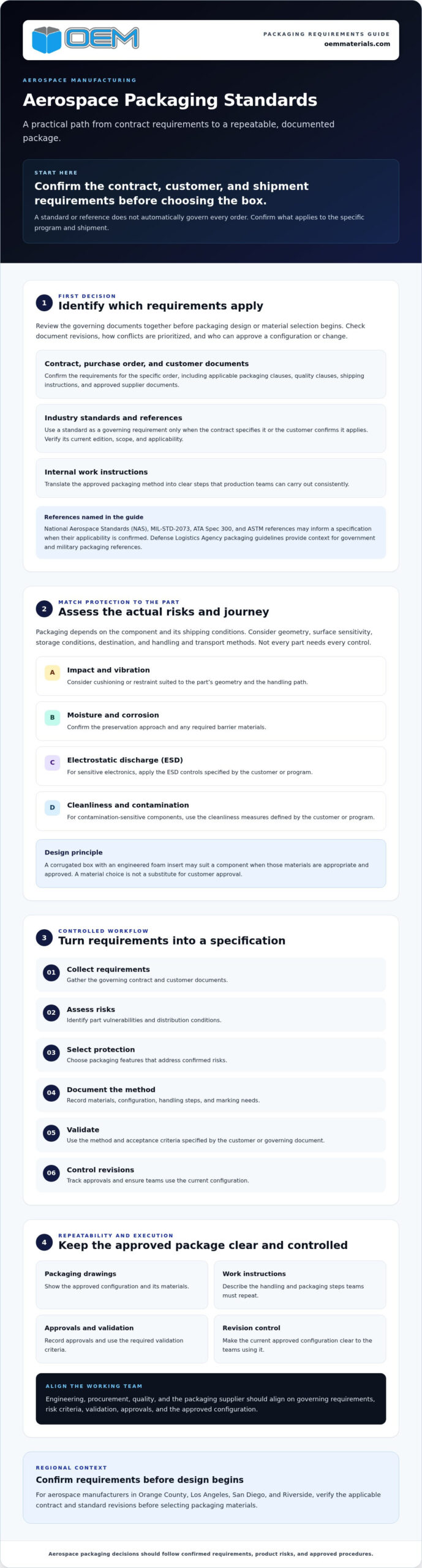
Turn requirements into a controlled packaging specification before production begins. A practical workflow keeps the source of each requirement visible and separates confirmed obligations from design recommendations awaiting approval:
- Collect requirements: Gather the governing contract and customer documents.
- Assess risks: Identify the part’s vulnerabilities and distribution conditions.
- Select protection: Choose packaging features that address confirmed risks.
- Document: Record materials, configuration, handling steps, and marking needs.
- Validate: Use the method and acceptance criteria specified by the customer or governing document.
- Control revisions: Track approvals and ensure teams use the current configuration.
MIL-STD-2073, ATA Spec 300, or ASTM references may inform the specification, but only when the contract specifies them or the customer confirms they apply. Check each document’s current edition, scope, and contractual applicability before citing it. The Defense Logistics Agency packaging guidelines provide context for government and military packaging references.
Start with the purchase order, drawing, and packaging clauses
Review the purchase order, part drawing, quality clauses, shipping instructions, and approved supplier documents together. Capture the required preservation method, packaging level, labels, records, and destination or storage conditions in one controlled specification. A referenced standard identifies criteria to consider, but it doesn’t by itself prove that a package meets them or that the customer has approved the design. If documents conflict or leave a requirement unclear, ask the customer’s designated engineering or quality contact to resolve it before design proceeds.
Choose protection based on the part and distribution route
Use the risk assessment to guide cushioning, blocking, corrosion controls, and moisture protection. The right approach depends on the component and its route, not just its industry. For example, a part with delicate features may need support that limits movement, while a moisture-sensitive component may need a specified barrier. Apply ESD controls to sensitive electronics when the program or customer requires them. Clearly label unapproved design proposals so they aren’t mistaken for accepted requirements.
For manufacturers in Orange County, Los Angeles, San Diego, and Riverside, a packaging design partner can help convert confirmed requirements into a repeatable configuration and prepare prototypes for review. OEM Materials & Supplies supports custom packaging design and prototypes. Its packaging design capabilities can be considered as you plan the specification.
Comparing aerospace packaging requirements by protection need
Packaging choices should follow the failure risks identified for the part and shipment. This comparison is a starting point, not a set of universal prescriptions. Confirm the required protection level, materials, and acceptance criteria with the governing customer or program documents. Aerospace packaging standards and test references apply only when their scope and contractual use are confirmed.
| Risk category | Design considerations to evaluate |
|---|---|
| Impact and vibration | Part mass, fragility, contact points, orientation, and restraint during handling and transit. |
| Corrosion and moisture | Part materials, exposure conditions, storage, and any customer-specified preservation or barrier requirements. |
| Electrostatic discharge (ESD) | Whether the component is ESD-sensitive and which controls the program requires for packaging and handling. |
| Cleanliness and contamination | Surface sensitivity, cleanliness requirements, and controls for preventing foreign material from reaching the component. |
ASTM D4169 or another test reference may help define evaluation methods, but confirm the document’s current edition, scope, and applicability before using it. A test reference alone doesn’t establish the right package or prove customer acceptance.
Cushioning and restraint for impact or vibration
Match the support to the part. Mass affects how much force the package must manage, while fragility, geometry, and contact points influence where cushioning or restraint is needed. Shipping orientation and handling conditions also matter. Foam inserts, corrugated structures, and blocking can each be considered, but none is automatically compliant without meeting approved requirements and validation criteria. Explore custom foam packaging when shaped support may help position and protect a component.
Preservation, ESD, and cleanliness controls
Include corrosion or moisture controls when the component’s materials, storage, route, or customer requirements call for them. ESD protection serves a different purpose from cushioning. It addresses electrostatic risk for sensitive electronics, while cushioning and the outer package address physical handling and shipment hazards. A sturdy carton doesn’t replace required ESD controls.
Cleanroom packaging and other contamination controls are also program-specific. Confirm required cleanliness levels, handling steps, and packaging materials with the customer before specifying them. Keep verified requirements separate from proposed design features until the appropriate customer authority approves them.
How to document, validate, and maintain aerospace packaging
A repeatable packaging process depends on records that connect each design decision to an approved requirement. Documentation should help engineering, quality, procurement, and packing teams identify the correct configuration, follow the same method, and confirm which version is authorized for use.
Traceable packaging instructions help teams reproduce the approved packing method consistently across shifts and production runs.
Build a traceable packaging specification
Use a packaging drawing or controlled specification to identify the part, its orientation, protective materials, closure method, and required handling instructions. Record the source documents and their revision levels, such as the applicable purchase order, drawing, customer specification, or approved procedure. The format can vary by program, but users need to distinguish current requirements from superseded instructions.
Define who reviews and approves changes before a revised package enters production. This helps prevent a material substitution or drawing update from reaching the packing floor without the required review. Keep the approved packaging record and work instruction aligned so operators aren’t left to interpret conflicting information.
Verify packaging before production release
Confirm with the customer whether a sample or prototype review is required before production release. Don’t assume a particular test method or acceptance limit applies. Validation methods, inspection points, and acceptance criteria must come from the governing specification or the customer’s approved program documents. Record the agreed results and approvals with the packaging configuration so the release decision can be traced.
Reassess the package when the part configuration, materials, shipping route, handling conditions, or customer instructions change. A change may affect the original protection rationale, even if the outer package appears unchanged. Document the review, identify whether customer approval is needed, and issue revised work instructions only after the required authorization.
For manufacturers applying aerospace packaging standards, revision control is an ongoing production task, not a one-time design step. Packaging drawings, material details, approvals, validation records, and work instructions should all point to the same approved configuration. OEM Materials & Supplies supports packaging design from prototypes through production programs, helping translate confirmed requirements into repeatable packaging configurations. Project information and packaging support options are available through the packaging quote page.
Working with an aerospace packaging supplier on compliant execution
A packaging supplier can help turn approved requirements into a design and production process, but compliance decisions still depend on the governing documents and customer approval. Align engineering, procurement, quality, and the supplier around the same set of requirements. Engineering can explain part sensitivities and design constraints, procurement can coordinate materials and supply needs, and quality can clarify documentation and approval expectations.
OEM Materials & Supplies supports manufacturers with packaging design, prototypes, corrugated boxes, and engineered foam inserts for production programs. These capabilities can help translate confirmed requirements into a repeatable packaging configuration. They don’t replace customer approval or represent certification to aerospace packaging standards. More information about the company’s custom packaging design support can help frame a project discussion.
Questions to resolve with a packaging partner
Before design work begins, clarify how the supplier will document approved materials, packaging drawings, and work instructions. Discuss prototype review, anticipated production volume, supply continuity, and how changes will be communicated and controlled. Also identify which requirements the customer must interpret or approve, including test methods, acceptance criteria, and deviations. A clear division of responsibilities helps prevent proposed design choices from being mistaken for approved requirements.
When to involve a supplier and what to provide
Bring packaging design support in early if a part is sensitive, irregularly shaped, or difficult to pack consistently. Early coordination gives the team time to review available requirements, consider material options, and prepare a prototype for customer evaluation before production decisions are fixed.
Useful starting information includes part dimensions and weight, fragility or handling concerns, shipping route, expected annual usage, and available customer drawings, purchase orders, packaging clauses, or approved procedures. For programs in Orange County, Los Angeles, San Diego, and Riverside, OEM Materials & Supplies can discuss packaging options based on the information provided. Project details can be submitted through the packaging quote form.
Put approved packaging requirements into practice
Reliable aerospace packaging starts with confirmed customer and contract requirements, then matches protection to the part and shipment. Clear drawings, work instructions, validation criteria, and revision control help teams repeat the approved process as requirements or shipping conditions change.
Choosing a supplier is part of that process. OEM Materials & Supplies serves aerospace manufacturers with corrugated boxes, foam packaging, and crates. The right solution depends on the part, its protection needs, and the requirements the customer has approved. No packaging material or design alone establishes compliance with aerospace packaging standards.
For a productive discussion, gather the part’s dimensions and weight, annual usage, shipping route, and available customer specifications or packaging instructions. These details help frame practical packaging options and next steps. Request a packaging quote or consultation from OEM Materials & Supplies to review your requirements. With the necessary information and approvals in hand, your team can move forward with greater clarity.
Frequently Asked Questions
What are aerospace packaging standards?
Aerospace packaging standards are documented requirements for packaging materials, preservation, handling, and shipment of aerospace components. They help define how a part should be protected during storage and transport, but they don’t create one universal package for every component. Applicable requirements may come from industry standards, customer specifications, contracts, purchase orders, or approved procedures. Manufacturers should identify the documents that govern each program before selecting materials or finalizing a packaging design.
Which standards apply to aerospace packaging?
Potential references include MIL-STD-2073 for military packaging, ATA Spec 300 for some airline applications, and ASTM standards for commercial packaging. These references don’t automatically apply to every aerospace order. Check the contract and customer instructions to determine which documents are relevant, then verify each standard’s current revision, scope, and contractual applicability before citing it in a packaging specification. Ask the customer’s designated contact to resolve uncertainty about precedence or approval.
Is MIL-STD-2073 required for every aerospace shipment?
No. MIL-STD-2073 applies when the governing contract, customer instructions, or shipment requirements call for it. An aerospace component’s destination or association with a defense program alone shouldn’t be treated as proof that this standard governs its packaging. Review the purchase order, contract clauses, and approved program documents, and confirm applicability with the customer. If instructions conflict or are unclear, get direction from the designated engineering or quality contact before designing the package.
What is ATA Spec 300 used for in aerospace packaging?
ATA Spec 300 may be relevant to packaging airline supplies and parts, including certain repairable components. Its applicability depends on the customer, program, and contractual requirements, so don’t assume it governs every commercial aviation shipment. Confirm the required revision and any applicable packaging category with the customer before designing or approving a reusable or single-use package. The packaging specification should identify the requirement source and capture the customer-approved configuration.
How do aerospace suppliers protect parts from corrosion during shipping?
Suppliers begin by assessing whether the part’s materials, surface condition, storage, and shipping route create a corrosion or moisture risk. They then follow preservation methods specified or approved by the customer, rather than assuming one barrier or process suits every component. The packaging specification should identify required materials and handling steps, along with any customer-defined inspection or acceptance criteria. Confirm changes to the part, route, or storage conditions before relying on an existing design.
Can corrugated boxes be used for aerospace parts?
Yes, corrugated boxes can be suitable when they provide the protection required for the part and shipment. Suitability depends on component size, weight, sensitivity, internal cushioning or restraint, shipping conditions, and any customer-specified packaging requirements. A box by itself may not address risks such as movement, impact, moisture, or ESD. Manufacturers should review the full package configuration against approved documents and obtain any required customer approval before production use.
How should a company document aerospace packaging requirements?
Document the requirement sources, including relevant contracts, purchase orders, drawings, customer specifications, and their revision levels. Link those records to the approved packaging drawing, material details, and work instructions so production teams can identify the authorized configuration. Record customer approvals and use only customer-defined validation methods and acceptance criteria. For manufacturers in Orange County, Los Angeles, San Diego, and Riverside, consistent revision control helps keep packaging instructions aligned across teams and production runs.