

A backup packaging supplier is useful only if its materials meet your requirements and your team knows how to activate the source. If a delay from your primary supplier threatens production or outbound shipments, an untested alternative can create new problems, from packaging mismatches to extra purchasing and inventory work. Knowing how to find a backup packaging supplier in Orange County means checking the fit before a disruption puts that decision under pressure.
You can build a second source without adding unnecessary complexity. Start with the packaging items that would have the greatest operational impact if they became unavailable. Then assess potential suppliers against your specifications, quality requirements, communication practices, and ability to support your Orange County locations.
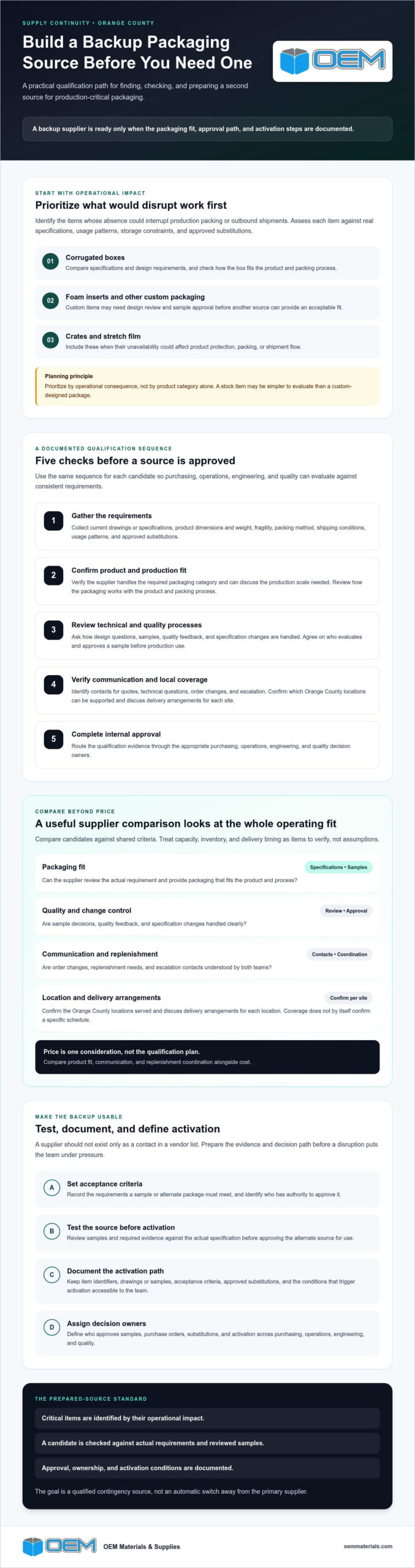
This guide offers a practical process for identifying candidates, comparing options such as corrugated boxes, foam packaging, crates, and stretch film, and testing product fit before approval. It also covers how to document specifications, replenishment needs, and activation steps so operations and purchasing can coordinate if the primary source is disrupted. The goal is a prepared backup, not a supplier relationship that exists only on paper.
Key Takeaways
- Prioritize backup sources for packaging materials that could most disrupt production or shipments if unavailable.
- Use a documented qualification sequence to check product category fit, production scale, quality requirements, and Orange County service relevance.
- Compare suppliers on packaging fit, communication, and replenishment coordination, not price alone.
- Learn how to find a backup packaging supplier in orange county by setting acceptance criteria and testing the source before activation.
- Assign internal ownership for approval and activation, and assess how packaging design, kitting, and assembly capabilities may support your process.
How to Find a Backup Packaging Supplier in Orange County Before a Disruption
Relying on one source for production-critical packaging creates a supply risk. If corrugated boxes, foam inserts, or another required material becomes unavailable, a manufacturer may struggle to pack finished goods or keep outbound shipments moving. A backup supplier is more than another vendor in a contact list. It is a qualified source with reviewed specifications, an agreed approval process, and a clear plan for when and how to place orders.
This is contingency planning, not an automatic switch away from your primary supplier. A second source may remain inactive until a defined trigger, such as a supply interruption or a documented inventory concern. Business continuity planning identifies supply chain interruption as a business risk, making packaging an important part of the plan when its absence could affect operations. For example, an Orange County manufacturer shipping finished assemblies can identify which materials would prevent orders from being packed if replenishment stopped.
Which packaging items need a second source first?
Start with the materials whose absence could halt production packing or outbound shipments. For each item, record its specifications, usage patterns, storage constraints, and any substitutions already approved by engineering or quality. Separate standard supplies from custom items. A stock box may be simpler to evaluate than a custom foam insert, which could need a design review before another source can provide an acceptable fit. See foam packaging options when assessing whether foam belongs in your contingency plan.
What makes a supplier genuinely backup-ready?
Ask the candidate to review the actual packaging specification, not just a product description. Identify who can approve samples, purchase orders, substitutions, and activation. Confirm which Orange County locations the supplier can support and discuss delivery arrangements for each site. Treat capacity, available inventory, and delivery timing as questions to verify, not assumptions. A source is not ready until required evidence and internal decision owners are documented.
Keep the qualification record accessible to the people who will act on it. Include drawings or samples where applicable, item identifiers, acceptance criteria, approved substitutions, and the conditions that trigger activation. Purchasing, operations, engineering, and quality may each have a role. Define responsibilities before a disruption so the team can make a controlled decision rather than rush an unreviewed packaging change.
A practical backup plan identifies critical items, verifies a candidate against real requirements, and documents activation steps. The result is a prepared contingency source, not an unnecessary routine supplier change.
How to Qualify an Orange County Backup Packaging Supplier
A supplier’s product list is only a starting point. Qualification should establish that the supplier can meet the packaging requirement, communicate changes clearly, and support the locations and production needs involved. Use the same sequence for each candidate so you can compare them against consistent operational criteria.
- Gather requirements. Compile current drawings or specifications, product dimensions and weight, fragility, packing method, shipping conditions, usage patterns, and any approved substitutions.
- Confirm packaging and production fit. Check that the supplier handles the required category and can discuss the production scale you need. For corrugated packaging, compare specifications and design requirements, not product descriptions alone. Review how the box fits the product and your packing process.
- Review technical and quality processes. Ask how design questions are handled, how samples are reviewed, and how quality feedback or specification changes are recorded. Agree on who evaluates and approves a sample before it is used in production.
- Verify communication and regional coverage. Identify contacts for quoting, technical questions, order changes, and escalation. Ask which Orange County and nearby Southern California locations the supplier can support. Confirm delivery arrangements for each site rather than assuming that service-area coverage guarantees a particular schedule.
- Complete internal approval. Route the evidence through purchasing, operations, engineering, and quality as required. Record approval status, open questions, and who can authorize an order or substitution.
Evaluate process, communication, and regional coverage
Assess how the supplier will communicate during routine coordination and a disruption. Ask who receives order updates, how changes are confirmed, and where unresolved technical or service questions go. Use consistent criteria to assess wholesale industrial packaging supplier criteria, and check location-specific arrangements directly with the supplier.
Build a documented qualification record
Keep approved specifications, sample feedback, contact details, and unresolved items in one record. Mark each capability as confirmed, pending written verification, or not applicable. This distinction helps prevent assumptions about production capacity, inventory, or delivery timing from being treated as commitments.
| Evaluation criterion | Record |
|---|---|
| Packaging fit | Specification reviewed and sample status |
| Process | Design, quality feedback, and order-change contacts |
| Regional support | Locations covered and delivery details to verify |
| Approval | Internal owner and outstanding actions |
A documented qualification process is central to finding a backup packaging supplier in Orange County. It turns supplier selection into a repeatable decision rather than a rushed search. For a relevant review, share your packaging specifications and usage details with a supplier such as OEM Materials & Supplies.
How to Compare Backup Packaging Suppliers Without Choosing on Price Alone
A low quote does not establish that a backup source can protect production. Compare each candidate against the same requirements, including packaging fit, quality practices, responsiveness, technical support, relevant services, and replenishment coordination. Look for verified capabilities that address your operational risks, not simply the lowest quoted price.
Cost comparisons depend on product dimensions, packaging materials, shipping requirements, and order conditions. Assess the broader operational impact, too. A packaging change that adds packing steps, creates storage issues, or increases damage risk may complicate operations even if its quoted unit price is lower. A second supplier can add coordination work, so define who owns communication, specification approval, and order release before activating the source.
Use a weighted scorecard for supplier fit
Set priorities based on your operation, then score every candidate against the same criteria. Weight factors according to their importance to production and shipping. Do not award credit for claims that have not been verified. Mark missing documentation as unverified and assign an owner to resolve it.
- Packaging fit: Does the candidate address the documented specification and packing method?
- Quality and change control: Are sample review, revisions, and approvals clearly handled?
- Communication: Are contacts and procedures clear for questions, order updates, and escalation?
- Technical and service support: Are relevant design, kitting, or assembly capabilities confirmed for the requirement?
- Replenishment coordination: Can the supplier discuss a workable plan for the operation’s usage and inventory needs?
Assess quality and change-control risks
Ask how sample feedback, specification revisions, and production changes are recorded and communicated. Clarify how your team should report a packaging deviation or damage concern, and who will review it. Confirm any quality processes or certifications directly rather than assuming they are in place. A documented response path helps purchasing, engineering, and operations handle issues consistently.
Compare replenishment and inventory support
Discuss replenishment using your actual usage patterns, storage limits, and order conditions. For operations considering coordinated delivery, just-in-time packaging services may be relevant to evaluate. Vendor-managed inventory may also be worth discussing if it fits your purchasing controls. Confirm program details, delivery arrangements, and responsibilities before including either approach in the backup plan.
A scorecard gives your Orange County backup-supplier search a structured, evidence-based comparison. It also exposes unresolved questions early, so adding a qualified second source does not become an unmanaged purchasing burden.
How to Test and Activate a Backup Packaging Supplier
A supplier should pass a practical test before a disruption makes the decision urgent. Coordinate any sample or trial order with your purchasing and quality teams, and use the same specifications and approval controls required for production packaging. A controlled test can reveal fit or process issues while there is still time to address them.
Run a controlled sample or trial order
Set the trial parameters before requesting material. Agree on the item and specification, quantity, evaluation method, and person responsible for approval. Test the packaging with the actual product and packing process. Assess fit, protection, handling, and workflow, including whether the packaging is practical for the people who will use it.
Document the results against acceptance criteria established in advance. Record any defects, fit concerns, or corrective actions, then review the updated sample or specification as needed. Do not approve routine backup use until the required internal reviewers have accepted the outcome.
Document the switch and replenishment plan
Write down which items may be sourced from the backup supplier and who can authorize activation. Include approved specifications, ordering instructions, supplier contacts, and the steps for communicating order changes. Store the plan where purchasing, operations, and other responsible teams can access it.
Assign an owner for each decision: approval, order placement, inventory review, and supplier communication. If vendor-managed inventory could reduce manual replenishment work, first confirm the program’s responsibilities, inventory controls, and operating details with the supplier. Do not treat a general discussion as an agreed replenishment arrangement.
Review readiness as operations change
Packaging requirements can shift when a product, shipping method, or packing process changes. Recheck the approved specifications and trial results after a relevant change, and set a review cadence that matches your purchasing process and operational risk. For Orange County facilities and other Southern California locations, keep site-specific ordering and delivery instructions in the same accessible plan.
A backup source is ready only while its qualification remains current and the activation steps are clear to the people responsible for using them. To discuss packaging requirements for a backup plan, discuss your packaging requirements with OEM Materials & Supplies.
Find an Orange County Packaging Partner for Your Backup Plan
A dependable backup plan rests on four steps: qualify packaging fit, document the evidence, test the process, and assign clear activation ownership. Evaluate the supplier against your actual packaging requirements and the needs of the facility that would use the alternate source. For manufacturers in Orange County, regional service relevance matters, but delivery arrangements and program details still need direct confirmation.
OEM Materials & Supplies serves manufacturers across Orange County and Southern California. Its capabilities include corrugated boxes, foam packaging, crates, packaging design, kitting, and assembly. Packaging needs can range from prototypes to high-volume production programs, subject to confirming the fit and details for the specific requirement. These capabilities can help frame a supplier discussion around the packaging itself and the work involved in preparing or replenishing it.
Match the packaging requirement to the right discussion
For a corrugated requirement, bring the current box specifications and packing needs to a review of custom corrugated box options. If replenishment coordination is part of the backup plan, ask whether vendor-managed packaging inventory is appropriate for your operation and clarify the responsibilities and process before considering it. Discuss any prototype, short run, or production program in relation to your specific requirements.
Prepare information for a useful quote or consultation
Provide the details that determine packaging fit and operating needs: product dimensions, weight, fragility, packing method, and shipping conditions. Include current packaging specifications and annual usage when available. Explain what the backup source should address, such as supply interruptions, product protection concerns, or an inefficient packing workflow. This context helps focus the discussion on a workable solution rather than a generic product match.
Knowing how to find a backup packaging supplier in orange county means choosing a source you can assess against defined requirements, not relying on location or a product list alone. Share the information with the supplier and verify service coverage, delivery arrangements, and any proposed program details before making a sourcing decision.
To review your packaging needs, request a packaging quote or consultation. Include available specifications and usage information so the discussion can start with your actual operating requirements.
Put a Qualified Backup Source in Place
A backup supplier only reduces risk when packaging fit, approval evidence, and activation responsibilities are clear before a disruption. The practical approach is to prioritize critical materials, compare potential suppliers against consistent requirements, and test the approved option using your actual product and packing process.
For manufacturers considering how to find a backup packaging supplier in orange county, local relevance is one factor to verify alongside specifications, communication, and replenishment arrangements. OEM Materials & Supplies serves manufacturers across Orange County and Southern California, with custom packaging support from prototypes through high-volume production programs. Capabilities include packaging design, kitting, assembly, and vendor-managed inventory. Confirm the fit and details of any capability for your specific requirements.
Bring product dimensions, weight, annual usage, current packaging specifications, and shipping requirements to the supplier discussion. These details help focus the review on your operation and the issues the backup should address. Request a packaging quote or consultation to discuss your requirements with OEM Materials & Supplies. A documented, tested plan gives your team a clearer path to keep packaging decisions controlled when supply conditions change.
Frequently Asked Questions
How do I find a backup packaging supplier in Orange County?
To learn how to find a backup packaging supplier in Orange County, start with the items whose shortage could interrupt production or shipping. Document each item’s specifications, usage, and approval requirements, then contact suppliers that serve your locations and handle the relevant packaging category. Compare verified technical fit, communication, and replenishment capabilities. Test the proposed source before relying on it, and document who can activate it and how.
What should I ask a backup packaging supplier before qualifying them?
Ask whether the supplier can review your actual specifications and support the packaging category and production needs involved. Clarify how samples, quality feedback, specification changes, and order communications are handled. Confirm which locations the supplier serves and which service or delivery details still need verification. Discuss replenishment options in the context of your operation. Keep written notes of answers, open questions, and internal approvals required before placing an order.
How can I test a backup packaging supplier before an emergency?
Arrange an internally approved sample or controlled trial order using documented specifications and acceptance criteria. Evaluate fit, product protection, handling, and the packing workflow with the employees who use the packaging. Record results, issues, and any corrective actions, then obtain required purchasing and quality approvals before qualifying the source. A quote or sample can support evaluation, but it does not confirm future inventory, capacity, or delivery timing.
Should a backup packaging supplier be located in Orange County?
Orange County location can be relevant, but it does not establish packaging fit or readiness on its own. Confirm support for your actual sites and discuss delivery arrangements directly. If your operations extend across Southern California, include facilities in Los Angeles, Riverside, and San Diego in the service-area review. Evaluate technical capability, communication, and contingency procedures alongside geography, and document any location-specific requirements your team would need to follow during activation.
How many backup packaging suppliers should a manufacturer have?
There is no universal number that fits every manufacturer. The right sourcing plan depends on packaging criticality, specification complexity, operational exposure, and the effort required to qualify and manage each source. Begin by identifying items whose shortage could have the greatest effect on production or shipping. Then assess the risk of relying on one supplier and set the number of qualified sources through your company’s purchasing and business continuity process.
Can a backup supplier reduce packaging costs?
A second source can give your team another option to evaluate, but savings are not guaranteed. Comparisons depend on product dimensions, materials, shipping requirements, order conditions, and the work involved in qualifying and coordinating another supplier. Assess operational impact as well as purchase price, including packaging fit and any changes to handling or packing steps. Request item-specific recommendations and verify assumptions before factoring projected savings into a sourcing decision.
What information should I send when requesting a packaging quote?
Share product dimensions, weight, fragility, packing method, and shipping conditions. Include current packaging specifications, annual usage, and known storage or handling constraints. Identify the category you need, such as corrugated boxes, foam packaging, or crates, and explain the issue the backup source should address. For custom packaging, provide available drawings or samples and note any internal review steps required before a trial or production order.