
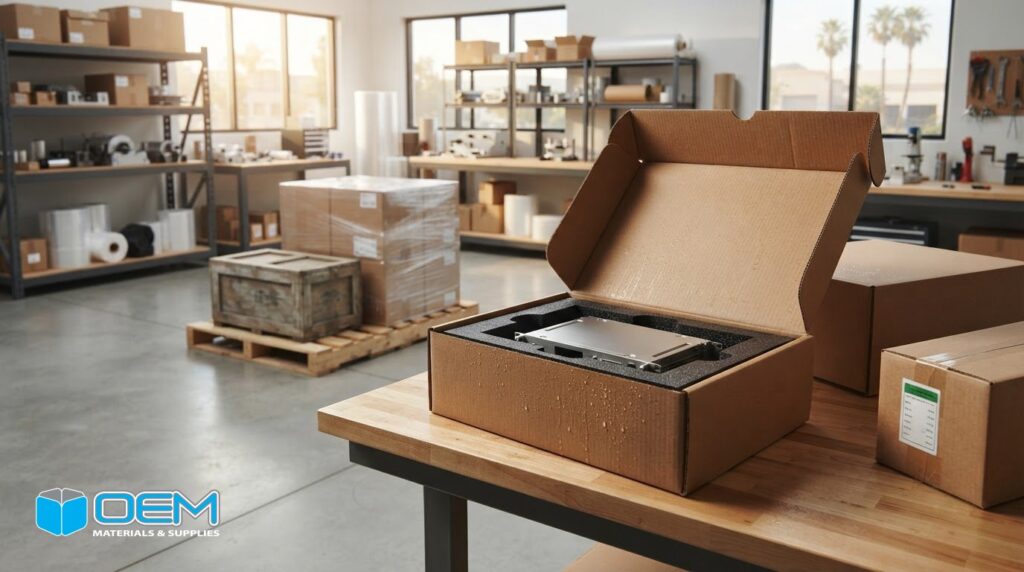
Selecting moisture resistant corrugated boxes Orange County operations can depend on starts with identifying how moisture reaches the package. Humid storage, condensation on surfaces, incidental wetting during handling, and direct water exposure present different risks.
Added moisture protection can help when exposure could weaken a box or affect its contents, but it does not make corrugated packaging waterproof. A design suited to brief incidental contact may not address prolonged exposure. The box also cannot replace the cushioning or inner protection a sensitive product needs.
This guide explains how to define exposure and protection requirements, then match box construction and inner packaging to actual handling conditions. Use product sensitivity, storage, shipping, and packing needs to compare options. For a useful packaging review or quote, gather product dimensions and weight, expected usage, and details about handling and distribution.
Key Takeaways
- Separate humidity, condensation, incidental wetting, and direct water exposure before selecting a box.
- Match box dimensions and construction to product sensitivity, weight, protective layers, and time in transit or storage.
- Compare moisture resistant corrugated boxes Orange County operations may need against actual handling conditions, not an assumption that they are waterproof.
- Build a clear specification with product dimensions, weight, annual usage, storage conditions, and shipping routes.
- Review a prototype to assess whether the box and inner protection fit the application and packing process.
What Moisture-Resistant Corrugated Boxes Can and Cannot Protect Against in Orange County
Moisture resistance means increased tolerance to moisture under intended conditions. It does not mean a corrugated box is waterproof or appropriate for every wet environment. Paper-based corrugated fiberboard can absorb moisture, which may affect the box’s protective function. The basic structure of corrugated fiberboard helps explain why exposure, construction, and use conditions matter.
For buyers specifying moisture resistant corrugated boxes for Orange County operations, start with the package’s actual journey. Conditions in a warehouse can differ from those at a loading area, during transit, or at a receiving dock. Assess the facilities, storage practices, routes, and handling points rather than relying on a general description of the local climate.
How do moisture-resistant boxes differ from waterproof packaging?
Moisture-resistant features can increase a box’s tolerance to moisture, but they do not make every panel, seam, or closure waterproof. Protection depends on the design and the type and duration of exposure. A box may help manage some moisture without preventing water from reaching the contents. Products sensitive to moisture may need a separate inner layer. Corrugated box design should account for both the outer package and the product’s protection needs.
Moisture resistance means increased tolerance to moisture, not a guarantee against water entry or product damage.
Which moisture risks should Orange County buyers assess?
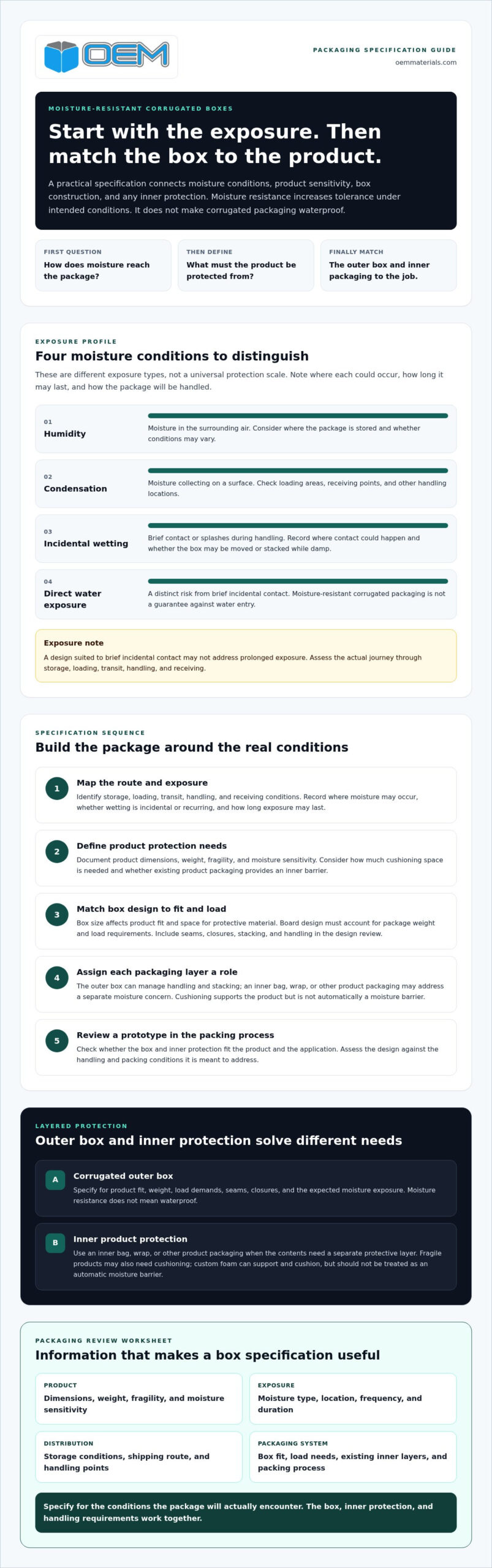
Map potential exposure throughout the handling cycle. Humidity is moisture in the surrounding air. Condensation forms when moisture collects on a surface. Incidental wetting may come from brief contact or splashes, while direct water exposure presents a different risk. For each situation, consider where it could occur, how long it could last, and whether the box will be closed, stacked, moved, or handled while damp.
For a practical review, examine:
- Warehouse storage: Is the package kept indoors, near an open loading area, or somewhere conditions may vary?
- Loading and receiving: Could boxes encounter wet surfaces, condensation, or brief contact with water?
- Transit and handling: Which routes and transfer points are involved, and how long might packages be exposed?
- Product and closure: How moisture-sensitive are the contents, and could seams or openings be exposed?
Protection depends on the contents, exposure duration, closure, and handling, not just the box material. A shipment subject to brief incidental wetting has different needs from one facing sustained direct water exposure. Documenting those conditions gives your packaging team a practical basis for matching the box and any inner protection to the application.
How Moisture Exposure, Product Sensitivity, and Box Design Work Together
A useful box specification addresses more than exposure. Product dimensions and weight affect fit, cushioning space, and the demands placed on the package during handling and stacking. Fragility and moisture sensitivity create different protection requirements. Assess them separately: the box may need to support a load and limit movement while the contents also need protection from moisture.
What information defines the packaging requirement?
Start with the product and its route through your operation. Record dimensions, weight, fragility, and moisture sensitivity. Then map where the package is stored, handled, transported, and received. Note whether potential wetting is incidental or recurring and how long exposure may last. This creates a practical design brief instead of relying on a broad label such as “wet conditions.”
Document existing protective layers, too. An inner bag, wrap, or other product packaging may provide a barrier, while the outer box manages handling and stacking. Define the role of each layer so the design addresses a real gap rather than adding materials without a clear purpose. For example, businesses shipping humidity-dependent items often rely on dedicated barrier bags inside sturdy corrugated containers; learn more about Fresh Off The Cap to explore how sterile grain bags and all-in-one mushroom grow kits utilize protective packaging.
How do box features interact with exposure and load?
Box size affects product fit and the space available for protective material. Board design must account for package weight and load requirements, while seams and closures may be paths for moisture entry. Exposure time matters: brief incidental contact creates a different design challenge from repeated or extended exposure. ASTM International discusses the effects of humidity on box strength, illustrating why structural needs should be considered alongside moisture conditions.
These requirements are related, but they are not interchangeable. A box selected for compression or stacking demands does not automatically protect a moisture-sensitive product. Likewise, cushioning alone does not resolve structural or moisture exposure concerns.
When does inner protection need to supplement the box?
Consider a fragile electronic component shipped in a corrugated box. If the route includes possible incidental wetting, the box design should account for that exposure, while the component may need a separate protective layer based on its moisture sensitivity. If the product also needs cushioning against movement or impact, custom foam packaging can help support and cushion it. Foam should not be treated as an automatic moisture barrier.
When evaluating moisture resistant corrugated boxes for Orange County shipments, bring product details, exposure, and load demands into one specification. A packaging quote request is more useful when it includes product dimensions, weight, fragility, existing protection, and storage and shipping conditions.
How to Compare Moisture-Resistant Corrugated Box Options for Orange County Operations
Compare the complete package against its application, not a single board-strength figure or moisture-related label. Standard corrugated may suit products stored and shipped in controlled conditions with no identified moisture exposure. If your assessment identifies recurring humidity, condensation, or incidental wetting, evaluate a design intended for those conditions. Neither option has a universal rating for every shipment.
Build a comparison around operating conditions
Assess each proposed design against the same criteria. A comparison record helps purchasing, engineering, and operations work from the same requirements:
Exposure: Record the likely moisture source, whether contact is incidental or recurring, and how long packages may be exposed.
Contents: Note product dimensions, weight, fragility, moisture sensitivity, and existing inner protection.
Storage: Describe where boxes are held, for how long, and whether conditions vary between the warehouse, loading area, and receiving area.
Closure: Document how the box is closed and identify seams or openings relevant to the exposure being assessed.
Shipping and load: Capture route and handling conditions, stacking or compression needs, and how packages are moved and received.
Design details: Compare box size, construction, product fit, and closure as a complete system. Record any material or performance claim that needs project-specific documentation.
Keep moisture protection separate from structural requirements. A board-strength figure alone does not describe performance under a particular moisture exposure, and a moisture-related label does not establish that a box can carry a specific load. The Fibre Box Association provides context on corrugated packaging, but the design decision still needs to reflect your product and distribution conditions.
Match each feature to a documented risk
Over-specification can add complexity without addressing the failure risk. Under-protection can leave a sensitive product or vulnerable package feature exposed. Tie each design choice to a documented need, such as fit, load, handling, closure, storage, or moisture exposure. For example, a product shipped through dry indoor handling may not need the same moisture-focused design considerations as one with recurring exposure during storage or transfer.
When comparing moisture resistant corrugated boxes for Orange County operations, evaluate how the design choices work together instead of selecting by one label. Corrugated packaging design guidance can help organize product, exposure, and shipping requirements into an application-specific evaluation.
How to Specify and Validate a Moisture-Resistant Box for Orange County Shipping
A useful box specification turns operating conditions into reviewable design requirements. For Orange County shipments, document the package’s route through storage, loading, transit, and receiving instead of relying on a general description such as “moisture resistant.” A clear specification also helps purchasing, engineering, and operations evaluate the same requirements.
What should an Orange County packaging specification include?
Prepare the product and usage details before requesting a design or quote. Include:
- Product information: Dimensions, weight, fragility, moisture sensitivity, and packing configuration, including any inner protection.
- Exposure conditions: Expected moisture source, whether exposure is incidental or recurring, and likely duration.
- Operating environment: Storage and handling conditions at the facility, loading area, along shipping routes, and at receiving.
- Distribution needs: Load and handling requirements, closure method, and how the package will be stacked, moved, and opened.
- Program details: Annual usage, production schedule, and inventory constraints that may affect packaging supply and use.
Use these details to define what the box must do and what it cannot be expected to do. Custom corrugated box solutions can be designed around the application, but the specification should distinguish moisture-related needs from fit, cushioning, and load requirements.
How should teams evaluate a prototype before production?
Review the prototype with the actual product and packing method. Confirm that the product fits, the closure can be applied consistently, and the contents can be packed and accessed without disrupting the protective arrangement. Then assess samples under representative storage and handling conditions based on the known shipping route. This practical review informs a design decision; it is not laboratory certification or a performance guarantee.
- Define the exposure and product requirements. Record the details above and identify the primary risks the package must address.
- Review the proposed design. Check dimensions, construction, closure, product fit, and inner protection against the specification.
- Evaluate a prototype. Pack the product and review it under representative storage and handling conditions.
- Document revisions and approval criteria. Record changes, unresolved issues, and the conditions the team will use to approve production.
- Approve the production specification. Align purchasing, engineering, and operations on the final design and usage requirements.
For moisture resistant corrugated boxes Orange County operations can specify with confidence, keep the approved requirements with the packaging record. Review corrugated box solutions, or request a quote for your packaging requirements with product dimensions, weight, annual usage, storage conditions, and shipping routes.
Sourcing Custom Moisture-Resistant Corrugated Boxes in Orange County
Custom packaging decisions should connect the box to the product, exposure, and the way your operation packs and ships. For moisture resistant corrugated boxes Orange County manufacturers need, begin with actual handling conditions rather than a broad request for a “weather-resistant” box. The design can then account for product fit, closure, load requirements, and any inner protection the contents need.
OEM Materials & Supplies works with manufacturers in Orange County and across Southern California on custom packaging solutions. Packaging design considers how the package functions within the broader operation, from the production line to storage, shipment, and receiving. For broader sourcing considerations, review custom packaging design.
What project information helps produce a useful quote?
Share the details that shape the box and its use. Include product dimensions and weight, fragility, moisture sensitivity, and packing configuration, including any cushioning or protective layers. Describe how the box is packed and closed, where it is stored, and the shipping destinations or routes it will travel. Note moisture concerns at storage, loading, transit, or receiving, and whether exposure is occasional or recurring.
Usage information matters, too. Include estimated annual volume, prototype needs, production requirements, and inventory constraints that affect how packaging is ordered and used. These details help align design and supply planning with your program and distinguish a prototype review from an ongoing production need.
How can packaging design support a more reliable supply process?
Packaging design can address product protection and packing steps together. A well-matched box and inner support can help organize packing while accounting for product fit and handling needs. Moisture resistance is not a substitute for cushioning, and an outer box alone should not be assumed to protect moisture-sensitive contents. If the project also requires foam inserts, kitting, assembly, or inventory planning, those needs can be considered as part of the packaging program.
A clear specification gives operations and purchasing a shared reference for evaluation and replenishment. It can also help identify practical issues before production, such as difficult packing steps or a mismatch between package dimensions and product configuration.
To discuss a custom box for your application, request a packaging quote with product dimensions, weight, moisture sensitivity, annual usage, packing process, storage conditions, and shipping details.
Put Your Packaging Requirements Into Action
Effective moisture protection starts with understanding exposure, product sensitivity, and handling requirements. Corrugated boxes can offer increased tolerance to moisture, but they are not waterproof. Evaluate box construction, closure, product fit, and inner protection together.
For moisture resistant corrugated boxes Orange County operations need, base the specification on actual storage and shipping conditions rather than a general label. Prototype review lets teams assess fit, packing steps, and handling before approving a production design.
OEM Materials & Supplies supports manufacturers in Orange County, Los Angeles, San Diego, and Riverside with custom packaging for prototypes, short runs, and high-volume programs. Share product dimensions, weight, annual usage, and shipping requirements to support a useful packaging review and quote.
Request a quote for moisture-resistant corrugated boxes with your project details to start a packaging review.
Frequently Asked Questions
Are moisture-resistant corrugated boxes waterproof?
No. Moisture-resistant corrugated boxes are designed for increased tolerance to moisture under particular conditions, not as a waterproof barrier. Water may still enter through seams, closures, or exposed areas, and prolonged or direct water exposure can affect the box and its contents. Define likely exposure and duration before selecting packaging. Products that cannot tolerate moisture may need their own protective layer inside the box.
What makes a corrugated box moisture resistant?
A box is considered moisture resistant when its design or materials provide increased tolerance to moisture for the intended application. The term alone does not identify a specific construction or guarantee performance under every condition. Review project-specific design details and supporting documentation relevant to your exposure requirements. Compare dimensions, construction, seams, closure, contents, and expected handling as a complete package rather than relying on a label alone.
Can corrugated boxes protect products from humidity and condensation?
They may be designed to better tolerate some moisture exposure, but a corrugated box does not automatically prevent humidity or condensation from reaching a product. Humidity affects the surrounding environment, while condensation can form on surfaces as conditions change. Assess where the package is stored and handled, how long it may be exposed, and how sensitive the contents are. For moisture-sensitive products, evaluate separate inner protection as part of the packaging system.
How do I choose a moisture-resistant box for shipping in Orange County?
Choose based on the shipment’s actual conditions, not assumptions about the region. Map the package’s path through your Orange County facility, loading area, transit, and receiving point, then identify possible humidity, condensation, or incidental wetting. Consider product sensitivity, dimensions, weight, closure, load, and exposure duration. Comparing moisture resistant corrugated boxes for Orange County operations should begin with these details so the design reflects the application.
Do moisture-resistant boxes still need inner packaging?
They may. The outer box and inner packaging serve different purposes: the box supports handling and distribution, while an inner layer may help protect a product that is sensitive to moisture or impact. Foam packaging can provide cushioning and product support, but it should not be treated as an automatic moisture barrier. Determine the product’s needs based on its sensitivity, packing configuration, and shipping conditions, then select the outer and inner components accordingly.
What information should I provide when requesting a quote for custom corrugated boxes?
Provide product dimensions, weight, fragility, moisture sensitivity, and packing configuration, including existing protective layers. Add estimated annual usage, prototype or production needs, and how the box will be packed and closed. Describe storage conditions, shipping routes and destinations, handling, and moisture concerns. These details help OEM Materials & Supplies develop a packaging recommendation for your operation in Orange County, Los Angeles, San Diego, Riverside, or elsewhere in Southern California.
Can custom corrugated boxes be designed for a specific product and shipping route?
Yes. Custom corrugated boxes can be designed around a product’s dimensions, weight, packing method, and distribution requirements. A shipping route and its handling points help define exposure and load conditions the package should address. OEM Materials & Supplies supports prototypes, short runs, and high-volume production programs, with packaging design tailored to the application. Sharing route, storage, and receiving details connects the box design to the full shipping process.
Ready to discuss packaging for your application? Request a quote with your product dimensions, weight, moisture sensitivity, annual usage, storage conditions, and shipping requirements.