
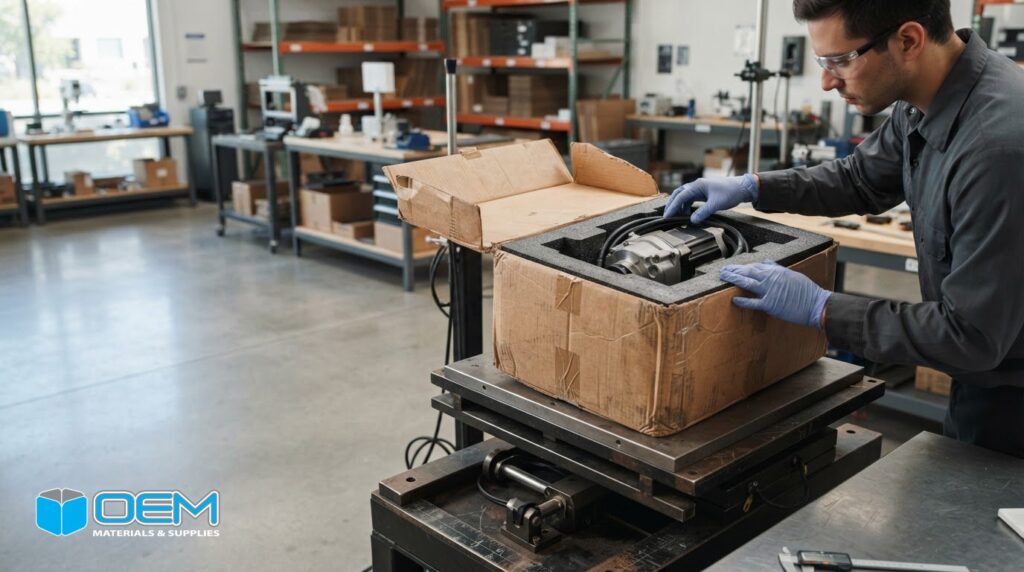
A foam insert can look substantial and still leave a product vulnerable to impact. For Riverside manufacturers evaluating custom foam packaging inserts, protection needs to be judged by how the product is packed and handled, not by appearance alone. The insert, product, and outer packaging work as one system.
A drop test can show how a specific package responds under defined conditions. It cannot predict every handling event or shipping scenario. Results are most useful when the test reflects a real concern and the product and outer package are inspected alongside the foam.
This article explains what drop-test results can and cannot demonstrate, how to compare foam designs, and how to use observed movement or damage to guide revisions. A single drop test may not represent every stage of shipping, so start with the product dimensions, weight, shipping configuration, and complete package. For Riverside-area operations, those details help engineers and operations teams assess custom foam inserts before production scales.
Key Takeaways
- Define the shipping concern before testing so the results answer a practical packaging question.
- Record product orientation, package configuration, and test conditions to make findings easier to interpret.
- Compare foam designs by fit, support points, product movement, and package condition, not by assumption.
- Use a documented baseline and revisions to guide a practical evaluation of custom foam packaging inserts for Riverside operations.
- Share product dimensions, weight, and annual usage to help shape an insert and outer-package recommendation around your requirements.
Why Riverside Manufacturers Use Drop Testing to Evaluate Custom Foam Packaging Inserts
Drop testing provides a controlled way to observe how a packaged product responds to impact. It helps manufacturers assess the protective system as a whole, including the product, foam insert, and outer package. Packaging provides physical protection from shock and vibration, but the right design depends on the product and its shipping requirements.
A test provides evidence about the sample and conditions evaluated. It can reveal a potential weak point, but it cannot establish how every package will perform across all shipments, handling events, or configurations. That distinction matters when selecting custom foam packaging inserts for a Riverside production program. Testing supports a design decision, not a universal guarantee.
What a packaged-product drop test can reveal
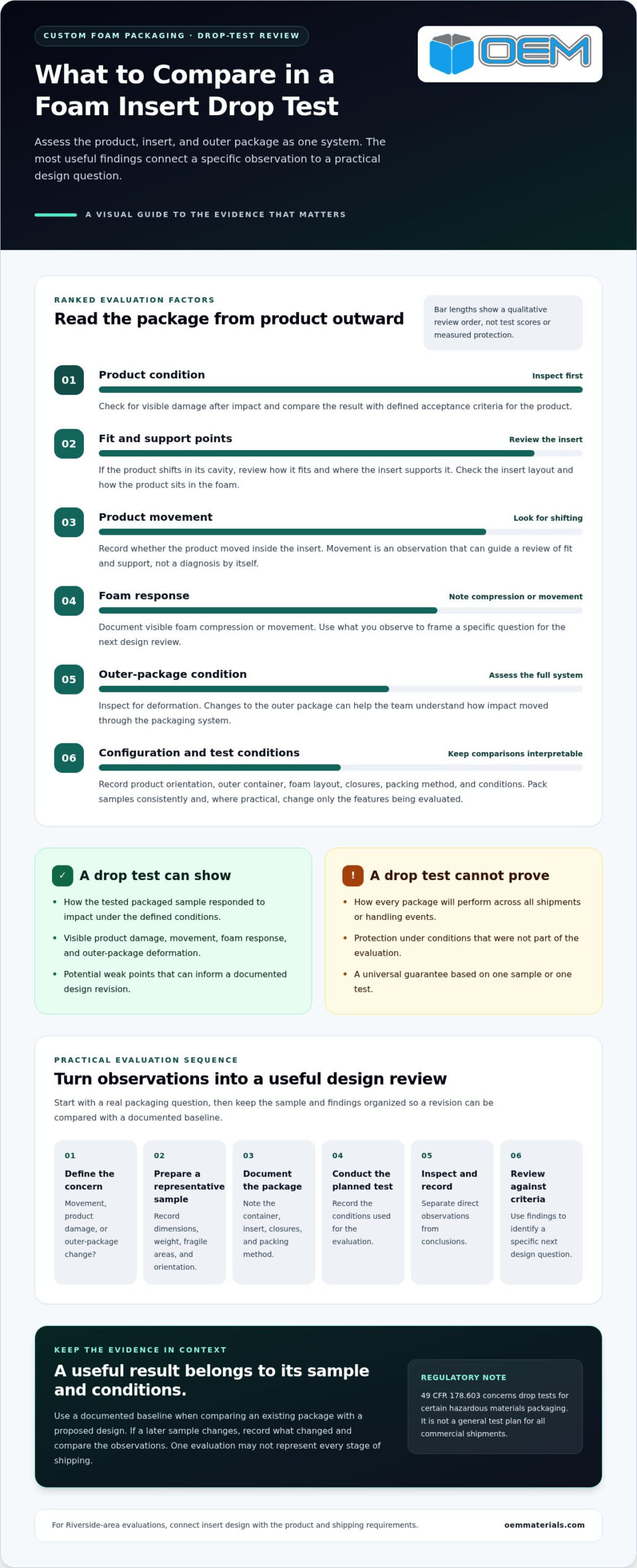
After impact, inspect the product for visible damage, the package for deformation, and the product for movement inside the insert. If the product shifts in its cavity, review the fit and support points. Deformation in the outer package can also help teams understand how impact moved through the packaging system.
Record the configuration and what you observed. These findings can guide the next design revision, but they do not establish protection under conditions that were not part of the evaluation.
When Riverside operations may benefit from testing
Drop testing can help when a manufacturer is redesigning packaging, investigating reported damage, or evaluating a prototype before scaling production. It gives engineering and operations teams a structured way to compare an existing package with a proposed configuration rather than relying on appearance or assumptions.
Document the current package as a baseline: product orientation, insert layout, outer package, and test conditions. If a later sample changes, record what changed and compare the observations. Without a clear baseline, it can be difficult to tell whether a revision addressed the concern or simply changed the package.
Riverside and the wider Inland Empire support manufacturing and distribution workflows where products move between production, storage, and fulfillment. Consistent evaluation records help engineering, purchasing, and warehouse teams communicate packaging changes. OEM Materials & Supplies works with manufacturers on custom foam packaging, connecting insert design with product and shipping requirements from prototype through production-scale programs. A documented test can inform that design review, while the findings remain specific to the sample and conditions tested.
How Drop Testing Works: From Packaged Sample to Useful Findings
A useful drop test starts with a clear question. Is the concern product movement, damage to a vulnerable area, or a change to the outer package? Define the issue first, then prepare a representative sample and document how it is packed. This keeps the evaluation focused on a packaging decision instead of producing observations with no clear next step.
A practical sequence is to define the question, prepare the sample, conduct the planned test, inspect the product and package, document observations, and review them against agreed criteria. Record the test conditions, because results are meaningful only in relation to the sample and conditions evaluated.
Prepare a representative product and package sample
Record the product’s dimensions, weight, fragile areas, and intended orientation. Document the outer container, foam layout, closures, and packing method, including how the product sits in the insert. These details help the team repeat the configuration and identify what changed if the packaging is revised.
When comparing designs, pack samples consistently and change only the features being evaluated where practical. A difference in orientation or closure, for example, can affect the comparison as much as a revised insert.
Inspect results and translate observations into actions
After testing, record visible product damage, foam compression or movement, product shifting, and changes to the outer package. Compare those observations with defined acceptance criteria for the product and packaging. If results raise a concern, identify a specific design question for the next review, such as whether the product has adequate support or the package configuration needs adjustment.
Separate direct observations from conclusions. A sample may show no visible damage under the conditions tested, but that alone does not establish performance in every distribution environment. Additional testing or evidence may be needed if the intended shipping conditions include exposures the evaluation did not address.
Some packaging is subject to specific federal testing requirements. The U.S. regulation at 49 CFR 178.603 concerns drop tests for certain hazardous materials packaging, so it should not be treated as a general test plan for all commercial shipments. For other projects, define test conditions based on the evaluation objective rather than assuming a particular procedure applies.
For custom foam packaging inserts Riverside manufacturers are evaluating, organized records make design reviews more useful from prototype through production. OEM Materials & Supplies connects foam insert design with the outer package and shipping requirements. Product dimensions, weight, fragile areas, and annual usage help frame a project-specific recommendation. These details can be shared through the packaging quote request.
Compare Foam Insert Designs Using Evidence, Not Assumptions
A useful prototype comparison focuses on what changed and what the evaluation showed. Review how the product sits in the insert, where the foam supports it, whether it shifts during handling or testing, and whether it contacts the outer package. Also consider whether staff can load the product consistently. A design that is difficult to pack repeatably can introduce variation before the package enters distribution.
Compare baseline and revised samples using the same documented product orientation, outer container, closures, packing method, and test conditions. If several features change at once, it becomes harder to connect an observed difference to a specific design decision.
What to compare between foam insert prototypes
Start by checking positioning and contact areas. Note whether the product is supported at the intended locations, retained without unwanted movement, and kept from contacting the outer package. Record visible product damage, insert movement or compression, and package changes after testing. These observations can identify questions for the next design review without treating one result as proof of performance in every shipping situation.
Consider material selection as part of the same review. Product dimensions, weight, fragile areas, and shipping requirements all inform the choice of foam and insert design. Select materials and geometry based on the application, not appearance alone.
| Comparison point | Baseline sample | Revised sample |
|---|---|---|
| Product fit and position | Record support points and alignment | Record the same details |
| Movement and contact | Note shifting or contact with the outer package | Note shifting or contact under the same conditions |
| Package condition | Describe visible changes after testing | Describe visible changes after testing |
| Packing repeatability | Record how consistently the product can be loaded | Record how consistently the product can be loaded |
How to interpret a design change
Connect each revision to a defined objective. If the baseline showed product movement, document what changed in the insert and whether the revised sample showed different movement under comparable conditions. If the goal was easier, more consistent packing, assess that separately from impact observations.
Use precise language in review records. State what was observed, under which conditions, and whether the sample met the project’s acceptance criteria. Claim improved protection only when comparable evidence supports that conclusion.
OEM Materials & Supplies develops foam inserts and packaging designs around product and shipping requirements, supporting projects from prototypes through production programs. Explore custom foam packaging as part of a complete package evaluation. For Riverside manufacturers comparing custom foam inserts, a documented baseline and clear revision objective make design decisions easier to explain and repeat.
Build a Practical Drop-Test Plan for Riverside Shipping Operations
A practical plan starts with the shipping problem, not a preset test sequence. Consider how the product moves through your operation and distribution route, including how it is packed, handled, and shipped. A concern tied to warehouse handling may call for a different evaluation question than damage reported after delivery. Define the exposure you want to examine, then choose test conditions relevant to that concern.
Before evaluating samples, gather the information needed to describe the package and production context:
- Product dimensions, weight, fragile areas, and intended orientation
- Outer packaging, foam insert layout, closures, and packing instructions
- Known damage concerns and the handling or shipping conditions relevant to the project
- Annual usage, to help frame the packaging design and production requirements
Set clear goals and acceptance criteria
State the decision the evaluation should support. For example, the team may need to assess a proposed insert revision or investigate a specific type of product damage. Before comparing samples, agree on the observable conditions that matter, such as visible product damage, product movement, or changes to the package. Set criteria around the product and shipping requirements rather than relying on a general pass-or-fail label.
Record the baseline package and results before making changes. Then track each revision against the original concern. This helps engineering, purchasing, and operations distinguish what changed from what was observed.
Document packaging changes across the operation
Keep versioned records of the insert layout, outer package, and packing instructions. Include the sample configuration and evaluation conditions in each record. If warehouse staff need to orient the product a particular way or close the package in a specific sequence, document those steps. Consistent packing makes comparisons more meaningful and helps production and fulfillment teams repeat the intended configuration.
Repeatability also matters in day-to-day operations. If a design is difficult to pack consistently, that can create variation between samples and shipments. Include observations about the packing workflow alongside product and package condition.
OEM Materials & Supplies develops packaging around product details, shipping needs, and production requirements. Its custom packaging design service supports projects from prototypes through production-scale programs. For custom foam packaging inserts Riverside manufacturers are evaluating, dimensions, weight, fragile areas, package configuration, and annual usage provide a practical starting point for design discussions.
Project details can be submitted through the quote request form.
Work with OEM Materials on Custom Foam Inserts and Packaging Validation
Packaging decisions affect more than the insert. Product fit, the outer container, packing steps, and shipping conditions all influence how a complete package performs. OEM Materials & Supplies works with manufacturers on engineered foam inserts and custom packaging, aligning design discussions with product needs and production requirements. For Riverside-area operations, this provides a practical path from an initial packaging concern to prototype evaluation and a production-ready design approach.
Project details help define the right questions, but they do not guarantee a particular test result. Findings depend on the sample, package configuration, and conditions used. The goal is to shape a recommendation around the actual product and shipping requirements, then use observations to inform design decisions.
What project information helps shape a foam insert
Start with the product’s dimensions, weight, intended orientation, and sensitive or fragile areas. Note how it is currently packed, any observed damage or movement, and the outer packaging used for shipment. Shipping configuration matters: a single packaged item and a package prepared for a larger distribution workflow may have different design considerations.
Include recurring usage and project stage as well. Prototype needs can differ from production-scale requirements, so estimated annual usage and packing workflow help frame design and planning discussions. OEM Materials & Supplies’ custom packaging design support connects foam insert development with the broader package and manufacturing context.
Move from evaluation to a packaging quote
Bring the evaluation record into the design discussion. Summarize the question the test was intended to answer, the product and package configuration, the conditions used, and the observations. For example, note whether the product shifted, whether the insert or outer package changed, and which acceptance criteria matter to your operation. This gives the packaging review a clear starting point without treating a single test as a guarantee of future shipment performance.
For Riverside manufacturers evaluating custom foam packaging inserts for recurring shipments, clear project inputs help shape a recommendation that fits product protection needs and production requirements. Share the details available, including product dimensions, weight, fragile areas, shipping configuration, and estimated annual usage.
Request a custom packaging quote to discuss your foam insert and packaging requirements.
Turn Drop-Test Findings into a Stronger Packaging Plan
A drop test is most useful when it answers a defined packaging question. Document the sample and conditions, inspect the product, insert, and outer package, then compare revisions against clear criteria. These steps help teams make evidence-based decisions without treating one test as a guarantee for every shipping scenario.
Projects involving custom foam packaging inserts Riverside manufacturers are evaluating benefit from considering the product, shipping configuration, and production needs together. OEM Materials & Supplies provides engineered foam inserts for industrial packaging applications, supporting manufacturers in Riverside and Southern California from design and prototypes through high-volume programs.
Share product dimensions, weight, fragile areas, shipping configuration, and estimated annual usage to help shape a relevant packaging recommendation. Request a custom packaging quote to start a practical review of your packaging requirements. Clear project details help your team develop a considered design and evaluation plan.
Frequently Asked Questions
What does a drop test show about custom foam packaging inserts?
A drop test shows how a specific packaged sample responds to a controlled impact. Inspect the product for visible damage, the insert for movement or compression, and the outer package for deformation. These observations can reveal where a design may need review, such as when a product shifts in its cavity. Findings apply only to the sample configuration and test conditions used. They do not prove identical performance across every shipment.
How do you prepare a packaged product for a drop test?
Prepare a representative product and package, then record the product’s orientation and complete packaging configuration, including the insert, outer container, and closures. Define the evaluation goal before testing, such as checking for product movement or package damage. Keep the setup consistent when comparing samples. A clear record of the sample and test conditions makes findings easier to interpret and connect to specific packaging decisions.
Can drop testing prove that a product will never be damaged in shipping?
No. A drop test evaluates a sample under defined conditions, not every impact or handling event a shipment may encounter. Actual shipping can involve different routes, handling practices, package configurations, and distribution exposures. Use test results to identify potential weak points and guide design decisions, but do not treat them as a guarantee against all damage. The evaluation should reflect the shipping concerns the packaging is intended to address.
How do foam inserts help protect products during shipment?
Foam inserts are designed around a product’s shape and support needs. A properly configured insert can hold the product in position, support selected areas, and reduce unwanted movement inside the package. The insert works as part of a system that includes the product and outer container. Product dimensions, weight, sensitive areas, and shipping requirements all inform the design, so performance depends on the specific application and package configuration.
When should a manufacturer test a custom foam insert?
Consider testing when redesigning packaging, investigating reported product damage, reviewing a prototype, or making a production-related packaging change. An evaluation can help teams compare a baseline with a proposed revision and document what they observe. Define the concern first, then assess the product, insert, and outer package against relevant criteria. Testing is most useful when it informs a specific packaging decision rather than serving as a general check.
What information is needed to design custom foam packaging inserts in Riverside?
The design of custom foam packaging inserts Riverside manufacturers use should begin with product dimensions, weight, orientation, and fragile or sensitive areas. Include the outer package, packing method, shipping configuration, and estimated annual usage. These details help connect insert design to product protection needs and production requirements. OEM Materials & Supplies serves manufacturers in Riverside, Orange County, Los Angeles, and San Diego, supporting projects from prototypes through production programs.
Can a foam insert be revised after drop-test results?
Yes. Documented observations can guide a design review and identify a specific revision to evaluate, such as adjusting product support or retention. Record what changed, then compare the revised sample with the baseline using the same package configuration and test conditions where practical. Review the product, insert, and outer package against the project’s criteria. Any conclusion should reflect the evidence gathered, not assume a revision improved protection.