
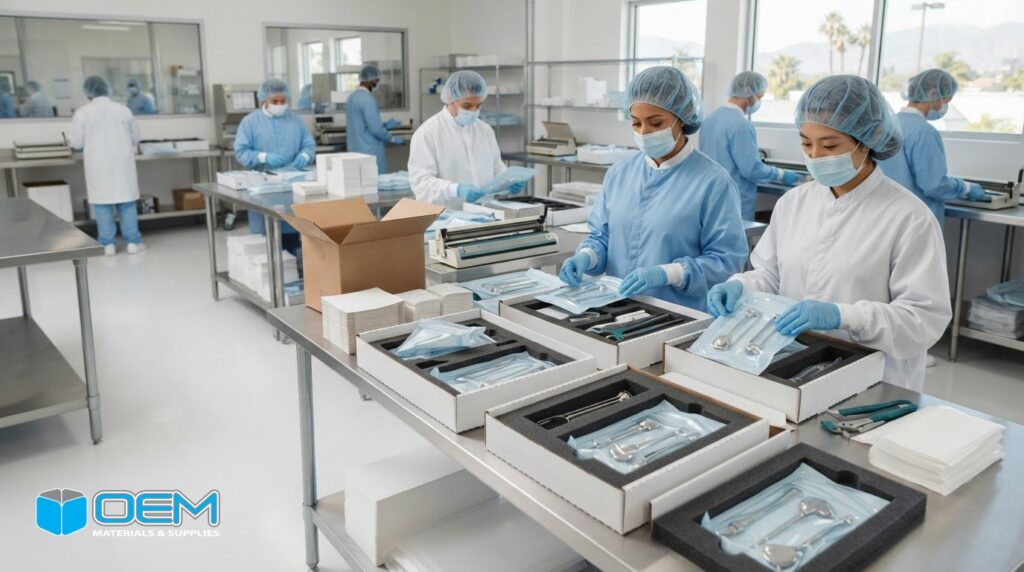
A cleanroom pouch can fit a part and still be a poor fit for the way it’s handled, packed, and shipped. A practical plan for custom medical packaging boxes Los Angeles buyers can use starts with the component and its workflow, not just the outer box. Fit, opening and closing steps, storage conditions, and shipping exposure all affect how the packaging system should be configured.
Keeping medical parts clean and protected is only the starting point. To compare bag and pouch options and request a useful quote, document the part’s dimensions, handling needs, and packaging sequence. This guide explains how to assess options against your workflow and plan the transition from prototypes to repeat supply.
Cleanroom packaging can work alongside corrugated boxes and foam when parts need additional physical protection. OEM Materials & Supplies supports packaging design and supply coordination for manufacturers in Los Angeles and throughout Southern California, including Orange County, Riverside, and San Diego. The goal is to consider the part, protective packaging, and operating process together.
Key Takeaways
- Distinguish cleanroom packaging from sterile-barrier packaging so the package’s role is clear in your handling and storage process.
- Build a useful packaging specification from part dimensions, weight, geometry, surface sensitivity, handling stages, and shipping conditions.
- Compare bag and pouch formats against the part and workflow instead of assuming one option suits every application.
- Use project-specific prototypes to review fit, packing steps, repeatability, and compatibility with outer packaging.
- Coordinate custom medical packaging boxes Los Angeles teams need with foam and corrugated packaging when additional physical protection is required.
Cleanroom Bags and Pouches for Medical Parts in Los Angeles: What They Protect
A cleanroom bag or pouch is an inner package selected to help protect a medical part from contamination or handling-related exposure during defined stages of processing, storage, or transfer. Its role depends on the part, facility process, and documented customer requirements. By itself, it does not establish that a part is sterile or that a packaging process meets a regulatory requirement.
For teams evaluating custom medical packaging boxes los angeles, treat the bag or pouch as one component of a packaging system. Identify the protection needed at each stage, then determine whether the inner package needs cushioning or an outer package for physical protection during movement and shipment.
Cleanroom packaging versus sterile-barrier packaging
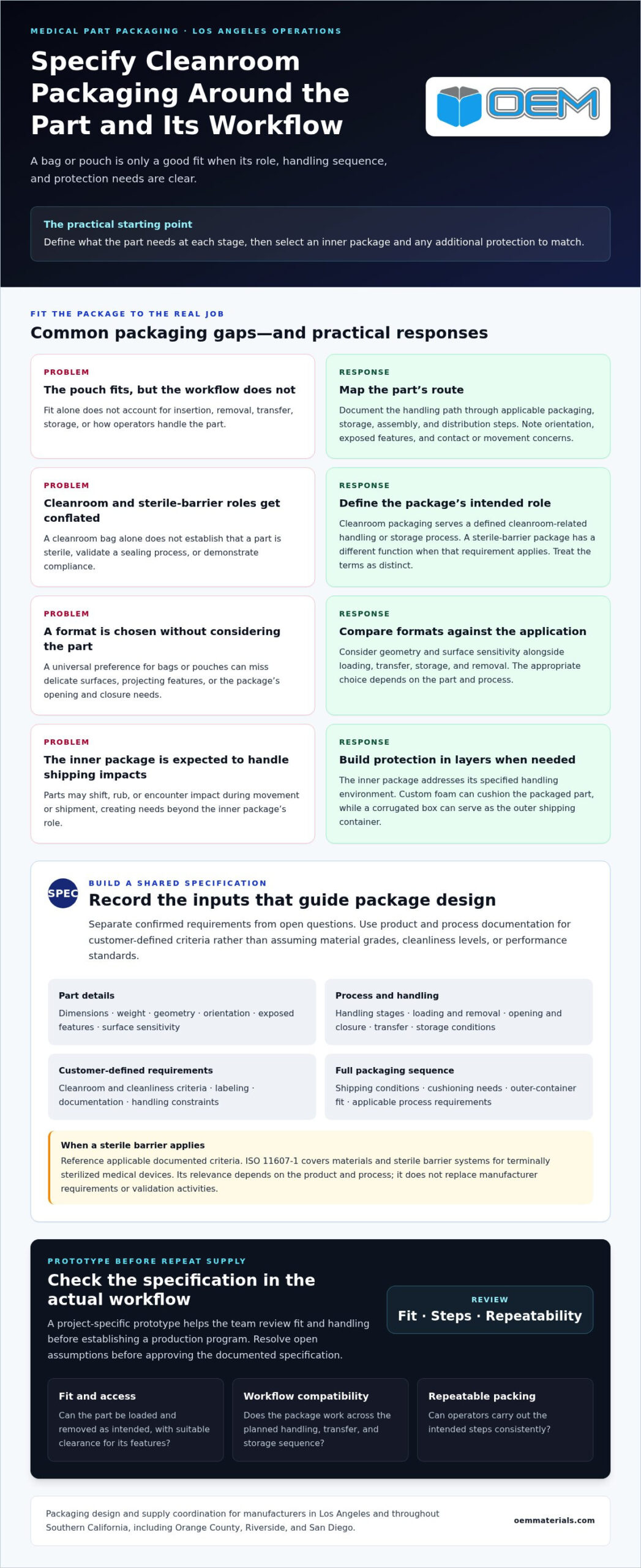
Cleanroom packaging is selected for a defined cleanroom-related handling or storage process. A sterile-barrier package has a different intended function: it is designed to maintain a sterile barrier when that requirement applies. These terms are not interchangeable. A cleanroom bag alone does not establish sterility, validate a sealing process, or demonstrate compliance.
Cleanroom standards provide context for controlled environments, but application-specific packaging criteria should come from product and process documentation. Use those requirements to define the package’s role, handling sequence, and acceptance criteria.
When medical parts need bags, pouches, or layered protection
Part geometry and surface sensitivity help determine the package format. A component with delicate surfaces or projecting features may need a package that limits contact during insertion and removal. If parts pass through several stations, consider how the package opens, transfers, and stores without adding unnecessary handling steps. The right choice depends on the application, not on a universal preference for bags or pouches.
An inner package may need additional physical protection if the part could shift, rub, or encounter impact during movement or shipping. In that case, custom foam packaging can cushion the packaged part, with a corrugated box serving as the outer shipping container. Each layer has a distinct role: the inner package addresses the specified handling environment, while cushioning and the outer package help protect against physical demands in the workflow.
Document the required protection at each stage before selecting materials or requesting a quote. Include the part’s shape and surface considerations, how operators handle it, where it is stored, and how it will be shipped. These details give packaging design a practical basis and help align the inner package with the rest of the system.
How to Specify Cleanroom Bags and Pouches for Medical Parts
A clear specification starts with the part and its route through your operation. Separate confirmed requirements from open questions so design decisions don’t rely on assumed material grades, cleanliness levels, or performance standards. This gives engineering, operations, and purchasing a shared basis for review.
Core inputs for a bag or pouch specification are the part’s dimensions, weight, geometry, surface sensitivity, handling path, storage conditions, and shipping requirements.
Start with the medical part and its handling path
Map the part’s route through packaging, storage, assembly, and distribution, wherever those steps apply. Record its orientation, exposed features, and any handling constraints specified by the customer. Note where contact, abrasion, or movement could affect product condition. For example, a projecting feature may need clearance during insertion, while a surface-sensitive part may require a process that limits unnecessary contact.
Document material, fit, and process requirements
Capture how the package needs to fit and function at each step. Specify the required opening and closure approach based on the application, along with how operators load, transfer, store, and remove the part. Record customer-defined cleanroom, cleanliness, labeling, and documentation requirements for design review rather than treating them as assumptions.
If the application includes a sterile barrier for a terminally sterilized medical device, reference the applicable documented criteria. The ISO 11607-1 standard covers materials and sterile barrier systems for terminally sterilized medical devices. Its relevance depends on the product and process; it does not replace the manufacturer’s own requirements or validation activities.
For teams planning custom medical packaging boxes los angeles, include shipping conditions in the specification even when the bag or pouch is primarily intended for an earlier handling stage. The inner package may need to fit within cushioning or an outer container, so document the full packaging sequence and any customer-defined constraints.
Use prototypes to test the specification
A project-specific prototype lets the team evaluate fit and handling before establishing a production program. Check whether the part can be loaded and removed as intended, whether the package works throughout the planned sequence, and whether operators can repeat the steps consistently. Resolve open assumptions before approving the documented specification.
- 1. Identify the part: Record dimensions, weight, geometry, orientation, and exposed features.
- 2. Map the process: Document applicable handling, storage, assembly, and distribution stages.
- 3. Define protection needs: Note surface sensitivities and possible contact, abrasion, or movement concerns.
- 4. Capture package requirements: Document fit, opening, closure, and customer-defined cleanliness or documentation criteria.
- 5. Review a prototype: Evaluate fit and repeatability, then resolve assumptions.
- 6. Issue the specification: Record approved requirements, shipping conditions, and any unresolved items.
OEM Materials & Supplies supports custom packaging design and prototype review based on the part and its workflow. To start a project discussion, send the part dimensions, weight, and annual usage along with documented handling requirements.
Compare Cleanroom Bag and Pouch Options Against Your Application
Compare packaging formats against the part and work sequence rather than assuming one option is best for every medical application. A flat component, an irregular part, and an assembled unit can have different fit and access needs. Opening and closing steps matter too: a package that is difficult to load consistently can slow packing, even if its dimensions appear suitable.
Use the comparison below to organize a design review. It highlights questions to resolve, not material grades or proof of suitability. Final choices should follow documented product, facility, and customer requirements.
| Format to evaluate | Part geometry | Handling and access | Storage and workflow |
|---|---|---|---|
| Bag-style format | Consider whether the part fits without crowding or unnecessary movement, especially if it has exposed features. | Review how the operator loads, closes, opens, and removes the part at each step. | Check how the package is stored, transferred, and placed into any secondary packaging. |
| Pouch-style format | Assess whether the shape provides practical access for a flat, irregular, or assembled part. | Observe whether the opening supports the intended packing sequence and repeatable handling. | Evaluate how the package fits the storage arrangement and the next stage of the process. |
| Either format with cushioning or an outer package | Determine whether the part needs restraint or separation from other components. | Check that added layers do not obstruct established loading and removal steps. | Review fit within cushioning and the shipping container, including handling and distribution conditions. |
Choose a format based on geometry and access
For a flat part, access and surface contact may guide the comparison. For an irregular component, consider how projecting features fit and whether the package can be handled without forcing or repositioning the part. An assembled unit may need a different opening approach than a single component. Test the actual packing sequence with the people who perform it. Evaluate repeatability and ease of access rather than relying on the format name alone.
Evaluate protection across the complete package
Keep contamination-control requirements separate from physical protection needs. A bag or pouch addresses its defined role in the handling process; it does not automatically protect against impact, vibration, or compression during shipment. Depending on the part and shipping conditions, foam may provide cushioning, while corrugated boxes for medical packaging can serve as an outer shipping layer. Assess how the layers fit and work together.
For custom medical packaging boxes Los Angeles projects, compare options using documented requirements and the full packaging workflow. A prototype can help the team assess fit, access, and compatibility with cushioning and the outer package before selecting a format for the program.
Plan Cleanroom Packaging Prototypes and Supply for Los Angeles Operations
A prototype is most useful when it reflects the actual part and packing process. For manufacturers in Los Angeles and nearby Southern California locations, reviewing the package with the team that will use it can reveal fit and workflow issues before production planning. Check whether operators can load and remove the part consistently and whether the inner package fits its cushioning and outer container.
Use prototypes to assess fit and packing workflow
Test the prototype with the intended part, not just a drawing or empty sample. Follow the planned sequence from loading through closure, storage, transfer, and placement into the shipping package. Record where the part shifts, catches, or requires extra handling. Note operator steps and identify changes that could improve fit or make the process repeatable. Review the sample against documented customer requirements before approving the packaging specification.
Include the full package in the review. A bag or pouch that fits the part may still be difficult to place into cushioning or an outer box. Check that each layer works with the next and that the packing sequence is clear for the people who will perform it.
Coordinate recurring supply across Southern California facilities
Once the design is established, align replenishment planning with actual usage, storage space, and each facility’s needs. A Los Angeles County operation may have different order patterns or storage constraints than a site in Orange County, Riverside County, or San Diego County. Sharing usage and inventory information across locations can help teams plan repeat supply and reduce process surprises.
For recurring programs, just-in-time packaging support can be planned around demand patterns and replenishment needs. Vendor-managed inventory may help coordinate stock planning, while kitting or assembly can group packaging components around a defined workflow. These are operational approaches, not guaranteed cost reductions; outcomes depend on the program, materials, and usage requirements.
For custom medical packaging boxes los angeles programs, connect prototype review to the supply plan early. A documented package specification, agreed packing sequence, and clear usage information give design and operations teams a common reference as the project moves from sample evaluation to repeat orders.
To discuss a prototype or recurring packaging program, request a quote for your packaging project with part dimensions, weight, annual usage, and relevant workflow requirements.
Work with OEM Materials & Supplies on Medical Packaging in Los Angeles
A medical packaging project works best when the inner package, protective components, and shipping container are considered together. OEM Materials & Supplies supports manufacturers in Los Angeles and throughout Southern California with packaging design, prototypes, corrugated boxes, foam packaging, and operational support from project planning through production programs.
A cleanroom bag or pouch has a defined role in the workflow. If the part also needs protection from movement or physical contact during shipment, cushioning and an outer box may be needed as additional layers. Configure the package around the part and its documented requirements. Recommendations depend on dimensions, materials, handling steps, storage, and shipping conditions, not on a one-size-fits-all package.
Bring the complete packaging problem into the design discussion
Share how the part is packed, transferred, stored, and shipped, along with constraints that affect operator access or package fit. This lets the design review account for the inner package and how it works with cushioning and the outer container. Where cushioning is needed, foam packaging can be considered as part of the coordinated design. Prototypes help teams review the package with the actual part and refine the workflow before production planning.
OEM Materials & Supplies works with manufacturers on projects ranging from prototypes and short runs to high-volume programs. The design discussion can cover protective packaging and how the package will be assembled and supplied as production needs evolve.
Prepare a useful quote request
Provide enough detail to connect the packaging design to the part and operation. Useful inputs include:
- Part dimensions, weight, geometry, and surface sensitivities
- Annual usage and expected demand patterns
- Handling steps, storage conditions, and shipping requirements
- Target workflow, including how operators load, close, transfer, and unpack the package
- Current packaging pain points, such as poor fit, difficult handling, or damage concerns
These details help OEM Materials & Supplies assess the project as a complete packaging and supply requirement. For recurring programs, planning may also include kitting, assembly, or inventory support to align packaging supply with operating needs.
For custom medical packaging boxes los angeles manufacturers can integrate with their parts and workflows, request a packaging quote with dimensions, weight, annual usage, handling steps, and shipping requirements.
Build a Packaging Plan That Fits Your Operation
Choosing cleanroom bags and pouches starts with the medical part, its handling path, and documented requirements. Compare formats based on fit and access, then review a prototype with the actual part and packing sequence. For teams sourcing custom medical packaging boxes los angeles, this evaluation connects the inner package to the broader workflow.
A bag or pouch may be only one layer of the solution. Depending on part dimensions, materials, and shipping requirements, the complete package may also need foam cushioning and a corrugated outer box. OEM Materials & Supplies supports packaging design from prototypes through high-volume production programs, with corrugated boxes, foam, kitting, assembly, and inventory support.
Bring part details and workflow requirements together before requesting a quote. Share dimensions, weight, annual usage, handling steps, and shipping conditions so the packaging plan can be tailored to the application.
Request a medical packaging quote to discuss your requirements and next steps with OEM Materials. A clear specification is a practical starting point for a packaging program built around your operation.
Frequently Asked Questions
What is the difference between cleanroom bags and sterile-barrier pouches?
A cleanroom bag is selected for a defined handling or storage stage in a cleanroom-related process, while a sterile-barrier pouch is intended to maintain a sterile barrier when that requirement applies. The terms are not interchangeable. A cleanroom bag alone does not establish sterility or demonstrate that packaging meets a specific requirement. Use product and process documentation to determine the required packaging function and criteria for your application.
How do I choose a cleanroom bag for a medical part?
Start with the part and its handling path. Record dimensions, weight, geometry, orientation, surface sensitivities, and how the part moves through packaging, storage, assembly, and distribution. Then document customer-defined cleanliness, handling, and packaging requirements. Consider how operators will load, close, transfer, and remove the part. A prototype can help evaluate fit and repeatability before the team finalizes the packaging specification.
Can cleanroom bags protect medical parts during shipping?
A cleanroom bag may serve as an inner package during specified handling and storage stages, but it should not be assumed to provide all the physical protection needed for shipping. Consider the part’s sensitivity and shipping conditions separately. If impact, movement, or compression is a concern, cushioning and a corrugated outer box may be appropriate parts of the packaging system. The complete configuration should follow documented product and shipping requirements.
What information should I provide for a medical packaging quote?
Provide part dimensions, weight, geometry, annual usage, and the steps involved in handling and packing. Include storage and shipping conditions, target workflow, and any customer-defined packaging or documentation requirements. Also describe current issues, such as poor fit, difficult packing steps, or damage concerns. These details help connect packaging design to the part and operation.
Do medical parts need both a cleanroom pouch and a corrugated box?
Not every application needs both. A pouch may serve as the inner package for a defined handling or storage requirement, while a corrugated box can provide an outer shipping container. Foam cushioning may also be considered if the part needs additional physical protection. The right combination depends on the part, workflow, and shipping conditions. A corrugated box does not replace a sterile-barrier package when one is required.
Can packaging prototypes help before a medical parts program scales?
Yes. A project-specific prototype gives the team a way to evaluate package fit and packing steps with the actual part before production planning. Review how operators load and remove the part, whether the sequence is repeatable, and how the inner package fits with cushioning and the outer container. OEM Materials & Supplies supports custom packaging projects from prototypes and short runs through high-volume production programs.
Does OEM Materials support medical packaging projects in Los Angeles?
Yes. OEM Materials & Supplies supports medical and other industrial packaging projects in Los Angeles and throughout Southern California, including Orange County, Riverside, and San Diego. Support includes packaging design, corrugated boxes, foam packaging, kitting, assembly, and vendor-managed inventory. Manufacturers planning custom medical packaging boxes in Los Angeles can share part dimensions, weight, annual usage, and workflow details to help define the project.