
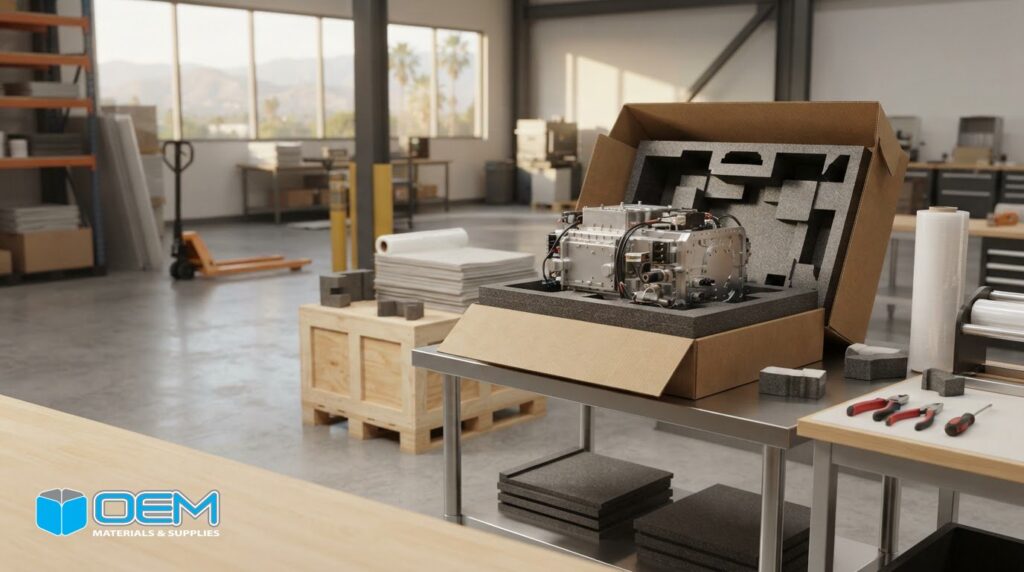
What if the packaging that looks most protective is creating a new problem on your production line? For Riverside manufacturers, electro-mechanical packaging must do more than cushion a product. It needs to limit movement and impact during handling and transit without adding unnecessary packing steps or hard-to-manage components. Balancing those needs is central to choosing electro-mechanical packaging Riverside operations can rely on.
Damage can disrupt production and delivery, but overcomplicated packaging can also slow packing and make replenishment harder. The right approach starts with the product’s dimensions, weight, vulnerable areas, and route through the supply chain. From there, corrugated boxes, engineered foam inserts, cushioning, or crates can be considered as parts of a coordinated packaging system.
This guide explains how to define protection requirements, compare materials and configurations, and assess packaging consistency and supply continuity. It also covers how working with a Riverside-area packaging partner on design, kitting, assembly, and inventory support can help align product protection with warehouse and production needs.
Key Takeaways
- Start with product dimensions, weight, vulnerable features, and shipping route to define the protection the package needs.
- Assess corrugated boxes and foam inserts as a coordinated system, considering fit, cushioning placement, and product restraint together.
- Compare packaging options by protection, pack-out labor, storage needs, and replenishment requirements before choosing a configuration.
- For electro-mechanical packaging Riverside operations can manage consistently, document product and shipping details before evaluating packaging concepts.
- Coordinate packaging design with kitting, assembly, and inventory support to align protection with production and warehouse workflows.
Electro-Mechanical Packaging in Riverside: Start with Product and Transit Requirements
Electro-mechanical packaging is a protective system configured around a product’s physical characteristics, handling needs, and distribution route. In practical terms, it matches the package to the product’s journey, from packing and storage through delivery. Packaging protects the finished product; it doesn’t replace or alter the product’s manufacturing process. For buyers evaluating electro-mechanical packaging Riverside operations, defining that journey first helps prevent a material choice from being made in isolation.
Which product details should buyers document first?
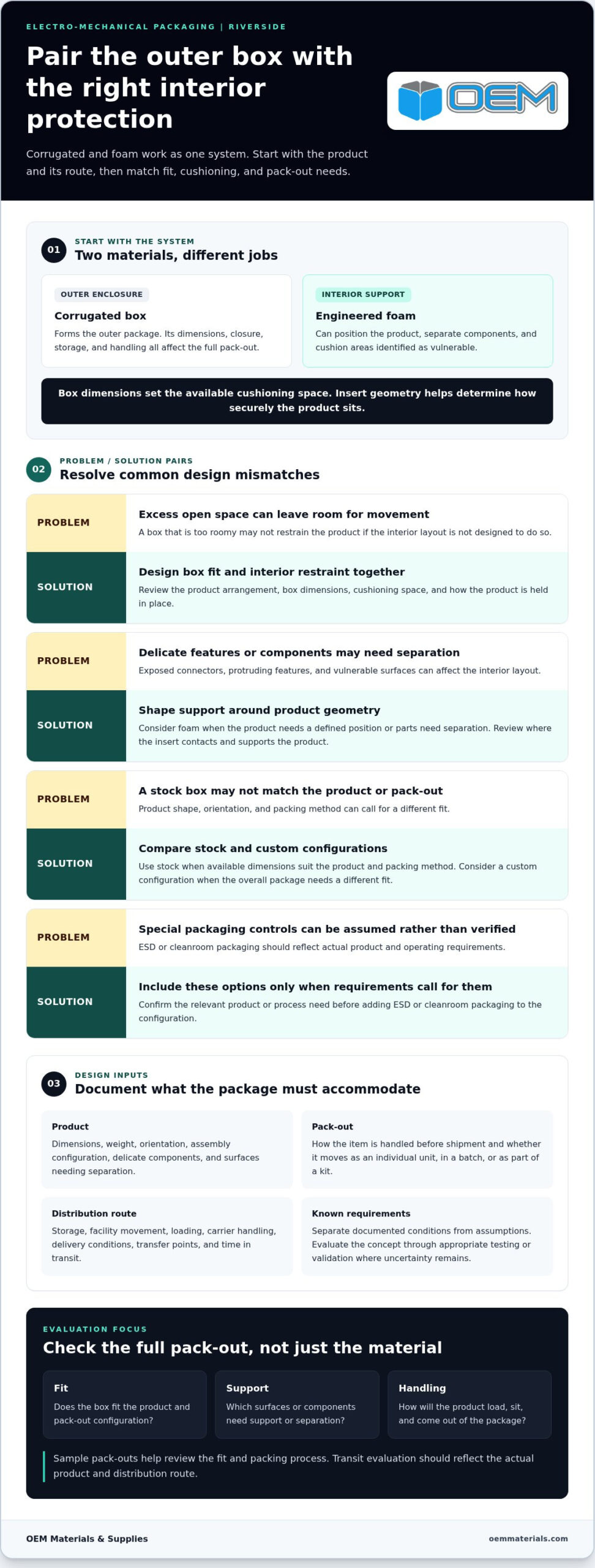
Start with the product’s dimensions, weight, intended orientation, and assembly configuration. Note delicate components, exposed connectors, protruding features, or surfaces that need separation from other parts. Record how the item is handled before shipment, including whether it moves as an individual unit, in a batch, or as part of a kit. A component that arrives assembled may need a different pack-out from one shipped with accessories or multiple parts.
These details help inform the package’s interior layout and the work required at packing. A foam insert may locate a product and separate sensitive features, while a corrugated box or crate provides the outer enclosure. OEM Materials & Supplies develops foam packaging as part of packaging configurations tailored to product and operating requirements. For a foundational overview of cushioning materials and their role in shipment protection, see Package cushioning.
How does the distribution route affect packaging needs?
Map the full route: where products are stored, how they move inside the facility, how they’re loaded and handled by carriers, and what conditions they encounter at delivery. Separate known requirements from assumptions. For example, a documented stacking condition is different from an unverified expectation about how a shipment will be handled. Where uncertainty remains, evaluate the packaging concept through appropriate testing or validation before relying on it for production shipments.
Local Riverside deliveries and longer-distance shipments may involve different handling patterns, transfer points, and time in transit. A package designed for a controlled, direct movement may not suit a route with more storage or handling stages. Capture the actual distribution path, not just the destination, so the packaging design can account for the product’s movement and the operation’s pack-out process.
How Corrugated Boxes and Foam Inserts Work Together for Electro-Mechanical Products
Corrugated and foam serve different functions. A corrugated box forms the outer package, while foam inserts can position the product, separate components, and cushion areas identified as vulnerable. The two need to be designed as one system: box dimensions affect how much room is available for cushioning, and insert geometry affects how securely the product sits inside.
A box that leaves excessive open space can allow movement if the interior layout doesn’t restrain the product. An insert that holds the product in place still needs to fit the box and suit the packing process. Buyers evaluating electro-mechanical packaging riverside can use this comparison to clarify design questions early.
| Material | Primary role | Design question | Application consideration |
|---|---|---|---|
| Corrugated box | Outer enclosure | Does the box fit the product and pack-out configuration? | Consider product arrangement, closure, storage, and handling. |
| Engineered foam | Positioning and separation | Which surfaces or components need support or separation? | Shape and layout depend on product geometry and handling needs. |
| ESD or cleanroom packaging | Addresses specific operating requirements | Does the product or process require these controls? | Include only when product and operating requirements call for it. |
When does a custom corrugated box make sense?
A stock box can suit a product that fits its available dimensions and packing method. A custom configuration may be more appropriate when the product’s shape, orientation, or pack-out calls for a different fit. The decision should account for the complete package, including interior cushioning and how staff close and handle the box. Explore corrugated box options as part of that evaluation.
When should buyers consider engineered foam inserts?
Consider shaped foam when a product needs a defined position or components need separation within the package. The insert’s geometry should reflect the product’s dimensions and the points intended to contact or support it. Review sample pack-outs to see how the product loads, sits, and is removed. OEM Materials & Supplies can coordinate foam and corrugated design around those requirements.
For transit evaluation, the International Safe Transit Association (ISTA) provides information on test procedures. Testing can help assess a packaging configuration under selected distribution conditions; it should reflect the actual product and route. To discuss a packaging concept, share product dimensions, weight, and shipping requirements through the packaging quote request.
Compare Electro-Mechanical Packaging Options by Protection, Labor, and Supply Needs
A useful comparison looks beyond the material itself. Packaging choices should be compared across the full workflow, from protection and pack-out to storage and replenishment. A configuration that suits a single product may add steps when workers pack several components together. Another may be easy to store but fail to address a product’s specific movement or separation needs.
| Option | Protection consideration | Pack-out and storage | Replenishment consideration |
|---|---|---|---|
| Corrugated box | Provides an outer enclosure; assess fit and closure for the product and route. | Review how boxes are erected, packed, and stored before use. | Plan quantities around usage and available storage space. |
| Foam packaging | Can locate or separate product features according to the insert design. | Consider insert orientation, placement, and removal during packing and unpacking. | Coordinate insert supply with the box and product schedule. |
| Crate | Consider for product and shipment profiles that call for a rigid outer structure. | Account for handling, storage footprint, and the packing process. | Include crate requirements in shipment and inventory planning. |
| Cushioning materials | Can fill or cushion areas within a package, depending on configuration. | Review how material is added and whether the method is repeatable. | Coordinate stock levels with pack-out volume and material usage. |
How should teams weigh protection against packing efficiency?
Map each packing step and note where the product could shift, contact another component, or require careful positioning. Then consider how consistently workers can repeat the pack-out, how many pieces they handle, and how easily the recipient can unpack the product. A configuration should be reviewed with actual samples and operating conditions. Don’t assume it will reduce damage without project-specific evidence or validation.
Packaging also has meanings beyond shipment protection. The National Advanced Packaging Manufacturing Program addresses advanced manufacturing of semiconductor packages, a different subject from protective packaging used to ship electro-mechanical products. Keeping that distinction clear helps teams compare the right materials and requirements.
When do kitting and assembly support fit the packaging program?
Coordinated kits can bring the selected packaging components together for a defined product, batch, or shipment, helping make the pack-out sequence easier to follow. Assembly support may also suit workflows where packaging preparation can be coordinated with production needs. Review the component count, packing sequence, and replenishment pattern before deciding how to organize kits. For electro-mechanical packaging Riverside teams can manage as a consistent workflow, OEM Materials & Supplies can coordinate packaging design, kitting, and assembly. Cost outcomes depend on product dimensions, selected materials, shipping requirements, and operating conditions.
To discuss a packaging configuration, share the product details and pack-out requirements through the packaging quote request.
Plan a Riverside Packaging Evaluation from Prototype to Production
A structured evaluation helps teams move from product requirements to a packaging concept that can be reviewed in real operating conditions. For electro-mechanical packaging Riverside programs, include both protection needs and the way packaging will be packed, stored, and replenished.
- Gather product information. Record dimensions, weight, orientation, images, assembly configuration, and handling instructions. Identify components or surfaces that need added care.
- Document the current process. Describe existing packaging, pack-out steps, storage conditions, and any observed damage, excess movement, or labor challenges.
- Map distribution requirements. Note internal transfers, carrier handling, delivery routes, and any known shipment conditions. Separate documented requirements from assumptions.
- Define program needs. Estimate packaging usage and describe production schedules or volume changes when known. Clarify whether products ship individually, in batches, or as kits.
- Review a packaging concept. Evaluate a prototype with representative products and packers. Record fit, handling, pack-out consistency, storage needs, and feedback for revision before scaling into production.
A useful packaging review starts with product dimensions, weight, images, handling instructions, current packaging, observed issues, shipment routes, storage conditions, and expected usage. Include sample products when possible so the proposed configuration can be considered against the actual item and packing sequence.
How can teams coordinate packaging replenishment?
Match purchasing cadence to actual usage, available storage space, and the production schedule. Ordering too far ahead can occupy space needed for operations, while replenishment that doesn’t reflect usage can create shortages or disrupt pack-out. Review how often each component is consumed and how packaging demand changes with production volume.
Just-in-time delivery coordinates packaging supply with planned operational needs. Vendor-managed inventory (VMI) supports replenishment planning around agreed usage and inventory information. Both approaches depend on clear communication about consumption and schedule changes. OEM Materials & Supplies supports Riverside manufacturers with vendor-managed packaging inventory, alongside packaging development from prototypes through production programs.
Prototype feedback should guide revisions before a design is adopted across a production run. Teams can assess whether the package is practical for operators, fits storage constraints, and follows the intended handling sequence. To begin a packaging review, request a packaging quote with product dimensions, weight, sample or image, and estimated usage.
Choose an Electro-Mechanical Packaging Partner Serving Riverside
Choosing a packaging partner is about coordinating product protection with the way your operation packs, stores, and ships. For electro-mechanical packaging Riverside manufacturers need, assess capabilities across four areas: design, materials, production scale, and replenishment. A connected approach can help teams address product needs and operational constraints in the same packaging plan.
What should a capable packaging partner coordinate?
Packaging design should bring the product’s configuration, material choices, distribution route, and pack-out workflow together. Corrugated boxes can provide the outer package, while engineered foam inserts, cushioning, or crates can be considered according to the product and shipment requirements. Kitting and assembly can also support defined packing workflows. The aim is a configuration suited to the application, not a one-size-fits-all material selection.
Program needs change over time. A packaging concept may begin with a prototype or short run, then move into a higher-volume production program. OEM Materials & Supplies serves Riverside and the broader Southern California region with packaging support across these stages. Its capabilities include custom corrugated boxes, engineered foam inserts, crates, packaging design, kitting, assembly, and vendor-managed inventory. Buyers can explore custom packaging design as part of a coordinated evaluation.
Replenishment matters, too. Review how packaging components are used, where they’re stored, and how supply timing fits production. Coordinating design and inventory planning can help address inconsistent components or supply interruptions without separating packaging decisions from warehouse needs.
How can Riverside buyers take the next step?
Bring practical project information to the discussion: product dimensions and weight, annual usage, packing configuration, and shipping details. Include images or a sample if available. Describe current damage concerns, labor-intensive packing steps, storage constraints, or inventory challenges. These details help frame a project-specific recommendation and determine what should be reviewed in a prototype.
Packaging costs and potential savings depend on product dimensions, materials, shipping requirements, and operating conditions. A clear brief helps the team assess those factors without relying on assumptions. Contact OEM Materials & Supplies to request a quote or discuss a packaging consultation for your Riverside operation.
Build a Packaging Plan That Works from Prototype to Production
Effective electro-mechanical packaging starts with the product and its route through handling, storage, and delivery. Corrugated boxes, engineered foam, and crates each serve different roles, so evaluate them as a coordinated package. Include pack-out labor and replenishment needs in the decision, not just material selection.
For Riverside manufacturers, electro-mechanical packaging Riverside support should account for both protection requirements and how packaging fits daily operations. OEM Materials & Supplies serves Riverside and Southern California with packaging design, custom corrugated, engineered foam, crates, kitting, assembly, and inventory services. Support can span prototypes and short runs through high-volume programs.
To begin, share product dimensions, weight, annual usage, and shipping details, along with any current damage, labor, or inventory concerns. These details help frame a project-specific packaging recommendation.
Request a quote for your electro-mechanical packaging project and take the next step toward a packaging plan aligned with your product and operation.
Frequently Asked Questions
What is electro-mechanical packaging?
Electro-mechanical packaging is a system designed to protect electro-mechanical products during handling, storage, and distribution. It can combine an outer container, such as a corrugated box or crate, with interior foam or cushioning to position and separate product components. The configuration depends on the product’s dimensions, weight, vulnerable features, packing process, and shipment route. It protects the finished product, not the manufacturing process.
How do I choose packaging for electro-mechanical products?
Start with the product and the route it will travel. Document dimensions, weight, orientation, assembly configuration, and components requiring added care. Then map storage, internal movement, carrier handling, and delivery conditions. Compare possible materials by their roles in the package, along with pack-out steps, storage space, and replenishment needs. Review a proposed configuration with representative samples before adopting it for regular production or shipment.
Are foam inserts necessary for electro-mechanical packaging?
Foam inserts aren’t necessary for every product. They can be useful when a product needs to stay positioned within its package or when components need separation. The decision depends on product geometry, vulnerable areas, handling conditions, and the rest of the package. A corrugated box with another suitable cushioning arrangement may fit a different application. Evaluate the full configuration rather than selecting foam by default.
Can corrugated boxes protect electro-mechanical products during shipping?
Corrugated boxes can serve as the outer enclosure for electro-mechanical products, but the box alone may not address every protection need. Fit, closure, interior cushioning, product restraint, and shipment conditions all matter. For example, a product that can move inside an oversized package may need an interior layout designed to limit that movement. Packaging performance depends on the complete configuration and should be evaluated for the intended route.
What information should I provide for a custom packaging quote?
Provide product dimensions, weight, orientation, images or a sample, and details about sensitive or protruding features. Include the current packaging configuration, packing steps, known damage or handling concerns, and distribution routes. Estimated annual usage, batch or kit requirements, storage constraints, and expected production changes also help shape a project-specific recommendation. Savings, if any, depend on product dimensions, materials, shipping requirements, and operating conditions.
Does OEM Materials & Supplies serve Riverside manufacturers?
Yes. OEM Materials & Supplies serves manufacturers in Riverside and throughout Southern California, including Orange County, Los Angeles County, and San Diego County. The company supports electro-mechanical packaging Riverside manufacturers need with custom corrugated boxes, engineered foam inserts, crates, packaging design, kitting, assembly, and inventory services. Packaging support spans prototypes and short runs through high-volume production programs.
Can packaging be coordinated with production and inventory needs?
Yes. Packaging can be planned alongside production schedules, pack-out requirements, storage capacity, and material usage. Kitting and assembly can organize packaging components for defined workflows, while just-in-time delivery and vendor-managed inventory are approaches to coordinating replenishment. The right arrangement depends on how materials are consumed and how production needs change. Sharing usage patterns and schedule requirements helps align packaging supply with operational demand.
To discuss a packaging project for your operation, request a quote and include product dimensions, weight, annual usage, and shipping details.