

What if the packaging with the lowest unit price is adding cost elsewhere in your operation? Convincing management to approve packaging spend means showing how a decision affects more than the purchase price. Product damage, repacking, packing labor, inventory requirements, and shipping efficiency all shape the business case.
It’s reasonable for management to scrutinize upfront costs. The challenge is that different departments may track packaging performance in different ways, making the full impact difficult to see. A consistent comparison based on current operating data can connect packaging choices to measurable outcomes.
This article explains how to build that case without relying on assumptions or overstated savings. You’ll learn what data to gather, how to compare options, and how to propose a focused trial with clear success measures. The goal is a practical framework for evaluating packaging as an investment in product protection and supply-chain performance, not just a line-item expense.
Key Takeaways
- Start with a documented operating problem, then separate observed facts from assumptions about its causes.
- Compare options using company records for materials, labor, damage handling, storage, and replenishment.
- Make the business case easier to evaluate by comparing the current setup, a targeted adjustment, and a broader redesign against the same criteria.
- Present the investment scope, expected impact, assumptions, risks, and implementation requirements clearly.
- Propose a scoped trial with assigned owners and baseline-based success measures, and record exceptions during the test.
Make the Case for Packaging Spend by Defining the Operating Problem
Repeated repacking after inspection is an operational symptom worth investigating. It can delay orders, add handling steps, and pull staff away from other work. But the symptom alone doesn’t prove that packaging caused the problem. A credible case for convincing management to approve packaging spend starts by documenting what happened, where it happened, and what the records can support.
Separate observations from interpretations. A damage report may confirm that a product arrived with a damaged corner, but not whether the cause was product movement, handling, or another factor in transit. Packing logs can show extra steps or interruptions, while inventory records can reveal packaging shortages or excess stock. Label assumptions as assumptions, then identify what evidence would test them.
Be specific about who and what is affected. Identify the product or product family, packing process, shipment type, and teams involved, such as warehouse, quality, customer service, or procurement. If fragile components repeatedly shift inside a carton, review inspection records and the packing method before proposing a change. A foam packaging configuration may be one option to evaluate for product movement, with suitability determined by the product and shipping requirements.
Which packaging problems justify a management review?
Look for patterns in damage reports, returns, repacking records, work instructions, labor observations, and inventory transactions. Note recurring touches, such as repositioning a product, adding cushioning, or rebuilding a package before shipment. Include shortages, excess stock, or packaging variation only when purchasing and inventory records support them. The aim is to define an operational issue, not assign blame or promise savings.
How to establish a credible baseline
Select a representative product, shipment lane, order type, or production period. Record the current materials, package configuration, packing steps, and known exceptions. State where each measure comes from and the period it covers. If damage reports omit shipment volume, say so, and don’t present a count as a rate. A clear baseline supports later evaluation using a Total Cost of Ownership (TCO) perspective, which considers more than the initial purchase.
Keep the problem statement concise and quotable: “For [product or process], current packaging is associated with [documented issue], creating [verified operational impact] for [affected team or delivery outcome].” Fill each bracket with evidence, and distinguish confirmed impact from a proposed explanation. That gives management a defined problem to evaluate before comparing packaging options.
Measure Packaging Spend Against the Costs and Risks It Influences
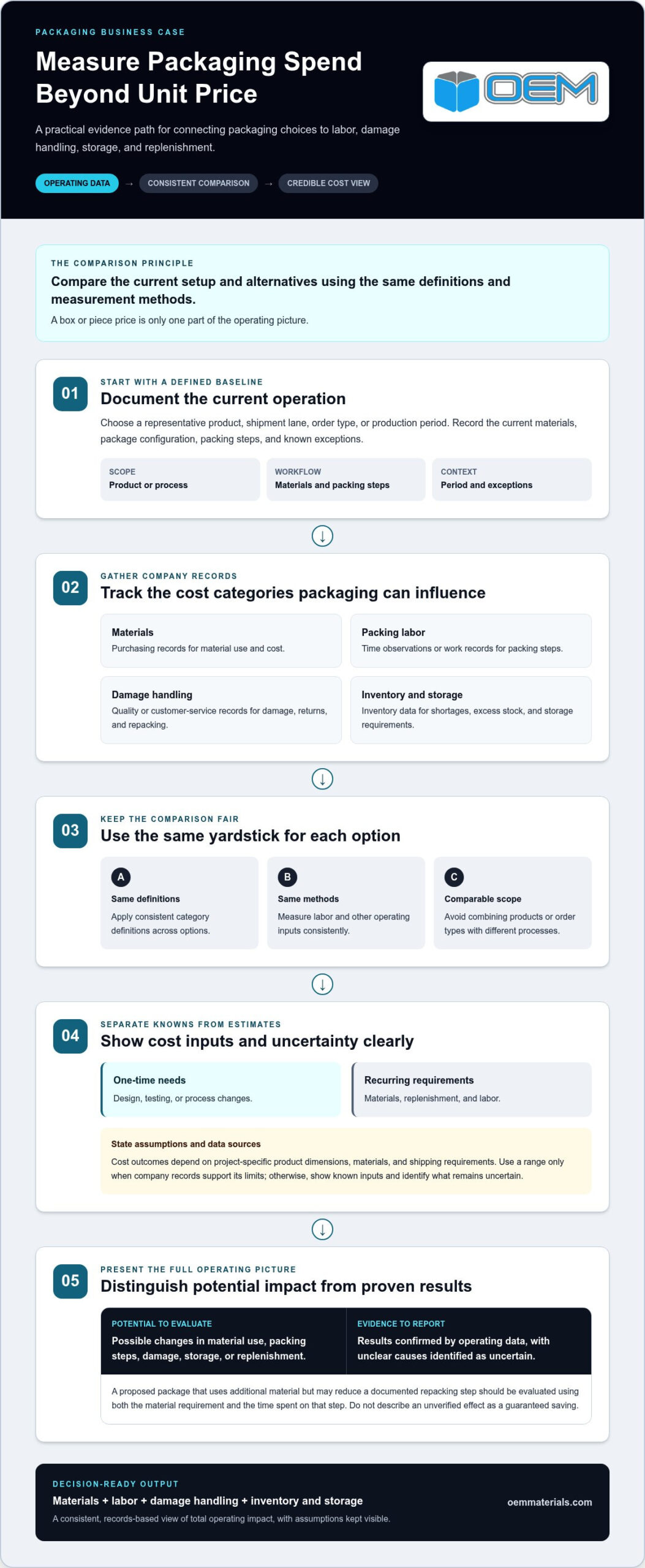
A comparison based only on cost per box or piece leaves out expenses that can shift to other parts of the operation. Consider total operating impact alongside unit price because packaging also affects labor, product damage, storage, and replenishment.
Build the comparison around categories your company can track. Use purchasing records for material use, time observations or work records for packing labor, and quality or customer-service records for damage, returns, and repacking. Add inventory data when shortages, excess stock, or storage requirements affect the workflow. Apply the same definitions and measurement methods to each option to keep the comparison consistent.
For example, a proposed package might require additional material but reduce a documented repacking step. Record the material requirement and the time spent on that step rather than describing the change as a guaranteed saving. A lever for supply chain efficiency should be evaluated through operating measures, not assumed from design intent alone.
Which measures belong in a packaging business case?
Select measures tied to the problem under review. Track damage and returns using available internal records, and distinguish incidents with known packaging involvement from cases where the cause is unclear. For labor, document the same packing steps using the same timing method before and during a trial. Include inventory availability and storage use if they influence production or shipping. Avoid combining unrelated products or order types when their packaging processes differ.
How to explain uncertain costs responsibly
Separate one-time implementation needs, such as design, testing, or process changes, from recurring requirements such as materials, replenishment, and labor. Show calculations as estimates, identify their data sources, and state assumptions about product dimensions, materials, and shipping requirements. Cost outcomes depend on those project-specific variables. Use a range only when company records support its limits. Otherwise, show the known inputs and identify what remains uncertain.
Keep projected effects distinct from realized results. If damage records don’t identify packaging as the cause, present reduced damage as a possibility to test, not a booked benefit. Apply the same discipline to labor: a shorter packing sequence isn’t a realized labor reduction unless operating data confirms the impact. This makes the case for convincing management to approve packaging spend more credible by showing both potential value and the evidence still needed.
For a project-specific packaging review, include product dimensions, weight, shipping requirements, and annual usage in the packaging quote request.
Compare Packaging Options Using Criteria Management Can Evaluate
A useful comparison gives management more than a choice between a low-cost package and a higher-cost one. Put the current configuration, a targeted adjustment, and a broader redesign side by side. Assess each against the same product, handling process, shipment conditions, and operating assumptions. This shows which options address the documented problem and which trade-offs still need testing.
Use the table as a decision framework, not a claim of proven performance. Mark each entry as verified, projected, or unresolved. For instance, a new cushioning layout may be designed to limit product movement, but its protective performance remains a projection until evaluated under representative conditions.
| Evaluation criterion | Current configuration | Targeted adjustment | Broader redesign |
|---|---|---|---|
| Protection | Record observed damage and known limitations. | Identify the specific protection gap it targets. | Assess fit for the product and shipping conditions. |
| Labor steps | Document the existing packing sequence. | Note steps added, removed, or changed. | Identify process or training changes required. |
| Material use | List materials and quantities currently used. | Compare the adjusted material requirements. | Document the proposed package components. |
| Storage and supply | Record storage needs and replenishment issues. | Check for changes to inventory and availability. | Identify supply dependencies and transition needs. |
| Implementation | Maintain as the baseline. | Define what must change for a focused test. | Plan design evaluation and process adoption. |
Compare fit, not just materials
Use consistent assumptions for every option. A custom packaging design can align package structure with product dimensions, handling, and shipping requirements, but a redesign may also require updated work instructions or storage planning. For a smaller adjustment, specify exactly what changes and what stays the same. Procurement can compare material requirements, while operations and quality teams assess workflow and protection implications.
Consider the broader lifecycle, not only purchase price. Consider the Total Cost of Ownership when weighing material use alongside labor, storage, damage handling, and replenishment. Keep verified results separate from expected outcomes so projected gains aren’t mistaken for established savings. This evidence-based comparison supports convincing management to approve packaging spend without hiding unresolved trade-offs.
Include supply programs when availability is the issue
If records show replenishment timing is disrupting operations, assess whether just-in-time packaging services fit the requirement. If stock visibility or availability is the concern, vendor-managed inventory may also be relevant. Evaluate these as supply approaches alongside the packaging configuration, and state the operational issue each is intended to address.
Present a Packaging Proposal That Answers Management’s Main Concerns
Management needs a clear decision, not a broad request to “improve packaging.” Organize the proposal so reviewers can quickly see the operating problem, baseline evidence, options considered, expected impact, risks, and approval requested. State the investment scope and implementation requirements plainly. Separate verified results from projections, and identify assumptions that could change the recommendation.
Make the ask specific. For example, request approval to evaluate a defined packaging adjustment for a named product or order type, with an agreed materials scope, participating teams, and review date. A bounded evaluation gives management a clear decision point without presenting a forecast as a guaranteed result.
Address unit-cost and budget objections directly
Acknowledge any unit-price difference rather than hiding it. Then show what the comparison includes: material use, packing steps, damage handling, storage, and replenishment where company records support those measures. Label estimates, explain their assumptions, and clarify that outcomes depend on product dimensions, materials, and shipping requirements. Define in advance what evidence would support the change, require revision, or stop the evaluation.
Reduce perceived implementation risk
Specify the test scope, product range, participating teams, and each owner’s responsibilities. Document supply requirements, operational constraints, and any work-instruction or training changes. Set acceptance criteria before the evaluation begins, using measures tied to the original problem. Criteria might cover package condition, packing steps, material use, and supply availability. Record exceptions so unusual orders or process disruptions don’t distort the review.
Keep the approval summary short enough to stand on its own. Use a format such as: “Approve [defined scope] for evaluation because [baseline evidence] indicates [documented operating issue]. We will assess [agreed measures], account for [key risks or assumptions], and return with findings on [review date].” This makes the requested decision explicit and shows how the team will verify or revise its expectations. It turns convincing management to approve packaging spend into a disciplined operating decision rather than a debate over unit price alone.
For a proposal grounded in product and shipping requirements, include product dimensions, weight, and annual usage when you request a packaging quote.
Move from Packaging Approval to a Measured Implementation Plan
Approval is the start of the evaluation, not proof that a packaging change will work as intended. Turn the decision into a defined trial with a named product or product range, participating teams, assigned owners, a timeline, and a review date. Keep the scope narrow enough to monitor, but representative of the handling and shipping conditions the package must support.
Agree on responsibilities before the first package is used. Operations can document packing steps, procurement can track material consumption and replenishment, and quality or receiving teams can record observed damage and package condition. Assign one person to collect the records and note process exceptions. Use the same definitions and measures as the baseline so the comparison remains meaningful.
What to document during a packaging trial
Log the packaging configuration, materials used, packing steps, observed damage, and stock availability. Capture operator and receiving-team feedback alongside process disruptions, but keep comments distinct from measured results. Note differences in product, shipment, handling, or order type that could affect the outcome. For operations across Orange County, Los Angeles County, the Inland Empire, or San Diego County, record site-specific conditions rather than assuming one location represents all others.
How to turn results into a decision
At the agreed review point, compare trial findings with the original baseline and acceptance criteria. State what improved, what did not, and where evidence is limited. If a package performs well for one shipment type but creates storage or replenishment challenges elsewhere, describe that trade-off before recommending expansion. The right next step may be to refine the configuration, extend the evaluation to another operating condition, expand the change, or discontinue it.
Keep the decision tied to evidence, not expectations. That makes convincing management to approve packaging spend an ongoing process of measurement and adjustment, rather than a one-time argument. A documented trial also gives purchasing, operations, quality, and supply-chain teams a shared basis for deciding what happens next.
For a packaging review or quote, provide product dimensions, weight, shipping requirements, and annual usage. These details help align recommendations with the product and operating process.
Build the Next Packaging Decision on Evidence
A strong packaging proposal starts with a documented operating problem, compares options against consistent criteria, and makes assumptions visible. It also gives management a defined way to evaluate the change using the same measures before and during a trial. This practical approach makes convincing management to approve packaging spend less about defending a unit price and more about assessing its effect on daily operations.
OEM Materials & Supplies supports manufacturers with packaging design and solutions, from prototypes and short runs to high-volume programs. Kitting, assembly, just-in-time delivery, and vendor-managed inventory can address specific workflow and supply needs. The company serves manufacturers in Orange County, Los Angeles, San Diego, Riverside, and across the United States.
Bring your product and operating requirements into the discussion early. Request a packaging quote or project review with product dimensions, weight, shipping requirements, and annual usage. These details help shape a recommendation around your application and give your team a clear basis for evaluating next steps.
Frequently Asked Questions
How do you convince management to approve packaging spend?
Build the case around a documented operating problem and its effect on production, labor, product condition, or delivery. Compare the current setup with practical alternatives using consistent measures, and distinguish recorded results from estimates. State the investment scope, assumptions, risks, and decision requested. A focused evaluation with agreed success criteria gives management a clear way to assess the proposal without treating projected benefits as guaranteed.
What should a packaging business case include?
A packaging business case should define the problem, establish a baseline, compare options, and explain expected impact, risks, and implementation needs. Include relevant company data on material use, packing steps, damage handling, storage, and replenishment. Identify each data source and any limitations. Make the requested decision clear, such as approval to evaluate a defined packaging adjustment for a specific product or shipment type.
How can I show the ROI of better packaging?
Compare the proposed investment with operating impacts that can be measured, such as material consumption, packing labor, damage handling, returns, storage, and replenishment. Use company records to establish the baseline, then label projected benefits as estimates until a trial verifies them. Include only effects supported by project data, and state assumptions about product dimensions, materials, and shipping requirements. This creates a more credible return estimate than unit price alone.
How do I respond when management focuses only on packaging unit cost?
Acknowledge the unit-price difference and show the full comparison without dismissing the budget concern. Explain which operating factors are included, such as packing steps, product damage records, storage, and supply availability. Clearly mark assumptions and possible benefits as projections. Then propose evidence that would support, revise, or stop the change. This keeps the discussion grounded in measurable business needs rather than claims of guaranteed savings.
Should we run a packaging trial before approving a wider change?
A scoped trial can help evaluate a packaging change before broader adoption, especially when performance is uncertain. Define the product range, participating teams, responsibilities, timeline, and review point in advance. Use the same measures as the baseline and set acceptance criteria before the trial begins. Record exceptions, such as different shipment conditions or process interruptions, so the final decision reflects actual operating conditions.
What information should I provide for a packaging quote or review?
Provide product dimensions, weight, annual usage, and shipping requirements, along with details about the current package and the problem you want to address. Photos or a sample can help clarify product orientation and handling needs. OEM Materials & Supplies works with manufacturers in Orange County, Los Angeles, San Diego, and Riverside, as well as across the United States. Project details help align recommendations with the application.
Can packaging design reduce labor or product damage?
Packaging design can be evaluated for its potential to improve product fit, protection, and packing workflow, but results depend on the product and shipping requirements. A configuration that reduces unnecessary handling steps may support a more consistent packing process, while suitable cushioning or structure may address a documented protection issue. OEM Materials & Supplies supports custom packaging from prototypes and short runs to high-volume programs. Verify expected effects with project-specific measures.