
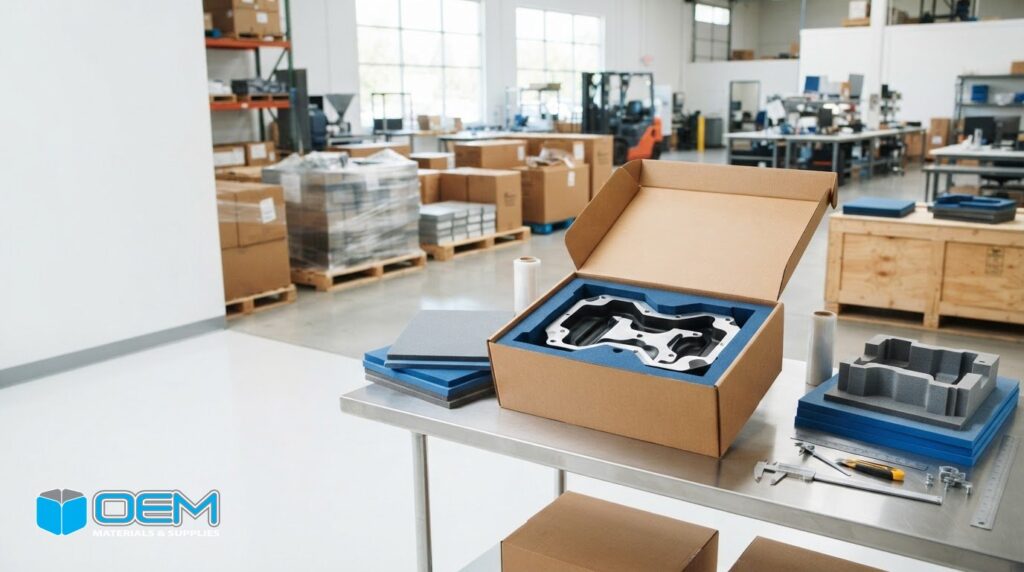
A well-designed foam insert is not simply the one with the most material. It is the one that supports the product through packing, handling, and shipment. When evaluating a custom XLPE foam fabricator in Los Angeles, start by translating product and shipping requirements into a repeatable protective design. Guesswork about thickness, density, or part geometry can lead to product movement, damage, or inconsistent packing.
Purchasing, engineering, and operations teams can build a useful specification from product dimensions and weight, the item’s orientation in the package, and how it will be packed and shipped. This guide explains how to define those requirements, assess design support and production fit, and prepare a clear quote request. It also covers how foam inserts work with the outer box and packing workflow. OEM Materials & Supplies provides custom packaging design and engineered foam packaging for projects ranging from prototypes to production programs, helping manufacturers connect product protection with consistent operations.
Key Takeaways
- Build a useful foam specification from product dimensions, weight, fragile areas, handling needs, and shipping conditions.
- Compare a custom XLPE foam fabricator los angeles project partner by design collaboration, prototype support, production fit, and communication.
- Include drawings or product samples, annual usage, and shipment details to make your quote request more actionable.
- Consider how foam inserts fit with the outer packaging and packing workflow to support consistent product protection.
- OEM Materials & Supplies supports custom packaging design, engineered foam packaging, prototypes, short runs, and production programs for Southern California manufacturers.
What custom XLPE foam packaging does for industrial products
XLPE foam is crosslinked polyethylene foam used as cushioning material in packaging. Cross-linked polyethylene (XLPE) refers to polyethylene whose polymer chains are linked through a crosslinking process. In packaging, foam is one component of a protective system, not a complete insert or package by itself.
An insert’s shape, contact points, and fit within its container determine how it supports a product. Material selection and insert design are related, but they are not interchangeable. Choosing a foam material alone does not establish whether the finished pack will control movement or suit the shipping process. For an overview of foam packaging approaches, see the foam packaging options available for industrial applications.
When XLPE foam may suit a custom packaging application
XLPE may be considered when a part needs cushioning shaped around its geometry and support points. A housing with protruding connectors, for example, may need an insert that supports the main body without putting pressure on those features. The right design depends on the item, how it is handled, and its shipping conditions, not just the foam type.
Material selection should account for the complete packaging requirement: the product’s weight, packing method, outer container, and shipping route. A custom XLPE foam fabricator in Los Angeles needs clear product and shipment information to assess the application. No single foam choice suits every part or distribution pattern.
Which products and shipping risks should shape the design?
Start with the product. Record its overall dimensions and weight, identify fragile areas, and note where support is needed. Drawings or a sample can clarify contours and features that measurements alone may not show. Describe how operators lift, place, and remove the item during packing and unpacking.
Next, consider the journey. Repeated handling, shipment orientation, and the possibility of movement inside the package all affect insert layout. A component shipped upright may need a different support arrangement from one packed on its side. These details connect the product’s geometry to a practical design instead of relying on a material label alone.
For broader guidance on insert planning, consult the Industrial Guide to Foam Inserts. A well-defined brief gives the design process a stronger starting point and helps teams assess whether the proposed packaging supports consistent packing as well as product protection.
How to specify custom XLPE foam for your product
A useful foam specification starts with the product and its journey, then moves through design review and a quote request. A clear brief helps a Los Angeles-area fabricator understand the requirements and develop a practical design without guessing about fit or support.
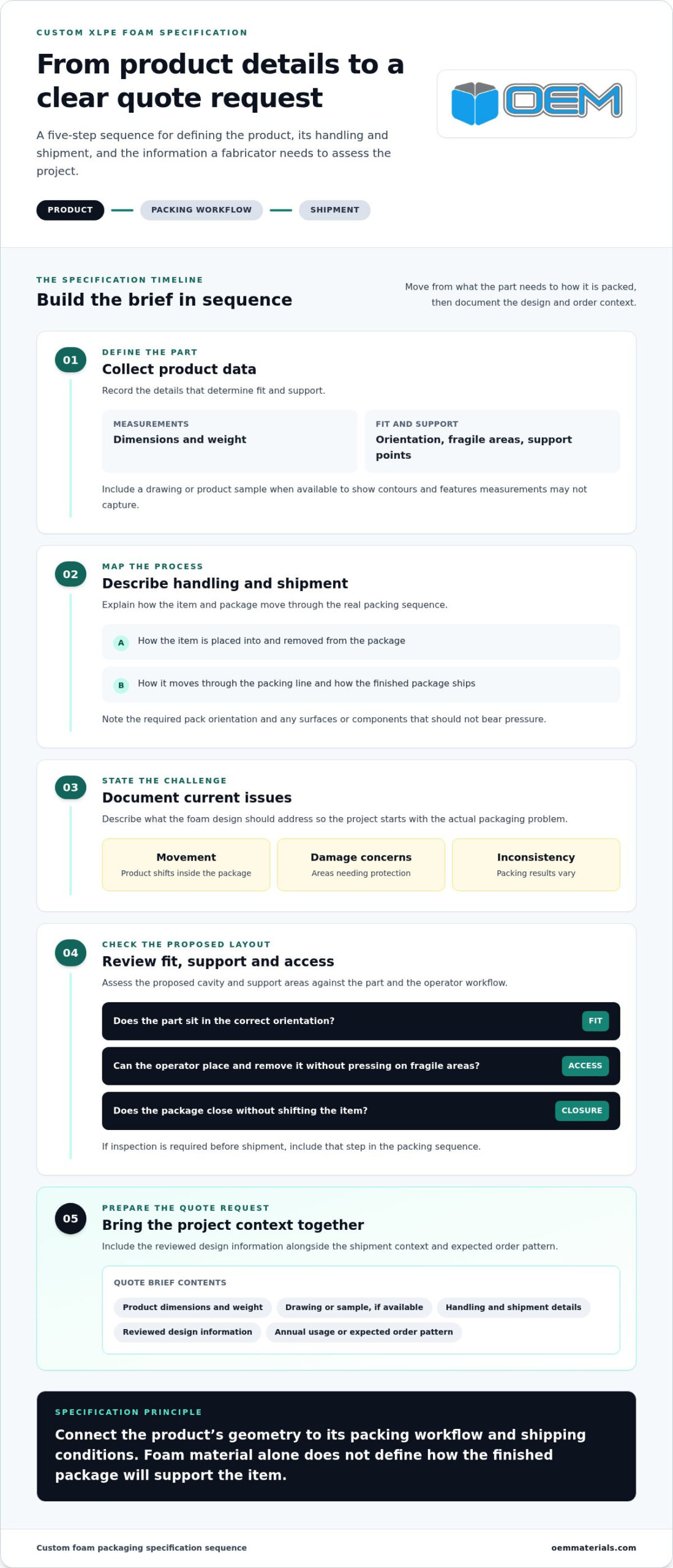
Use this sequence to organize the work:
- Collect product data. Record dimensions, weight, orientation, fragile areas, and points that need support. Include a drawing or product sample when available.
- Describe handling and shipment. Note how the item is placed in and removed from the package, how it moves through the packing line, and how the finished pack ships.
- Document current issues. Describe product movement, damage concerns, packing inconsistencies, or other problems the design should address.
- Review the proposed layout. Check how the cavity, support areas, and access features fit the part and the operator workflow.
- Prepare the quote request. Include the approved design information, shipment context, and expected order pattern.
What product and shipment information belongs in the brief?
Provide product dimensions and weight, along with drawings or a sample that shows its shape and delicate features. Identify the required pack orientation and any surfaces or components that should not bear pressure. Describe each handling step, from loading the item to unpacking it at its destination.
Include the packaging format and shipment context, such as how the finished package is grouped or transported. If known, share annual usage or the expected order pattern. This information helps the project team consider how the design fits your production program without assuming a fixed volume.
How should the foam layout support packing and protection?
The cavity should match the product’s shape and position its intended support points against the item. Access features matter too: operators need to insert and remove the part without struggling or pressing on fragile areas. If the item requires inspection before shipment, account for that step in the packing sequence.
Review a proposed design against the actual packing process. Does the part sit in the correct orientation? Can the operator place it consistently? Does the package close without shifting the item? OEM Materials’ custom packaging design service connects packaging requirements with design support. To start a quote discussion, share the product dimensions, weight, available drawings or sample, annual usage, and shipment details through the quote request page.
How to compare XLPE foam fabricators in Los Angeles
Supplier directories can help identify companies, but a listing does not show how well a team can turn a packaging requirement into a repeatable design. When evaluating a custom XLPE foam fabricator in Los Angeles, compare design collaboration, prototype review, production fit, and communication, not just the material name.
Use this scorecard to structure the comparison:
Engineering collaboration: Does the team connect the product’s geometry and shipping conditions to an insert design, and explain the reasoning behind the layout?
Prototype process: Is there an opportunity to review a prototype, test how the product fits, and provide feedback before moving forward?
Production fit: Can the packaging plan accommodate the expected order pattern and the way operators pack, handle, and replenish materials?
Communication: Are design decisions, revisions, and approved specifications documented clearly for purchasing, engineering, and operations?
Pay attention to how design changes are managed. A product revision may affect cavity dimensions or support points; a change in shipment orientation may call for a design review. For repeat orders, documented specifications help teams maintain consistency. OEM Materials & Supplies supports packaging design and projects from prototypes and short runs through high-volume production programs. Its custom packaging design service connects product requirements with the wider packaging system.
Which technical and production capabilities matter?
Look for design and fabrication processes that fit your project’s requirements. A machine list alone does not tell you how a team handles the work. Ask how prototype feedback is captured, how revisions are evaluated, and how the approved design carries into production. Review both the insert’s fit and whether operators can use it consistently in the actual packing workflow.
What makes a Los Angeles-area partner practical?
For teams operating across Los Angeles County and Southern California, clear project coordination matters. Consider how design communication, order planning, storage, and replenishment connect with your production schedule. OEM Materials serves manufacturers in Los Angeles, Orange County, Riverside, and San Diego, with packaging support that can connect foam inserts to other packaging components and workflows.
Evaluate custom foam against the problem it is meant to solve, not on material price alone. Compare product damage concerns, foam and other packaging material use, and the labor involved in packing. Outcomes depend on product dimensions, packaging design, and shipment requirements. A clear project review helps buyers weigh those variables without assuming a custom insert will automatically reduce total cost.
How to prepare an XLPE foam quote request for a Los Angeles project
A useful quote request gives the packaging team enough information to understand the product, packing process, and shipment. For a custom XLPE foam fabricator los angeles project, do not rely on a material name alone. Design, material, quantity, and shipping requirements all influence which packaging approach makes sense.
What should procurement include in the first project submission?
Build the request around the product and the intended packaging outcome. Include available drawings or photographs, and note any handling instructions that affect how the item is packed or protected. A sample can clarify features that are not obvious from a drawing.
- Product: Description, dimensions, weight, and fragile or sensitive areas.
- Packaging objective: The protection or packing problem to address, such as movement inside the package or inconsistent placement.
- Reference materials: Drawings, photographs, samples, and current packaging details, if available.
- Operations: Packing steps, handling points, and required pack orientation.
- Program details: Annual usage, order pattern, target launch timing, and destination or shipment context.
Be specific about current damage concerns and how the finished package moves through your operation. A shipment that travels in a particular orientation or passes through several handling stages may need a different design review from a package handled in a controlled workflow.
How can packaging requirements connect to operations?
Describe who packs the product, how the package is assembled, and which steps take the most time or require careful handling. This helps the team assess whether the proposed insert works with the actual packing sequence, rather than only looking suitable on a drawing. OEM Materials connects foam packaging options with packaging design and broader operational needs.
For ongoing programs, expected volume and order frequency can inform planning. Kitting or assembly can help coordinate packaging components, while vendor-managed inventory (VMI) can support replenishment planning. The right fit depends on your program’s requirements and schedule.
Use the product description, dimensions, weight, drawings or samples, annual usage, and shipment details to start the discussion. Submit your packaging project for a quote with the information available, and include any known constraints or target timing.
Work with OEM Materials on custom foam packaging in Southern California
OEM Materials & Supplies supports manufacturers in Los Angeles and across Southern California with custom packaging solutions. For an XLPE project, consider the complete packaging requirement: the product, proposed foam insert, outer package, and steps operators follow to pack and ship it. That context keeps the design connected to the way the product moves through your operation.
OEM Materials provides engineered foam packaging and packaging design support for projects ranging from prototypes and short runs to high-volume production programs. The packaging approach can be developed around your product and workflow, then aligned with the required production scale. Material and design choices depend on the application.
How custom foam fits into a complete packaging program
A foam insert works as part of a package. Its fit and support need to align with the box or other outer packaging, as well as how the packed product will be handled and shipped. For example, the insert and container should work together to hold the product in its intended position without making routine packing and removal difficult. Corrugated packaging or other protective components can also be considered when they suit the project.
Packaging design, kitting, and assembly can address the workflow around an insert, particularly when operators need to gather components or repeat the same packing steps. For additional design context, consult the Industrial Guide to Foam Inserts alongside your product and shipment requirements.
What to send to move the project forward
Share the information needed to frame a quote or packaging consultation: product dimensions and weight, annual usage, shipment requirements, and available drawings or samples. Include the current packaging setup and the concerns you want the design to address, such as product movement, damage, or inconsistent packing. If you have a target launch or production schedule, include that context as well.
OEM Materials works with manufacturers on custom packaging programs in Southern California, connecting engineered foam packaging and design support with the broader packaging system. Request a custom packaging quote and share your project details to begin.
Move your foam packaging project forward
A useful foam specification starts with the product and its shipping demands. Dimensions, weight, fragile areas, handling steps, and shipment context give the design process a practical foundation. When comparing a custom XLPE foam fabricator los angeles project, focus on how well the team connects those requirements to a repeatable insert design and your production workflow.
OEM Materials & Supplies serves manufacturers in Los Angeles, Orange County, Riverside, and San Diego with custom packaging solutions, including engineered foam inserts and packaging design. Project support spans prototypes, short runs, and high-volume production programs, so the packaging plan can be developed around your operation’s needs and scale.
To begin, gather product dimensions, weight, annual usage, shipping requirements, and any available drawings or samples. Include current packaging concerns so the project team understands what the design needs to address. Request a custom packaging quote to discuss your project with OEM Materials. A clear brief is a practical first step toward packaging that fits both the product and the work required to ship it.
Frequently Asked Questions
What is XLPE foam, and why is it used in custom packaging?
XLPE is crosslinked polyethylene foam used as cushioning in custom packaging. Shaped inserts can be designed to support a product’s geometry and help limit movement inside a package. The foam is one part of the protective system: insert layout, outer container, handling process, and shipment conditions all influence how the package performs. The right design depends on the item and its packaging requirements.
How do I choose a custom XLPE foam fabricator in Los Angeles?
Choose a partner that can translate product and shipment requirements into a practical packaging design. Review how the team collaborates on design, handles prototype feedback and revisions, and supports your production needs. Also consider communication and how the packaging fits your operators’ workflow. Assess a custom XLPE foam fabricator in Los Angeles by how well its process supports a repeatable packaging solution, not just by the material offered.
What information should I provide for a custom XLPE foam quote?
Provide the product description, dimensions, weight, fragile areas, and points that need support. Include drawings, photographs, or a sample if available, along with current packaging details and any damage or packing concerns. Describe shipment conditions, pack orientation, and how operators handle the product. Annual usage, expected order pattern, target timing, and destination details can also help the packaging team understand the project requirements.
Is XLPE foam suitable for every industrial packaging application?
No single foam material suits every product or shipping requirement. Application fit depends on the product’s geometry, weight, handling, shipment conditions, and the type and level of support needed. The outer package and packing workflow matter too. Describe these factors in the project brief so the proposed design can be assessed as a complete packaging system, rather than selecting foam based on its material name alone.
Can custom foam inserts reduce product damage or packing labor?
A custom insert can be designed to support specific product areas and make placement more consistent, which may help address movement or variation during packing. Its effect depends on the product, insert layout, outer packaging, handling, and shipping conditions. Labor impact also depends on how operators use the pack. Review the design in the actual workflow before assuming it will reduce damage or packing time.
What affects the cost of a custom XLPE foam project?
Project recommendations and pricing depend on factors such as product dimensions, design requirements, material selection, order quantity, and shipping context. Prototype needs and production plans can also shape the project scope. A useful quote requires those details. Provide product information, drawings or samples, annual usage, and the packaging or shipping issues the design should address.
Does OEM Materials support custom foam packaging projects in Los Angeles?
Yes. OEM Materials & Supplies serves manufacturers in Los Angeles and across Southern California, including Orange County, San Diego, and Riverside. Its custom packaging solutions include engineered foam inserts and packaging design, with support for prototypes, short runs, and high-volume production programs. Share product dimensions, weight, annual usage, available drawings or samples, and shipping requirements to start a project discussion tailored to your packaging needs.