

Could packaging that looks protective still leave an electronic component exposed to electrostatic discharge? It can if the material doesn’t match the product’s sensitivity and the conditions it will face during packing, storage, and transit. Preventing static electricity in packaging takes more than choosing an anti-static material. Packaging must work alongside handling controls and the product’s protection requirements.
It’s understandable to focus first on the packaging itself. But terms such as antistatic, dissipative, conductive, and shielding describe different properties, and they aren’t interchangeable. The right choice depends on the product’s documented requirements and where it will be handled.
This guide explains how to match packaging materials to product sensitivity, reduce avoidable charge generation, and limit exposure to electrostatic discharge. It also covers practical handling measures and ways to coordinate packaging with packing and shipping workflows, so your process supports product protection without adding unnecessary complexity. These steps are relevant to manufacturers and distribution teams across Orange County, Los Angeles, San Diego, and Riverside.
Key Takeaways
- Start with the product’s ESD sensitivity and current packing process to identify where protection is needed.
- Inventory every material contact point, from work surfaces and cushioning to bags and outer packaging.
- Understand the distinct functions of antistatic, dissipative, and conductive materials before selecting packaging.
- Preventing static electricity in packaging requires coordinated material choices and handling practices across packing, storage, and shipping.
- Use packaging design to account for product geometry, packing sequence, and shipping conditions, helping make approved steps repeatable.
Why Preventing Static Electricity in Packaging Matters for Sensitive Products
Electrostatic discharge (ESD) occurs when built-up electrical charge moves suddenly between objects or between an object and a person. If that discharge reaches a sensitive electronic component, it may disrupt operation or cause damage. The effect isn’t always visible during packing or inspection, so a product that appears intact may still be at risk.
Static charge and ESD are related, but they’re not the same event. Charge can build up on a material or product; a discharge happens when that charge transfers. Packaging and handling decisions can influence both. For a foundational overview of how charge develops and behaves, see Understanding Static Electricity.
How charge develops during packaging and handling
The triboelectric effect describes charge transfer when two materials contact and then separate. Film pulled from a roll, foam moved against a product, or a garment rubbing against a work surface can all create conditions for charge buildup. Product and packaging movement during packing, internal transfers, storage, and shipment can introduce further contact and separation points.
That doesn’t mean every contact event damages a product. Risk depends on the charge, the product’s sensitivity, and the path a discharge may take. Review the full packing sequence, not only the bag or box touching the item. Foam packaging, for example, is one element to assess alongside the other materials and handling steps in the system.
Which products may need static-aware packaging?
Electronic assemblies and components are clear examples of products that may need controlled packaging. Sensitivity varies by product, so don’t apply a single assumed threshold to every item. Use the product’s handling requirements and established ESD controls to guide material selection.
Map potential exposure across the workflow. During packing, consider contact with work surfaces, cushioning, bags, and outer packaging. Internal transfers between stations can add handling and material contact. In storage, packaging remains part of the product’s protective environment. During shipment, movement and vibration can shift items or packaging against one another.
Packaging is one layer of an ESD control process, not a standalone solution. Work surfaces, personnel grounding, and handling procedures also matter. Treating the package as part of this broader process helps connect material choices with actual product sensitivity and workflow.
How to Prevent Static Electricity in Packaging: A Step-by-Step Process
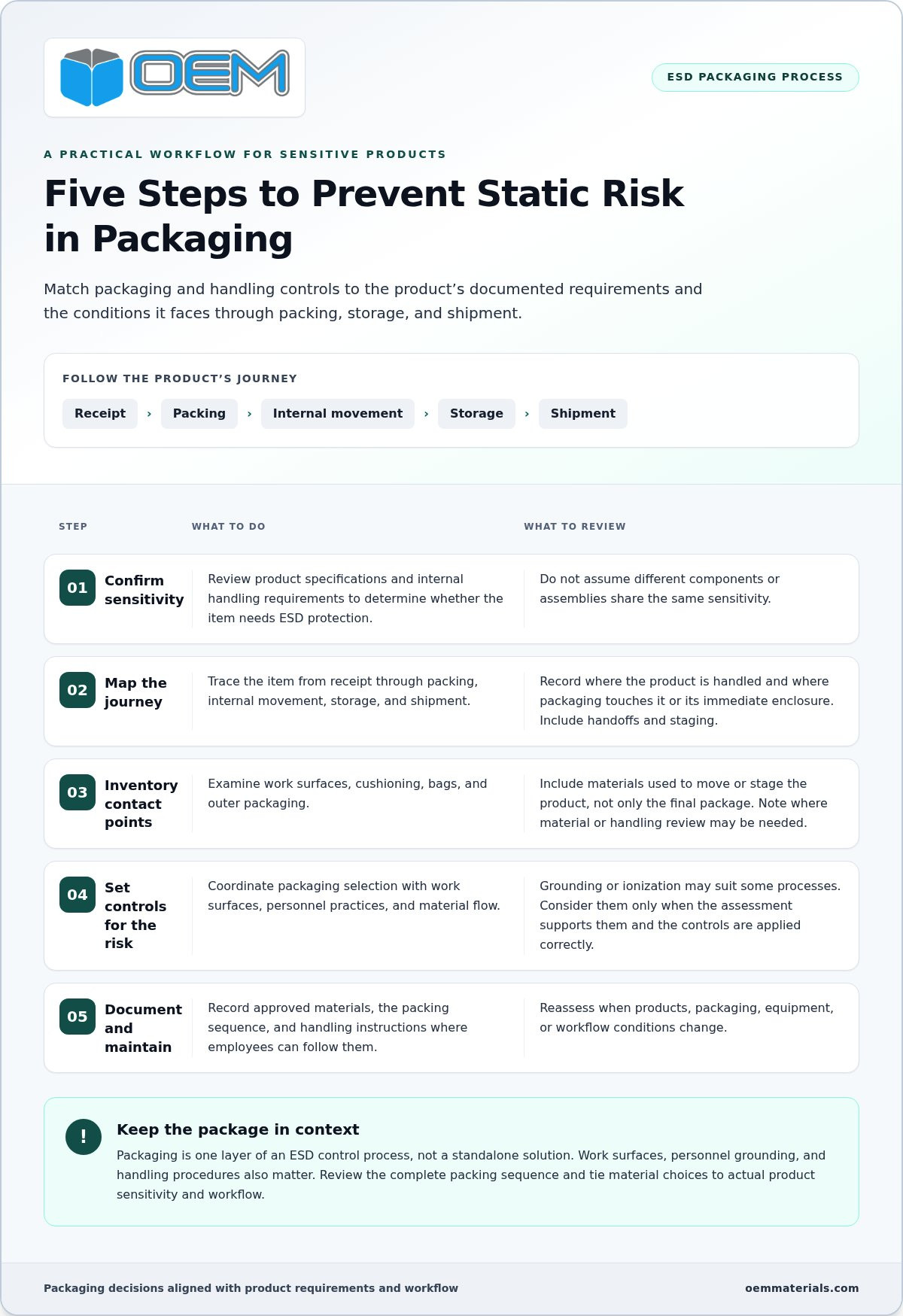
A repeatable process starts with the product and the way it moves through your operation. Use these steps to identify exposure points, set practical controls, and keep packaging decisions aligned with production and shipping requirements.
- Step 1: Confirm product sensitivity. Review product specifications and internal handling requirements to determine whether the item needs ESD protection. Don’t assume different components or assemblies share the same sensitivity.
- Step 2: Map the packaging journey. Trace the item from receipt through packing, internal movement, storage, and shipment. Record where the product is handled and where packaging touches it or its immediate enclosure.
- Step 3: Inventory contact points. Examine work surfaces, cushioning, bags, and outer packaging. Include materials used to move or stage the product, not just the final package. This inventory can reveal where materials or handling steps need review.
- Step 4: Set controls for the identified risk. Coordinate packaging selection with work surfaces, personnel practices, and material flow. Grounding or ionization may be appropriate in some processes, but consider them only when the assessment supports them and the controls are applied correctly.
- Step 5: Document and maintain the process. Record approved materials, packing sequence, and handling instructions where employees can follow them. Reassess the process when products, packaging, equipment, or workflow conditions change.
Assess product sensitivity and the packaging journey
Begin with documented product requirements rather than assumptions based on appearance or product category. Then walk the actual process, observing handoffs, staging, and packing tasks. A component that stays protected inside an assembly may have different contact points from one handled individually. Mapping these details ties the packaging choice to real operating conditions.
Build static control into the packing process
Review the packing station as a system. Consider how people handle the item, where materials are stored, and how packaging moves through the work area. Avoid adding controls without understanding the process they are meant to address. Qualified ESD personnel can help evaluate proposed measures against current technical guidance and the product’s requirements.
Packaging design can translate a risk assessment into a consistent packing sequence. OEM Materials & Supplies provides custom packaging solutions coordinated around product geometry and workflow. To discuss a configuration, share your product and packing requirements. A documented process makes preventing static electricity in packaging easier to maintain as products and operations evolve.
Antistatic vs. Dissipative vs. Conductive Packaging: What Is the Difference?
Packaging terms describe different electrical behaviors, not a universal level of product protection. A material’s label alone doesn’t establish that it’s suitable for a specific component, packing step, or shipping environment. Selection should account for product sensitivity, whether the material contacts the product or forms an outer enclosure, and how the package will be used.
| Material type | General function | Selection consideration |
|---|---|---|
| Antistatic | Helps reduce the generation or accumulation of static charge on the material. | Low charge generation alone doesn’t mean the material shields a product from an external discharge. |
| Dissipative | Allows charge to move across or through the material in a controlled manner. | Its role depends on the packaging configuration and the product’s handling requirements. |
| Conductive | Allows charge to move readily through the material. | Conductivity isn’t automatically appropriate for every product, contact point, or workflow. |
What antistatic packaging does and does not mean
Antistatic properties address charge generation or buildup on a material. They don’t, by themselves, establish that packaging provides shielding from an external electrostatic discharge. Depending on the product’s sensitivity and exposure during handling or transit, a low-charging contact material may not be enough. Consider the bag, cushioning, and outer package as a system, along with the packing process.
When dissipative or conductive materials may be considered
Dissipative materials can support controlled charge movement, while conductive materials allow charge to move more readily. Neither category is a universal substitute for the other. A conductive surface placed in direct contact with a product, for example, may not fit the intended application. Base the decision on the product’s requirements and the role each material plays in the package.
For products that need cushioning as well as electrical considerations, custom foam packaging can be designed around product geometry and packing needs. Cushioning is only one part of the protection system, so coordinate it with the rest of the package and handling controls.
Preventing static electricity in packaging means selecting materials by function, not by label alone. Packaging design support can help align contact materials, cushioning, enclosure, and packing steps with the product’s intended use. A coordinated design makes material choices clearer and the approved process easier to follow.
How to Reduce Static Risk During Packing, Storage, and Shipping
Static controls need to work at the packing station and remain effective through storage and transit. Operations teams can review a few practical points to keep the approved process clear and reduce unplanned material substitutions.
Packing station and material handling controls
- Identify approved packaging. Label or stage specified materials so employees can distinguish them from unapproved alternatives. A last-minute swap in a bag, cushioning material, or work surface can change how the package performs.
- Review the workstation. Include work surfaces, equipment, material flow, and personnel practices in the ESD control process. Keep the packing sequence straightforward so each handoff and contact point is understood.
- Store materials as specified. Protect packaging from damage or contamination and keep approved materials separate from substitutions awaiting review.
- Apply controls deliberately. Monitoring or ionization may be considered when the documented control plan supports their use. Don’t add them as isolated fixes without assessing the station and validating the approach.
Protect products through storage and shipment
Define the package from the product outward. First specify how the item is enclosed or otherwise protected before adding cushioning. Then select cushioning to support the product during handling and movement, followed by an outer package suited to storage and shipment. Each layer has a role, and the combination should be evaluated as a system rather than as a collection of separate materials.
Static control isn’t the only shipping requirement. Product fit, vibration, impact, and handling also shape the design. A loose fit can allow movement, while an unsuitable packing sequence can make the intended protection steps harder to follow. Custom packaging design can coordinate the enclosure, cushioning, and outer package with the product and workflow.
Keep approved materials and the packing sequence documented where the team can use them. Review the process before changing a material or packaging step, and reassess it when product, storage, or shipment conditions change. This makes preventing static electricity in packaging part of routine operations, not a separate task remembered only during troubleshooting.
For packaging recommendations tailored to your product and shipping requirements, request a packaging quote with product dimensions, weight, and annual usage.
How Packaging Design Helps Make Static Prevention Repeatable
Static controls are easier to apply consistently when they’re built into the package and packing sequence, rather than left to individual judgment at the workstation. Product geometry, ESD handling requirements, cushioning needs, and shipping conditions all influence the design. A package for a component handled individually may need a different sequence and material arrangement from one used to protect an assembly inside a larger unit.
OEM Materials & Supplies provides custom packaging solutions, including corrugated boxes and foam packaging, for industrial manufacturers. Coordinating these elements helps align the product enclosure, cushioning, and outer package with the documented process.
What information helps define a packaging solution?
Start with the product and its journey. Useful project details include:
- Product dimensions, weight, shape, and fragility
- Relevant ESD handling requirements and points of contact during packing
- The packing sequence, including how the product is enclosed before cushioning and boxing
- Shipment route and expected handling, storage, and transit conditions
- Annual usage or production needs to inform material and supply planning
These details connect the protective design to the actual workflow. For example, the package must accommodate the product’s geometry while allowing operators to place it in the correct orientation and follow the intended sequence. Planning around annual usage can also help purchasing and operations teams coordinate packaging requirements without assuming a particular cost outcome.
Turn the packaging specification into an operating process
Once materials and configuration are selected, document the approved components and packing instructions in a format that works for operators and purchasing teams. Clear specifications reduce ambiguity during replenishment and help prevent unreviewed material substitutions. Include the order of packing steps and any handling requirements relevant to the product.
Review the design when the product changes, a packing step is revised, or shipping conditions shift. A package that fits an earlier configuration may no longer support the same process. Custom packaging design can bring product fit, material coordination, and production requirements into one plan.
For a packaging quote or consultation, share your project details, including product dimensions, weight, fragility, relevant ESD requirements, and annual usage. This information gives the packaging team a practical basis for developing a solution aligned with your product and workflow.
Make Static Protection Part of Your Packaging Process
Reliable static control starts with understanding the product’s sensitivity and tracing how it’s handled from packing through shipment. Antistatic, dissipative, and conductive describe different functions, so select packaging based on its role in the complete system. Pair those materials with clear handling steps, and document approved specifications so the process stays consistent as products or workflows change.
Preventing static electricity in packaging is a coordinated design and operations decision, not a single-material fix. OEM Materials & Supplies provides custom packaging design and manufacturing for electronics and other industrial sectors, serving manufacturers in Orange County, Los Angeles, San Diego, Riverside, and across the United States.
Share your product dimensions, weight, and annual usage to start a practical packaging review. Request a packaging quote or consultation to discuss a process that fits your product and workflow.
Frequently Asked Questions
Is antistatic packaging enough to protect sensitive electronics?
Not necessarily. Antistatic materials can help reduce charge generation or accumulation, but that doesn’t automatically mean they shield a product from electrostatic discharge. Protection depends on the product’s requirements, the packaging layers, and the handling process. Base material selection on applicable technical requirements and the complete package configuration, not on an antistatic label alone.
What is the difference between antistatic and ESD packaging?
Antistatic describes a material property related to reducing static charge generation or accumulation. ESD packaging is a broader term for packaging selected to help control electrostatic risks for a particular product and process. The terms aren’t interchangeable guarantees. Define the packaging need based on product sensitivity, contact points, and handling conditions, then verify the material choice against current technical guidance.
Can regular foam packaging cause static electricity?
Some materials and handling conditions can contribute to charge generation, but the word “foam” alone doesn’t determine suitability. Material composition, contact, movement, and product sensitivity all matter. Don’t assume that ordinary cushioning provides ESD protection based on its appearance or a generic material label. Select cushioning and other packaging materials according to product requirements and the full packing process, including storage and shipment.
How do I choose packaging for ESD-sensitive electronics?
Start with the product’s handling requirements and identify every material that contacts or surrounds it. Compare material functions, then account for packing steps, storage, and shipment conditions. Review the complete package rather than choosing a bag, foam, or box in isolation. Manufacturers in Orange County, Los Angeles, San Diego, and Riverside can use these details to develop packaging that fits their product and workflow.
Do I need an ionizer to prevent static electricity in packaging?
Not in every operation. The need depends on the process, materials, work area, and product sensitivity. Ionization may be considered as one control when an assessment indicates it’s appropriate, but it doesn’t replace suitable packaging or other process controls. Have qualified personnel evaluate the application and verify the approach against current ESD guidance before incorporating equipment into routine packaging operations.
How can static electricity be reduced during packaging and shipping?
Assess product sensitivity first, then review material contact points from packing through shipment. Select packaging for the product, control substitutions, and document repeatable handling steps. Include workstation and personnel practices in the wider ESD process. Evaluate the assembled package for both static-related requirements and physical protection before adopting it for routine use, and review the specification when products or workflows change.
Does corrugated packaging prevent electrostatic discharge?
Corrugated packaging provides an outer container, but it shouldn’t be assumed to provide ESD protection on its own. The product enclosure, interior packaging, and handling process all contribute to how static-related risks are managed. Select the outer box as part of a complete package design that accounts for cushioning and shipment needs, and verify any ESD-related material claims against reliable technical documentation.
For packaging support tailored to your product and workflow, contact OEM Materials & Supplies with your product dimensions, weight, and annual usage. Request a packaging quote or consultation to discuss the next steps.