

A low quote does not show whether a packaging vendor can protect your product or support production. Use a qualifying a new packaging vendor checklist to look beyond unit price and compare the evidence behind each supplier’s proposal.
Quotes can differ in design scope, quality controls, service, and inventory support. If those differences go unnoticed, packaging defects may lead to product damage, rework, or shipment delays. A structured review helps identify gaps before you expand the relationship.
This guide covers packaging fit, quality controls, supply reliability, and implementation readiness. Define requirements, review samples under relevant operating conditions, assess how specifications and changing volumes are managed, and document the results. The goal is to confirm production fit before broader adoption and reduce avoidable sourcing, quality, and continuity risks.
Key Takeaways
- Compare operational evidence, not just quoted prices, when reviewing a new packaging vendor.
- Confirm that specifications capture product dimensions, pack configuration, and handling requirements before reviewing prototypes.
- Assess how the vendor manages specifications, material checks, production quality, and nonconformances.
- Map delivery points, receiving constraints, storage capacity, and replenishment responsibilities to your operation.
- Record evidence, risks, owners, and approval conditions in a scorecard to support a clear vendor decision.
Why qualify a new packaging vendor before approving production?
Packaging defects can damage products, trigger rework, slow packing, and interrupt shipments. A quote review cannot show whether a package fits your product, whether production checks can hold the specification, or whether replenishment can keep pace with demand. Qualification tests these requirements using documented evidence, not price or capability claims alone.
Set the review scope first. You might qualify one component, such as a corrugated box or foam insert, packaging for a product family, or a broader program covering several items and delivery locations. The right scope depends on product sensitivity, shipping conditions, and the consequences of a failure. Packaging for a fragile assembly moving through multiple handling steps may need more evaluation than a low-impact item used in a stable process.
A structured review also helps procurement, engineering, quality, and operations assess the same requirements. This aligns with Supplier Relationship Management, which considers supplier performance and collaboration beyond the initial purchase.
Which packaging and business risks should the review cover?
Start with the product and its journey. Record dimensions and weight, identify fragile or sensitive areas, and describe how the item is handled during packing, storage, and shipment. Note the current pack configuration and constraints such as loading, movement, and receiving.
Then document the problems the new supplier is expected to address. These may include product damage, labor-intensive packing, inconsistent pack quality, or inventory shortages. Include production volume, demand variability, and replenishment needs. A supplier supporting a variable production schedule needs to understand how demand changes affect packaging availability, not just the initial order quantity.
What belongs in a packaging vendor qualification record?
Keep a traceable record of requirements, supplier contacts, evidence reviewed, findings, approval decisions, and unresolved actions. Separate mandatory requirements from preferences. A specified pack configuration might be mandatory, while a proposed improvement to packing convenience might be a preference. This keeps an optional feature from obscuring an unmet requirement.
Assign an owner to each review area. Procurement can track commercial and supply information, engineering can review design and fit, quality can assess controls and issue handling, and operations can evaluate packing and receiving. Record evidence against each requirement rather than relying on a general impression from a meeting. For a Southern California program spanning Los Angeles and Orange County facilities, document delivery and replenishment needs by location. If delivery timing is part of the operating plan, define how just-in-time packaging delivery fits the workflow and who owns replenishment decisions.
Packaging vendor checklist: confirm design and production fit
A package can look right on a drawing and still create problems on the line. Confirm that its design fits the product, packing process, and production requirements. A practical qualifying a new packaging vendor checklist makes these questions reviewable, rather than relying on a sample or sales discussion alone.
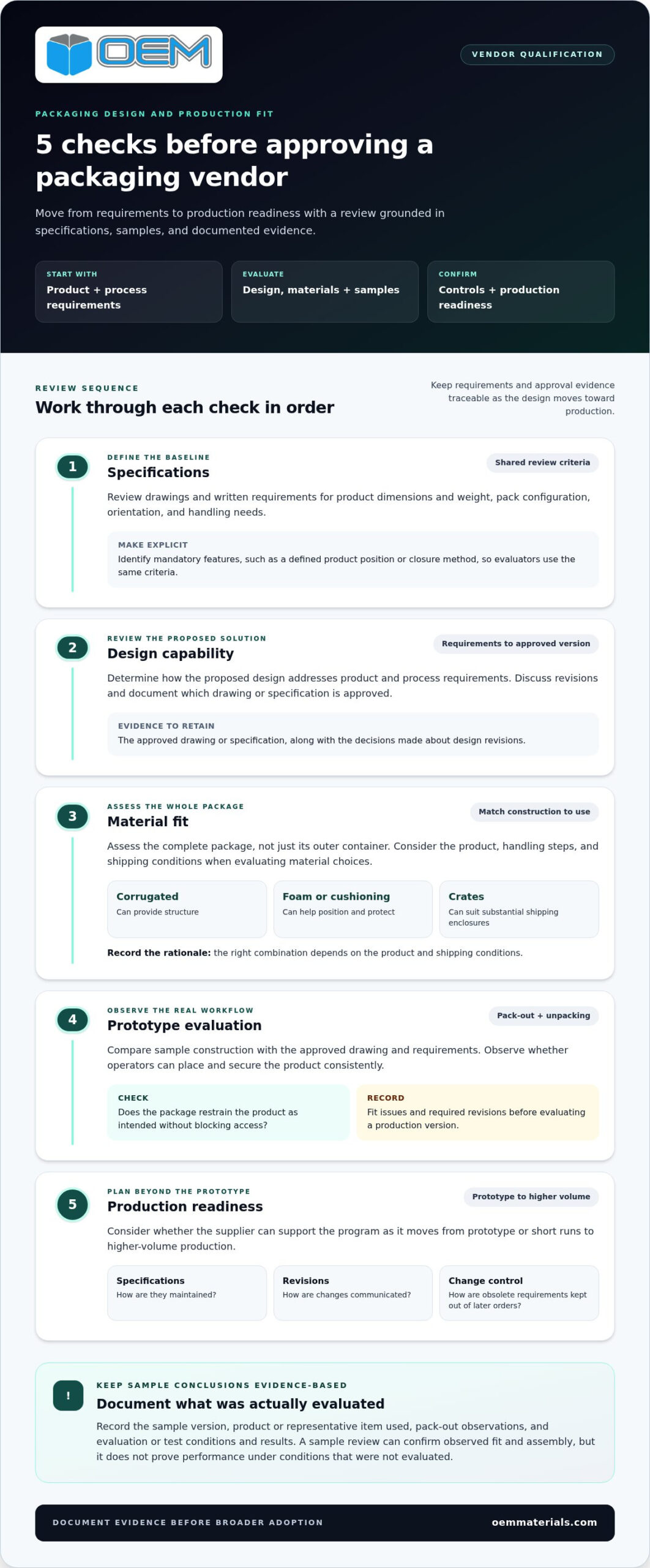
Work through these five checks:
1. Specifications. Review drawings and written requirements for product dimensions and weight, pack configuration, orientation, and handling needs. Identify mandatory features, such as a defined product position or closure method, so evaluators use the same criteria.
2. Design capability. Determine how the proposed design addresses product and process requirements. Discuss revisions and document which drawing or specification is approved. Custom packaging design services can support collaboration on packaging suited to a product and its handling needs.
3. Material fit. Assess the complete package, not just its outer container. Corrugated can provide structure, while foam or other cushioning can help position and protect a product. Crates can suit products that need a more substantial shipping enclosure. The right combination depends on the product and shipping conditions, so record the rationale instead of assuming one material fits every application.
4. Prototype evaluation. Compare the sample’s construction with the approved drawing and requirements. Observe pack-out and unpacking: Can operators place and secure the product consistently? Does the package restrain it as intended without blocking access? Record fit issues and required revisions before evaluating a production version.
5. Production readiness. Consider whether the supplier can support the program as it moves from prototype or short runs to higher-volume production. Review how specifications are maintained, revisions are communicated, and changes are controlled so obsolete requirements do not carry into later orders.
How should buyers validate packaging design and samples?
Evaluate samples under conditions relevant to the intended workflow. Record the sample version, product or representative item used, pack-out observations, and any evaluation or test conditions and results. Keep conclusions within the evidence: a sample review can confirm observed fit and assembly, but it does not prove performance under conditions that were not evaluated.
How do material and production capabilities affect fit?
Match construction to the product, handling steps, and shipping environment. Ask how design changes are approved and how updated specifications reach production staff. A supplier that supports prototypes through higher-volume programs can help maintain design continuity as requirements evolve. Still, document the production needs and approval evidence for the specific program.
For a design review, provide product dimensions, weight, pack configuration, and known handling or shipping requirements through the request-a-quote form.
How to assess quality controls, service, and supply reliability
Evaluate what the supplier can demonstrate, not only what it says it can do. For each important requirement, record the evidence reviewed, your finding, and who owns any follow-up. This makes the quality and service portion of a qualifying a new packaging vendor checklist consistent across suppliers and useful after approval.
Use a comparison table to guide discussions. Tailor the questions to your program, and distinguish evidence received from actions still open.
| Evidence to review | Buyer questions | Findings to record | Follow-up owner |
|---|---|---|---|
| Specifications and revision records | How does production identify the current approved packaging specification? | Document control method, revision reviewed, and any gaps | Engineering or quality |
| Incoming material and production checks | What checks are performed, and how are results recorded? | Records reviewed, check points, and unresolved questions | Quality |
| Sample approvals and corrective actions | How are sample approval, deviations, and corrective actions documented? | Approval evidence, examples reviewed, and open actions | Quality or engineering |
| Order and replenishment communication | How are order status, demand changes, and potential interruptions communicated? | Contacts, escalation path, and fit with service requirements | Procurement or operations |
What quality evidence should a buyer review?
Review records relevant to the packaging being qualified, such as inspection documentation, sample approvals, and corrective actions. Confirm that production staff can identify the applicable specification at the point of use. Ask how deviations, material substitutions, and design changes are escalated, who approves them, and how affected orders are handled. Record what you reviewed, and do not treat a verbal assurance as equivalent to documented evidence.
How can buyers evaluate service and continuity?
Assess routine communication and exception handling. Discuss order visibility, replenishment updates, and the person responsible for escalating an issue. Review how the supplier responds to demand changes or a potential supply interruption, then compare those processes with your requirements. If several locations depend on the same packaging item, clarify how demand changes are communicated and coordinated across the program.
Keep the review specific to your project. A quality process, service commitment, or continuity plan is useful only if it addresses your requirements. Note evidence gaps, assign an owner and due action, and carry unresolved items into the approval decision instead of assuming they will be addressed after production starts.
Check operational fit, inventory support, and Southern California service
A technically sound packaging program can still create friction if deliveries arrive at the wrong location, stock has nowhere to go, or replenishment ownership is unclear. Evaluate the supplier’s operating model against your workflow. For operations in Southern California, assess each facility in Orange County, Los Angeles County, the Inland Empire, or San Diego County separately. Shared geography does not mean shared receiving capacity or service needs.
Map every ship-to point in scope. Record delivery windows, receiving contacts, unloading requirements, storage limits, and how packaging moves from receiving to point of use. Note which team monitors inventory, who initiates replenishment, and how order changes are communicated. These details make the operational portion of a qualifying a new packaging vendor checklist actionable, rather than a general statement that a supplier can support delivery.
When should VMI, JIT, kitting, or assembly be part of qualification?
Include these services when they address a defined workflow issue. With vendor-managed inventory, establish who monitors stock, what triggers replenishment, and how inventory status and exceptions are shared. Evaluate VMI against your stocking responsibilities and communication process, rather than treating it as a substitute for defining them.
For just-in-time delivery, compare the plan with production schedules, receiving capacity, and the consequences of missed replenishment. Just-in-time packaging should fit the operation’s timing and handling requirements. For kitting or assembly, map each step to the line or pack-out process. Confirm which components must be grouped, how completed kits are identified, and where assembly can reduce handling or improve consistency. Record the responsibilities that remain with your team.
How should location and delivery needs shape the review?
Build a delivery profile for each location instead of assuming one plan will work across all sites. An Orange County facility may have different receiving hours, storage capacity, or unloading constraints than a Los Angeles County warehouse or an Inland Empire production site. Include San Diego County if it is part of the program. Assign a receiving contact and escalation owner at each destination so delivery issues have a clear route to resolution.
For a nationwide program, capture the locations in the qualification scope and the coordination required between them. Compare proposed order visibility, replenishment communication, and exception handling with internal requirements. Keep assumptions visible, especially if demand varies by site or shipments serve different production schedules.
To discuss packaging supply support for your facility workflow, request a packaging quote with your delivery locations, usage patterns, and receiving requirements.
Use a qualification scorecard to approve a packaging vendor
A documented scorecard turns review findings into a clear approval decision. Start by defining the scope, such as a single packaging component, a product family, or a broader supply program. Agree on the requirements and approved specification that will guide evaluation. Apply the same criteria and evidence categories to each candidate so the decision reflects comparable information rather than different assumptions.
For each requirement, record the evidence reviewed, the risk if it is not met, the responsible owner, and the decision. Include open actions and due dates so unresolved issues remain visible. For example, log missing inspection evidence as an open action with an assigned owner, rather than allowing a strong overall impression of the supplier to obscure it.
- Requirement: State the buyer’s defined need and identify whether it is mandatory or preferred.
- Evidence: Reference the specification, sample review, record, or other documentation considered.
- Risk: Describe the operational consequence if the requirement is not met.
- Owner: Assign responsibility for evaluating evidence or closing an action.
- Decision: Record pass, conditional approval, or unresolved action, with the basis for the outcome.
How can procurement compare vendors consistently?
Apply the same requirements to each candidate, then weight them according to product risk and operational importance. A requirement tied directly to product protection may carry more weight than a preference for a particular ordering process. Set weighting rules before comparing results. Record exceptions separately, including their risk, approval owner, and next action. A combined score can organize findings, but it should not replace review of unmet mandatory requirements.
What information helps start a packaging review?
Before requesting a project review, gather product dimensions and weight, current packaging, and annual usage when available. Add shipping conditions, pack-out steps, delivery locations, and known damage or labor concerns. These details help frame a relevant discussion about design, production fit, and supply needs. If information is unavailable, identify the gap so the review distinguishes confirmed requirements from assumptions.
Approval should follow your defined criteria. A pass means mandatory requirements have been met with reviewed evidence. Use conditional approval when a controlled next step is acceptable, with conditions, owners, and closure criteria documented. An unresolved action means a decision-critical requirement still needs evidence or review. Do not treat it as approval by default.
Before broader adoption, align on the approved specification and scope, then review initial production against your acceptance criteria. Record findings and any corrective actions before expanding the program. To discuss packaging requirements or request a project-specific review, request a packaging quote or project review and share product dimensions, weight, current packaging, and annual usage when available.
Turn vendor approval into a controlled rollout
Vendor approval is a starting point, not the end of the review. Treat your qualifying a new packaging vendor checklist as a working record. Update it when requirements change, document what initial production shows, and use those findings to guide future purchasing decisions. This keeps the approved package and supplier’s role aligned as the program develops.
OEM Materials & Supplies supports packaging projects from prototypes through high-volume production, with custom packaging design, kitting, assembly, vendor-managed inventory, and just-in-time delivery. The company serves manufacturers in Southern California and customers across the United States. A useful project discussion starts with your product requirements and operating conditions, so recommendations reflect the application rather than a generic package.
Bring forward the requirements that matter most, including product dimensions, weight, current packaging, and known production or shipping concerns. Request a quote or packaging project review to discuss your application and next steps. A documented qualification process helps your team make a clear, evidence-based approval decision.
Frequently Asked Questions
What should a packaging vendor qualification checklist include?
A qualifying a new packaging vendor checklist should connect packaging requirements to evidence and a decision. Include the package’s intended use, approved drawings or specifications, sample evaluation, applicable quality records, order and replenishment needs, and open actions with owners. Add a field for exceptions so deviations from requirements are visible and addressed rather than lost in a general approval note.
How do you evaluate a packaging supplier before placing a production order?
Evaluate the supplier against a defined scope and the conditions the package will face. Review a representative sample with the product or an appropriate substitute, observe pack-out, and document fit or handling issues. Before placing a production order, align internally on the approved version and how initial production will be reviewed. This creates a controlled first step without treating an untested assumption as proven performance.
What documents should a new packaging vendor provide?
Request records relevant to the specific program, such as current drawings or specifications, sample approval documentation, inspection records, and examples of how deviations or corrective actions are recorded. For ongoing supply, document order contacts and the process for communicating changes or replenishment needs. The record set should reflect your quality process and product risk, rather than assuming every program requires identical documents.
How can a buyer verify packaging quality before approving a vendor?
Compare a sample with the approved design and check it through the actual packing sequence. Confirm that operators can load, secure, and remove the product as intended, then document observations and any required changes. If testing is part of your approval process, record the conditions and results. A passing sample review supports only the conditions evaluated, so do not extend the conclusion beyond the evidence.
When should a manufacturer use vendor-managed inventory for packaging?
Consider vendor-managed inventory when recurring packaging demand makes stock monitoring and replenishment coordination an operational burden. Before adopting it, define who reviews inventory, what triggers replenishment, how exceptions are communicated, and who remains accountable for availability at the point of use. It may be less suitable when usage is highly irregular or storage responsibilities are unclear, so assess the arrangement against actual consumption patterns.
Can one packaging vendor support prototypes and high-volume production?
Yes. OEM Materials & Supplies supports packaging projects from prototypes through high-volume production programs. During qualification, map how an approved design moves into production, how revisions are handled, and how requirements stay aligned as volumes change. This is relevant for manufacturers in Orange County, Los Angeles, San Diego, and Riverside planning a program that may expand beyond its initial run.
How much does it cost to qualify a new packaging vendor?
There is no single qualification cost that applies to every program. The effort depends on review scope, internal staff time, prototype needs, and any evaluation or testing your process requires. Packaging recommendations and related costs also depend on product dimensions, materials, and shipping requirements. Define the evidence needed for approval, then request project-specific pricing for packaging work without assuming qualification itself has a standard fee.