

Reducing box material isn’t automatically a sustainability improvement. If a lighter corrugated box allows products to shift or requires more foam, stretch film, or repacking, the change may create new material use and operational costs. Finding sustainable corrugated packaging solutions starts with evaluating the complete package and how it performs through shipping and handling.
That assessment can be difficult when material use and waste aren’t tracked consistently, or when teams have limited data on damage, packing time, and shipping requirements. The goal isn’t simply to use less packaging. It’s to reduce unnecessary material while maintaining product protection and efficient operations.
This guide presents a repeatable audit framework for establishing a baseline, reviewing packaging components, and comparing design options against practical requirements. You’ll learn how to prioritize changes using measures such as material use, product damage, labor, and shipping fit, so recommendations reflect the demands of your products, warehouse, and distribution process.
Key Takeaways
- Build a consistent baseline by tracking packaging materials, weights, and use per shipment or packaged unit.
- Compare current packs with feasible redesigns across product protection, material use, packing steps, handling, and recovery.
- Assess sustainable corrugated packaging solutions as part of the full packaging mix, including cushioning and other components.
- Rank proposed changes by operational relevance, supporting evidence, implementation effort, and risk.
- Test a prioritized change on a representative product or shipment, then use the results to guide broader implementation.
Why Audit Sustainable Corrugated Packaging Before Changing Materials?
A packaging change can reduce one material and create problems elsewhere. A thinner box, for example, may use less corrugated material but allow a product to shift in transit, require additional cushioning, or take longer to pack. Before changing specifications, document how the current package protects the product, moves through the operation, and is handled at the end of its use.
A packaging sustainability audit is a documented review of materials, product protection, handling workflows, and end-of-life pathways. It gives procurement, engineering, and operations teams a shared record for assessing sustainable corrugated packaging solutions against actual shipping and facility requirements. The review should account for the complete package, including corrugated boxes, cushioning, protective components, and pallet-level materials where relevant.
Packaging reduction removes material; packaging optimization reduces unnecessary material while preserving protection and operational performance. That distinction matters because a material swap alone can miss product damage, added packing labor, changes to shipment fit, or new supply continuity concerns. A useful starting point is to record current operating conditions separately from proposed changes, so teams can distinguish measured baseline data from assumptions that still need testing. For broader context on sustainable packaging principles and lifecycle assessment, consider how material choices and end-of-life pathways fit within the full package rather than judging one component in isolation.
Which packaging and workflows belong in the audit?
Start with representative SKUs, packaging formats, and shipment profiles rather than treating every item as identical. Select products that reflect meaningful differences in size, fragility, pack-out steps, or shipping route. For each, record the box, cushioning, protective components, and pallet-level materials used, along with how the package is assembled, handled, and prepared for shipment.
Define the audit scope by product family, facility, shipping lane, and packaging format. A package used for outbound freight may face different handling and transit conditions than one used for an internal transfer. Keep the existing configuration and workflow as the baseline; document proposed designs in a separate record. This makes later comparisons more reliable and helps teams identify which conditions actually changed.
What should the audit aim to improve?
Set clear objectives before comparing alternatives. A team may prioritize material use, product protection, packing labor, or supply continuity, but should also state which requirements cannot be compromised. For example, a redesign that reduces box material still needs to fit the product, support established handling practices, and perform across its intended shipment profile. Evaluate operational effects alongside material changes.
Facility and distribution conditions can differ across Southern California, including between operations in Orange County, Los Angeles County, the Inland Empire, and San Diego County. Packing equipment, storage practices, shipment destinations, and replenishment needs may vary by site. If an audit identifies changes to packaging supply workflows, a just-in-time packaging program can be considered as part of maintaining supply continuity.
With objectives and scope documented, the audit can move from general sustainability goals to a practical baseline that teams can measure and compare.
How to Conduct a Packaging Sustainability Audit: Build a Reliable Baseline
A reliable audit depends on consistent records, not perfect data. Use the same measurement rules across selected product families, and keep the source and limits of each entry visible. Purchasing, engineering, warehouse, quality, and shipping teams each hold part of the picture: invoices show purchasing quantities, pack-out observations reveal labor steps, and quality records can help identify damage or rework. Bring these sources together before comparing packaging options.
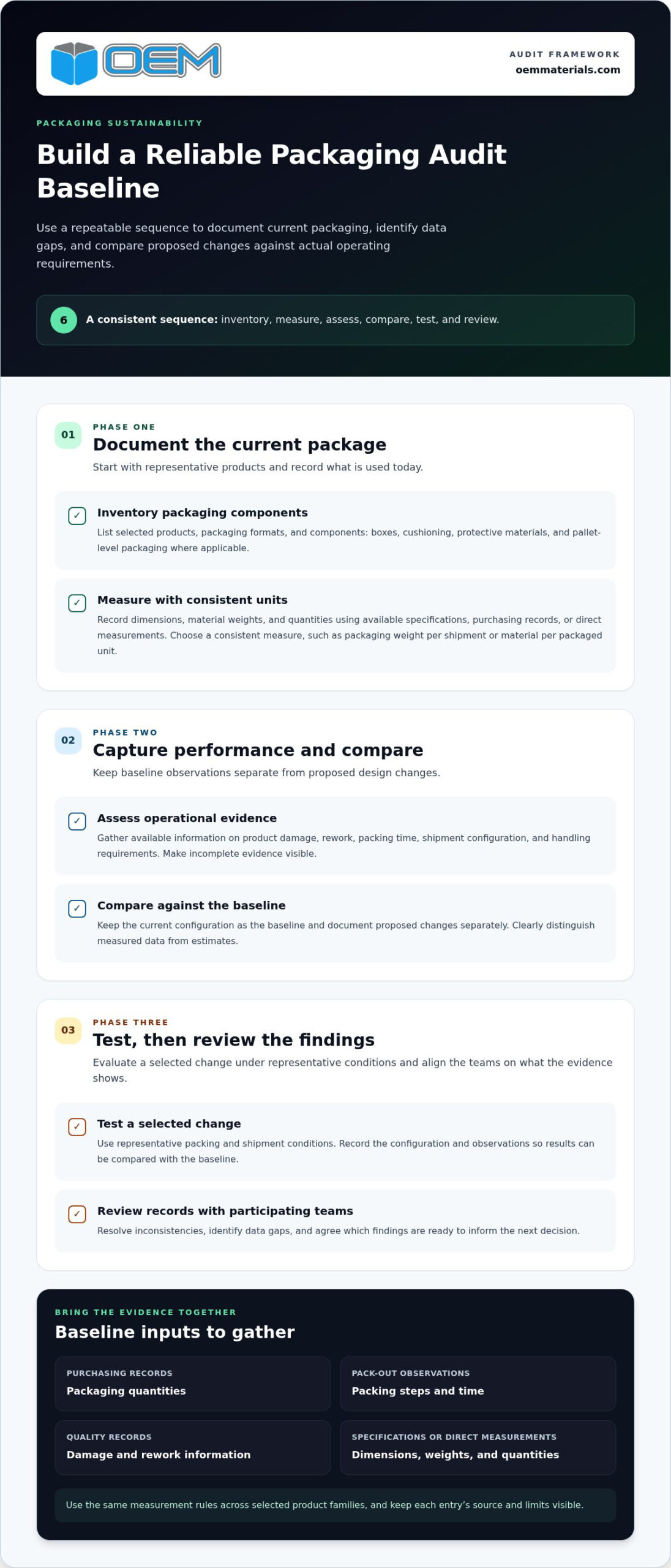
Use a repeatable sequence to build the baseline and move from records to decisions:
- Inventory: List selected products, packaging formats, and components, including boxes, cushioning, protective materials, and pallet-level packaging where applicable.
- Measure: Record dimensions, material weights, and quantities using available specifications, purchasing records, or direct measurements. Choose a consistent unit, such as packaging weight per shipment or material per packaged unit.
- Assess: Gather available information on product damage, rework, packing time, shipment configuration, and handling requirements. Note where evidence is incomplete.
- Compare: Establish the current configuration as the baseline, then document proposed changes separately. Keep measured data distinct from estimates.
- Test: Evaluate a selected change under representative packing and shipment conditions. Record the configuration and observations so the result can be compared with the baseline.
- Review: Bring the participating teams together to resolve inconsistencies, identify data gaps, and agree on which findings are ready to inform the next decision.
Which baseline measures help teams make comparisons?
Capture each packaging component’s description, dimensions, material weight, and quantity per packaged unit or shipment when those details are available. For example, record the box and cushioning separately rather than combining them into one package weight. This makes it easier to see which components account for material use and to compare a redesign without overlooking a change elsewhere in the pack-out.
Track damage, rework, packing time, and shipment configuration when operational records support those measures. Ask packaging suppliers for available information about material composition and recovery pathways. If a detail is unavailable, mark it as unknown instead of treating an estimate as verified data.
How can teams keep audit data comparable?
Use one unit of analysis for each product family, such as packaging per shipment or per packaged unit, and apply it consistently to current and proposed configurations. For every data point, record its source, measurement period, and limitations. A specification sheet, purchasing record, warehouse observation, and quality report may describe different conditions, so identify which one supports each entry.
Label measured results, estimates, and assumptions distinctly. If shipment weights come from a sample or packing times reflect a single workflow, state that limitation in the audit record. Clear labels help decision-makers judge evidence fairly and identify what should be measured before approving a change.
Once the baseline is organized, teams can use it to evaluate sustainable corrugated packaging solutions without confusing a material reduction with a verified operational result. If a potential redesign needs further definition, share the packaging requirements for a project-specific quote.
How to Compare Corrugated Packaging Options Without Increasing Risk
Compare packaging configurations against the same product, handling process, and shipment profile. A smaller box may reduce corrugated material but leave too little room for protective cushioning. A different pack-out may protect the product yet add labor or complicate pallet handling. Use the audit baseline to compare the full system, not a single material in isolation.
A side-by-side review can make trade-offs visible:
| Criterion | What to compare |
|---|---|
| Protection | Fit, cushioning arrangement, observed damage, and transit requirements. |
| Material use | Components and material weights per packaged unit or shipment. |
| Pack-out | Assembly steps, packing time, and ease of consistent assembly. |
| Handling | How the package moves through the facility and fits the shipment configuration. |
| Recovery | Material-specific information about composition and available recovery pathways. |
Compare the current pack with feasible corrugated redesigns and relevant cushioning configurations. Keep recorded results separate from assumptions, and don’t claim a lower environmental impact unless the options have comparable, supportable information. Recycled content and recyclability are separate questions: document evidence for each material and component rather than treating one as proof of the other. A corrugated box, foam insert, tape, and stretch film can have different composition and recovery information.
When might a corrugated redesign improve the packaging system?
Review box dimensions, product fit, assembly, and material use against actual protection and transit needs. If a standard format leaves avoidable void, requires extra cushioning, or creates awkward handling, a custom design may address those issues. The right comparison still depends on pack-out consistency and product performance, not just the box dimensions. OEM’s corrugated box options provide a reference point for evaluating formats and design needs.
How should teams compare protective materials and shipping formats?
Assess cushioning and foam according to product sensitivity and observed shipping risks. A configuration that works for one product family may not suit another, so compare each option with the same product and shipment conditions. Include pallet wrapping and shipment stability when they affect the audited route. For example, changing a box while retaining the same pallet configuration may leave a handling issue unresolved.
Record what each configuration is designed to protect against, how it is packed, and what materials it uses. Where evidence is incomplete, identify the gap rather than assigning an assumed performance or recovery benefit. This gives engineering, quality, and operations teams a clear basis for deciding which options are ready for testing.
Turn Audit Findings Into a Test Plan and Trackable Actions
An audit becomes useful when its findings lead to controlled decisions. Rank each opportunity by four factors: expected operational relevance, evidence quality, implementation effort, and risk. A change supported by clear measurements and manageable risk may be ready for a trial. An idea based mainly on estimates, or one that could affect product protection, needs more evidence before implementation.
For each proposed change, record the reason for testing, the expected outcome, and the measures that will determine whether it works. This keeps the trial focused on an operational question, such as whether a revised box uses less material without adding packing steps or compromising product condition.
How can a packaging trial protect product and process performance?
Set acceptance criteria before the trial begins. Define acceptable product condition, required packing steps, and shipment handling expectations using the existing baseline and quality requirements. Document the exact packaging configuration being tested, including corrugated components and cushioning, and note any differences in route, handling, or operating conditions that could affect the result.
Use a representative product or shipment, then gather feedback from warehouse, quality, shipping, and receiving teams. Their observations can reveal issues that a material measurement alone won’t show, such as a difficult pack-out or problems handling the shipment. Record deviations and unexpected results rather than treating them as noise.
How should teams keep improvements on track?
Assign an owner to each approved change, along with responsibility for updating specifications, work instructions, and packaging records. Agree on who will monitor results and when the team will review them. This creates accountability after the trial and helps prevent an approved configuration from drifting as shifts, facilities, or purchasing practices change.
Use available records to monitor packaging use, damage indicators, and workflow impacts after implementation. Compare results against the original baseline using the same unit of analysis and document changes in operating conditions. If pallet wrapping is part of the opportunity, include stretch film use and shipment stability in the review. The stretch film options can be considered as part of the full pallet configuration, not as a stand-alone material decision.
Keep the review practical. If performance falls short, identify whether the issue came from the design, pack-out method, or changed shipment conditions before revising the specification. If the trial meets its criteria, document the approved configuration and the evidence behind the decision. This is how teams turn sustainable corrugated packaging solutions from proposals into changes that can be tracked and managed.
To develop a packaging option for a controlled trial, request a quote for a project-specific packaging review and include product dimensions, weight, and shipment requirements.
Apply Audit Findings With a Packaging Partner in Southern California
After the audit and trial, the next task is to turn the accepted results into a clear packaging brief. A packaging partner can help translate the team’s documented requirements into design decisions, review proposed revisions against trial findings, and organize the information needed for a production handoff. The brief should identify which requirements are essential and which changes remain subject to evaluation.
For manufacturers in Southern California, this process can account for differences between facilities, workflows, and distribution needs without assuming one configuration suits every operation. The objective is a project-specific path from audit evidence to an approved packaging specification, with the reasons for the decision kept visible to the teams that will use and manage it.
What project information supports a useful packaging recommendation?
Along with the audit record, provide relevant drawings or samples, the current package configuration, and the operating constraints that could affect a design. Explain how the item is packed and handled, what conditions the shipment encounters, and which trial criteria the proposed change must meet. Annual usage and inventory requirements can help frame the scope of a packaging project and its supply needs.
Point out unresolved data gaps or exceptions between facilities. That context helps keep recommendations tied to the evidence available and makes it easier to identify what still needs review before a specification is finalized.
How can OEM support packaging changes after the audit?
OEM Materials & Supplies can use custom packaging design to help align a packaging project with its documented objectives and operating requirements. The audit findings and trial results provide the basis for discussing design priorities, evaluating revisions, and defining what the production plan needs to address.
If the audit also identifies supply continuity as a concern, teams can consider inventory and delivery arrangements as part of implementation planning. Kitting or assembly may also be relevant when a packaging change affects how materials are prepared for the packing process. These are operational choices to assess against the project’s needs, not automatic environmental benefits.
To scope the next step, request a quote for your packaging project. Include product dimensions, weight, current configuration, and annual usage so the discussion can start with the requirements your audit identified.
Make the Next Packaging Decision Measurable
Use the audit’s decision criteria beyond the current project. Adding them to internal packaging specifications or future project briefs gives procurement, engineering, and operations teams a consistent basis for reviewing design proposals as product and supply needs evolve.
This makes the audit a practical reference for future decisions, not just a record of one completed review. Teams can identify which requirements remain essential, where evidence needs updating, and what should be evaluated before approving a packaging change. That discipline keeps sustainable corrugated packaging solutions connected to documented business and product requirements.
OEM Materials & Supplies can discuss packaging needs for industrial applications based on the project scope and the information available.
Request a quote for your packaging project to start a focused discussion about the next step. A clear project brief can help your team move from audit findings to a well-defined packaging decision.
Frequently Asked Questions
What is a packaging sustainability audit?
A packaging sustainability audit is a formal review used to guide packaging decisions and document their basis. To make its findings useful after the review, maintain a controlled record that identifies the applicable product and packaging revision, the decision owner, and any approval status. This helps teams distinguish current requirements from older specifications when a product or package changes, and keeps audit conclusions traceable during future design reviews.
How often should a company conduct a packaging sustainability audit?
Set the review cadence to match the company’s packaging change-control process rather than choosing an interval without an operational reason. A review can be scheduled alongside product or packaging specification updates, with an additional assessment if a change affects the package’s intended use. This approach helps keep records relevant while avoiding unnecessary rework. If no changes occur, document that the existing configuration remains under review rather than implying new performance results.
Can corrugated packaging be made more sustainable without reducing protection?
Yes, a design may use material more effectively while still meeting the product’s protection needs, but the result depends on the package and its use. Consider the interaction between box fit, cushioning placement, and how the package is handled, rather than removing material by default. A design that works for one product or route may not transfer to another. Treat each configuration as specific to its intended application.
What data should a packaging sustainability audit collect?
Beyond operational measurements, maintain enough identifying information to connect each record to the correct product and packaging revision. A consistent SKU or product-family identifier, specification version, and effective date can prevent data from different configurations from being combined. Keep source documents with the audit record where practical, and note who supplied or verified each entry. This makes later reviews easier to trace without relying on staff memory.
How do you compare packaging sustainability options?
Make sure each option provides the same packaging function before comparing environmental attributes. For example, a package intended for a different handling method or shipment configuration is not a direct substitute, even if one component appears to use less material. Review evidence for the actual materials and configuration under consideration, and limit conclusions to what that evidence supports. This avoids treating broad material descriptions as proof of performance or environmental benefit.
Who should be involved in a packaging sustainability audit?
In addition to subject-matter contributors, assign one person to maintain the audit record and one decision owner to approve changes. This prevents unresolved comments from being mistaken for approval and clarifies who updates specifications after a decision. A simple sign-off record can note the change accepted, its effective date, and any conditions attached to the decision. That governance makes the process easier to sustain when responsibilities shift.