

A mailer that protects a product but slows the packing line isn’t a good fit. For custom corrugated mailers Orange County manufacturers can rely on, the design needs to account for the product, shipping conditions, and fulfillment workflow. If items shift in transit or employees struggle to pack them consistently, the packaging specification may need attention, not just the material.
Choosing the right format takes more than measuring a product. Mailers, boxes, and other packaging serve different needs, and a poor fit can add handling steps or leave products vulnerable during shipment. Supply planning matters, too, especially when packaging needs to stay aligned with production and order patterns.
This guide explains how to evaluate custom corrugated mailers for product dimensions and shipping demands, compare them with other packaging formats, and align the design with your packing workflow. It also covers the information to prepare for a quote or prototype, including how to assess a sample and plan for repeat orders.
Key Takeaways
- Match mailer design to the product, shipping journey, and packing process instead of choosing by format alone.
- Account for product dimensions and planned protective materials when establishing internal package dimensions.
- Compare corrugated mailers, boxes, and poly mailers based on product shape, enclosure needs, packing steps, and presentation.
- Prepare product, shipping, workflow, and order-pattern details to build a useful specification for custom corrugated mailers Orange County operations.
- Evaluate prototypes against the product and packing process, then use the approved specification to plan repeat orders.
When Custom Corrugated Mailers Make Sense for Orange County Shipments
Start with the shipment, not the packaging format. A suitable package must fit the item, suit its shipping journey, and work with the steps employees follow to pack and dispatch it. For buyers evaluating custom corrugated mailers Orange County operations, those factors help determine whether a mailer is practical or another format fits the job better.
Suitability depends on product geometry, fragility, shipping conditions, and handling. A compact component sent as an individual parcel may have different needs from a large assembly moving on a pallet. Define the shipping task first, then select a package format around it.
Which products and shipping workflows suit corrugated mailers?
A corrugated mailer may suit a compact product that benefits from a close-fitting corrugated enclosure. Electronics or manufactured components shipped as individual parcels can be candidates for evaluation, but the product and route determine whether the format is appropriate. A palletized shipment, oversized item, or load that needs a larger enclosure may call for a corrugated box, crate, or another packaging approach instead.
Review how each order moves through fulfillment. Does staff pack one unit at a time, combine components, or prepare shipments for pallet handling? Corrugated box design principles include structural and graphic considerations. The package should meet its functional requirements as well as any presentation goals.
What problem should the packaging solve?
Separate required protection from secondary goals. Protection needs relate to known exposure during storage, handling, and transit. Presentation goals may include a consistent branded appearance. Neither should distract from practical issues such as product movement inside the package or packing steps that slow fulfillment.
Review damage patterns and observe the current pack-out process. Note where movement occurs, where staff add materials, and which steps vary between employees or orders. These observations help define what a new design needs to change instead of assuming a different mailer alone will resolve the problem.
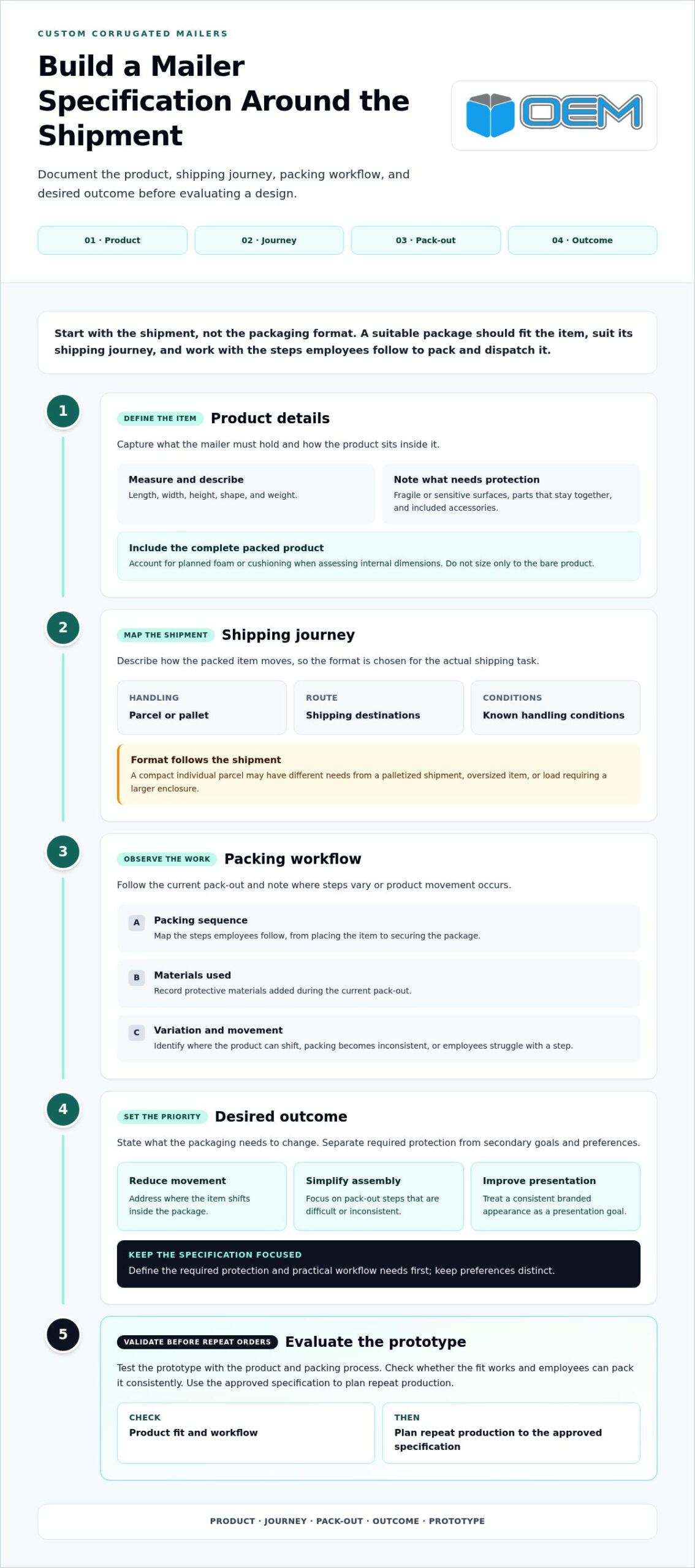
Before requesting a design, Orange County manufacturers can document the shipment in four areas:
- Product: Record its dimensions, shape, weight, fragility, and any parts that must remain together.
- Journey: Describe parcel or pallet handling, shipping destinations, and known handling conditions.
- Pack-out: Map the packing sequence, materials used, and points where the item can shift or packing becomes inconsistent.
- Outcome: Identify the priority, such as reducing movement, simplifying assembly, or improving presentation. Separate requirements from preferences.
This information gives packaging design a defined starting point. OEM Materials & Supplies supports custom packaging design for manufacturers in Orange County and throughout Southern California, aligning product requirements with the packing process. A prototype lets your team evaluate fit and workflow before moving the design into repeat production.
How Corrugated Mailer Design Balances Fit, Protection, and Packing
A custom corrugated mailer is a corrugated package designed around a product and the way it will be handled. Its dimensions, structure, and opening method should reflect both the item being shipped and the work required to prepare each order. A useful design balances those needs rather than treating package size as the only decision.
Accurate fit helps limit product movement, but the packaging design must also account for protective materials and the way employees assemble and close the package. That principle guides custom corrugated mailers Orange County manufacturers specify for products with defined shipping and fulfillment requirements.
Which dimensions and product details should inform the design?
Start with the product’s length, width, height, and weight. Record how it sits in the package, which surfaces are sensitive, and whether parts or accessories ship with it. Measure the actual item and include any planned foam or cushioning in the fit assessment. Internal dimensions need to accommodate the complete packed product, not just its bare dimensions.
Product variation matters. If a part changes between configurations or shipments include different combinations, one design may not serve every pack-out equally well. Document those differences before settling on a size. Then consider internal fit alongside external constraints, such as how the finished package must fit into an outer carton, storage location, or shipping process.
How do material and structure affect the package?
Corrugated board uses a shaped inner layer between outer liner layers. In a die-cut design, the board is cut and creased into panels and folds that assemble into the intended structure. The selected structure should suit the product and handling requirements. Evaluate the complete package against the actual application instead of assuming performance from the material name alone.
Closure and access affect daily use. Folds determine how the package takes shape, while the closure approach influences the steps employees follow to secure and open it. A design that requires awkward handling or varies from one packer to another can undermine an otherwise accurate fit. Review the assembly sequence with the team to identify where the structure could support a more consistent pack-out.
Foam or other cushioning may be appropriate when the product needs a separate protective element inside the corrugated enclosure. Include it in the design evaluation from the start because it takes up space and affects how the product sits. OEM Materials & Supplies can align custom packaging design with product requirements and packing steps, then develop a prototype for evaluation.
For a project review, prepare product dimensions, weight, configuration details, and a description of the packing sequence. Share your packaging requirements to begin discussing a design or prototype.
Custom Corrugated Mailers vs. Boxes and Poly Mailers
Choose a format based on the product and what the package must do. A compact, regularly shaped item may fit a corrugated mailer, while a product that needs more clearance or a larger enclosure may be better suited to a standard corrugated box. A flexible poly mailer is another option to evaluate when the item does not require a rigid enclosure.
| Format | Product shape and enclosure | Packing and presentation |
|---|---|---|
| Corrugated mailer | May suit compact products that fit a close corrugated enclosure. | Designed around a particular pack-out; presents the shipment in a structured package. |
| Standard corrugated box | Useful for varied shapes, larger items, or shipments that need more room around the product. | May require additional void fill and can provide room for multiple items or protective materials. |
| Poly mailer | Flexible format to consider when the product does not need a rigid enclosure. | Can involve a straightforward pack-out, but offers a different presentation and enclosure style from corrugated packaging. |
This is a format comparison, not a guarantee of protection. Protection depends on the complete package and its application, including the product, cushioning, closure, and handling conditions. The format name alone does not establish how a shipment will perform.
When is a corrugated mailer preferable to a standard box?
Consider the product geometry and the enclosure the shipment requires. A close-fitting mailer may suit a compact product that does not need much extra space. A standard box may be more appropriate for irregular shapes, multiple items, or a product that needs room for separate protective materials. If a stock box already fits the product and works with the packing process, a custom format may add little value.
Compare the actual pack-out before changing formats. Note how much space remains around the product, what materials fill that space, and whether the current package is easy to assemble. Do not assume a custom design will use less material or reduce costs. Any such result depends on product dimensions, materials, and shipping requirements.
When should a business consider a poly mailer or added cushioning?
Consider a flexible mailer for products that do not require a rigid enclosure, then assess the product’s sensitivity and shipping conditions separately. A fragile or sensitive item may need engineered cushioning even if the outer format seems suitable. Cushioning materials can be part of the package design when the product needs a separate protective element.
For a practical comparison, evaluate the formats using the same product and packing sequence. Check how the item sits, whether staff can pack it consistently, and whether the completed package suits the shipping method. For custom corrugated mailers Orange County buyers should weigh those observations against a stock option that already meets the job’s requirements. Choose the format that suits the application, not one based on a general assumption about material or cost.
How Orange County Buyers Can Build a Corrugated Mailer Specification
A clear project brief gives packaging design a practical starting point. For buyers considering custom corrugated mailers in Orange County, capture the product, shipping route, packing sequence, and expected order pattern before requesting a quote or prototype. These details help define the application and reduce guesswork during design review.
What information belongs in a mailer project brief?
Document the product’s dimensions, weight, quantity per shipment, fragility, orientation, and any sensitive surfaces. Include variations or configurations that could affect fit. Describe how employees pack the item, the preferred closure approach, and whether foam or other protective materials are part of the pack-out. This helps distinguish product requirements from preferences that can be considered during design.
Next, describe the shipping route and order pattern. Note whether shipments move individually or in larger consolidated loads, and share expected order frequency or annual usage when available. Identify the project stage, too. Are you evaluating an initial prototype, planning a short run, or preparing for repeat production? Prototype requirements and production needs can differ, so make both clear from the outset.
- Product: Dimensions, weight, quantity, orientation, fragility, and configuration changes.
- Shipping: Route, shipment type, handling conditions, and any outer-package constraints.
- Pack-out: Assembly steps, labor considerations, preferred closure, and protective materials.
- Supply plan: Prototype or production intent, order pattern, and estimated annual usage.
Material and cost recommendations depend on the product’s dimensions, chosen materials, and shipping requirements. A complete brief keeps those variables visible during design discussions, instead of comparing options without application context. Custom packaging design can help align the specification with product needs and the packing workflow.
How should buyers evaluate fit before scaling?
Review a prototype with the actual product and the people who pack it. Check how the item sits inside, whether the package closes as intended, and how each assembly step works at the packing station. Record product movement, awkward handling, and any difference between the intended pack-out and what warehouse users do in practice.
Use that feedback to refine the design before moving into repeat production. Confirm that the approved configuration reflects the product and packing steps used for regular orders, including any planned protective materials. A disciplined review helps purchasing and operations teams evaluate the same specification and plan supply around the expected order pattern.
To discuss a quote or prototype, send your product dimensions, weight, shipping requirements, and expected usage. These details give the packaging team useful context for reviewing the project.
Custom Corrugated Mailers from OEM Materials & Supplies
Packaging needs to work across design, fulfillment, and replenishment. OEM Materials & Supplies serves manufacturers in Orange County and throughout Southern California with custom corrugated and die-cut packaging, packaging design, and programs ranging from prototypes and short runs to high-volume production. This support helps teams evaluate packaging as part of an operating process, not as a standalone item.
That matters when a mailer must fit a specific product and work with established packing steps. Engineering, purchasing, and warehouse teams can bring their requirements into the same project discussion, helping align product protection, package assembly, and production planning.
How design and production support fit together
Design starts with the application: product details, handling requirements, shipping conditions, and pack-out workflow. Those inputs inform the structure of custom corrugated or die-cut packaging. A prototype gives the team a physical design to evaluate with the product and packing process before setting repeat production requirements. Feedback from that review can guide revisions before the specification is used for ongoing orders.
Some projects may call for a different corrugated format. For broader packaging needs, OEM Materials & Supplies also provides custom corrugated boxes. The right format depends on the product and shipment, so design decisions should follow the application rather than a preference for one package type.
For custom corrugated mailers Orange County manufacturers can develop through a coordinated program, prototypes and production planning can be considered together. A design that works at the prototype stage also needs a clear specification that purchasing and operations can use to plan repeat orders. Aligning those steps helps teams assess the package before scaling and communicate requirements consistently.
How ongoing supply programs support operations
Packaging is part of the work that happens before a product is ready to ship. Kitting and assembly can coordinate packaging with product preparation, bringing components or packaging steps together within the fulfillment workflow. Vendor-managed inventory can help coordinate packaging supply with operational demand.
These programs work best when shaped around how the business orders and uses packaging. Production volume, order patterns, storage considerations, and replenishment needs all inform the supply approach. Connecting those details to the approved package design helps operations and purchasing teams plan around a consistent specification rather than treating every order as a separate packaging decision.
To discuss a prototype or production program, share the product dimensions, weight, annual usage, and shipping requirements. Request a custom packaging quote to start a project discussion with OEM Materials & Supplies.
Put Your Mailer Requirements Into Action
Turn packaging observations into a project brief your team can use. Identify the product configuration to evaluate, the shipping conditions that matter, and the pack-out steps the design needs to support. This gives purchasing, engineering, and warehouse teams a shared basis for reviewing a prototype and deciding what belongs in the production specification.
For businesses evaluating custom corrugated mailers orange county, a well-defined request moves the conversation from a general packaging need to a design based on the actual application. Include product dimensions, weight, annual usage, and shipping requirements so the project can be reviewed with the right context.
Request a custom corrugated mailer quote to discuss your packaging requirements and next steps. A clear brief is a practical starting point for a package designed around your product and operation.
Frequently Asked Questions
Are corrugated mailers recyclable?
Corrugated mailers are commonly recyclable as paper packaging, but acceptance depends on local recycling guidelines and the mailer’s condition. Keep packaging free of food, liquids, and other contaminants, and separate non-paper components if required by your local program. Businesses in Orange County, Los Angeles, San Diego, and Riverside should follow the instructions provided by their recycling service.
Can custom corrugated mailers be used for fragile products?
They may be suitable as part of a protective packaging system, depending on the product and shipping conditions. For sensitive items, specify which surfaces or components need protection and how the item should be secured inside the package. The outer mailer alone does not establish adequate protection. Review the complete packed configuration against the handling requirements for that product.
Can a custom mailer be designed for more than one product size?
Sometimes, but different sizes should be assessed rather than assumed to fit one design. Compare the product variants and identify whether they share the same shape, orientation, and packing requirements. If the range is too broad, separate package specifications may make packing and inventory control clearer. Grouping products by common dimensions or configuration can help define which sizes belong in the same packaging program.
What information should I provide to request a corrugated mailer quote?
Along with core product and order details, include a drawing, product photograph, or sample if available. Share any existing packaging that illustrates what works or what needs to change, and note constraints such as storage space or receiving procedures. These materials can clarify details that are difficult to convey in writing and help ground the design discussion in the actual application.
Are corrugated mailers suitable for aerospace or medical products?
They can be considered for some shipments in these industries, but suitability depends on the product’s packaging requirements and intended use. A corrugated mailer should not be assumed to meet specialized requirements by itself. Define any cleanliness, electrostatic, handling, or documentation needs in the packaging brief, and distinguish the shipping enclosure from packaging that directly contacts or protects the product.
When should a business use a mailer instead of a box?
Consider how the package will be opened and handled at the receiving point, not only how it leaves the facility. A mailer may suit a shipment that arrives as a single compact unit and needs straightforward access, while a box may better support a receiving process that separates several packed items. The recipient’s unpacking and inspection steps can help determine which format fits the complete transaction.
Can corrugated mailers be produced for both prototypes and ongoing orders?
Yes. To keep later orders aligned with an approved design, maintain a controlled record of the accepted sample, drawing, and any revisions. Share that reference across purchasing, engineering, and warehouse teams so everyone is working from the same package definition. Documenting approvals and changes helps prevent an earlier prototype or outdated specification from guiding a future order.