
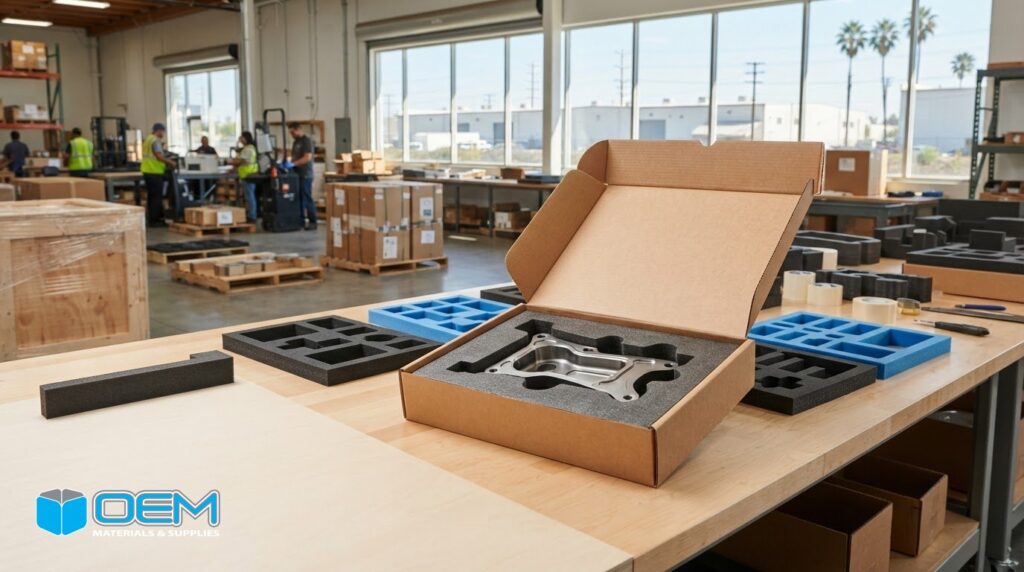
The foam material is only one part of a protective packaging solution. When evaluating a cross-linked polyethylene foam manufacturer in Southern California, start with the product’s geometry, shipping conditions, and handling process. A material label alone can’t tell you whether an insert will hold a part securely or fit into a repeatable packing workflow.
The goal is dependable protection without unnecessary packing steps, material, or damage risk. A practical specification starts with the product and its operating requirements, then connects foam selection and fabrication to the wider packaging system.
This guide explains how to assess whether XLPE suits your application, compare design approaches, and prepare useful details for a custom packaging project. Product dimensions, weight, shipping conditions, and production needs all help shape the design discussion. OEM Materials & Supplies supports manufacturers in Orange County, Los Angeles County, the Inland Empire, and San Diego County with engineered foam inserts, packaging design, prototypes, and production programs.
Key Takeaways
- Assess XLPE against the product, shipping risks, and packing workflow instead of choosing by material name alone.
- Bring product dimensions, weight, shipping conditions, and packing requirements into the foam specification discussion.
- Compare simple protective layouts and shaped inserts based on part geometry and production needs, not generic rankings.
- Evaluate a cross-linked polyethylene foam manufacturer in Southern California by how well it coordinates design and production planning.
- OEM Materials & Supplies connects engineered foam inserts with packaging design and support for prototypes, short runs, and larger programs.
What Cross-Linked Polyethylene Foam Does in Industrial Packaging
Cross-linked polyethylene foam, commonly abbreviated XLPE, is polyethylene foam whose polymer chains are chemically or physically linked into a network. The Cross-linked polyethylene (XLPE) overview describes these cross-linking methods and the broader material family. For packaging buyers, the key point is that XLPE identifies a material, not a complete packaging design or a guarantee of protection.
XLPE may be used as cushioning or shaped into an insert that positions and supports a product inside its package. Its suitability depends on the part, handling steps, shipping conditions, and packaging requirements. A material that works for one application may not suit another with different geometry, weight, or exposure to handling forces.
How cross-linked polyethylene foam differs from other foam options
Cross-linking creates bonds between polymer chains. Non-cross-linked polyethylene foam is made without those links. This structural distinction identifies the material category, but it doesn’t determine which option will work better for a particular shipment.
Compare foam options against the actual use case. Consider the product’s contact surfaces, how it is loaded and removed, and the protection the package needs to provide. Material selection should follow those requirements rather than a general assumption that one foam type is always preferable.
Where XLPE fits in a custom packaging design
A fitted insert can use shaped cavities to position a part or separate components within a package. The design should account for the product’s shape and how operators place and remove it. A cavity is a design choice, not a guarantee of protection. Its suitability depends on the part and the conditions the package must address.
The insert is also part of a larger system. A box or crate provides the outer enclosure, while cushioning and the insert layout help manage how the product sits inside. OEM Materials & Supplies’ foam packaging solutions include engineered inserts developed in relation to packaging needs.
Separate material selection from insert design to make project reviews more useful. First establish what the packaging must do, then assess whether XLPE and a particular layout fit those requirements. A cross-linked polyethylene foam manufacturer in Southern California should consider the part and packaging system together, rather than recommend foam based on its label alone.
For example, a component with protruding features may need a layout that keeps those areas from contacting the outer package. A set of parts may need separate locations to simplify packing and retrieval. These are design questions, not universal prescriptions. Product dimensions, weight, handling sequence, shipping conditions, and the surrounding box or crate all inform the assessment.
For repeated production runs, review how the insert fits the actual product and workflow. A well-considered design can support a consistent packing process, but it still needs to address defined risks and how the item moves through handling and shipment.
How to Specify XLPE Foam Around the Product and Shipping Conditions
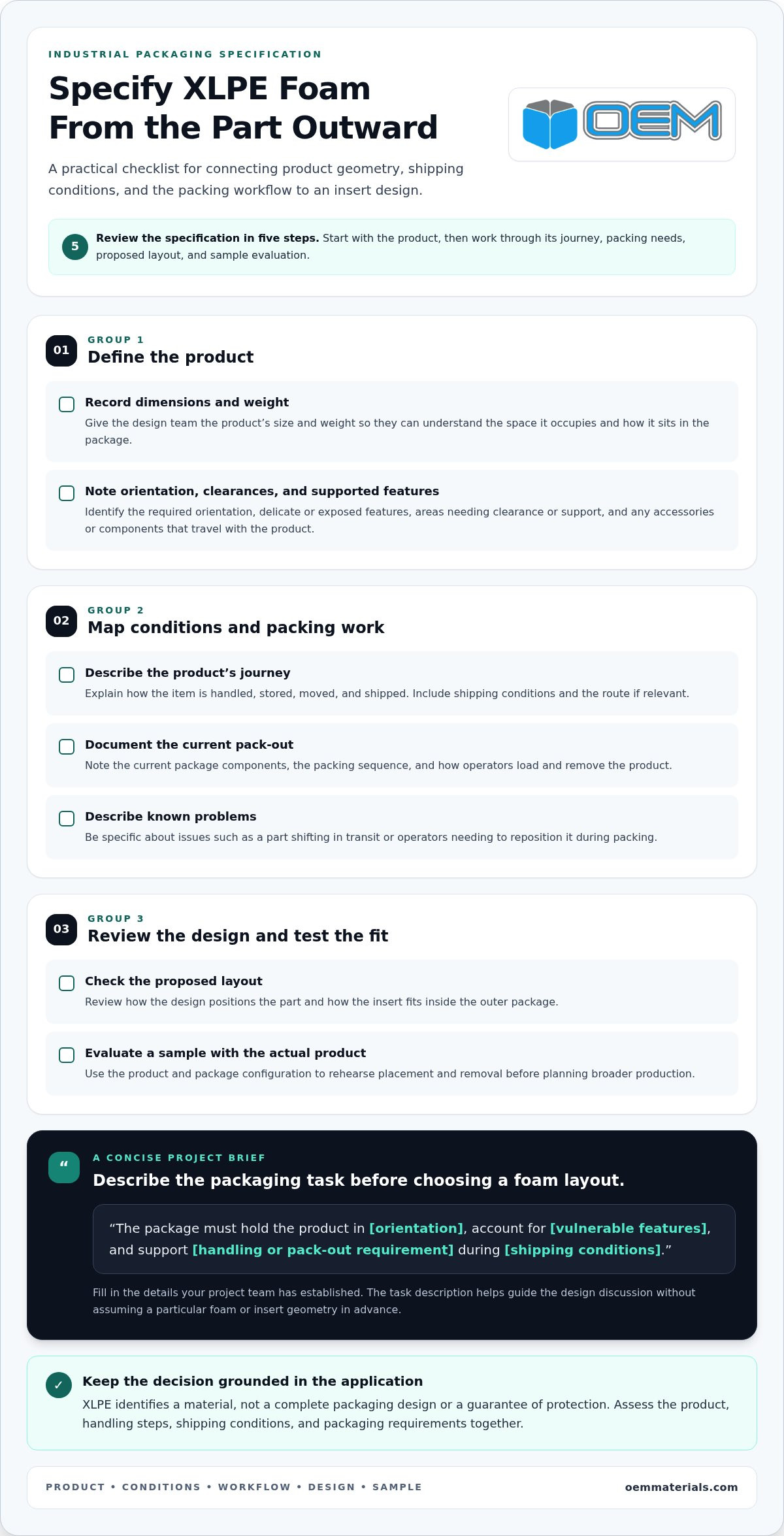
A useful specification follows the packaging task from the part itself to the point of use. Work through these steps with engineering and operations so the proposed insert reflects how the product is packed and shipped:
- Define the product. Record its dimensions, weight, orientation, and any features that need clearance or support.
- Map the risks. Describe how the item is handled, stored, moved, and shipped.
- Set packing requirements. Note the current package, pack-out sequence, and known damage or workflow problems.
- Review a design. Check how the proposed layout positions the part and fits the outer package.
- Evaluate a sample. Rehearse placement and removal before planning broader production.
A concise specification can keep the review focused: “The package must hold the product in [orientation], account for [vulnerable features], and support [handling or pack-out requirement] during [shipping conditions].” Fill in the details your project team has established. This describes the packaging task without assuming a specific foam or insert geometry in advance.
What product and packaging information should buyers prepare?
Product dimensions and weight help the design team understand the space the part occupies and how it will sit in the package. Identify delicate or exposed features, required orientation, and whether accessories or multiple components travel together. Explain how operators load and remove the product. Access and handling can affect the layout as much as the part’s outline.
Describe storage and shipping conditions, the route if relevant, and how the packaged item is moved. Include current packaging components and specific problems, such as a part shifting in transit or operators needing to reposition it during packing. These application details help guide material and design recommendations.
Some applications also have requirements specific to the product being packaged. For edible products, for example, the eCFR packaging material provision addresses a particular regulatory context. It should not be treated as a general requirement for industrial packaging.
How do design review and sample evaluation reduce uncertainty?
A sample lets the team examine the proposed layout using the actual product and package configuration. Check whether the item seats as intended, stays in the desired position during routine handling, and can be removed without awkward or inconsistent steps. Review the full pack-out sequence, including how the insert fits inside the outer package.
Document feedback and unresolved questions. If additional testing is appropriate, define conditions and acceptance criteria for the application rather than relying on a universal protocol. For a cross-linked polyethylene foam manufacturer in Southern California project, this review connects design decisions to how the package will be used.
Compare XLPE Foam Design and Fabrication Options for Your Application
No single insert layout suits every part or production program. Compare design approaches against the product’s geometry, protection needs, packing steps, and outer container. A simpler arrangement may work when the product’s position is easy to control. A shaped insert may be worth evaluating when the part’s contours or repeatable placement call for a more defined fit.
Use the comparison to frame a design discussion, not as a ranking. The right approach and fabrication plan depend on the application, project quantities, and production requirements.
| Design approach | Suitable project context | Questions to resolve |
|---|---|---|
| Simple protective layout | Products that can be positioned consistently with a less complex arrangement | Does it control orientation? Can operators pack and remove the part reliably? Does it work inside the existing box or crate? |
| Shaped insert | Parts with contours or features that call for a more defined location in the package | Does the shape support the intended placement? Can the product be accessed and removed smoothly? Is the design repeatable at the planned volume? |
When does a simple foam layout suit the packaging need?
A simpler layout may suit a product with a straightforward orientation, particularly when the outer container helps maintain its position. Still, account for the number of parts, how they are arranged, and the steps operators follow during pack-out. A layout that holds a single component may not work for a package containing several parts. Assess fit and handling in the actual package before choosing an approach.
When should buyers consider a shaped foam insert?
Consider a shaped insert when part contours or repeatable placement are central to the packaging requirement. Review how the product enters and leaves the insert, whether operators can access it without disturbing other components, and how the insert fits into the box or crate. OEM Materials & Supplies’ custom packaging design connects insert development to the wider package and its intended workflow.
Production plans also shape the discussion. A prototype or short run can help evaluate a design before planning a larger program. For repeated production, consider whether the product and pack-out process are consistent, how many units are packaged together, and which design details need to remain uniform. A design that works for a sample still needs review in the intended packing sequence and package configuration.
Bring expected quantities and the production outlook into the design conversation early. These details help align the prototype review with the likely program scale, without assuming one design or fabrication approach fits every volume. A cross-linked polyethylene foam manufacturer in Southern California should connect the proposed layout to product requirements and production planning, then use sample feedback to refine the design.
What Southern California Buyers Should Plan for in an XLPE Project
A custom foam project benefits from clear ownership at each handoff. Engineering can define how the package must accommodate the product, operations can identify pack-out constraints, and procurement can align the project with purchasing and production plans. Keeping decisions and revisions in a shared project record helps everyone work from the same approved package concept.
Plan distinct review points: establish requirements, discuss the design, assess a sample, and align production planning with anticipated use. At each handoff, record open questions, design changes, and decisions that affect the next stage. This is especially useful when product configurations or packaging workflows change during a project.
How should procurement prepare a project for review?
Along with the product and package details gathered by engineering, procurement can clarify the business context: prototype needs, expected production scale, purchasing cadence, and recurring constraints that affect packaging availability or use. Identify who will review the sample and who approves the design for production. Clear decision roles help manage feedback from several departments.
Cost outcomes depend on project-specific requirements. Keep quote reviews tied to the scope and assumptions the team has agreed on, and document changes to the design or production plan before the project advances.
How can packaging supply planning support production?
Use order patterns and packaging consumption to frame supply planning. A steady production schedule and a variable one create different purchasing discussions, even if both use the same insert. Share expected usage patterns and planned product or workflow changes. This helps align the packaging conversation with production needs without assuming a fixed delivery schedule or inventory outcome.
Where the operation’s workflow calls for it, consider kitting or assembly alongside the foam project. Vendor-managed inventory may also support broader packaging needs. Tie these options to a defined operational requirement rather than treating them as automatic extensions of an insert design.
Bring the relevant requirements and production assumptions together so engineering, operations, and procurement can evaluate the same scope. Discuss your XLPE packaging requirements with OEM Materials & Supplies.
How OEM Materials & Supplies Supports Custom Foam Packaging Projects
OEM Materials & Supplies treats foam as one part of the packaging system, not as a stand-alone material selection. Project discussions connect product requirements with insert design, the outer package, and the work involved in packing and handling. This helps purchasing, engineering, and operations teams evaluate a packaging concept against the job it needs to do.
OEM Materials & Supplies provides engineered foam inserts for prototypes, short runs, and high-volume programs. Project scope and requirements guide the design discussion. A prototype gives the team a basis for reviewing a concept, while production planning accounts for the program’s expected scale and packaging needs.
From project requirements to an integrated packaging solution
Design discussions start with the product and its shipping requirements, then consider how an insert works with the outer packaging. Depending on the application, the wider package may include a corrugated box or crate alongside the foam. OEM Materials & Supplies connects these elements so the insert’s role is considered within the complete package, not in isolation.
For related design context, the custom packaging design process connects packaging requirements to an overall solution. The right direction depends on the product, shipping conditions, and production workflow.
This integrated view helps teams resolve more than part fit. The outer container, component arrangement, and the way operators pack and remove the product all influence the packaging concept. A design review can account for these factors before production planning begins.
It also gives procurement and operations a shared basis for evaluating the proposal. They can consider whether the packaging fits the intended handling process, how the insert works with existing components, and what information is still needed to advance the design. A cross-linked polyethylene foam manufacturer in Southern California should be part of that broader packaging conversation.
What to include in a request for an XLPE packaging quote
A useful request gives the project team enough context to discuss the insert and its place in the package. Include product dimensions and weight, quantity per shipment, annual usage, and shipping environment. Drawings, photographs, or a sample of the current packaging can help illustrate the part and existing pack-out.
Also describe known damage concerns, handling constraints, and prototype or production requirements. These details focus the discussion on the application rather than a generic material selection.
- Product dimensions, weight, and quantity per package
- Annual usage and expected production scale
- Shipping environment and handling requirements
- Drawings, photographs, or current packaging details
- Known damage concerns or recurring pack-out challenges
Share the available project details to start the conversation. Request a quote for your packaging project with the product dimensions, weight, annual usage, and shipping requirements.
Make Your Next Packaging Decision With Clear Requirements
Give engineering, procurement, and operations a shared basis for assessing the packaging concept. Use agreed requirements to keep design decisions tied to the application, and record changes that affect the package before production planning moves forward.
Evaluate a cross-linked polyethylene foam manufacturer in Southern California by how well the project discussion connects the product’s needs to the packaging design. That connection helps your team make a more informed decision than a material label alone can support.
Discuss your custom foam packaging project with OEM Materials & Supplies. Share your product dimensions, weight, annual usage, and shipping requirements to start a focused project discussion.
Frequently Asked Questions
What is cross-linked polyethylene foam used for in industrial packaging?
XLPE foam is used as cushioning or as part of a fitted insert that helps locate products within a package. An insert, for example, may separate multiple components to keep them from contacting one another during handling. The design should reflect the item’s shape and packaging use. XLPE is not a universal solution; suitability depends on the product and shipment requirements.
How does cross-linked polyethylene foam differ from standard polyethylene foam?
The key distinction is the material structure: XLPE has linked polymer chains, while standard polyethylene foam may be non-cross-linked. That distinction alone doesn’t establish which material is right for a package. Compare material information with the product’s packaging needs and assess the proposed design in context. Don’t choose solely by a foam label or assume one option performs better in every application.
Is cross-linked polyethylene foam suitable for protecting delicate components?
It may be suitable, depending on the component and package design. Delicate features require careful attention to where the part contacts the insert, how it is oriented, and how it is removed during unpacking. A component with exposed connectors, for example, may need those areas addressed in the insert layout. Review the design for the actual application rather than assuming the foam alone ensures protection.
Can XLPE foam be used with custom corrugated boxes or crates?
Yes. An XLPE insert can be designed as part of a package that uses a corrugated box or crate. The insert and outer container have different roles, so their dimensions and layout need to work together. For instance, the insert must fit within the usable interior while allowing the package to close as intended. The right combination depends on the product and shipping requirements.
How do I specify the right foam insert for a product?
Start with a product drawing or measured dimensions, including weight, orientation, and features that need clearance or support. Then describe how the item is packed, handled, and unpacked. If the product has movable parts or accessories, explain how they relate to the main component. This context helps the design team consider insert geometry and pack-out needs together, rather than specify foam without product details.
Can XLPE foam provide ESD protection for electronic components?
Don’t assume XLPE foam provides electrostatic discharge protection based on the material name alone. If the component has ESD control requirements, include them in the packaging specification and evaluate the complete package against those needs. The insert is only one part of the system. Clearly identifying the component, its handling process, and required ESD packaging performance helps guide an application-specific review.
What information should I provide when requesting a custom foam packaging quote?
Provide product dimensions, weight, quantity per package, annual usage, and shipping environment. Drawings or photographs can clarify the part’s shape and delicate features; current packaging can show how it is packed. Include production scale and known damage or pack-out concerns. A cross-linked polyethylene foam manufacturer in Southern California can use these details to frame the project discussion around the product and its packaging needs.