

The best corner protector isn’t necessarily the one with the most material. Molded pulp corner protectors may suit one product and package geometry, while corrugated or foam protection may better match another. A close fit matters, but it is only part of the decision. Corners can still be exposed to impact, compression, and movement during handling and transit.
Start by reviewing how your product is packed, stacked, and shipped. This guide compares molded pulp with corrugated and foam alternatives, and explains how to assess fit, protection, and packing-line requirements. It also covers the product and shipment details to gather before requesting a design or quote, including dimensions, weight, annual usage, and shipping requirements. The aim is to evaluate the complete packaging setup, not just the corner protector on its own.
Key Takeaways
- Match corner-protector geometry to the product’s dimensions, corner shape, finish, and orientation.
- Compare molded pulp corner protectors with corrugated, foam, and other edge-protection formats against your package and handling needs.
- Review the protector, inner packaging, and outer carton as one system rather than evaluating corner protection in isolation.
- Document product risks and shipping conditions, then review a packed sample before moving toward a production run.
- Coordinate corner protection with the packing workflow, cartons, cushioning, and supply needs so the packaging works across the operation.
What Molded Pulp Corner Protectors Do in a Shipping Package
Molded pulp corner protectors are shaped fiber components placed around vulnerable corners of a product or package. They create a barrier at a specific contact point, helping keep nearby packaging or other surfaces from pressing directly against the corner. Molded pulp (also known as molded fiber) is a packaging material typically made from recycled paperboard and/or newsprint. The material alone doesn’t determine whether a protector is suitable. Its shape and position within the complete package matter just as much.
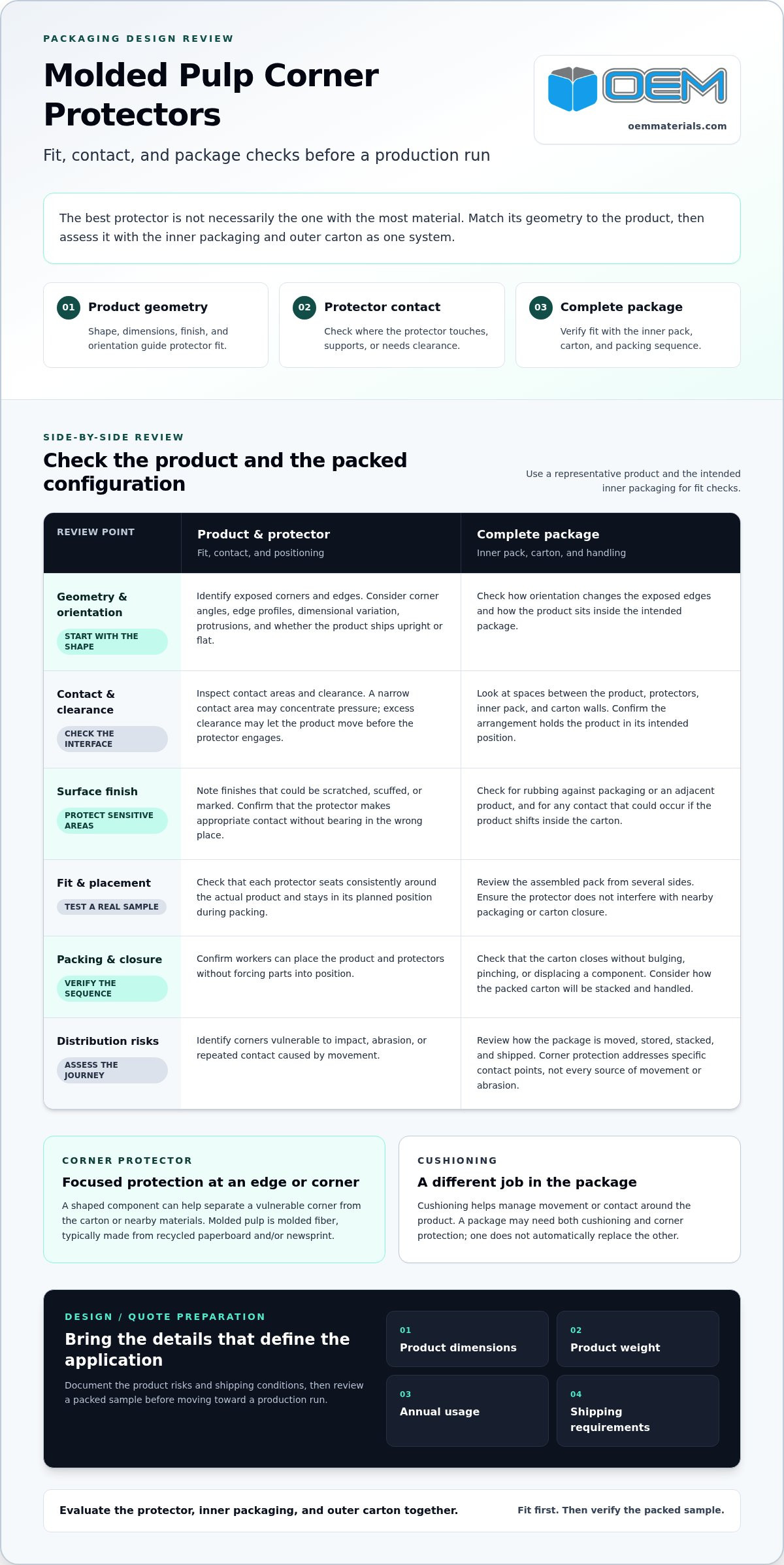
Corner protection serves a different function from general cushioning. Cushioning materials help manage movement or contact around the product, while a corner protector focuses on a particular edge or corner. A package may need both. One doesn’t automatically replace the other: the right arrangement depends on what can move, touch, or carry load in the packed configuration.
Where corner damage can occur during distribution
Risk can start at the packing station, when a product is placed into an inner pack, and continue as cartons are moved, stored, stacked, and shipped. A corner impact happens when a vulnerable point hits a hard surface. Abrasion can result from rubbing against packaging or an adjacent product. Movement inside the carton creates a separate risk, as a shifting product may repeatedly bring an edge into contact with the inner pack.
For example, a finished panel with exposed corners might be packed in a corrugated carton. If the panel shifts, a corner may strike the carton wall. If the carton is handled roughly, an exterior corner may also take an impact. Protectors placed at the panel’s corners can help limit direct contact at those points, but they won’t address every source of abrasion or movement. The inner pack and carton also need to hold the product in the intended position.
How molded fiber fits into a protective package
A shaped fiber component can locate a product by fitting around a corner, or separate that area from the carton and nearby materials. Its contact area should suit the product’s shape and finish. A protector that touches only a small or poorly placed area may not provide the intended support. One that interferes with the fit can make packing less consistent. Assess these design questions with the actual product and package rather than making assumptions based on material type alone.
OEM Materials & Supplies’ edge and corner protectors page covers protection options within this broader category. For molded pulp specifically, evaluate product geometry, surrounding packaging, and distribution conditions together. A configuration suited to a rigid, square item may not suit a product with rounded corners, a delicate finish, or a different pack orientation. The fit has to work in the real shipping package.
How Molded Pulp Corner Protector Design Affects Fit and Protection
A protector’s shape should suit the product and the way it sits in the package. Overall dimensions are only a starting point. Corner angles, edge profiles, protrusions, surface finish, and pack orientation all affect where a protector can make contact and how it holds the product in place. A unit packed upright may expose different edges than the same unit packed flat, so design decisions should reflect the shipping configuration, not just a product drawing.
Assess protector fit with the packed product and package, not as a standalone component. Consider the protector alongside the inner pack and outer carton. A close fit can help position the product, but contact in the wrong place may concentrate pressure or mark a sensitive finish. A loose fit may allow movement. The goal is to establish appropriate contact and clearance for the actual product, then verify that the complete pack can be assembled and closed as intended.
Match the protector geometry to the product
First, identify which corners or edges are most exposed in the planned orientation. Note dimensional variation across the product, along with handles, flanges, fasteners, or other protrusions that could affect placement. Record any surface finish that could be scratched, scuffed, or marked through contact. These details help define where support is needed and where clearance should remain.
Use a representative product and the intended inner packaging for fit checks. A protector that looks suitable against a drawing may sit differently around a real corner or interfere with a nearby feature. For molded pulp corner protectors, check whether each component seats consistently and stays in the planned position as the product is packed. OEM Materials’ custom packaging design considers component fit within the overall package.
Assess contact, clearance, and package interaction
Inspect contact points for a balanced fit. If the protector bears against a narrow area, pressure may concentrate there. If clearance is excessive, the product may shift before the protector engages. Check the assembled package from several sides, including the spaces between the product, protectors, inner pack, and carton walls. The right arrangement depends on product geometry and the conditions the package will encounter.
Then test the packing sequence. Confirm that workers can place the product and protectors without forcing parts into position, and that the carton closes without bulging, pinching, or displacing a component. Consider how the packed carton will be stacked and handled. An internal fit that works on the bench can still conflict with carton closure or other packaging elements. The International Molded Fiber Association’s overview of molded fiber provides background on the material, but package suitability still depends on the specific design and application.
Before finalizing a configuration, document the product dimensions, orientation, contact areas, and any fit or closure issues found in a packed sample. Include those details, along with product weight and shipping requirements, when requesting a packaging quote. This gives the design discussion a practical basis without assuming a universal protector dimension or performance rating.
Molded Pulp vs. Corrugated, Foam, and Other Corner Protection
Choose a material based on the product’s damage risks and how the package is built. A protector designed for one corner may not address broader movement or surface contact. Compare options by function, fit, storage, and how they work at the packing station. Then evaluate the complete package rather than choosing by material alone.
The comparison below is a starting point. Designs vary, so use it to identify what to inspect in a packed sample.
| Format | Fit and package integration | Handling, storage, and workflow |
|---|---|---|
| Molded pulp | Shaped components can be designed around defined corners or edges. Evaluate contact areas, clearance, and fit with the inner pack and carton. | Check how components are supplied, stored, positioned, and kept in place during packing. The design and packing sequence determine workflow fit. |
| Corrugated protection | Folded or formed corrugated parts can protect edges and interface with a corrugated carton. Fit depends on the part design and product geometry. | Review how parts are assembled and placed, and whether the package configuration supports consistent packing. For broader context on carton options, see corrugated box packaging. |
| Foam | Foam components can provide a shaped interface or cushioning around more than one contact point. Assess the fit and contact areas for the product and package. | Consider how inserts are handled and positioned, and how their shape affects packing steps and storage. Foam packaging may be relevant when the brief calls for support beyond corner contact. |
| Other edge-protection formats | Alternative protectors may address edges or package interfaces in different ways. Confirm that the selected format protects the vulnerable area without interfering with the product or carton. | Compare how each format is stored, applied, and secured as part of the actual packing process. |
When molded pulp may suit the packaging brief
Molded pulp corner protectors are worth evaluating when a product has clearly defined corners that need a shaped point of contact within the package. Suitability depends on the actual design, not the material category alone. Check how the protector fits the product, stays positioned during packing, and interacts with the inner pack and carton. Review the packed configuration under the handling and shipping conditions relevant to your operation before selecting a design.
When another protective material may be a better fit
If the risk involves movement or contact across broader product surfaces, the package may call for cushioning in addition to, or instead of, localized corner protection. Corrugated components may integrate with the carton structure, while foam can provide a shaped or broader cushioning interface. These are functional distinctions, not guarantees of performance. Assess each option in the intended package and packing sequence, including any complementary cushioning, to determine whether the configuration addresses the identified damage risks and operational requirements.
How to Evaluate Molded Pulp Corner Protectors Before a Production Run
A pre-production evaluation should answer two practical questions: does the package address the product’s known damage risks, and can the team pack it consistently? Document the product and shipment first, then trial the complete package. Review molded pulp corner protectors as part of that configuration, not as isolated components.
A useful packaging assessment starts with product dimensions, weight, finish, package orientation, existing materials, and shipping conditions. Drawings, photos, and a sample product can add detail when measurements alone don’t show fragile areas or handling concerns.
Prepare the product and shipment requirements
Gather product dimensions or drawings, weight, surface-finish requirements, and information about fragile areas or protrusions. Record the current carton, inner packaging, and packing sequence so the evaluation reflects the actual operation. Describe how the package is handled, stored, stacked, and shipped, including known points where damage has occurred. This information helps define what the trial needs to assess without assuming a standard test protocol.
- Document the damage risks. Identify which product areas need protection and the issue to prevent, such as corner impact, abrasion, or movement within the package. Separate observed damage from potential risks so the review has a clear basis.
- Capture the package configuration. Record product orientation, carton style, inner-pack materials, and how components are assembled. Note any constraints on carton closure, stacking, or available packing space.
- Define shipment conditions. Describe the handling, storage, and transit conditions the package is expected to encounter. Include relevant details from the actual distribution route or process rather than relying on a generic assumption.
- Pack a representative sample. Use the intended product, protector arrangement, inner pack, and outer carton. Follow the normal packing sequence and observe whether the protectors seat consistently or require extra adjustment.
- Review and record the result. Check for product movement, visible damage, shifting protectors, inconsistent placement, and interference with carton closure. Record observations and revise the package design if the sample reveals a fit or workflow issue.
Run a practical packaging trial
Keep the trial close to routine operations. Have the packer load the product and protective components as they would during normal production, then inspect the closed carton for fit and closure issues. After representative handling or transit evaluation, examine both the product and package. Look for marks, contact points, displaced components, or signs that the product moved. Document what happened, not just whether the package appeared intact.
Use the findings to guide the next design discussion. A protector that stays in place but slows packing may need a different arrangement. A configuration that is quick to pack still needs to address the identified damage risks. To discuss how product and shipment details can inform a packaging recommendation, request a packaging quote with your dimensions, weight, annual usage, and shipping requirements.
Plan Corner Protection as Part of a Complete Packaging Program
Corner protection works as part of a package, not as a standalone fix. A protector has to fit the product and coordinate with the carton, any cushioning, and the method used to close and handle the package. If one component shifts or takes up space needed by another, the finished pack may be harder to assemble or may not hold the product as intended.
Coordinate protection with the rest of the package
Start by defining the job of each component. The box contains the shipment, cushioning can address movement or contact beyond a specific edge, and corner protection focuses on vulnerable areas. Check how these parts fit together, including whether protectors stay positioned during packing, leave adequate room for closure, and suit the way cartons are stacked and handled. Custom packaging design considers those interactions across the full package configuration.
A package using molded pulp corner protectors may still need other materials to address a separate risk. For example, corner support alone may not keep a product from moving within a carton. The right combination depends on product geometry, existing packaging, packing steps, and distribution conditions. Review the assembled package as a working system, including how consistently employees can build it and how its components are supplied together.
Prepare a packaging inquiry with useful project details
For a productive design and supply discussion, gather the product dimensions, weight, surface finish, and annual usage. Include the current carton and inner-pack materials, product orientation, and known damage concerns. Shipping requirements matter too: describe relevant handling, storage, stacking, and transit conditions. Photos, drawings, or an existing packed sample can help explain details that measurements alone may not convey.
OEM Materials works with manufacturers on packaging design and related materials, including cartons, cushioning, and edge protection. For companies in Orange County, Los Angeles County, the Inland Empire, and San Diego County, planning these components together can connect product protection with the practical needs of the packing operation. Material selection and cost depend on product dimensions, materials, package configuration, annual usage, and shipping requirements.
Bring those details to the quote request so the discussion can focus on your packaging needs. Request a packaging quote with your product dimensions, weight, annual usage, and shipping requirements.
Put Your Packaging Requirements Into Action
Before adopting molded pulp corner protectors, align engineering, procurement, and warehouse teams on what the packaging program needs to support. Agreeing on priorities for product protection, packing operations, and supply planning gives each group a shared basis for reviewing the proposed approach.
That alignment can also clarify who will evaluate the packaging, provide operational feedback, and manage purchasing decisions. A coordinated review keeps the decision connected to the needs of the people who design, pack, and source the materials.
Ready to discuss your packaging requirements? Request a packaging quote to start the conversation.
Frequently Asked Questions
Can molded pulp corner protectors be used with stretch film?
Yes, molded pulp corner protectors can be used with stretch film, but compatibility depends on protector shape, product surface, wrap tension, and package configuration. Film may press against a protector or change how it contacts the product, so include the intended wrap pattern in the evaluation. Use the same film application and packing sequence planned for production, then inspect the complete load for changes in component position or product contact.
Do molded pulp corner protectors need special storage conditions?
Storage requirements depend on the specific design and warehouse environment. Consider how long components will remain in inventory, how they’ll be stacked or moved, and whether handling could damage them before use. Follow the product’s storage instructions rather than applying a general humidity or storage limit. During an inventory review, record any concerns observed between receiving and packing so storage practices can be addressed.
Can molded pulp corner protectors be reused?
Reuse depends on each protector’s condition after use and the requirements of the next shipment. Inspect for deformation, damage, or contamination, and check whether the component still fits the intended application. Don’t assume that a protector used on one product or shipment remains suitable for another. If reuse is part of a standard process, define a consistent inspection and disposition method for the packaging team.
Are molded pulp corner protectors suitable for products with unusual shapes?
They may be, but unusual shapes can leave few stable contact areas or include features such as ports, controls, handles, or projecting components that need clearance. Before selecting molded pulp corner protectors, identify which surfaces must remain accessible and whether the same packaging needs to accommodate multiple product variants. These details help define the design challenge and prevent a protector from obstructing product features or complicating the intended pack arrangement.
Can molded pulp corner protectors be used in automated packing lines?
Potentially, but line suitability depends on how each protector is presented and picked up by the equipment. Consider component orientation in the infeed, the machine’s placement sequence, and whether parts stay aligned for consistent placement. Different product variants may also require different settings or presentation. Evaluate these machine-interface details with the line team, and document any misfeeds, repositioning, or interruptions during a representative run.
What information should I provide when requesting a corner-protection quote?
Along with basic product and shipment details, include existing packaging specifications, photos of damage or failure points, and constraints from your packing line. If the project involves multiple product versions, identify which versions need to share a packaging configuration. This context helps focus the discussion on the operating problem and relevant options. Include these details in the packaging quote request to begin the review.