
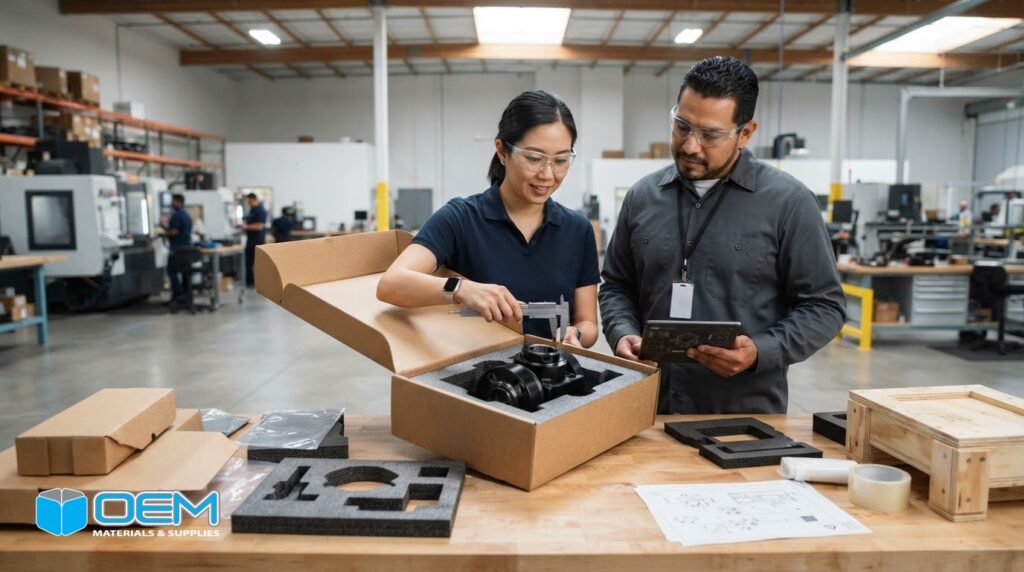
A packaging prototype is most valuable before a production run, not after a shipment reveals a poor fit. Packaging design and prototyping services turn product dimensions, weight, and shipping requirements into a sample teams can evaluate before scaling up. A focused review can expose fit, handling, and packing issues while changes are still part of the design process.
The goal is more than a package that holds the product. It must provide appropriate protection, support efficient packing, and fit production needs. This article explains how requirements shape a design, what a prototype can help teams assess, and how review findings can guide the next step.
We’ll cover the path from initial specifications to prototype review, including custom corrugated boxes, die-cut packaging, and engineered foam inserts. You’ll also learn how design work can connect to short runs or high-volume programs, helping engineering, purchasing, and operations teams evaluate a package before committing to production.
Key Takeaways
- Packaging design and prototyping services translate product and shipping requirements into a package teams can evaluate before production.
- Use product dimensions, weight, fragility, and shipping conditions to guide the design and prototype review.
- Assess the prototype for fit, protective components, closure, packing steps, and production practicality. Record what needs adjustment.
- Prepare dimensions, weight, annual usage, and shipping requirements to support a focused recommendation and clear next steps.
- OEM Materials & Supplies supports manufacturers in Orange County, Los Angeles County, the Inland Empire, and San Diego County, from prototypes and short runs to high-volume programs.
Why Packaging Design and Prototyping Services Matter for Industrial Products
Industrial packaging has to meet several practical demands at once: the product must fit, protective materials must support it appropriately, and the completed pack must be manageable during packing, storage, and shipment. Packaging design and prototyping services translate those demands into a package teams can inspect before committing to production. The work may involve a custom corrugated box, a die-cut structure, engineered foam inserts, or a combination shaped around the product and its route through the supply chain.
Unlike packaging designed primarily for a retail shelf, industrial packaging puts protection, handling, storage, and production fit at the center of the review. Graphics can help with identification, but they cannot compensate for poor fit or an awkward packing process. The discipline of Packaging engineering brings material, structural, manufacturing, and protection considerations together. OEM Materials & Supplies supports this work through custom packaging design for manufacturers, connecting design review with prototype development.
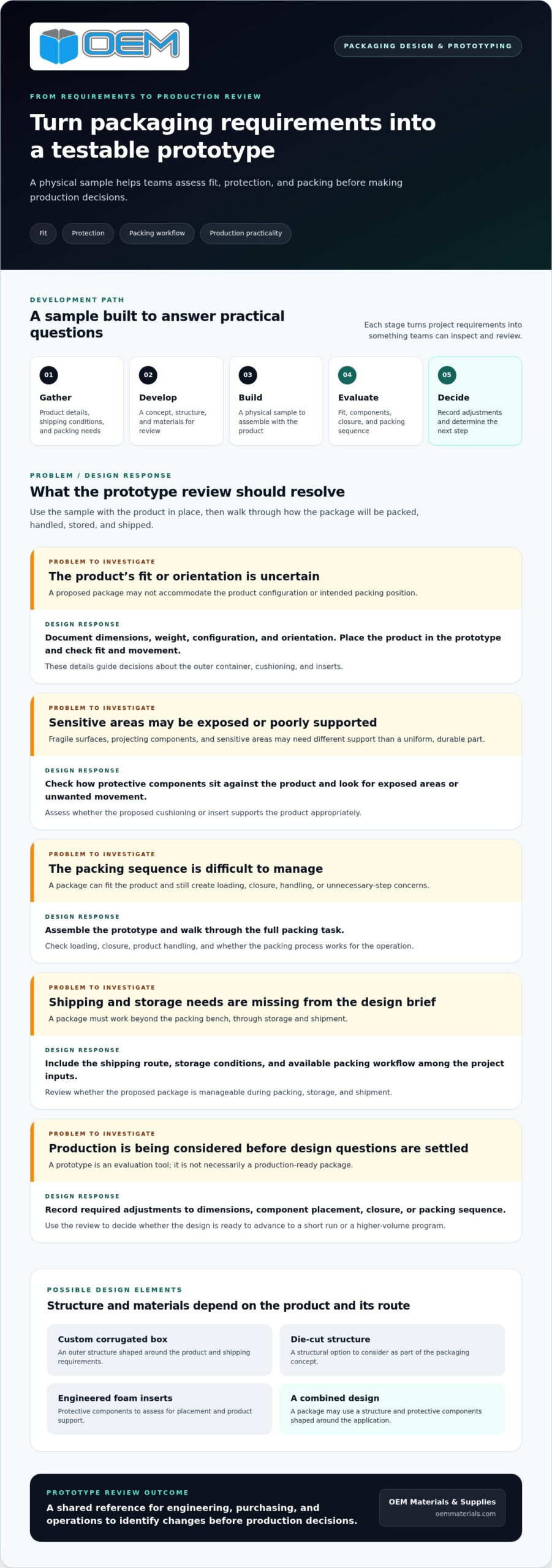
A packaging prototype is a sample built to evaluate how a proposed package fits, protects, and can be handled before production decisions are made. It gives engineering, purchasing, and operations teams a shared reference for identifying changes while the design is under review.
Which packaging problems should design work address?
Start with the product’s dimensions, weight, and configuration. These define the space the package must accommodate and inform decisions about cushioning, inserts, and the outer container. Fragile surfaces, projecting components, or sensitive areas may need different support than a durable, uniform part. Note the product’s intended orientation as well, since a design that works in one position may not work when the item is packed another way.
Review the full packing task, not only the closed box. Look for product movement, exposed areas, excess material, difficult closures, and steps that require unnecessary handling. Damage, inefficient packing, and labor demands are useful signals for design review, but improvements depend on the product, materials, and shipping requirements. A package optimized for one item or route may not suit another.
When does a prototype add value?
A physical sample makes fit and assembly easier to assess than a drawing alone. Teams can place the product inside, check how protective components sit, and walk through the packing sequence. That review can reveal practical concerns, such as an insert that makes loading difficult or a package that takes up more space than the operation can accommodate.
Prototypes are especially useful for product launches, packaging changes, or new shipping requirements. They are evaluation tools, not necessarily production-ready packages. The review helps teams identify adjustments and decide whether the design is ready to advance to a short run or a higher-volume program.
How Packaging Design and Prototype Development Move from Requirements to a Testable Package
A useful prototype starts with a clear definition of the job the package must do. Product details, shipping conditions, and packing needs guide the design, so the sample can answer practical questions instead of simply showing what a package might look like. OEM Materials & Supplies develops custom packaging designs through a practical sequence: gather requirements, develop a concept, review the structure, then evaluate a prototype.
Packaging design and prototyping services bring product, material, and handling considerations into one development process. As Packaging Engineering at Christian Brothers University describes, packaging engineering applies scientific and engineering principles to protect, preserve, and transport products. For industrial buyers, that means grounding decisions in how a specific item is packed, stored, and shipped.
What information shapes the initial packaging design?
Begin with the product’s dimensions, weight, configuration, and known handling needs. Note areas that require support, surfaces that must be protected, and how the item is oriented during packing. Add shipping route, storage conditions, and the available packing workflow when they affect package choices. These inputs help the design team compare a corrugated structure, die-cut components, foam inserts, or a combination without assuming one solution fits every product.
Application matters. Aerospace components, automotive parts, medical products, and electronics can differ in shape, fragility, handling, and packaging requirements. The design brief should capture the project’s actual constraints rather than rely on broad industry assumptions. A clear set of inputs also gives reviewers a basis for deciding whether the proposed structure is workable.
How does a design move from concept to prototype?
After requirements are documented, the team develops a packaging concept and selects a structure and materials for review. The design is translated into a physical sample that can be assembled and checked with the product. Reviewers can then identify adjustments to dimensions, component placement, closure, or packing sequence before deciding whether the package should proceed to production planning.
Review a prototype before production approval so teams can resolve design questions before committing to a production package. The review should end with a clear decision: approve the design for the next step or revise it based on observed fit and handling.
What can teams evaluate with a physical sample?
Place the product in the sample and inspect whether it sits in the intended position, whether protective components align as designed, and whether the closure works as planned. Have the people who perform the packing steps work through the sequence. Their review can uncover awkward placement or assembly steps that are difficult to judge from a drawing.
A prototype supports review of the design, but it does not by itself establish shipping performance. Any performance conclusion must be based on tests actually conducted. Manufacturers can share product and shipping requirements through OEM Materials & Supplies’ packaging inquiry. Include dimensions, weight, configuration, and known handling needs so the design discussion starts with useful inputs.
How to Evaluate a Packaging Prototype for Fit, Protection, and Production
A useful prototype review turns opinions into specific design decisions. Bring the product, proposed package, and people who handle packing into the same evaluation. Record what fits, what needs adjustment, and what evidence supports approval. A sample can show how components and packing steps work together, but it does not prove transit performance unless relevant testing has been performed.
Use a review table to keep engineering, operations, and purchasing aligned. Record observations rather than relying on a general judgment that the package “looks right.”
| Review area | Question to answer | Evidence to record |
|---|---|---|
| Product fit | Does the item sit in the intended position without unwanted movement or contact? | Observed contact points, clearance concerns, and any movement during handling |
| Protective components | Are cushioning or inserts placed where the product needs support? | Component locations, areas needing additional review, and fit observations |
| Closure | Can the package be closed as designed without interfering with the product or inserts? | Closure alignment, interference, and steps that need adjustment |
| Packing steps | Can the intended team place, protect, and remove the item consistently? | Sequence followed, difficult steps, and handling feedback |
| Production practicality | Do the material and structure suit the planned packing workflow and production volume? | Assembly considerations, material choices, and changes for the next review |
Does the package fit and protect the product?
Start by placing the product in its intended orientation. Check contact points, access for packing and unpacking, and whether the item shifts during ordinary handling. Review foam or cushioning against the product’s shape, weight, fragility, and shipping requirements. Foam packaging can be part of the design when an engineered insert is needed. Use the prototype to assess placement and fit, while treating transit testing as a separate step.
Can the package work in the intended operation?
Have the team that will pack the product assemble the sample and follow the intended sequence. Note whether components are easy to place, the closure is practical, and the process can be repeated consistently. Consider storage and handling as well as the package itself. A corrugated design may suit a particular application, but its structure and material choices should align with the product, shipping needs, and expected production volume.
Use review findings to separate design approval from performance claims. Fit, closure, and assembly can be inspected directly on the sample. Protection under shipping conditions requires appropriate testing, and conclusions should reflect only tests actually completed. This distinction gives decision-makers a clear basis for approving a design, requesting a revision, or identifying what still needs validation.
How to Plan a Packaging Prototype Project and Prepare for Production
A planned prototype project gives teams a clear route from the current packaging problem to a production decision. Document the requirements, develop a design around them, review the prototype, then record the approved next steps. This keeps feedback tied to the original need, whether the priority is better product protection, a simpler packing process, or a package suited to a new shipping route.
Before requesting a recommendation, gather the details that influence design and scope. Product dimensions and weight help define the package and protective components. Annual usage provides context for planning the program, while shipping requirements clarify how the package will be handled. Current packaging samples, photos, or drawings can also help explain what needs to change.
What should buyers prepare before requesting a quote?
Share the product configuration and known handling concerns along with its dimensions and weight. Describe shipping conditions and the operational issue the new package should address, such as product movement, difficult packing, or excessive material use. If available, include a current package or drawing to show the starting point. These inputs help connect custom packaging design services to actual requirements rather than assumptions.
- Product dimensions, weight, and configuration
- Annual usage and expected production needs
- Shipping route or other relevant shipping requirements
- Current packaging examples or drawings, when available
- The specific damage, fit, handling, or packing issue to resolve
Be precise about the problem, but distinguish observed issues from desired outcomes. For example, identify where a package is difficult to assemble or where a product shifts during handling, then explain what the revised design should address. Potential savings depend on product dimensions, materials, and shipping requirements, so assess them against the project’s actual conditions rather than assuming a result in advance.
How should teams move from prototype review to production?
After reviewing the sample, document the accepted design choices, requested revisions, and questions that still need resolution. Assign clear next steps so engineering, purchasing, and operations are working from the same decisions. A prototype may lead to another design iteration, a short run, or planning for a high-volume program. Each path has different scope and production considerations, so record the intended volume and the reason for the next step.
Consider the complete packing workflow before approving the transition. If products need to be grouped, prepared, or packed together, kitting or assembly may be relevant. Include those requirements in the project discussion so the packaging plan reflects how work moves through the facility, not only the final package.
For a focused project discussion, share product dimensions, weight, annual usage, and shipping requirements. These details provide a practical foundation for discussing a prototype and the appropriate next step toward production.
Packaging Design and Prototyping Services for Southern California Manufacturers
Industrial packaging needs to support the product and the work surrounding it. A package may need to protect a component, make packing more manageable, or fit a program moving from prototype evaluation into ongoing production. OEM Materials & Supplies works with manufacturers on packaging design and prototyping services, connecting structural decisions to practical needs across the supply chain rather than treating packaging as a commodity purchase alone.
For manufacturers in Orange County, Los Angeles County, Riverside and the Inland Empire, and San Diego County, project requirements vary by product, shipping conditions, and expected volume. An aerospace component may call for a different configuration than an automotive part, medical product, or electronic device. The design process starts with the project requirements, then considers suitable materials and how the package will be used in practice.
What packaging capabilities support industrial programs?
Custom corrugated boxes can provide the outer structure, while die-cut packaging and engineered foam inserts can be considered when the product’s shape or handling needs call for a more tailored arrangement. Evaluate these components as part of a complete package, with attention to fit, packing workflow, and shipping requirements. Custom corrugated box solutions can be designed around industrial applications and product requirements.
Program needs also change over time. A prototype gives teams a physical design to review. A short run can support an initial production need, while a high-volume program calls for planning around sustained requirements. OEM Materials & Supplies supports manufacturers across these stages, connecting design and prototype work with the next production step. The right approach depends on the product, materials, shipping needs, and planned usage.
How can buyers start a packaging design conversation?
Share information that lets the project discussion begin with the product and its operating conditions. Include dimensions, weight, annual usage, and shipping requirements. Current package examples or drawings can clarify the starting point, while a concise description of the issue can focus the recommendation.
Be specific about the challenge. Product damage, awkward packing steps, excess material, labor demands, or inventory concerns each point to different considerations. If a prototype is the next step, explain what the team needs to evaluate and who will review it. This helps align design decisions across engineering, purchasing, and operations, then gives the group a basis for deciding whether to revise, run a short quantity, or plan for higher-volume production.
OEM Materials & Supplies brings packaging design, custom corrugated boxes, die-cut packaging, engineered foam inserts, and production support together for industrial programs. A packaging design or prototype quote request can include product dimensions, weight, annual usage, and shipping requirements.
Set a Clear Direction for Your Next Packaging Decision
A packaging decision is strongest when the people who specify, purchase, and handle the package share the same acceptance criteria. Use the next design review to align priorities before approving a change: what needs protection, which packing steps must work consistently, and what constraints matter as the program develops. That alignment keeps packaging design and prototyping services tied to an operational decision, rather than treating a sample as an isolated deliverable.
Bring unresolved concerns into the discussion early. A clear view of the product and its operating context gives OEM Materials & Supplies a practical starting point for recommending a design path. Teams can then evaluate the proposed next step against their requirements and make decisions with engineering, operations, and purchasing in view.
Request a packaging design or prototype quote and describe the challenge your team needs to address. Include product dimensions, weight, annual usage, and shipping requirements to help focus the discussion on a practical next step.
Frequently Asked Questions
What is the difference between a packaging prototype, a proof, and a production sample?
A prototype is a physical model used to assess a package’s structure and intended use. A proof is generally a review document or mockup for checking details such as graphics, text, or layout. A production sample represents the package made with the materials and process planned for manufacturing. Since these terms can vary between projects, define what each item is intended to verify before review begins.
What information should I provide to request packaging design and prototyping services?
For products with multiple versions, identify each configuration that may need packaging and note which versions can share a design. Include relevant drawings or revision details, handling instructions, and constraints that could affect the design, such as limits on how the package is assembled. Also identify who will review and approve the proposal. This helps focus packaging design and prototyping services on the right product and decision-makers.
Can a packaging prototype help identify product fit or packing issues?
Yes. A prototype can help reveal issues that appear only with a particular product configuration, such as a feature that interferes with an insert or prevents the package from closing as intended. If the product has revisions or variants, review a representative example of each configuration expected to use the same package. Record which version was evaluated so feedback remains tied to the correct design and product.
How do teams evaluate whether a packaging prototype is ready for production?
Set a clear approval record that identifies the accepted design revision and the people authorized to sign off. Before production, compare the approved documentation with the sample to ensure they describe the same package. If testing was conducted, retain its results with the project record and state what was tested. This revision control helps purchasing and operations refer to the same approved design when the program moves forward.
Can packaging design services support both prototypes and high-volume programs?
Yes. Packaging design services can support a project from early prototype review into a high-volume program. As the project advances, teams can use the approved design as a reference for communicating requirements across engineering, purchasing, and operations. If production needs or product configurations change, treat those changes as new review inputs rather than assuming the existing package still fits. That keeps decisions connected to the current application.
What packaging materials can be considered for an industrial prototype?
Options can include corrugated boxes, die-cut packaging, engineered foam inserts, cushioning materials, and crates. These can serve different roles within a package: an outer container, a formed component, or added support around a product. The right combination depends on the application and how the package will be handled. Review how the components fit together as a complete system, not as isolated materials.
Can packaging design and prototyping services support manufacturers in Southern California?
Yes. OEM Materials & Supplies supports manufacturers in Orange County, Los Angeles County, the Inland Empire, and San Diego County with packaging design and prototype projects. Teams can bring engineering, purchasing, and operations priorities into the same project discussion, aligning packaging decisions with the product and workflow. The company also serves customers across the United States, supporting manufacturers with broader operations.