
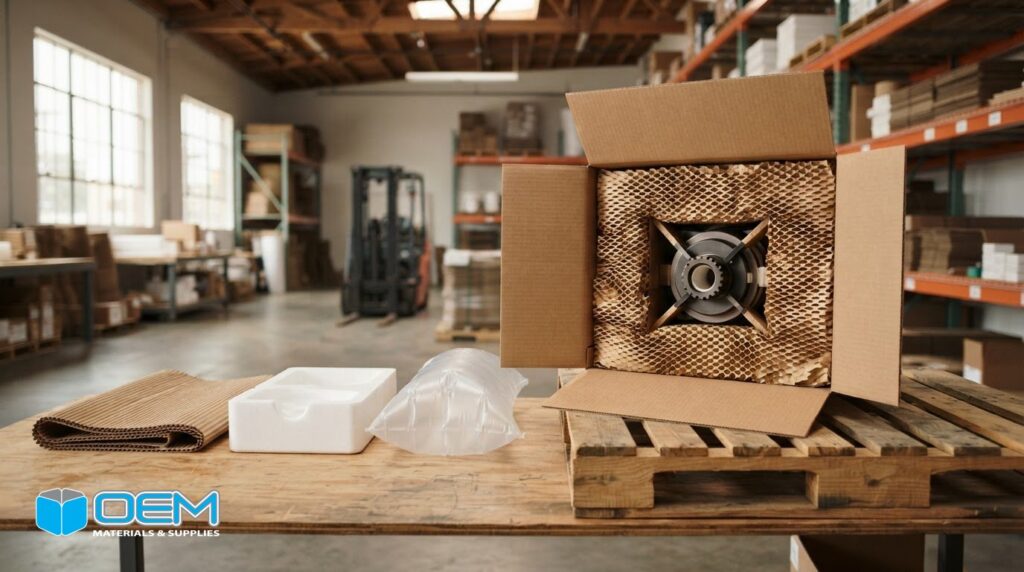
The most protective void fill isn’t necessarily the material that fills a carton fastest. A shipment can still arrive damaged if the product shifts or gaps remain unsupported. Honeycomb void fill for shipping can brace a load and limit movement, but whether it fits depends on the product’s shape, carton geometry, and shipping conditions.
Void fill and cushioning perform different jobs. Void fill helps hold a product in place, while cushioning helps protect it from shock. Selecting a suitable package means considering both functions and how the complete package performs, not relying on material claims alone.
This guide explains how honeycomb void fill works, where it may fit, and how to compare it with options such as foam, paper, and other cushioning materials. You’ll learn which product, carton, shipment, and packing-process details to consider, including material use, labor, and storage. The goal is a better-informed decision based on evaluating the full package, not judging the void fill alone.
Key Takeaways
- Assess honeycomb void fill for shipping by how well it limits product movement within your carton, not by material claims alone.
- Separate void-fill needs from cushioning needs so the package addresses both empty space and impact exposure.
- Compare honeycomb with paper, foam, and inflatable options based on product fit, packing method, and handling requirements.
- Use product dimensions, weight, carton geometry, and shipping conditions to guide packaging evaluation.
- Consider the full packing workflow, including material use, labor, storage, and how the carton and protective materials work together.
What Is Honeycomb Void Fill for Shipping, and What Problem Does It Solve?
A product can be properly boxed and still move inside its carton. Unfilled space lets items shift as packages are tilted, stacked, or handled, potentially causing contact with other contents or the carton walls. Honeycomb void fill for shipping is a paper-based material used to occupy some of that space and help hold a product in position. Its role is to manage movement, not to serve automatically as a complete protective package.
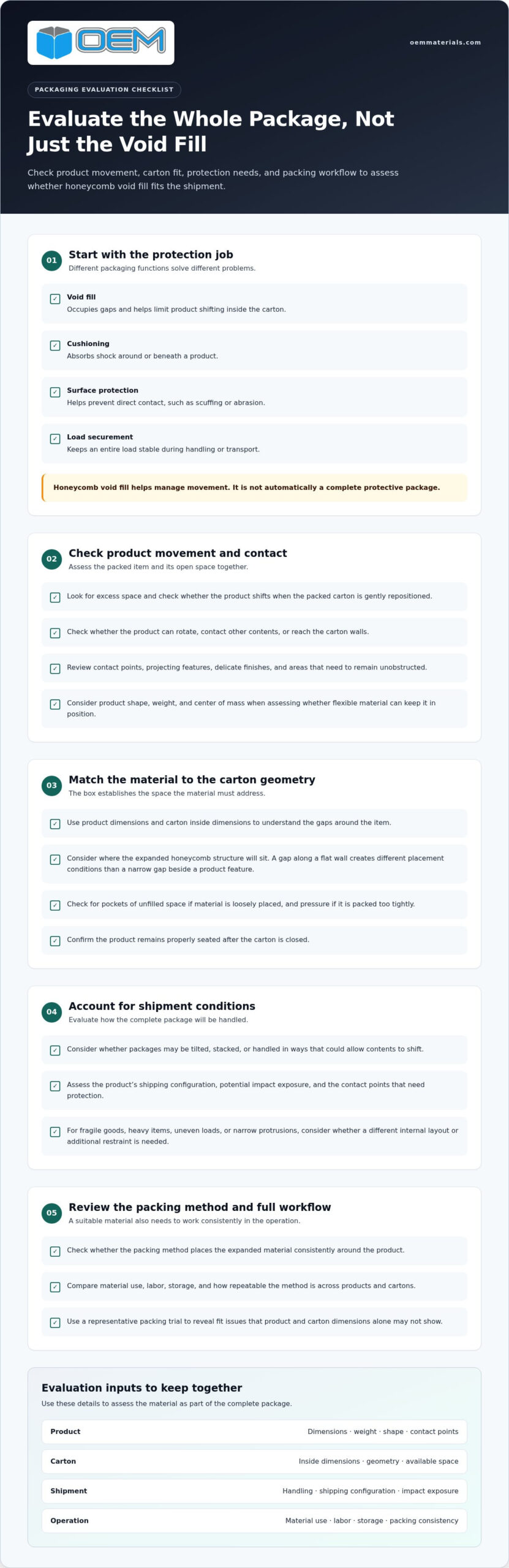
The distinction matters. Void fill occupies gaps and helps limit shifting. Cushioning is placed around or beneath a product to absorb shock. Surface protection helps prevent direct contact, such as scuffing or abrasion, while load securement keeps an entire load stable during handling or transport. A shipment may need one function or a combination, depending on the item and shipping configuration.
How honeycomb void fill is structured
Honeycomb paper expands into a connected, cell-based structure. Its repeating cells create an open form that can occupy gaps around or between products when positioned in the carton. The term refers to the familiar honeycomb structure, a pattern found in natural and engineered materials. In packaging, the way expanded material contacts the product and carton affects how well it can restrict movement.
When a shipment needs void fill
Start by checking for excess space and whether the product shifts when the packed carton is gently repositioned. A small component inside a larger carton, for example, may need the open area managed so it doesn’t move freely. Assess the product, carton, and shipping configuration together. Changing the box’s inside dimensions changes the gaps that need to be addressed.
Carton fit is part of the decision. The corrugated boxes selected for a shipment establish the space around the product. If the carton is substantially larger than its contents, void fill may help occupy the gap, but it may not provide close-fitting cushioning or prevent multiple items from contacting one another. Those needs may call for a different or additional packaging component.
Honeycomb material may suit a shipment with open space that can be managed with a paper-based structure and a packing method that places it consistently. It isn’t a universal solution for fragile surfaces, concentrated impact exposure, or loads requiring restraint. Assess the product’s contact points, its potential to move, and how the package will be handled. The role for void fill becomes clearer when you consider these factors separately rather than treating all protection as one function.
How Honeycomb Void Fill Works: Structure, Product Contact, and Limitations
Honeycomb material changes shape as its connected cells open, allowing the paper structure to occupy space inside a carton. Its final fit depends on the material design, how it is prepared, and the geometry of the gap. A space along a flat carton wall creates different placement conditions than a narrow gap beside a product feature.
What the honeycomb structure contributes
The open cells form a flexible network that can conform around contours and contact the product and carton at multiple points. The amount of contact depends on how much material is expanded and where it is placed. Flexibility and structural support are design considerations, not guarantees of fit or performance. Don’t assume that characteristics described for one honeycomb material apply to every design.
Pay close attention to clearance. If expanded material presses against a projecting feature, delicate finish, or area that must remain unobstructed, the arrangement may not suit the product. Loose placement can leave pockets of unfilled space, while tightly packed material can create pressure. Review the packed item from several angles and check that it remains properly seated after the carton is closed.
Where void fill alone may not be enough
Some product shapes are difficult to stabilize with a flexible, open-cell material alone. Heavy items, items with an uneven center of mass, or products with narrow protrusions may need a different internal layout or additional restraint. Fragile goods may require a package designed around their specific exposure and contact points. The appropriate configuration depends on both the product and its shipping conditions.
Assess the whole arrangement rather than the material in isolation. Check whether the product can rotate, whether the expanded cells stay in place, and whether the carton closes without forcing the contents into an unsuitable position. A representative packing trial can reveal fit issues that dimensions alone don’t show. For broader packaging sustainability context, the Sustainable Packaging Coalition offers industry resources. Material construction and local acceptance determine disposal options.
OEM Materials can help evaluate how material selection fits the package design and packing process. Share product and carton details through custom packaging design support to discuss a coordinated configuration.
Honeycomb Void Fill vs. Other Shipping Materials: How to Compare the Options
Compare materials by their form, how packers position them, and how easily the method can be repeated across your products and cartons. Honeycomb void fill for shipping expands into a connected structure, while other materials arrive as loose paper, formed pads, fitted pieces, or air-filled units. These differences affect how each option fits varied carton layouts and packing routines.
Honeycomb paper compared with other paper void fill
Honeycomb paper opens into a connected cellular form that can be positioned around a product. Packers shape crumpled kraft paper during use, while paper pads arrive in formed sections for placement at selected locations. For cartons with varying open areas, compare how easily each format can be adjusted. For repeat orders, consider whether staff can place the material consistently.
| Material | Form and placement | Workflow considerations |
|---|---|---|
| Honeycomb paper | Expanded cellular structure positioned around the product | Consistency of expansion, placement, and carton fit |
| Crumpled kraft paper | Loose paper shaped by hand or during packing | Packer technique and repeatability across orders |
| Paper pads | Preformed sections placed at selected points | Pad positioning and fit across product variations |
| Foam | Loose, shaped, or fitted components depending on design | Matching the configuration to product geometry and storage needs |
| Inflatable cushioning | Air-filled units arranged within the carton | Placement, handling, and integration into the packing station |
Void fill compared with cushioning materials
Format affects more than carton fit. Loose paper gives packers flexibility to shape material at the station, while pads provide a defined form that can support a consistent packing sequence. Foam can be configured to fit products with distinct contours. Inflatable units may suit a process built around placing prepared units into cartons. The practical choice depends on the shipment mix and the work required to prepare each package.
For example, a line handling several product configurations may need material that packers can reposition quickly as carton layouts change. A repeat shipment with a stable product configuration may benefit from a defined placement pattern. OEM Materials’ cushioning materials can be considered as part of a package configuration matched to product-specific requirements.
Compare candidate materials using representative orders and the normal packing procedure. Observe how packers handle, position, and store each format, and note whether carton closure remains consistent. A combination of materials may be appropriate when different products or contact areas need different configurations. Choose based on the actual shipment mix and workflow rather than assuming one format will suit every carton.
How to Specify Honeycomb Void Fill for Your Shipping Operation
A useful packaging specification starts with the shipment, not a preferred material. Gather product and carton details, identify how the package moves through your operation, and then evaluate a representative pack. This gives purchasing, engineering, and warehouse teams a shared basis for comparing fit, protection, material use, and packing effort.
Build a shipment profile before selecting material
Record the product’s dimensions and weight, its orientation in the carton, fragile features, and surfaces that should avoid direct contact. Include the carton’s interior dimensions and note where open space remains after the product is placed inside. Document the current packing method, including how materials are positioned and the steps needed to close and prepare the carton.
The key inputs are product dimensions, weight, carton, and shipping conditions. Also document relevant handling and storage conditions, such as how cartons are moved, stacked, or staged before shipment. For products with multiple configurations, capture variations that could change carton clearance or contact points. These details help ensure the specification fits more than one product version when needed.
Evaluate fit, packing consistency, and results
Use a practical sequence to compare candidate configurations:
- Choose representative products. Include typical shipments and versions with different shapes, exposed surfaces, or amounts of available carton space.
- Pack using the normal process. Have warehouse staff follow the current workflow so the evaluation reflects real placement, handling, and carton closure.
- Inspect fit before shipment. Check whether gaps are addressed, whether the product shifts, and whether the fill presses on areas that should remain clear.
- Assess the shipment after handling. Apply your company’s established evaluation process and inspect for movement, contact, or product damage.
- Review the workflow. Note how consistently employees can pack the carton and whether the material changes handling, storage, or packing steps.
For example, if a product can be packed in more than one orientation, evaluate each orientation used in production. Available gaps and contact points may change, so an arrangement may require a different fill pattern or carton setup. Record the results alongside the exact product and carton configuration tested. That makes the findings useful for future revisions instead of relying on a general impression of the material.
Evaluate honeycomb void fill for shipping as part of the complete package, including carton fit and any separate cushioning or restraint needs. Cost and material-use outcomes depend on product dimensions, materials, and shipping requirements, as well as how the package is assembled. OEM Materials can connect these inputs to packaging design and the wider packing workflow. Use the packaging quote form to share your shipment details.
Plan a Honeycomb Void-Fill Project with OEM Materials
A void-fill decision affects more than the material inside the carton. It can influence box dimensions, product positioning, packing steps, and how consistently a team prepares orders. OEM Materials & Supplies approaches these decisions as part of the complete packaging system, considering carton design, cushioning requirements, and operational needs together.
Coordinate void fill with the complete package
Start with the product and the space around it. A carton with excess interior clearance may need a different fill approach than one designed closely around the item. Review product orientation, contact points, and carton dimensions together. If the product needs impact protection or a surface barrier, account for those functions separately rather than expecting void fill to provide every type of protection.
OEM Materials & Supplies offers custom packaging design support that connects carton fit and cushioning choices to shipment requirements. The goal is a coordinated specification: the box holds the product in a workable position, protective materials address its specific needs, and the packing sequence can be followed on the warehouse floor. A package that works in a design review also needs to fit the actual packing process.
Consider how materials are stored, brought to the packing station, applied, and replenished. A proposed fill method may fit the carton but require extra positioning steps or difficult handling. Include those observations in the evaluation. Cost and material-use outcomes depend on product dimensions, materials, and shipping requirements, so compare the complete setup rather than assuming a material change will produce the same result for every product.
Prepare a useful quote or consultation request
Provide details that help the packaging team assess the application:
- Product dimensions and weight, including variations that affect fit or handling.
- Annual usage, along with whether the project involves a prototype, short run, or ongoing production program.
- Shipping requirements, including relevant handling conditions and destination patterns.
- Current packaging information, such as carton dimensions, protective materials, packing steps, and recurring damage or workflow concerns.
OEM Materials & Supplies supports packaging needs from prototypes through high-volume programs. Manufacturers in Orange County, Los Angeles, Riverside, and San Diego can discuss local production and distribution requirements. Nationwide programs can also benefit from evaluating carton design and packing needs as a connected system.
By aligning packaging design with the way materials move through your operation, OEM Materials & Supplies can bring product fit, packing steps, and supply needs into one coordinated plan. Discuss a packaging solution for your operation and share the details needed to plan around both the shipment and the workflow.
Turn Your Packaging Evaluation into a Practical Next Step
A packaging change is most useful when it gives your team a clear baseline for future decisions. Record the carton configuration, packing steps, and observed shipment results during evaluation. Those records can help identify when a product change, a new shipping condition, or a shift in packing volume calls for another review.
Judge honeycomb void fill for shipping within the package and process it will actually serve. OEM Materials & Supplies can help manufacturers assess packaging requirements alongside corrugated packaging and design considerations. Any cost or material-use outcome depends on the product, packaging materials, and shipping requirements.
Bring your product dimensions, weight, annual usage, and shipping requirements to the next conversation. Request a quote for your packaging requirements and put those details to work on a solution that fits your operation.
Frequently Asked Questions
Is honeycomb void fill suitable for fragile products?
It may help keep a fragile item from shifting, but don’t treat it as the item’s only protection without evaluating the shipment. Honeycomb void fill for shipping addresses open space. Delicate finishes, glass components, or sensitive internal parts may need cushioning designed for impact exposure. Consider the product’s fragility, how it sits in the carton, and expected handling conditions when deciding whether to combine materials.
Can honeycomb void fill replace foam packaging?
Sometimes, but the product and package determine the choice because the materials can serve different functions. Honeycomb can help occupy gaps around an item, while foam may create a shaped interface or provide support at specific contact points. A product with recessed features or vulnerable corners may need a different arrangement than a uniform item. Evaluate fit and protection needs together rather than treating either material as universally better.
How much honeycomb void fill should I use in a shipping box?
There isn’t a standard amount for every carton. The quantity depends on the open space, product dimensions, and how the material is positioned during packing. Record the carton’s inside dimensions, product orientation, and packing method. Then trial the configuration with representative orders and inspect whether the product stays in place without unwanted pressure or obstructed carton closure.
Is honeycomb void fill recyclable?
Recyclability depends on the specific material construction and what local recycling programs accept. A paper-based appearance alone doesn’t establish how a particular shipment’s fill should be disposed of. Check the material’s packaging information and the acceptance guidance for the collection program used by your facility or destination. If the material includes other components or coatings, account for those when assessing disposal options.
Can honeycomb void fill be used for products with different shapes?
It can be considered for varied shapes, but fit depends on product geometry and the carton space around it. A compact item with broad surfaces presents different placement needs than a product with protrusions, narrow edges, or uneven contact areas. Test each product configuration used in production. Unusual shapes or multiple product variations may benefit from a tailored package design and a repeatable packing pattern.
How can I reduce packaging material without increasing shipping damage?
Change material use through controlled package evaluation, not by removing fill based on appearance alone. Compare the current pack with a revised carton and material arrangement using representative shipments, then inspect the product and package through your established evaluation process. For manufacturers in Orange County, Los Angeles, San Diego, and Riverside, document product, material, and shipping requirements before revising a packing standard. Results depend on those project variables.