
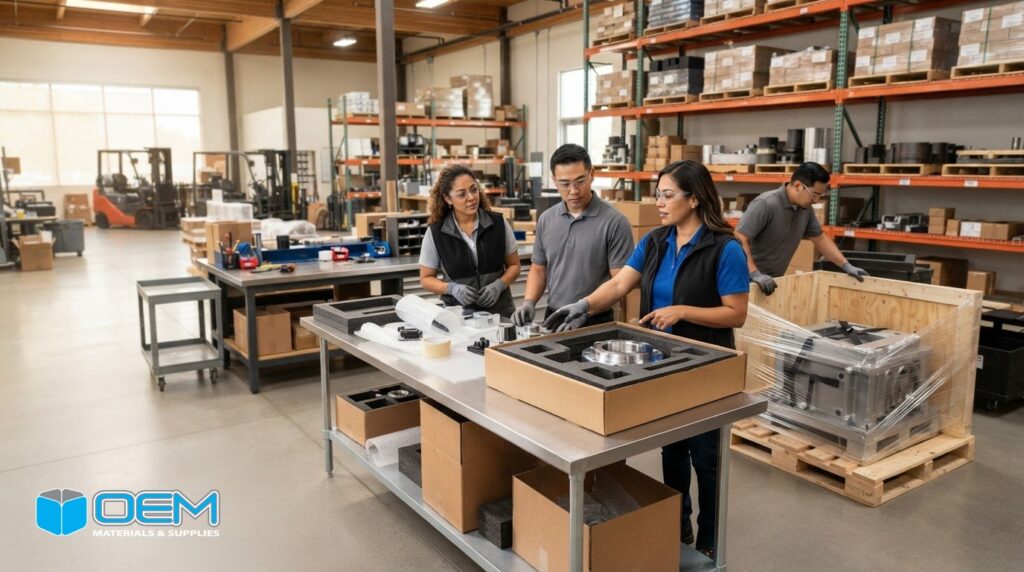
What if the best way to improve packaging performance is to outsource only the work slowing production down? The benefits of outsourcing packaging depend on choosing the right tasks, not handing over every responsibility. When packaging labor competes with production and warehouse priorities, targeted outside support can address specific bottlenecks while your team retains oversight of quality, schedules, and shipping requirements.
Material costs, product damage, and inventory shortages can make packaging difficult to manage consistently. Outsourcing selected activities may provide support with packaging design, material sourcing, kitting and assembly, or inventory management without requiring a full operational handoff. The right approach depends on your products, demand patterns, internal capacity, and shipping needs.
This guide explains which packaging responsibilities may make sense to outsource and how to compare the operational trade-offs. It covers practical factors such as product dimensions, materials, labor demands, and demand variability, then outlines how to plan a manageable transition and work effectively with a supplier. Manufacturers in Orange County, Los Angeles, Riverside, and San Diego can use these steps to decide where outside support fits, where internal control matters, and how to keep packaging aligned with production and fulfillment priorities.
Key Takeaways
- The benefits of outsourcing packaging depend on targeting specific bottlenecks, rather than transferring every packaging responsibility.
- Compare labor, equipment, storage, material use, damage, and replenishment to assess the operational and cost trade-offs.
- Use a clear baseline and define scope, responsibilities, specifications, approvals, and performance measures before transitioning work.
- Choose between in-house, outsourced, or shared responsibilities based on the control and operational knowledge your team needs to retain.
- Packaging design, corrugated boxes, foam packaging, crates, and inventory support can address distinct packaging and shipping needs.
Benefits of Outsourcing Packaging Start with the Work You Need to Solve
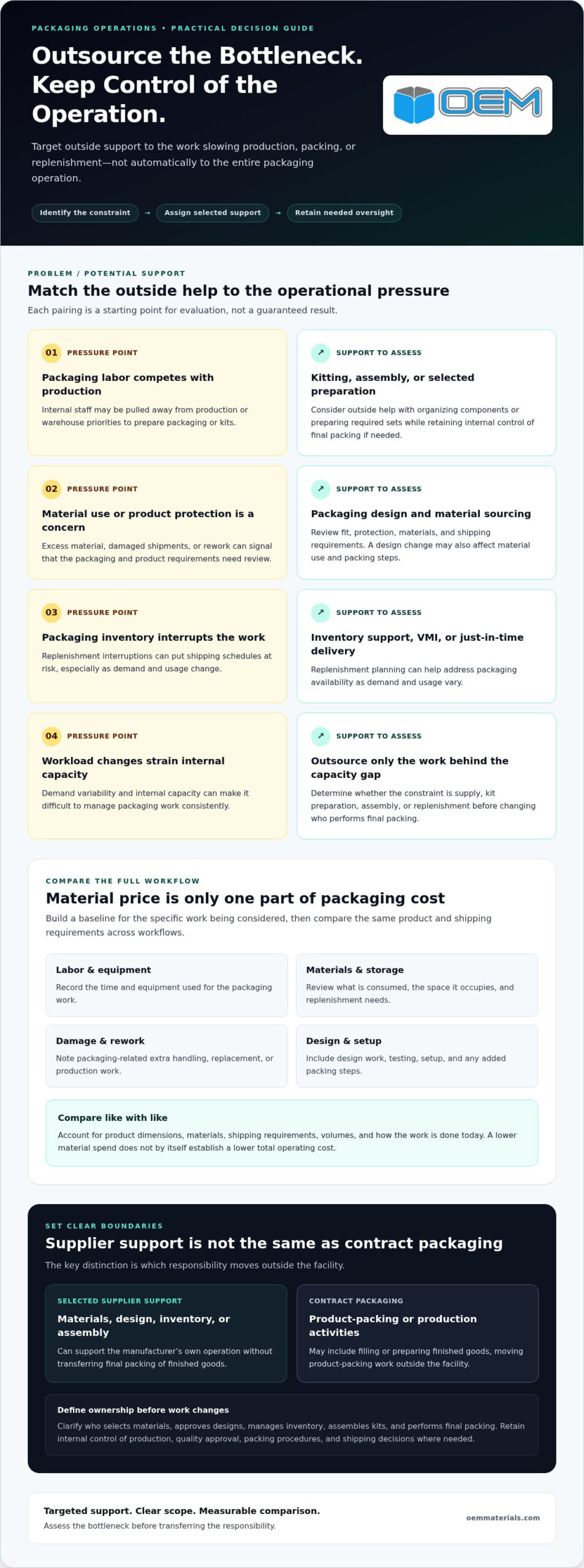
Limited labor can pull people away from production and warehouse priorities. Inefficient packing may use excess material, damaged shipments can point to a mismatch between packaging and product needs, and inventory interruptions can put shipping schedules at risk. These pressures don’t always call for a wholesale change. The benefits of outsourcing packaging are often clearest when a manufacturer identifies one specific bottleneck and assigns only the related work or support to an external partner.
Packaging outsourcing means using an outside partner for selected packaging tasks or supply-chain support. It can include sourcing materials, developing a packaging design, supplying packaging, preparing kits, or supporting replenishment. The manufacturer can retain control of production, packing procedures, quality approval, and shipping decisions while outsourcing only the responsibilities that fit its needs.
Which packaging responsibilities can a manufacturer outsource?
Break the work into distinct needs. Material sourcing covers the selection and supply of packaging materials. Design support focuses on how packaging fits the product and shipping requirements. Packaging supply includes items such as corrugated boxes, foam packaging, crates, and cushioning materials. These activities can support internal operations without transferring the packing of finished goods.
Kitting and assembly can address specific preparation or labor constraints by organizing components or packaging into required sets. Inventory support tackles a different challenge: keeping packaging available as demand and usage change. Vendor-managed inventory (VMI) and just-in-time delivery can support replenishment planning. For example, a manufacturer seeking more predictable packaging availability can consider just-in-time packaging as part of its supply approach.
Outsourcing packaging versus hiring a contract packager
These models aren’t interchangeable. Contract packaging generally means transferring product-packing or production activities, which may include filling or preparing finished goods. The Contract Packager overview describes this type of arrangement. A packaging supplier may instead support the materials, design, inventory, or assembly that enables a manufacturer’s own team to do the work.
The practical distinction is which responsibility moves outside the facility. If the need is additional capacity to pack, fill, or fulfill finished goods, that points toward contract packaging. If the issue is packaging design, material availability, kit preparation, or replenishment, targeted supplier support may address it without moving product-packing operations outside the facility. Define the scope before evaluating options: identify who selects materials, approves designs, manages inventory, assembles kits, and performs final packing. Clear boundaries preserve internal oversight and prevent a limited sourcing arrangement from being mistaken for a transfer of the entire packaging operation.
How Outsourcing Packaging Can Improve Cost Control, Capacity, and Consistency
Moving packaging work outside the facility doesn’t prove that the operation has improved. Start with a baseline. Track labor used for packaging, equipment demands, storage space, material consumption, rework, shipping damage, and replenishment interruptions. Compare those measures with the specific work an external partner would handle. This gives purchasing and operations teams a practical way to assess the benefits of outsourcing packaging against current constraints instead of relying on broad cost or efficiency claims.
Cost control depends on the full packaging workflow
Material price is only one part of packaging cost. Include the labor required to pack, move, and restock materials, along with storage needs, damaged shipments, and rework. If a packaging change requires design work, testing, or setup, account for those needs too. A lower material spend may not reduce total operating cost if it adds handling steps or fails to protect the product in transit.
- Labor and equipment: Record the time and equipment used for the packaging work being considered.
- Materials and storage: Review what is consumed, how much space it occupies, and how often it needs replenishment.
- Damage and rework: Note where packaging-related issues create extra handling, replacement, or production work.
Compare the same product and shipping requirements across the current and proposed workflows. Savings depend on product dimensions, materials, shipping requirements, volumes, and how the work is done today. A packaging design change may also affect material use and packing steps, so include design and setup requirements in the comparison. Custom packaging design can help when fit or protection is part of the problem.
Capacity and flexibility during demand changes
Selected outside support may help a manufacturer manage workload peaks without assigning every packaging task to internal staff. Pinpoint the capacity gap: does the team need help with packaging supply, kit preparation, assembly, or replenishment, or is the constraint in production or finished-goods packing? Matching the scope to the pressure point helps preserve internal attention for production, engineering, or fulfillment priorities.
Compare that need across prototypes, short runs, and high-volume programs. A prototype may require packaging design and a limited material run, while a sustained program may need planned supply and replenishment. Flexibility depends on the agreed scope, forecast, materials, and delivery requirements. Confirming these details helps teams avoid assuming that an outside arrangement can absorb every demand change without planning.
Outsourcing benefits depend on the specific work, the operating baseline, and the service arrangement. Use that principle to set expectations and choose measures that reflect the actual bottleneck, such as packaging labor hours, material usage, damage, or supply interruptions.
For a project-specific comparison, manufacturers can share packaging requirements for a quote, including product dimensions, weight, shipping needs, and expected usage.
Outsourcing Packaging vs. Keeping It In-House: Compare Control, Risk, and Fit
Outsourcing doesn’t automatically mean handing over packaging decisions. A manufacturer can retain control of specifications, approvals, and final packing while assigning a defined task, such as design support, material sourcing, or replenishment, to an outside partner. The right arrangement depends on where internal capacity is strong and where a specific constraint affects production or shipping.
Use this comparison to clarify the trade-offs before changing responsibilities:
| Approach | Control and staffing | Capital and material availability | Coordination and operational knowledge | Key trade-off |
|---|---|---|---|---|
| Internal work | Direct day-to-day oversight; relies on internal staff. | Uses existing equipment and storage, or requires the company to provide them. | Knowledge stays close to production and quality teams. | Maintains direct control but requires enough staff, space, and equipment to meet demand. |
| Outsourced work | Responsibility for the agreed task moves outside the facility. | Can reduce the need to manage selected materials or equipment internally. | Requires clear specifications, communication, and handoffs. | Provides external support but gives the company less direct control over the transferred activity. |
| Shared responsibility | Internal teams keep approvals or packing while a partner supports selected tasks. | Combines internal resources with outside material or supply support. | Retains company knowledge while requiring agreement on responsibilities and timing. | Targets a defined constraint, but coordination between teams must be managed. |
When keeping packaging work in-house may make sense
Internal operations may be a good fit when existing equipment and employee skills meet a predictable workload. Keeping work close can also support direct daily oversight when a process has specific quality requirements or depends on detailed production knowledge. Outsourcing isn’t automatically less expensive or more effective. If internal capacity is adequate and the workflow is stable, transferring work may add coordination without resolving a meaningful constraint.
When a hybrid packaging model may be a better fit
A hybrid model lets a manufacturer retain core processes and delegate only the task causing friction. For example, the team might continue packing products in-house while using outside support for packaging design, specialized materials, replenishment, or kit assembly. Custom packaging design services can support design needs while internal teams retain approval authority. Define the handoff, decision rights, and required information so the added support fits the existing workflow.
Partial outsourcing targets a defined operational constraint without requiring a transfer of the entire packaging function. To decide what belongs inside or outside, identify which tasks rely on critical internal knowledge, which consume scarce labor or equipment, and which depend on reliable material availability. Then assign each task to the arrangement that meets its requirements with manageable oversight.
How to Evaluate and Transition a Packaging Outsourcing Program
A controlled transition starts with a clear picture of the current operation. Without a baseline, changes in labor, material use, damage, or supply reliability can be difficult to assess. The goal isn’t to redesign every packaging process at once. Define the specific work under consideration, document how it performs today, and set practical measures for reviewing any change.
Build a packaging scope from operational data
Gather the information that affects packaging fit and supply planning. For the products in scope, record dimensions, weight, fragility, shipping conditions, and annual usage where available. Document current materials, packing steps, storage limits, and any supply interruptions. This detail helps distinguish a design issue from a replenishment or labor constraint and gives teams a shared basis for defining the work.
Set measures that match the problem. A labor constraint may call for tracking time spent on a defined task. A material concern may require documenting usage per shipment, while a damage issue calls for recording relevant shipment problems and rework. For an inventory challenge, note how often shortages interrupt work and what delivery requirements packaging must meet. Choose one measurable operational problem to address rather than requesting a general overhaul.
Plan a controlled transition and review
Before work begins, document the scope and handoffs. Specify who owns packaging requirements, design and material approvals, inventory visibility, delivery coordination, and issue escalation. Agree on how changes are reviewed and which measures will indicate whether the arrangement is working. Clear responsibilities help prevent gaps between purchasing, engineering, warehouse, and supplier teams.
- Select a pilot. Choose a defined product line or packaging task with a clear baseline and manageable scope.
- Confirm requirements. Align on specifications, approved materials, order or replenishment information, delivery needs, and the internal approval path.
- Track performance. Record the agreed measures during the pilot, including relevant labor, material use, damage, and inventory interruptions.
- Review before expanding. Compare results with the baseline, identify workflow gaps, and decide whether to adjust, continue, or broaden the arrangement.
Review results in context. A change in material use may reflect a design revision, a different product mix, or a volume shift. Delivery performance should be considered against the agreed schedule and actual requirements, not in isolation. The benefits of outsourcing packaging are easier to evaluate when the team can connect each result to the task transferred and the conditions under which it was performed.
If replenishment timing is part of the scope, just-in-time packaging can be considered alongside the facility’s usage patterns and delivery requirements. For a project-specific review, request a packaging quote with product dimensions, weight, shipping conditions, and annual usage where available.
How OEM Materials Supports Manufacturers Outsourcing Packaging Work
Outsourcing packaging work doesn’t have to mean transferring production or finished-goods packing. OEM Materials & Supplies supports manufacturers with defined packaging and supply-chain needs, including packaging design, material sourcing, kitting and assembly, vendor-managed inventory, and just-in-time delivery. These services can address a particular bottleneck while your team retains oversight of production and packaging decisions.
Material choices should fit the product and its shipping requirements. Corrugated boxes, foam packaging, crates, cushioning materials, stretch film, and edge protectors each serve different packaging roles. Product dimensions, weight, protection needs, and shipping conditions help guide the right approach. Custom corrugated boxes, for example, can be designed as part of a packaging plan built around the product and how it moves through the supply chain.
Match packaging support to the product and workflow
Packaging requirements can differ across prototypes, short runs, and high-volume programs. A prototype may call for design and material evaluation, while a recurring production program may need coordinated packaging supply or inventory support. OEM Materials & Supplies supports these program types without requiring manufacturers to hand over unrelated packaging responsibilities. The appropriate scope depends on the specific products, workflow, materials, and delivery needs.
Match support to the operational constraint:
- Design and materials: Align packaging selection with product dimensions, protection needs, and shipping requirements.
- Kitting and assembly: Address defined preparation tasks that compete for internal labor or disrupt workflow.
- Inventory support: Use vendor-managed inventory or just-in-time delivery to address packaging replenishment needs.
These are distinct forms of support, not a single contract-packing operation. A manufacturer may source packaging materials externally and continue packing products in-house, or use kitting and assembly support for a specific workflow while retaining approval of requirements. The benefits of outsourcing packaging depend on how well the selected support fits the work being performed.
Prepare a useful request for a packaging consultation
A focused request connects packaging recommendations to actual operating conditions. Include product dimensions and weight, annual usage where available, and shipping requirements. Identify the challenge you want to address, such as product damage, excessive packing labor, inefficient material use, or packaging inventory interruptions. If requirements vary across product lines, note which products or tasks should be considered first.
OEM Materials & Supplies serves manufacturers in Southern California, including Orange County, Los Angeles County, Riverside, and San Diego County, as well as customers nationwide. To discuss packaging materials, design, kitting, or inventory support for your operation, request a packaging quote or consultation with the relevant product and shipping details.
Make Your Next Packaging Decision Measurable
Packaging requirements can shift as products, designs, and shipping patterns change. Treat approved specifications as working documents, not permanent assumptions. Keep revision history and decision ownership clear so future changes can be assessed without losing the reasoning behind the current packaging configuration.
The benefits of outsourcing packaging are more sustainable when teams preserve what they learn. Record which requirements shaped the selected materials and service arrangement, then use that knowledge during product or process changes. This gives purchasing, engineering, and operations a stronger basis for future sourcing decisions.
OEM Materials & Supplies can help you address packaging requirements for your operation. Request a packaging quote or consultation with product and shipping details to discuss your needs. A clear record today can make tomorrow’s packaging decisions more consistent.
Frequently Asked Questions
What does outsourcing packaging mean for a manufacturer?
For a manufacturer, outsourcing packaging means defining which packaging deliverables and decisions sit outside the plant. For example, a supplier may provide packaging to an approved specification, while the manufacturer retains responsibility for product release and pack-out instructions. Documenting who owns purchase orders, specification changes, and issue escalation helps purchasing, engineering, and operations coordinate without blurring accountability.
Can a company outsource only part of its packaging process?
Yes. A company can limit the arrangement to a particular item or responsibility, such as coordinating supply for one packaging material while keeping packing procedures and quality checks internal. Be specific about what triggers a change request, who can approve it, and how revised requirements reach the people doing the work. Those boundaries help keep a limited sourcing arrangement from changing other parts of the process by default.
How do you measure the benefits of outsourcing packaging?
Compare like with like. Track the same product family, order type, or facility before and after the change, and normalize results where practical, such as material use per shipment rather than total use alone. Separate unusual orders or product-mix changes from routine activity. This makes the benefits of outsourcing packaging easier to interpret and helps teams identify whether a result came from the new arrangement or a change in what they shipped.
Is outsourcing packaging always less expensive than doing it in-house?
No. An outside arrangement may add coordination or service expenses, while internal labor and equipment may remain in place after a task moves. Consider how much capacity the current setup actually uses and whether costs that remain fixed can change. Compare the proposed arrangement with the current one over the same period and workload. This avoids treating a supplier invoice as a direct substitute for the full internal operating cost.
Can outsourced packaging support both prototypes and large production programs?
Yes. A prototype can provide an opportunity to document the approved packaging configuration before repeat production. Capture revisions, sign-off status, and any pack-out instructions that need to carry forward. As production volume changes, teams can use that controlled record to distinguish an approved change from an informal variation. The same discipline helps engineering and operations manage packaging requirements across different production stages.
What information should I prepare before requesting a packaging quote?
Along with basic product and shipment details, gather any existing packaging drawings, material part numbers, pack-out instructions, or representative samples. Note how order timing varies and identify handling or delivery constraints that affect the packaging choice. If several product configurations are involved, distinguish them clearly. These records help clarify what should remain unchanged and where a packaging recommendation may need to account for differences.
How can vendor-managed inventory help with packaging supplies?
Vendor-managed inventory can support coordination by connecting packaging replenishment planning to item-level usage information. Its usefulness depends on accurate, timely visibility into consumption and changes in production needs. Decide who provides those updates, how exceptions are communicated, and how inventory records are reconciled. For example, separating routine production use from one-time project demand can make consumption patterns more useful for planning future replenishment.