
The lower quoted unit price can still result in a higher cost per usable box. That’s the key consideration when comparing cost per box digital vs litho printing for corrugated packaging. A quote may separate setup fees from unit costs, while leaving inventory exposure and artwork changes outside the headline price.
It’s reasonable to focus on the per-box figure when comparing suppliers. But that number doesn’t show how much you’ll spend on setup, how order quantity affects production cost, or whether stored boxes could become unusable after a design change. A fair comparison accounts for the full order cycle, not just the initial quote.
This article explains how to compare digital and litho printing on a like-for-like basis. You’ll see how production volume, artwork versions, and ordering cadence affect the cost per usable box, and what project details to gather before requesting a quote. Since box design and print-method selection work together, start with your packaging requirements and production program.
Key Takeaways
- Compare the cost per usable box, not just the unit price. Include relevant charges and the number of boxes actually used.
- Understand how digital printing’s file-based process and litho-lam setup can affect costs as order quantities and artwork needs change.
- Use the same box dimensions, board requirements, graphics, and order quantity to compare quotes on a like-for-like basis.
- Evaluate cost per box digital vs litho printing across order scenarios, including artwork revisions and inventory that may go unused.
- Choose a print approach based on box construction, print requirements, demand stability, and ordering cadence, not a universal break-even quantity.
Digital vs. Litho Printing for Corrugated Boxes: What Does Cost Per Box Mean?
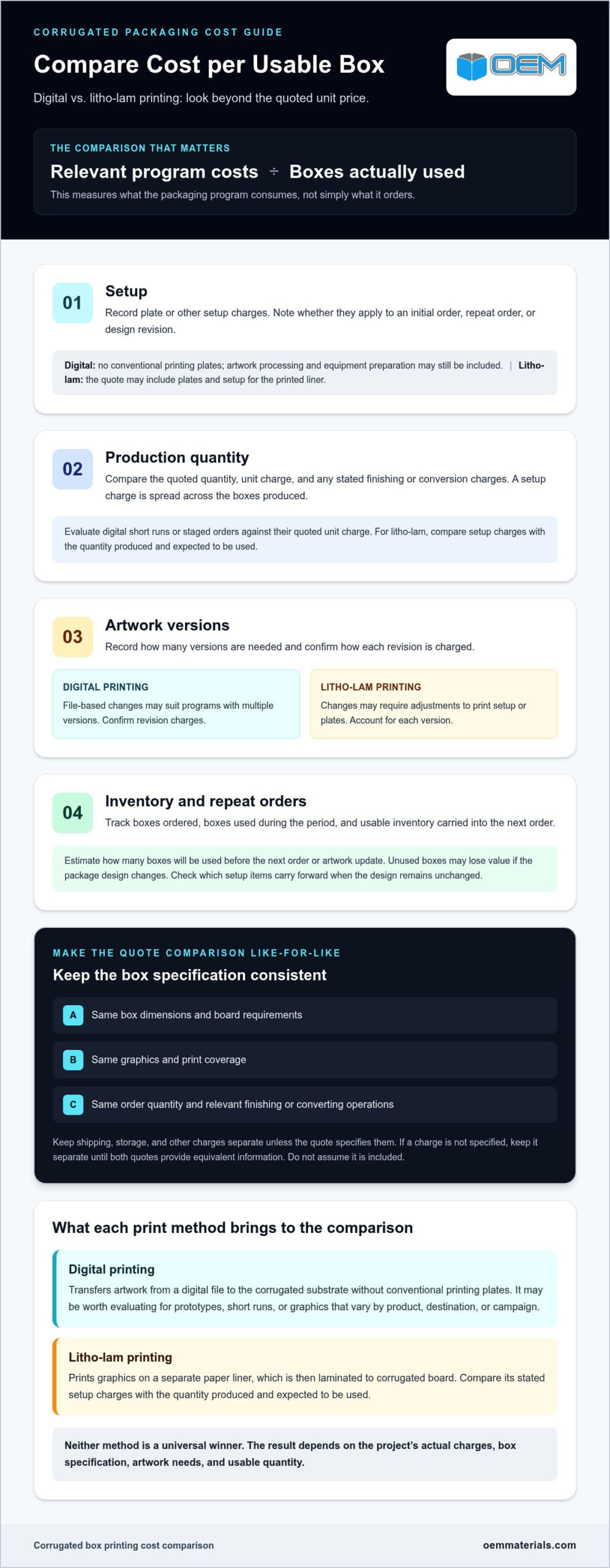
For a corrugated packaging program, the useful comparison is more than the price charged for each box. Define cost per usable box as the relevant program cost divided by the number of boxes actually used. This measure reflects what the program consumes, rather than treating every box ordered as a box that delivers value.
Litho-lam is a corrugated packaging process in which graphics are printed on a separate paper liner and then laminated to corrugated board. It differs from a generic lithographic print job, which may not include the materials, converting, or handling needed to produce a finished box. Digital printing transfers artwork from a file to the corrugated substrate without conventional printing plates. For background on the process, see Digital printing. The finished corrugated box, its construction, and its print requirements all belong in the comparison.
This definition does not declare a universal winner. It gives purchasing and operations teams a consistent way to evaluate options across different production quantities, design needs, and ordering patterns.
Which costs belong in a box-printing comparison?
Start with the charges and quantities shown in each quote. Keep cost categories visible so a lower unit charge does not obscure setup or inventory considerations.
- Setup: Record plate or other setup charges when listed. Note whether they apply to an initial order, a repeat order, or a design revision.
- Production: Capture the quoted production quantity, unit charge, and any stated finishing or conversion charges. Compare equivalent box dimensions, board requirements, and graphics.
- Inventory: Track boxes ordered, boxes used during the period, and usable inventory carried into the next order. Boxes still in storage have not yet been used.
- Artwork and ordering: Record the number of artwork versions and the timing of orders. Separate costs tied to changes or order cadence from charges that apply to every box.
To calculate the comparison, add the relevant quoted program costs, then divide by the number of boxes used. If a quote does not specify a charge, keep it separate until both quotes provide equivalent information. Do not assume it is included.
Why is a quoted price per box not the whole answer?
A setup charge is spread across the boxes produced, so it can have a greater effect on a shorter run than on a larger one. Compare all stated charges against the production quantity, not just the unit line. Then estimate how many boxes are likely to be used before the next order or artwork update.
For example, if a team orders more boxes than it can use before the package design changes, the unused balance reduces the value of an apparent unit-price advantage. Keep shipping, storage, and other charges separate unless the quote specifies them. This makes the comparison clearer and avoids assumptions about unstated costs. The cost per box digital vs litho printing depends on the program’s actual charges and usable quantity, not on print method alone.
How Digital and Litho-Lam Printing Change Corrugated Box Costs
Print method affects which costs appear in a corrugated box quote and how design updates fit into the production plan. Digital printing transfers artwork from a digital file to the substrate without conventional printing plates. Litho-lam uses a separately printed sheet that is laminated to corrugated board. The graphics are not printed directly onto each finished box in the same way as a direct-to-board process.
These process differences are useful cost inputs, but they do not determine the final result by themselves. Compare the same finished-box specification, including dimensions, board requirements, print coverage, and any finishing or converting operations. The exact production methods, charges, and included operations depend on the project quote.
| Cost factor | Digital printing | Litho-lam printing |
|---|---|---|
| Setup | No conventional printing plates; artwork processing and equipment preparation may still be included. | Quote may include printing plates and setup for the printed liner. |
| Order quantity | Evaluate short runs or staged orders against the quoted unit charge. | Compare setup charges with the quantity produced and expected to be used. |
| Artwork revisions | File-based changes may suit programs with multiple versions; confirm how revisions are charged. | Changes may require adjustments to print setup or plates; account for each version. |
| Repeat orders | Review repeat-order setup and unit charges for the stated specification. | Check which setup items carry forward when the design remains unchanged. |
When can digital printing fit a corrugated box program?
Digital printing can be worth evaluating for prototypes, short runs, or graphics that vary by product, destination, or campaign. It may help limit the number of boxes committed to one artwork version, but that does not guarantee a lower total cost. Compare the quoted setup and unit charges with the quantity you expect to use, including the risk that a later revision leaves older boxes in inventory.
Keep the finished-box requirement constant. A change in board or construction can affect the comparison independently of print method. Packaging design support can help align box dimensions and graphics with the program’s actual needs.
When can litho-lam printing fit a corrugated box program?
Litho-lam may suit a stable design with repeat demand, particularly when a larger production quantity can use the same printed liner and box specification. Evaluate plate and other setup charges alongside the quantity ordered and the number of boxes likely to be used. A lower quoted unit charge matters only if the order fits demand and inventory capacity.
There is no fixed volume threshold that applies to every program. Compare project-specific quotes, artwork assumptions, and usable quantities to assess the cost per box digital vs litho printing. For a project-specific comparison, share your box and print requirements.
How to Compare Digital and Litho Cost Per Box Across Order Scenarios
A useful comparison starts with matched specifications and expected usage. If the digital quote and litho-lam quote use different box dimensions, board requirements, graphics, quantities, or delivery assumptions, the price difference cannot be attributed to print method alone. Build two scenarios from the same packaging requirements, then calculate each method using its stated charges and the number of boxes your operation expects to use.
What is a practical cost-per-usable-box formula?
Cost per usable box = relevant quoted program costs ÷ expected usable boxes. Use this as a comparison measure, not as a substitute for reviewing the quote. List included charges, such as setup, production, finishing, and conversion, separately from items that remain unquoted or are handled elsewhere. Label assumptions for expected usage and inventory clearly. Keep buyer-specific storage, handling, and shipping inputs separate unless they are part of the quoted amount.
Apply the formula consistently to both print methods. A simple worksheet can make the comparison repeatable:
- Match the specifications. Use the same box dimensions, board requirements, graphics, print coverage, and finishing assumptions.
- Record each quote line. Capture setup charges, unit charges, production quantity, and any stated conversion or other charges. Mark missing or separately billed items rather than treating them as included.
- Estimate usable quantity. Base the denominator on boxes expected to be consumed during the relevant period, not automatically on the full order quantity.
- Calculate and document. Divide relevant quoted costs by expected usable boxes, and note assumptions that could change the result, including artwork updates or demand shifts.
This keeps the cost per box digital vs litho printing comparison tied to a defined package and planning period. It also makes quote differences easier to trace to setup, production, or usage assumptions.
How do artwork changes and excess inventory affect the result?
Model stable demand separately from a changing program. For a stable design, compare the quoted quantity with expected consumption before the next planned order. For changing graphics or uneven demand, estimate how many boxes could remain usable if a product version, label, or packaging requirement changes. Do not assume every ordered box will be consumed under its original artwork.
| Scenario | What to evaluate |
|---|---|
| Stable design and repeat demand | Compare setup and unit charges against the planned quantity and expected use before replenishment. |
| Artwork changes or uneven demand | Estimate usable inventory by artwork version and account for boxes that may no longer fit the current requirement. |
Storage and handling impacts vary by facility and ordering plan, so enter them as buyer-specific inputs rather than assumed savings. Review packaging design and print selection together. Custom packaging design support can help define the box specification used for a consistent quote comparison.
How to Normalize Box Quotes Before Choosing a Printing Method
Before comparing digital and litho-lam quotes, make sure each one covers the same corrugated box program. Differences in box size, board requirements, print coverage, order quantity, or delivery assumptions can shift the quoted total. A standardized request helps purchasing and operations teams see which charges come from the print method and which come from the packaging specification.
What information should buyers align across quotes?
Prepare one specification sheet and use it for every quote request. Include product dimensions and packed weight, along with the shipping requirements the box must support. State annual usage and expected order quantity, then clarify whether graphics are fixed or may change during the program. Consistent inputs make supplier responses easier to compare and help prevent a price difference from being mistaken for a print-method difference.
- Box requirements: Record finished dimensions, board requirements, construction, and print coverage.
- Artwork: Identify the current artwork version and expected number of versions or revisions.
- Quantity and cadence: Provide annual usage, quantity per order, and anticipated replenishment timing.
- Delivery assumptions: Use the same delivery locations and requested timing for each comparison.
Then normalize quote line items. Separate setup or plate charges, per-box production charges, finishing or conversion, and other stated fees. If a charge is missing or bundled into another line, mark that difference rather than assuming it is included in every quote. Keep shipping and storage separate unless the quote specifically includes them.
Compare planned orders with expected consumption as a final check. Annual usage can help show whether the quoted quantity aligns with demand or could leave excess inventory between replenishments. For a broader cost review, examine other packaging expenses, such as material use, handling, and the effect of ordering cadence, alongside print charges.
How can packaging design affect the cost comparison?
Print method is only one part of the box specification. Dimensions and construction should fit the product and its shipping requirements. A box that is larger or more complex than needed may change material and shipping costs, while a design adjustment may affect production assumptions. Potential savings depend on product dimensions, materials, and shipping requirements, so evaluate design changes alongside print charges rather than attributing every difference to printing.
For example, if one quote uses a different box size or board requirement, its unit price is not a direct comparison, even if the artwork looks similar. Align the design inputs first, then evaluate print options against the same functional requirements. OEM Materials & Supplies provides packaging design support for custom corrugated box programs, connecting box construction and graphics to the broader packaging need.
Once the specifications and assumptions are aligned, a cost per box digital vs litho printing review becomes more useful for procurement decisions. To prepare a project-specific quote comparison, submit your box specifications, product dimensions, packed weight, and annual usage.
Choose a Corrugated Box Printing Approach for Your Production Program
There is no universal winner in a digital-versus-litho comparison. Digital may be worth evaluating for prototypes, shorter production runs, or artwork that changes across versions. Litho-lam may suit a stable design and repeat demand when production quantities align with actual usage. The right choice depends on the finished box specification, print requirements, demand pattern, and how much inventory your operation can use before a change.
Keep these factors connected. A print method that looks favorable on a unit-price line may be less suitable if it results in graphics becoming obsolete or boxes sitting unused. Likewise, a higher setup charge may be easier to absorb when a consistent design supports repeat production. Compare both options against the packaging program, not just the first order.
OEM Materials & Supplies supports custom corrugated boxes, packaging design, prototypes, and high-volume production programs. Reviewing box requirements alongside graphics helps keep construction, protection needs, and print selection aligned. Cost per box digital vs litho printing is meaningful only when each option is based on the same requirements and realistic usable quantities.
What should buyers provide for a useful corrugated box quote?
Share the product’s dimensions, packed weight, annual usage, and shipping requirements. Include box drawings or an existing sample when available, along with current artwork files. If graphics may change, describe the expected versions and timing. These details give the project review a practical basis for comparing box construction, print requirements, order quantities, and replenishment needs without relying on mismatched assumptions.
How can a packaging partner support the decision?
A packaging partner can assess print options in context with box design and the product’s protective requirements. This helps distinguish print-related quote differences from changes in dimensions, materials, or construction. Potential savings depend on the specific product, materials, and shipping requirements, so recommendations should reflect the application rather than a general rule about print method.
For an accurate project review, include the details that affect both the box and the order plan:
- Product dimensions and packed weight.
- Annual usage and expected order cadence.
- Shipping requirements and any relevant handling considerations.
- Available box drawings, samples, and artwork files, including planned changes.
These inputs help connect the quoted box specification to how the packaging will be used across the program. They also support a clearer discussion of prototypes, short runs, or repeat production based on demand.
Request a project-specific quote with your dimensions, weight, annual usage, and shipping requirements. OEM Materials & Supplies supports businesses in Orange County, Los Angeles, San Diego, and Riverside with custom packaging solutions.
Set Up Your Next Corrugated Packaging Review
Use the next packaging review to look beyond the immediate purchase. A product update, new artwork, or shift in order cadence can change what makes sense for the program. Set a review point before those changes take effect, so print decisions stay connected to packaging requirements and production planning.
The cost per box digital vs litho printing comparison is most useful when it informs the next decision, not just the current quote. Keep the assumptions behind the selection available for future reviews, especially if demand or packaging specifications change. That gives purchasing and operations a clear basis for reassessing the approach without relying on an old unit price alone.
OEM Materials & Supplies can help assess corrugated box requirements and packaging design for your program. Start a project-specific quote request with your current box specification and production plans. Include product dimensions, packed weight, and annual usage to support a useful packaging review for your operation in Orange County, Los Angeles, San Diego, or Riverside.
Frequently Asked Questions
Which is cheaper per box, digital or litho printing?
Neither method is always less expensive per finished box. The cost per box digital vs litho printing depends on setup charges, order quantity, box specifications, artwork stability, and how many boxes your operation will actually use. For example, a lower unit quote may not be advantageous if part of the order becomes unusable after a packaging update. Compare quotes built from the same requirements and realistic consumption plans.
At what quantity does litho printing become cheaper than digital?
There is no single quantity that establishes a crossover for every corrugated box program. Box dimensions, print coverage, production requirements, setup charges, and repeat demand all affect the comparison. A quantity that fits one package or supplier’s process may not fit another. Request comparable quotes at the order quantities your operation could realistically place, then assess them against demand and inventory capacity rather than relying on a general threshold.
Does digital printing cost less for short runs of corrugated boxes?
Digital printing can be worth evaluating for prototypes, shorter runs, or graphics that change between versions because it avoids conventional printing plates. That does not guarantee the lowest finished-box cost. A specific quote may include setup, unit production, finishing, or other charges that affect the result. For a prototype or limited release, compare the required box construction and expected use alongside those charges, rather than choosing based on print method alone.
Why does litho-lam printing have setup costs?
Litho-lam prepares graphics on a separate printed sheet that is laminated to corrugated board, so a quote may include setup-related work for that process. Consider those charges in relation to the quantity ordered and the number of boxes expected to be used. Quotes may include different operations or line items, so review the specific quote instead of assuming every project has identical plate, setup, or finishing charges.
How do artwork changes affect the cost per corrugated box?
Artwork revisions can affect both production planning and the usefulness of boxes already on hand. For example, a product redesign may make packaging with an older model number or graphic unsuitable for the updated product. Before placing a large order, consider how much inventory is likely to be consumed before each version changes. Track quantities by artwork version so unused boxes are not mistaken for usable stock in a cost review.
What information do I need to compare digital and litho box quotes?
Provide matching box dimensions, board requirements, print coverage, artwork versions, order quantities, and delivery assumptions. Include annual usage, product dimensions, packed weight, and shipping requirements so the packaging review reflects the actual application. Drawings, existing samples, and artwork files can also clarify the specification. These details help businesses in Orange County, Los Angeles, San Diego, and Riverside compare packaging needs using consistent project inputs.