
A damaged shipment costs more than the product that needs replacing. To calculate the cost of a damaged shipment, add documented direct expenses, such as repair or replacement, to supported indirect costs, such as investigation and handling time. Use the same reporting period across records, remove duplicate amounts, and separate measured costs from estimates.
It’s easy to focus on the damaged goods and overlook the work and disruption involved in resolving the incident. A complete total gives purchasing, operations, and finance teams a clearer basis for assessing the impact and identifying recurring problems.
This article explains how to gather and categorize costs across claims, returns, credits, and replacement orders. It also covers employee time, production disruption, and customer-related expenses, while showing how to avoid counting the same loss twice.
Key Takeaways
- Build the total from documented direct expenses and damage-related indirect costs, while keeping estimates separate from measured amounts.
- Use a shared case identifier to connect claims, returns, credits, replacements, and freight records without counting the same expense twice.
- Include investigation, handling, and disruption costs only when records show their connection to the damage.
- Compare incidents by product, packaging configuration, route, carrier, and damage type to spot patterns that warrant investigation.
- Account for salvage value and depreciation when assessing the loss, and retain the records that support those adjustments.
Direct and indirect costs of product damage
To calculate the cost of a damaged shipment, identify the expenses that changed because of the incident. Finance can compare actual spending with the planned cost of completing the order. For example, include an unplanned production changeover only if the damage caused it. This separates incident-related impacts from ordinary operating expenses and gives managers a clearer basis for internal decisions.
Consequential losses are costs that result from the damage rather than from the damaged item itself. Estimate them by comparing the actual outcome with the reasonable operating plan that would have applied without the incident. If a production schedule shifted, examine the affected work and resulting constraint. Don’t assign the entire shift’s overhead to one shipment if other work continued as planned.
Cost ownership also matters. Purchasing may record a supplier credit, while operations absorbs the time needed to adjust a production sequence. Finance should distinguish the company-wide loss from the cost center where it appears. For instance, a warehouse may record extra staging activity while production experiences a delayed handoff. Keeping these views separate prevents internal transfers from appearing as new external costs.
Assess capacity effects using a business-specific basis. Time spent by an engineer may reduce available design capacity, but it does not automatically equal lost profit. The connection is clearer if a delayed engineering release holds up a confirmed production order. If the engineer completes the same work later without affecting delivery or output, record the time as disruption rather than claiming unsupported lost revenue.
Apply the same discipline to customer impact. A service credit is measurable, but a possible future order loss is not equivalent to a completed transaction. Review order history and customer communications before attributing a change in purchasing behavior to one shipment. If the customer places the next order as planned, don’t assign speculative retention costs to the incident.
For management reporting, show operational consequences separately from the accounting total. A production planner might track schedule changes, while finance tracks recognized expenses. These measures answer different questions: one shows process interruption, the other recorded financial impact. Comparing both across similar products or routes can help prioritize investigation without letting one unusual event distort routine decisions.
Damage claims, returns, credits, and replacement records
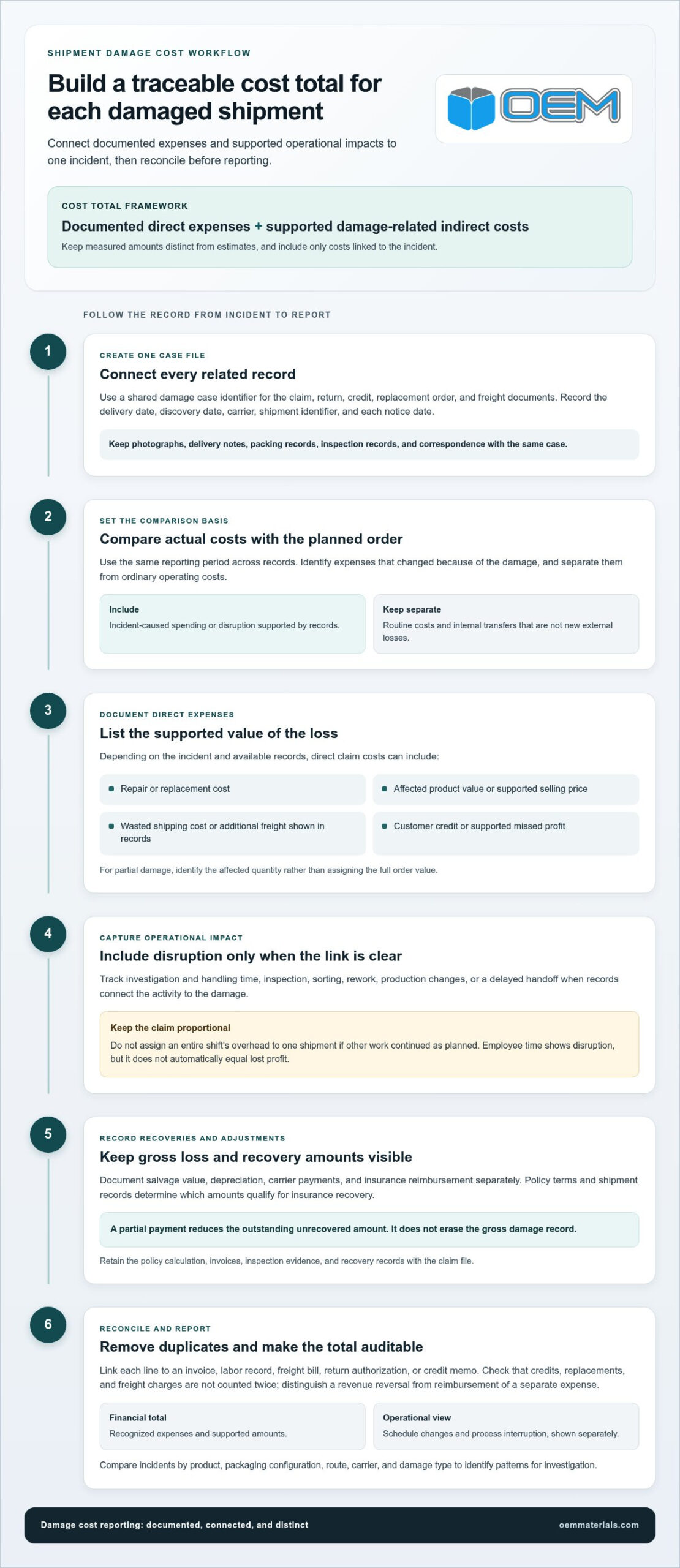
Connect each claim, return, credit, replacement order, and freight document to one damage case. Consistent records help distribution and finance teams reconcile amounts without duplicate entries.
Claim Deadlines and Carrier Liability Limits
A claim deadline determines when damage must be reported or a freight claim filed, while liability limits define the carrier’s financial responsibility. For U.S. shipments, the applicable transport terms determine deadlines and limits. No single figure applies to every shipment.
Record the delivery date, discovery date, carrier, shipment identifier, and date of each notice. Keep photographs, delivery notes, packing records, and correspondence in the same case file. These details help establish when damage appeared and which shipment the claim concerns. Document any delay between delivery and discovery with the inspection record.
Costs Included in Damage Claims
A damage claim can document the supported value of the loss, including product selling price, missed profit, wasted shipping cost, repair cost, or replacement cost. Include an amount only when it relates to the incident and is supported by a record.
Link each line item to an invoice, labor record, freight bill, return authorization, or credit memo. For example, match a customer credit to the affected order and note whether it reverses revenue or reimburses a separate expense. Keep internal investigation or handling time distinct from carrier charges. This gives reviewers a traceable basis for each claimed amount.
Repair and Replacement Costs
Repair cost is the documented expense of restoring damaged goods to usable condition. Replacement cost is the supported cost of supplying equivalent goods when repair is impractical or the product cannot meet its intended use.
Support the calculation with inspection findings, repair estimates, work orders, and replacement invoices. Separate labor, parts, and any additional freight shown in the records. If only part of a shipment is damaged, identify the affected quantity rather than applying the full order value. Link returns and replacement orders to the original case so their amounts remain distinct.
Insurance Reimbursement
Cargo insurance reimbursement is calculated under the policy’s covered valuation and claim terms, then adjusted for applicable deductibles, limits, and documented recovery value. The policy and shipment records determine which amounts qualify.
Compare the submitted loss with the policy’s valuation basis and retain invoices, inspection evidence, and carrier correspondence. Record salvage proceeds or carrier payments separately from the original loss. For example, a partial payment should reduce the outstanding unrecovered amount, not erase the gross damage record. Keep the insurer’s calculation with the claim file to explain the final reimbursement.
The cost and risks of damaged goods
Product damage affects more than the item’s recorded value. Packaging Digest reports that as much as 11% of unit loads arriving at a distribution center have some level of case damage. Each incident can trigger inspection, sorting, rework, or replacement activity. The effect depends on the product’s condition, the number of affected units, and whether goods remain usable. A cracked housing may need repair, while a contaminated or nonfunctional component may require replacement.
Replacement can also carry a larger logistics burden than the original shipment. Replacing a damaged product can cost 17 times more than shipping it. That comparison highlights how freight, handling, and replacement activity can magnify the loss. Calculate the product impact separately from additional shipping and internal labor. This makes it easier to see which part of the total comes from the damage itself and which comes from restoring the order.
Package dimensions and weight can change freight charges on replacement shipments. Dim weight, or dimensional weight, uses package volume rather than scale weight to determine billable weight when it exceeds actual weight. For USPS Priority Mail, Priority Mail Express, and Non-Lightweight Parcel Select, dimensional weight applies to packages exceeding 1 cubic foot. USPS dimensional-weight calculations use 1728 cubic inches per cubic foot and a divisor of 166. The greater of dim weight or actual scale weight determines the shipping cost.
For example, a 36 cm × 25 cm × 16 cm box has a dimensional weight of 3 kg with a 5000 divisor, or 2.4 kg with a 6000 divisor. Those metric examples show why the divisor and carrier service matter. In U.S. dimensional-weight calculations, measure package dimensions at their longest points and round to whole inches. Measurements from 9.00 to 9.49 inches round to 9 inches; 9.50 to 9.99 inches round to 10 inches. Small measurement changes can affect the billable amount.
Repeated shipment damage creates operational risk. Group incidents by product, packaging configuration, route, carrier, and damage type. A recurring pattern may point to a handling problem or packaging configuration that warrants review. Don’t let one unusually costly event outweigh repeated incidents without supporting evidence. Compare similar shipment groups and periods to distinguish recurring exposure from an isolated event.
Packaging choices affect that exposure, but the right configuration depends on product dimensions, weight, fragility, and shipping requirements. Review damage records alongside packing methods and freight charges. Reusable protective packaging may help reduce transit damage and can be repurposed. Track damage, replacement activity, and added shipping costs together to assess the operational impact across affected shipments.
What costs should be included in a damaged shipment claim?
A damaged shipment claim should list each supported loss as a distinct item. Separate product impact from shipping, repair, replacement, and documented operational expenses. This structure lets a reviewer trace each amount to an invoice, work order, freight document, or customer transaction. It also prevents an internal damage-cost total from being mistaken for the amount a carrier or insurer will reimburse.
Start with the affected goods. Use the product’s documented value and identify the damaged quantity, rather than applying the full order value when only part was affected. Keep figures tied to their records, and don’t add packaging again if it’s already included in another recorded amount.
- Product loss: Record the affected units and their supported value.
- Shipping: Include wasted outbound freight or documented return and replacement shipping.
- Repair or replacement: Attach the repair estimate, parts record, work order, or replacement invoice.
- Customer adjustment: Match any credit to the order and identify what it offsets.
- Operational impact: Include investigation, handling, production disruption, or workarounds only with records connecting them to the incident.
Treat missed profit carefully. A canceled order’s selling price is not automatically the amount of profit lost. Use the expected revenue and subtract costs avoided because the sale did not proceed. Keep this calculation separate from product value, shipping, or a customer credit. For example, if a credit reverses a sale, don’t also count the same sales amount as a separate loss without explaining the distinct impact.
Document employee time through task records, labor logs, or a case-specific time entry. Identify the work performed, such as inspection, claim preparation, or production rework. Include the cost only when the time relates to the shipment damage. A general estimate for lost productivity doesn’t show which work was displaced or how the incident caused that loss.
Finally, reconcile credits, carrier payments, salvage proceeds, and other recoveries against the related expense. Preserve the gross loss and show each offset separately so the net amount is clear. Use one case identifier across the claim, return, replacement order, and freight paperwork. The final schedule should distinguish measured amounts from estimates and explain every adjustment with a supporting record.
Use freight documents to identify the outbound shipping cost wasted because of the damage, along with any documented return or replacement shipping costs. For a partially damaged shipment, include only freight costs supported as losses related to the affected goods. Keep each amount separate from product loss and other expenses.
How do salvage value and depreciation affect a cargo damage claim?
Salvage value is the recoverable value of damaged goods that remain usable or can be sold. Depreciation reflects a reduction in value before the shipment damage occurred. Both can affect a cargo damage calculation, but they serve different purposes: salvage concerns what remains after damage, while depreciation concerns the item’s prior condition or value.
Start with the claim’s stated valuation basis and the goods’ condition before transit. Use purchase records, inventory records, or invoices to support the pre-damage value, then document the damage with inspection notes and photographs. If the goods retain some function, identify the usable quantity and any restrictions on resale or use. A clear condition record helps prevent the full value of unaffected goods from being assigned to damaged units.
Next, establish salvage value using evidence tied to the specific goods. Relevant records may include a documented resale offer, an internal reuse assessment, or a disposal record showing no recovery. The product type and extent of damage matter. For example, a scratched exterior on a functional machine component may leave usable value, while damage that affects performance may sharply limit recovery. Record the basis for the salvage estimate and keep it separate from the original goods valuation.
Depreciation should reflect the product’s condition before the incident, not the damage itself. Use applicable accounting or claim valuation records to document prior wear, age, obsolescence, or condition. Don’t reduce the value twice by applying depreciation to a figure that already reflects the same reduction. For inventory, distinguish a routine accounting adjustment from a damage-related loss. The claim terms determine which valuation basis applies.
A useful reconciliation presents three items separately: supported value before damage, the documented effect of the damage, and any remaining salvage value. The arithmetic may be expressed as pre-damage value minus supported post-damage value, with recoveries recorded separately. This comparison shows the loss attributable to the incident. Keep repair estimates separate if repair would restore function, and explain whether salvage represents the goods’ post-damage value.
For example, an inspection may find that some units remain usable while others cannot perform their intended role. Identify each quantity and condition separately, then apply consistent valuation evidence to each group. Avoid using one salvage estimate for products with different damage conditions. Keep inspection records, inventory details, valuation support, and claim correspondence together so reviewers can trace each adjustment.
Packaging changes may help address recurring damage patterns, but the appropriate materials depend on product dimensions, handling, and shipping requirements. If you’re evaluating protective packaging for a product, request a packaging quote with its dimensions and weight.
OEM Materials & Supplies: Corrugated Boxes
OEM Materials & Supplies can help address packaging configurations that leave products vulnerable to transit damage. Corrugated boxes are a practical option when the current carton does not fit the product securely or withstand shipping and handling requirements. For products needing additional cushioning, foam packaging or packaging kits can help position protective components around the item.
Turn to OEM Materials & Supplies when damage records point to recurring issues with carton fit, movement inside the package, or protection during distribution. Share the product dimensions, weight, existing packaging configuration, and shipping requirements so the team can tailor packaging to the application. The right solution depends on the product and how it moves through the supply chain.
Contact OEM Materials & Supplies to discuss packaging for your shipment.
Use Damage Records to Guide the Next Packaging Decision
A damage review can do more than close a claim. Use its findings to refine packaging requirements for future shipments. Compare the affected product’s dimensions, weight, handling needs, and shipping conditions with the packaging configuration used. This gives purchasing and operations teams a practical basis for discussing changes with engineering and evaluating whether the current setup suits the shipment.
For industrial products, corrugated boxes can provide the outer structure, while foam packaging or a packaging kit can help position and protect components. The right arrangement depends on the product and its distribution requirements. A clear record of damage patterns helps focus the review on a specific issue, such as movement inside the package or insufficient protection at a contact point.
Knowing how to calculate the cost of a damaged shipment gives your team a sound starting point for these decisions. If you’re reviewing packaging for a product or shipment, contact OEM Materials & Supplies about your packaging requirements. Bring the product dimensions, weight, and current packaging details to help frame the discussion. A well-documented review can support a more informed next step.
Frequently Asked Questions
How do you calculate the total cost of product damage?
Use a consistent accounting period and compare actual incident-related spending with the costs that would have occurred without the damage. This counterfactual helps separate incremental expenses from routine operations. For a batch of affected products, assign shared costs using a defensible basis, such as units affected or documented labor time. Keep the allocation method consistent when comparing product lines or reporting periods.
What Are the Hidden Costs of Product Damage in Industrial Shipping?
Hidden costs can include production resequencing, temporary storage, extra quality checks, and administrative work that never appears as a separate vendor charge. For example, a shipment held for inspection may occupy receiving space and require additional coordination. Look for these effects in schedule revisions, warehouse activity records, and quality-system entries. Include them in management analysis only when the incident’s effect can be distinguished from normal operations.
How can a business estimate labor costs associated with damage claims?
Use task-based time records to estimate labor rather than applying a broad percentage to the claim. Separate activities such as inspection, engineering review, customer communication, and claim administration. For shared tasks, allocate time according to documented participation or the portion attributable to the incident. This makes estimates more comparable across departments and can help identify recurring administrative steps to simplify.
How do you compare packaging costs with the cost of damaged goods?
Compare packaging alternatives using the same product, shipment profile, and evaluation period. Include material use, packing labor, freight effects, and observed damage outcomes. An option that uses more material may still be operationally preferable if it changes handling or damage patterns, but assess those effects using actual records. Keep test shipments separate from routine production so trial results don’t distort ongoing cost comparisons.
How do you calculate the value of damaged goods in a shipment?
Choose a value basis that matches the purpose of the calculation, such as inventory valuation for internal reporting or the applicable claim valuation for recovery. Then distinguish saleable, repairable, and unusable units. For products with a usable remainder, assess the affected component or function instead of treating the entire assembly as a total loss. Apply the same valuation method to comparable goods for consistent results.
What documentation is needed to support a damaged shipment claim?
Alongside transaction records, preserve evidence of the shipment’s condition at key handoffs. Receiving inspection notes, signed delivery exceptions, photographs of the package before disposal, and repacking records can clarify when damage was observed. Maintain original file names and dates for digital evidence. A clear chronology links condition findings to later inspection, repair, or disposition decisions.