
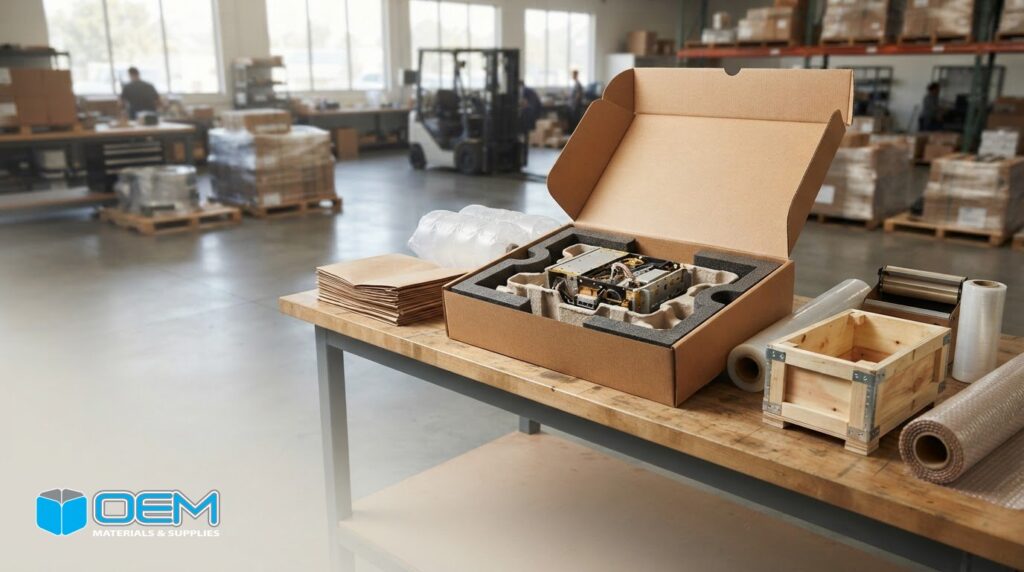
Damage prevention starts with matching cushioning to the product and the forces it will face in transit. Shock absorbing packaging materials help protect products from impacts during handling, shipping, and storage, while cushioning and package design can also limit vibration transfer. Sustainable options, including molded fiber made from recycled paper, can provide protection while supporting material reduction goals.
Choosing cushioning isn’t just about adding more material. Product weight, shape, fragility, and shipping conditions all affect package performance. Excess cushioning can add material without fixing the underlying problem. A well-designed package creates space between the product and the exterior while holding the product securely in place.
This article explains how cushioning absorbs shock and vibration, compares common materials and sustainable alternatives, and explores packaging needs in electronics, healthcare, e-commerce, and manufacturing. You’ll also see how thoughtful material selection and package design can help reduce damage, returns, and related operational disruption.
Key Takeaways
- Use cushioning to create a protective buffer between the product and outside surfaces, limiting damage from impacts during handling and transit.
- Match material and package design to the product’s fragility, shape, weight, and shipping conditions rather than adding cushioning without a clear purpose.
- Compare alternatives such as molded fiber, paper padding, and air cushions based on protection needs and sustainability priorities.
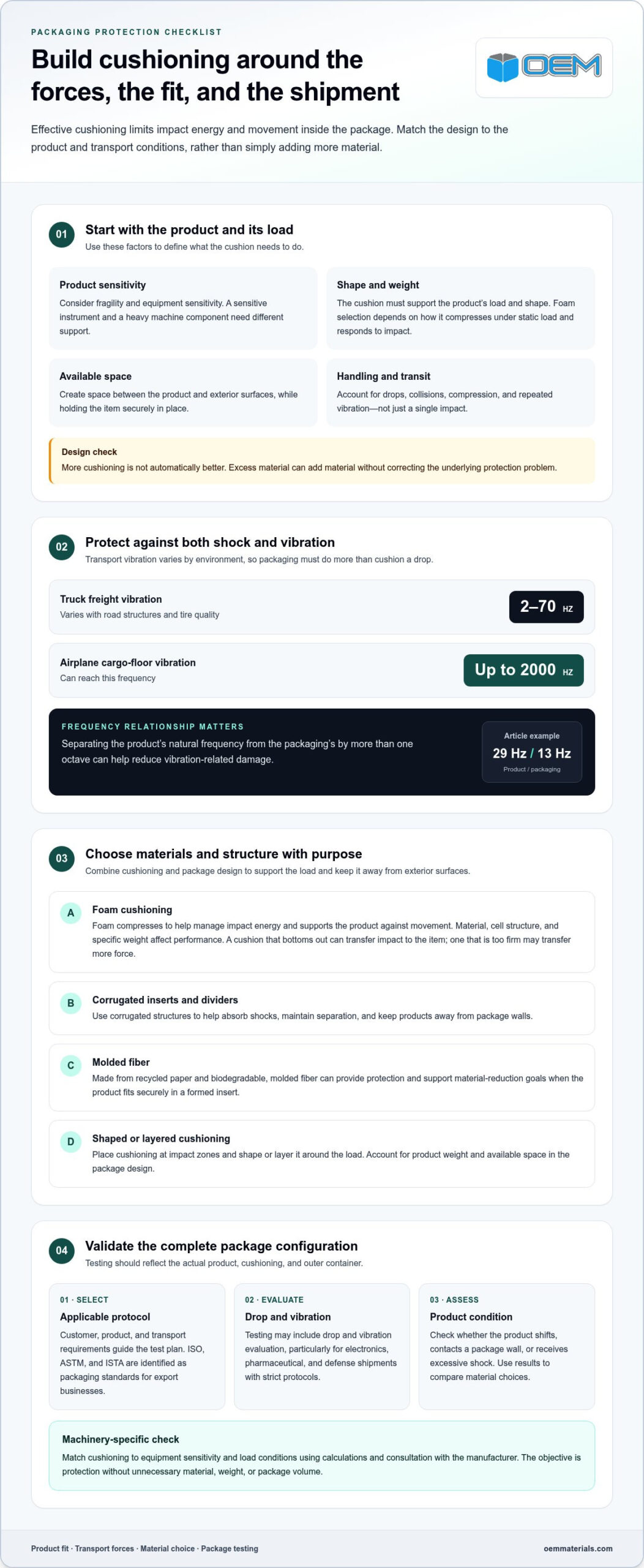
- Separating the product’s natural frequency from the packaging’s by more than one octave can help reduce vibration-related damage.
- Packaging requirements vary across electronics, healthcare, e-commerce, and manufacturing, so protection should reflect the product and its distribution environment.
How to protect your product from shock and vibration using sustainable packaging solutions?
Effective cushioning manages impact energy and limits movement inside the package. The right design depends on the material, product sensitivity, and transport conditions.
Impact and Vibration Protection
Cushioning creates a buffer that reduces the force transferred during drops, collisions, compression, and vibration. It matters because repeated movement during transport can damage products even when the outer package remains intact.
Truck freight vibration can vary from 2 to 70 Hz, depending on road structures and tire quality. Airplane cargo-floor vibration can reach up to 2000 Hz. Those ranges show why packaging must protect against more than a single drop. Corrugated inserts and dividers can absorb shocks, while impact zones keep products away from external package surfaces.
Vibration performance depends on the relationship between product and package frequencies. In one example, the product’s natural frequency is 29 Hz and the packaging’s is 13 Hz. Packaging and product natural frequencies should be separated by more than one octave to reduce damage risk. A properly loaded cushion also has equal shock-pulse rise and decay times. Layered cushioning can add protection when package design accounts for product weight and available space.
Cushioning for Machinery
Machinery cushioning uses shock- and vibration-absorbing materials selected for equipment sensitivity and load conditions. Choosing the right materials matters because vibration can affect both packaged machinery and its components.
For machinery and plant equipment, cushioning is matched to the packaged goods’ sensitivity using calculations and consultation with the manufacturer. This approach accounts for the equipment and its load rather than relying on a generic cushion. For example, a sensitive instrument and a heavy machine component need different support, even if their shipping containers are similar.
Packaging design can isolate equipment from external surfaces by placing cushioning at impact zones. Foam and other cushioning materials can be shaped or layered around the load, while corrugated structures help maintain separation. Sustainable options include molded fiber, made from recycled paper and biodegradable. The design objective is to protect the machinery while avoiding unnecessary material, weight, or package volume.
Cushioning Regulations and Shipping Standards
Packaging standards provide criteria for evaluating protection, but requirements depend on the product and shipment. For shipments within the United States, customer, product, and transport requirements guide the test plan.
ISO, ASTM, and ISTA are identified as packaging standards that export businesses must meet when using shock-absorbing materials. Testing may include drop and vibration evaluation, particularly for electronics, pharmaceutical, and defense shipments with strict packaging protocols. Select the applicable protocol before finalizing the package, then assess whether the product remains protected under those conditions.
A test should reflect the actual package configuration, including the product, cushioning, and outer container. Results can reveal whether the product shifts, contacts a package wall, or receives excessive shock. Testing also helps compare material choices. For instance, recyclable molded fiber may suit a product that fits securely in a formed insert, while other shapes may need different cushioning. Foam packaging can be evaluated as one option within that design process.
Shock Absorbing Packaging What is and Why is it Important?
Foam cushions products by compressing under load to help manage impact energy. Its polymer, cell structure, and specific weight affect performance.
Foam Cushioning Properties
Foam cushioning compresses to absorb energy, then supports the product against movement. Its performance matters because a material that bottoms out can transfer impact directly to the item. Foam characteristics depend on specific weight and cell structure, so density alone doesn’t determine protection. High-density shock-absorbing foam must suit the product’s weight, shape, and expected handling forces.
Foam cushioning properties vary by material, so the choice should suit the product’s protection needs. Polyurethane comes in soft, semi-hard, and hard forms. Foam hardness can affect cushioning and recovery, so the right balance depends on the application. These differences matter during repeated handling: a product that faces repeated impacts needs a cushion that recovers appropriately, not simply the firmest foam available.
For a heavy component, a designer considers how the foam compresses under the product’s static load and how it responds to impact. A cushion that compresses too far may fail to isolate the item; one that is too firm may transfer more force. Matching foam behavior to the load helps determine protective thickness and support points.
Foam Types for Protective Packaging
Polyethylene foam, or PE foam, is closed-cell and available in sheets, rolls, and custom-cut forms. It provides cushioning and vibration resistance for electronics, tools, and sensitive components. Its structure makes it useful for separating items inside a package. When selecting PE foam, consider the conditions it may encounter during transport or storage.
For electronics, a fitted PE foam insert can hold a device and keep accessories from contacting it. Medical-device packaging can also benefit from cushioning shaped around the product, though requirements depend on the device and its handling needs. Foam selection doesn’t establish sterility or replace separate packaging controls.
EVA foam is more durable than PE foam and can be cut with CNC equipment into custom shapes. That makes it suitable for protective inserts designed around irregular contours or repeatable product positions. The design can locate the product’s contact points and create clearance around vulnerable areas. Foam packaging can be selected by considering fit, product sensitivity, and shipping conditions together.
Foam Quality and Material Risks
Foam quality depends on the material’s consistency and the controls used during manufacturing. One manufacturer states its shock-absorbing foam sheets are produced under ISO 9001:2015 quality control standards. That statement concerns the manufacturer’s quality system; it doesn’t, by itself, establish performance for every package or product.
Environmental and health considerations vary with material composition, handling, and disposal. Foam choices include polystyrene, polyurethane, and polyethylene, so don’t assume every type has the same profile. Excess material also increases packaging volume. Molded fiber is another option, made from recycled paper and biodegradable.
For a practical review, identify the foam type and intended use, then examine relevant product documentation and handling guidance. Compare the required cushioning with the package’s actual fit. For example, a custom-cut insert may limit excess void fill, while molded fiber may suit a product that fits a formed support. The right choice balances product protection, material use, and end-of-life considerations.
Bubble wrap alternatives, including air cushions and paper padding
Foam, molded fiber, corrugated cardboard, and air pillows differ in fit and cushioning. Foam and molded fiber can support shaped products, corrugated inserts and dividers help absorb shocks, and air pillows fill package voids. Choose based on product fragility, weight, size, and exposure to sharp edges.
The amount of cushioning depends on product dimensions, weight, and material behavior. Place it at impact zones and prevent the item from shifting or contacting the package walls.
Choosing Cushioning for Product Needs
Cushioning selection matches the product’s fragility, weight, and size to the material’s protective behavior. This matters because a small, delicate component and a heavy item need different support and package fit.
For a light, irregular product, shredded kraft paper can fill voids and limit movement. A heavier item needs denser support, such as corrugated packaging. Air cushions compress under dynamic loads, but sharp edges or nails can puncture them. Bubble wrap has two polyethylene layers with air bubbles, so it also needs protection from sharp components.
Air bags use closed chambers made from elastic film and filled with air. Their air volume can vary to suit the packaged contents, and available forms include standard cushions, corner and edge protection, and tubular cushioning. Choose a form that supports exposed surfaces instead of leaving vulnerable edges unprotected.
Paper and Molded Pulp Cushioning
Kraft paper and molded fiber offer paper-based cushioning options that can reduce reliance on plastic. Product shape and weight determine whether loose fill or a fitted support will hold the item effectively.
Shredded kraft paper is naturally elastic and suits lightweight to medium-weight products, including cosmetics and handmade goods. It can fill spaces around items, but the package needs enough paper to keep contents from shifting during transport. Molded fiber, made from recycled paper, is biodegradable and can be shaped to fit products snugly against external impacts.
For a product with a consistent shape, a molded-fiber insert can provide a close fit. For mixed shapes or packages requiring void fill, kraft paper offers a more adaptable approach. Corrugated inserts and dividers provide another paper-based design option, especially when components need separation inside one box.
Cushioning Amount and Placement
Cushioning amount and placement determine how material supports a product without allowing damaging movement. Poorly placed cushioning may leave impact zones exposed, even when the box contains plenty of material.
Start by locating vulnerable surfaces, edges, and corners. Place cushioning between those areas and the outer container, then secure the product so it doesn’t shift. Air column bags, made from interconnected chambers of PE or PA plastic, conform around a product when inflated and provide surrounding cushioning.
For example, use molded fiber around a product with a repeatable shape, or kraft paper to fill spaces around a lightweight item. Bubble film is commonly used inside containers to cover sharp-edged components. Check whether the packed item shifts or touches the box, then adjust the material or its placement until the product remains separated from external surfaces.
Reducing product damage, returns, and complaints
Damage prevention begins with identifying how a product can fail. A cracked housing, bent connector, or scuffed finish points to different packaging needs. Reviewing return descriptions alongside damage locations helps teams distinguish impact damage from movement, compression, or poor product positioning.
Product fragility is expressed in G’s, which represent the maximum force its structure can withstand. Use that sensitivity as an input for packaging selection, alongside product weight, shape, and contact points. For example, a fragile instrument needs cushioning that limits transmitted force, while a robust metal part may need support to prevent movement and surface abrasion.
Vibration can cause damage without a single severe drop. Packaging and product natural frequencies should be separated by more than one octave to reduce damage risk. Frequency compatibility is therefore a useful design filter, especially for products exposed to repeated vibration. Packaging that allows a product to resonate with its surroundings may increase stress on sensitive components.
Apply product and material filters before selecting a cushion. Check whether the item has sharp edges, exposed connectors, delicate surfaces, or a high center of mass. Then compare those characteristics with the cushioning behavior. Air bags, for example, can be punctured by pointed items such as nails, while bubble film is commonly placed inside containers over sharp-edged components.
Package fit is another way to control damage. A product that shifts can strike the box wall, even if cushioning is present. Use inserts, dividers, or shaped supports to keep vulnerable areas clear of the outer container. For a multi-part assembly, separate loose components so they cannot collide with the main unit during handling.
Environmental exposure also affects material selection. Polyethylene foam is not weather-resistant, while rubberized fiber is relatively insensitive to moisture and high or low temperatures. Compare expected storage and transport conditions with each material’s characteristics. This helps avoid choosing a cushion whose protective behavior conflicts with the product’s route or exposure.
Use complaints as evidence for targeted packaging changes. If returns show recurring corner damage, inspect corner support and clearance first. If electronics arrive with loosened components, review restraint and vibration protection. Changes should address the observed failure mode rather than add cushioning uniformly throughout every package.
A practical review connects product sensitivity, material behavior, and damage records. Document the product’s vulnerable areas, selected cushioning, and observed issue, such as a cracked panel after transport. Then evaluate the revised package under relevant handling conditions. This focused process helps reduce repeat damage and gives operations teams a clearer basis for packaging decisions.
Packaging applications across electronics, healthcare, e-commerce, and manufacturing
Packaging requirements change with product sensitivity, package structure, and distribution conditions. Electronics, healthcare, e-commerce, and manufacturing each present distinct cushioning challenges.
Electronics
Electronic assemblies can contain delicate components, connectors, and moving parts that respond differently to impact and vibration. A fitted polyethylene foam insert can hold a device in position, while separate cavities keep accessories from contacting its surfaces. Bubble film can cover sharp-edged components inside a container.
Consider a control unit shipped with cables and mounting hardware. Separate pockets help prevent loose items from striking the unit during transport. The package structure should also keep the unit away from the outer walls, especially where corners or connectors are exposed.
Healthcare
Healthcare packaging must reflect the device and its handling requirements. Electronics, pharmaceutical, and defense shipments may involve strict packaging protocols, including drop testing. Testing evaluates the complete package configuration, not cushioning in isolation.
For a sensitive medical device, a shaped support can limit movement and protect vulnerable surfaces. Packaging must also account for any separate product-specific handling or environmental needs. Cushioning alone does not establish sterility or replace other packaging controls.
E-commerce
E-commerce parcels pass through handling steps that can expose products to drops, impacts, and shifting loads. A properly fitted insert can prevent a small item from moving inside an oversized box. For lightweight goods, shredded kraft paper can fill voids; molded fiber can support products with repeatable shapes.
Packaging structure matters as much as cushioning material. Corrugated inserts and dividers separate multiple items, while a close-fitting support limits contact with the box exterior. Selecting a package around the product can reduce excess void space without leaving vulnerable areas unsupported.
Manufacturing
Manufactured parts range from heavy components to sensitive instruments. Denser materials, such as corrugated packaging, suit heavy items, while foam can support tools and delicate components. Selection should reflect product weight, shape, and sensitivity rather than apply a standard pack-out to every item.
Machinery and plant equipment may need vibration-absorbing materials selected through calculations and consultation with the manufacturer. For example, a packaged instrument and a heavy machine component require different support. In both cases, cushioning and package structure should account for the load and equipment sensitivity.
The practical takeaway is to match each package to its distribution task. Identify the product’s vulnerable areas, choose materials suited to its weight and sensitivity, then assess the assembled package under relevant handling conditions. This application-based approach makes protective decisions more consistent across product lines.
OEM Materials & Supplies: Corrugated Boxes
OEM Materials & Supplies provides corrugated boxes, foam packaging, packaging kits, and mailing tubes and cores for product protection. Corrugated boxes provide the outer structure, while cushioning and foam help limit movement and protect vulnerable surfaces inside. Packaging kits bring components together in a consistent format for recurring shipments.
Consider these options when damage reviews point to poor product fit, shifting contents, or insufficient cushioning. Product dimensions, weight, and shipping conditions help determine the appropriate combination. For example, a component that needs cushioning inside a box may require a different setup from a long product suited to a mailing tube.
To discuss packaging for your products, contact OEM Materials & Supplies or visit oemmaterials.com.
Build a More Consistent Packaging Process
Make packaging decisions a repeatable part of product and process changes. When a product, supplier, or shipping route changes, review the existing pack-out against the new conditions. Record the approved materials, component placement, and packing sequence so warehouse teams can apply the same standard across shifts.
Use damage reports and returns as inputs for the next review. Group recurring issues by product and failure type, then update packaging requirements to address the specific problem. This creates a practical feedback loop for evaluating shock absorbing packaging materials without relying on assumptions or adding cushioning indiscriminately.
For a packaging review, prepare product dimensions, weight, and shipping requirements. Request a quote from OEM Materials & Supplies to discuss packaging needs and identify a suitable next step for your operation.
Frequently Asked Questions
What materials are commonly used for shock-absorbing packaging?
Common options include polyethylene, polyurethane, and polystyrene foam; corrugated inserts; molded fiber; kraft paper; bubble film; and air cushions. These shock absorbing packaging materials differ in fit, recovery, puncture resistance, and disposal options. For example, a shaped insert can hold individual components, while paper fill adapts around varied lightweight products. Consider product contact, sharp edges, reuse needs, and disposal methods when comparing materials.
Which shock-absorbing packaging materials are best for fragile items, electronics, and heavy products?
Fragile items often need a fitted support that limits movement and shields delicate surfaces. Electronics may require anti-static or ESD foam, depending on the product’s sensitivity. Heavy products generally need a supportive package structure, such as denser corrugated packaging, rather than loose fill alone. For a shipment combining an electronic assembly and accessories, separate cavities can keep the accessories from striking the assembly during handling.
How do I choose the right cushioning material based on product weight, fragility, and shipping conditions?
Start with the product’s weight, vulnerable areas, and sensitivity to impact, then consider the route and handling environment. A heavy part can compress soft cushioning excessively, while a delicate component may need controlled support around specific contact points. Also account for moisture, sharp edges, and repeated handling. Compare candidate materials in the actual package configuration, since the box, restraint, and cushion work together.
What cushioning performance tests measure shock absorption in packaging?
Drop testing evaluates how a packaged product responds to impact, while vibration testing examines its response to repeated movement during transport. Use the complete package, including the product, cushioning, and outer container, so the assessment reflects the shipped configuration. After testing, inspect the product and packaging for movement, contact damage, or cushion failure. The test sequence should reflect the handling risks relevant to the shipment.
Are recyclable, compostable, or reusable shock-absorbing packaging materials available?
Recyclable and biodegradable choices include molded fiber made from recycled paper; kraft paper is another paper-based cushioning option. Compostability depends on the specific material and disposal conditions, so don’t infer it from a recyclable or biodegradable claim. Reusable cushioning can suit repeat shipments if it retains its protective function after use. Manufacturers in Orange County, Los Angeles, San Diego, and Riverside can also consider local waste-handling practices when selecting materials.
What are the environmental and health risks of foam and other cushioning materials?
Environmental and health considerations vary with material composition, handling, and disposal. Excess foam adds packaging volume; molded fiber made from recycled paper is a biodegradable alternative.