

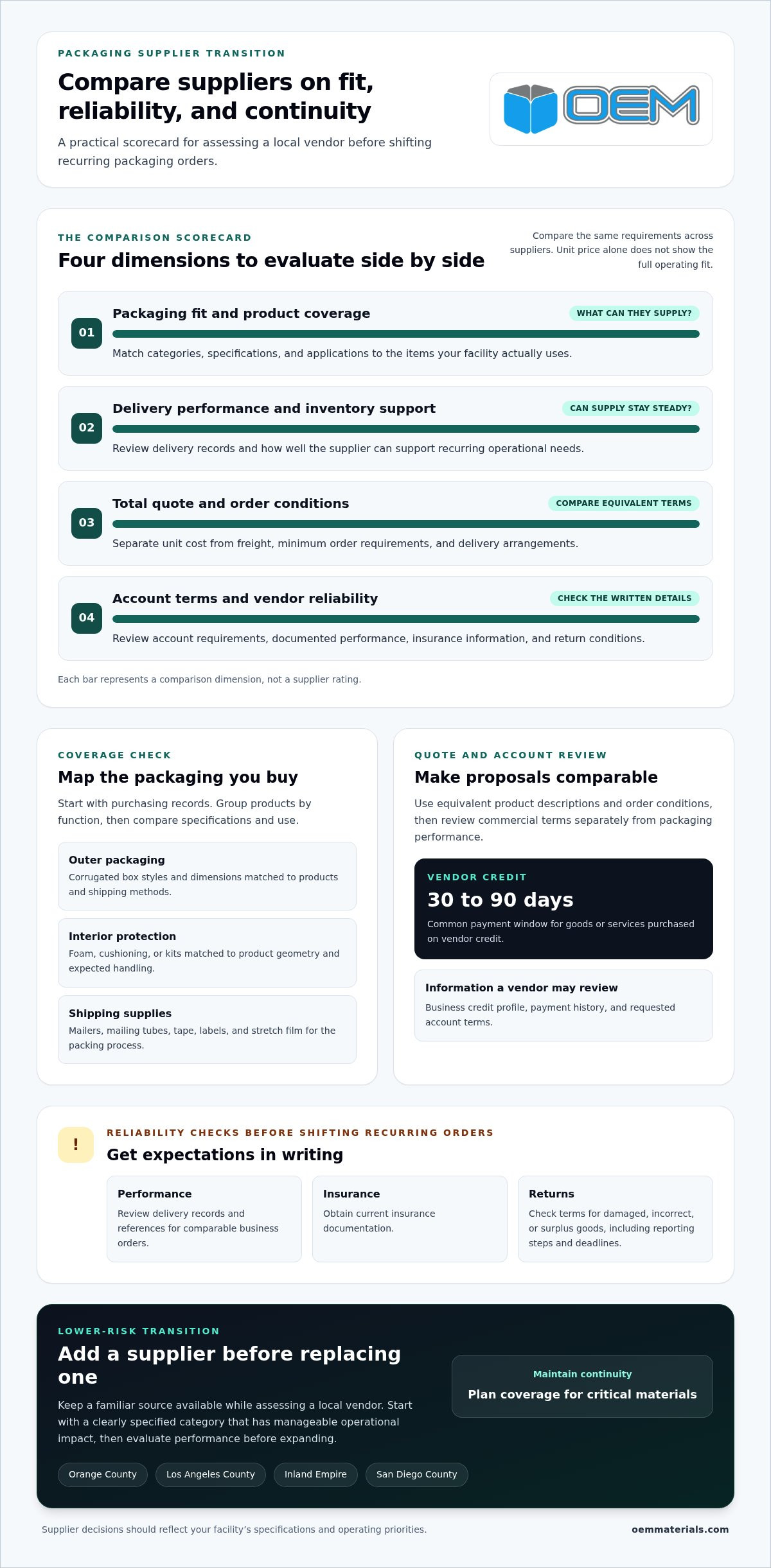
The best way to migrate from Uline to a local vendor may be to add a supplier before replacing one. Comparing options lets you assess packaging fit, delivery performance, inventory continuity, and business credit terms while keeping a familiar source available during the transition. Vendor credit commonly allows businesses to purchase goods or services and pay the supplier within 30 to 90 days.
Changing suppliers affects more than the unit cost of a box or cushioning material. Before placing orders, understand what information a vendor may review, including your business credit profile, payment history, and requested terms.
This article explains how to compare Uline with local packaging suppliers, what credit details may factor into account decisions, and how to reduce the risk of stockouts during a change. You’ll also see how to assess packaging requirements and supplier performance so your sourcing decision supports reliable day-to-day operations.
Key Takeaways
- Compare suppliers on packaging fit, delivery performance, inventory support, and account terms, not just the price per item.
- Map the products you currently buy to the packaging categories a local supplier can provide, then identify any gaps before shifting orders.
- Build quote requests around consistent specifications, including product dimensions, packaging requirements, and expected usage, so proposals are easier to compare.
- Use supplier scorecards to track quality, delivery, and supply-chain risk, with performance expectations tailored to each vendor.
- Reduce transition risk by planning inventory coverage and maintaining alternatives for critical packaging materials.
Comparing Uline with other vendors
Compare suppliers against your facility’s packaging requirements, account needs, and operating priorities. For a SoCal business, a local option should fit the work, not just the map.
Product Coverage Across Vendors
Product coverage describes the packaging categories a supplier can provide. Gaps can complicate purchasing, so compare your current Uline list with local offerings by category, specification, and application. A manufacturer may need cartons for finished goods, foam for delicate components, and tubes for rolled materials. Review each category separately to see where supplier coverage matches actual operations and where a distinct sourcing plan may be needed.
Finding Local Packaging and Shipping Vendors
Find suppliers serving your facility and carrying the packaging categories you use. Search by product and location, such as “industrial packaging supplier Orange County” or “foam packaging Inland Empire.” For a facility in Los Angeles or San Diego, include that location in your search. Compare supplier product information with purchasing records. A nearby address matters less than a product range that supports recurring operational needs.
Requesting Quotes and Negotiating Pricing
Compare proposals using equivalent product descriptions and order conditions. Separate unit cost from freight, minimum order requirements, and delivery arrangements. Consider how account terms affect purchasing flexibility, and review the requested information on any business credit application. A supplier may consider a business’s credit profile and payment history when assessing an account. Keep these commercial factors distinct from product performance, so favorable terms don’t outweigh a packaging mismatch.
Verifying Vendor Reliability and Policies
Verify a local vendor’s reliability by reviewing documented performance, insurance information, and written return conditions before shifting recurring orders. Check delivery records and references for comparable business orders, and obtain current insurance documentation. Read the return terms for damaged, incorrect, or surplus goods, including reporting steps and deadlines. Written expectations clarify responsibilities if a shipment arrives late or packaging fails inspection.
Multiple supplier accounts can diversify business credit and preserve options if one source cannot meet demand. Compare account requirements and service fit alongside the packaging itself. To migrate from Uline to a local vendor, start with a product category that has clear specifications and manageable operational impact. Assess the supplier against those requirements before expanding the relationship to other materials.
What products does Uline sell, and which can local vendors supply?
Uline sells packaging and shipping supplies across categories such as corrugated boxes, mailers, packing tape, cushioning, stretch film, and labels. Local packaging vendors also supply many everyday materials, along with foam packaging, mailing tubes, and protective kits. The useful comparison is not simply one brand against another. It is whether each supplier can meet your facility’s requirements for the items you actually use.
Start with purchase records, then group products by function. List shipping cartons separately from foam inserts, tape, and pallet wrap. A warehouse shipping small components has different requirements from a manufacturer protecting a large, fragile assembly. Record each item’s size, material, and application. This turns a broad catalog comparison into a practical coverage check.
- Outer packaging: Compare corrugated box styles and dimensions against the products and shipping methods they protect.
- Interior protection: Match foam, cushioning, or packaging kits to product geometry and the movement expected during handling.
- Shipping supplies: Compare mailers, mailing tubes, tape, labels, and stretch film by their role in your packing process.
Product names alone don’t establish equivalence. Two cartons with similar dimensions can differ in material or construction, while an insert designed for one component may not protect another. Keep existing packaging specifications on file, including dimensions and required material details. For a fragile electronic part, compare how the packaging holds the item in place, not merely whether both suppliers list foam.
Local suppliers can cover several purchasing categories, but their ranges differ. Group items as core materials, specialized packaging, and low-volume supplies, then note which products need coordinated components. A packaging kit, for example, can combine an outer box with matched protective materials, reducing the need to select separate items during packing. This comparison also helps identify products that need a distinct specification or sourcing arrangement.
For a SoCal facility, compare available product categories with actual use in Orange County, Los Angeles County, the Inland Empire, or San Diego County. If a local supplier’s product range aligns with your specifications, compare the items through a packaging quote request. Keep the product list consistent across suppliers so your evaluation reflects equivalent materials and applications.
How can I find reliable local packaging and shipping supply vendors near me?
Start with your facility’s location and the packaging categories it consumes. Search by product and service area, such as “industrial packaging supplier Orange County” or “shipping supplies Inland Empire.” For operations in Los Angeles County or San Diego County, use those locations in separate searches. Google Maps can help identify nearby businesses, while supplier websites show whether their product range matches your purchasing needs.
Build a shortlist from several sources rather than relying on one search result. Check local business directories, manufacturing associations, and referrals from nearby companies with similar shipping requirements. A medical-device manufacturer, for example, may need protective packaging for delicate components, while an automotive warehouse may prioritize reliable access to cartons and cushioning. Focus the shortlist on suppliers serving the facility’s location.
Compare each supplier’s product information with representative items from your purchasing records. Look for relevant categories such as corrugated cartons, foam protection, mailing tubes, or packaging kits. Compare specifications and intended applications, not just product names. If packaging protects a fragile assembly, ask how the proposed solution accommodates its shape and handling needs. A supplier with a range that fits your operation can simplify purchasing across related packaging needs.
- Map your operating area: Identify the shipping point and receiving locations in Orange County, Los Angeles County, the Inland Empire, or San Diego County.
- Search by packaging category: Use specific terms for boxes, cushioning, protective inserts, or shipping supplies.
- Check service fit: Compare the supplier’s product information with the materials and applications in your purchasing records.
- Shortlist by operational relevance: Prioritize suppliers whose range addresses recurring requirements, not just one occasional item.
Next, evaluate how each prospective supplier fits your order pattern. A warehouse using standard cartons repeatedly may value consistent replenishment, while a manufacturer shipping varied components may need packaging tailored to different applications. Describe your typical order mix, receiving schedule, and any materials that create production bottlenecks. These details clarify whether the supplier’s approach fits the work on your floor.
For a practical comparison, choose representative items and document their dimensions, use, and order frequency. Give each supplier the same information. This grounds the review in actual demand rather than broad claims about selection or proximity. A local address alone doesn’t establish a good fit. The supplier’s products and operating approach must support your facility’s packaging workflow.
How do I request quotes and negotiate pricing with local vendors?
Send each supplier a structured request for quote (RFQ) identifying the packaging items and commercial conditions you need priced. A clear RFQ lets purchasing compare proposals on the same basis and gives vendors a defined opportunity to suggest alternatives.
For every line item, include its description, order quantity, purchasing frequency, and delivery destination. Add a drawing or sample to clarify a nonstandard item. If you need recurring releases, describe the expected pattern instead of requesting a one-time order. State whether the quote should cover a trial order or ongoing supply so the proposal reflects the intended purchasing arrangement.
- Separate quote lines: Keep different packaging items distinct instead of combining them under a broad supply category.
- Clarify order assumptions: Identify requested quantities, delivery locations, and expected replenishment patterns.
- Request commercial details: Ask vendors to show freight, minimum order conditions, and payment terms separately.
- Record substitutions: Have proposed alternatives identified clearly so purchasing can assess them before approval.
Review the full proposal rather than comparing only unit prices. Freight, order minimums, packaging configuration, and delivery arrangements can affect the purchasing decision. If a quote uses a different pack quantity or substitute item, ask the supplier to clarify the basis. This prevents a price comparison from treating unlike orders as equivalent.
Focus negotiations on adjustable commercial terms. Discuss whether order frequency, shipment consolidation, or a planned release schedule changes the proposal. A supplier, for example, may quote differently for one large delivery than for scheduled releases. Assess the tradeoff against your storage capacity, receiving workload, and inventory needs before accepting the change.
Ask vendors to explain any proposed specification change before you approve it. A substitute may affect packing labor, storage, or product protection, even if it looks similar on a quote. Include the appropriate engineering or operations reviewer in packaging decisions, and record approved substitutions in purchasing documentation. This keeps cost discussions from bypassing technical review.
Before placing recurring orders, record the selected item, order structure, delivery expectations, and commercial terms. If a proposal leaves an assumption unclear, resolve it in writing before approval. A well-defined agreement gives purchasing and receiving teams a shared reference for order placement, invoice review, and supplier follow-up.
What risks can arise when changing packaging suppliers, and how can I prevent stockouts?
A supplier change can disrupt packaging availability, product protection, or packing routines. A replacement carton, for example, may differ in dimensions and force staff to adjust packing or storage. New cushioning may also perform differently with a fragile component. Treat the transition as an operational change, not just a purchasing update when you migrate from uline to a local vendor.
Stockouts can occur if orders from the outgoing supplier stop before replacement materials arrive. A specification mismatch can cause another delay if the first shipment needs correction. Map each packaging item to current inventory, expected consumption, open orders, and its replacement source. Prioritize materials whose absence would stop production or outbound shipping. Keep an alternative source for critical categories during the transition.
NIST recommends supplier scorecards that measure 2-3 key metrics, including supply chain risk and quality performance, and use on-time delivery standards tailored by vendor. Set each measure around the supplier’s role. For example, track order accuracy and delivery against the agreed schedule for a recurring carton supplier. For protective inserts, include quality checks that assess fit and condition when received. Clear standards make performance reviews more useful at OEM Materials & Supplies.
- Inventory coverage: Review available stock, open orders, and usage patterns for each critical packaging item.
- Specification control: Compare replacement materials with approved dimensions, construction, and packaging application.
- Supplier performance: Record delivery results, order accuracy, and quality issues by vendor.
- Transition timing: Avoid switching a critical item before the replacement has passed receiving and packing checks.
Multiple supply-chain sources can provide alternatives during natural disasters, strikes, or shipping changes, according to NIST. Resilience depends on having usable alternatives, not merely names in a supplier file. Keep specifications and purchasing contacts accessible, and know which materials each source can provide. A second supplier for a critical carton or cushioning material gives procurement another route if the primary source faces a disruption.
Manage the transition separately for each packaging category. First, confirm the replacement item suits the approved application. Then receive and inspect it before relying on it for routine shipments. Monitor packing results, damaged-product reports, and replenishment performance. If a new foam insert changes how a component sits inside its carton, assess the packed configuration before moving remaining orders. Track findings by item and supplier so corrective action stays specific.
Before requesting a recommendation for a packaging change, document the product dimensions, current material, and intended use. These details help suppliers address fit and protection requirements. Keep the former source available until the replacement meets your receiving and packing criteria.
OEM Materials & Supplies: Corrugated Boxes
OEM Materials & Supplies helps businesses compare corrugated boxes with the protective packaging used around products during storage and shipment. Turn to the team when a current carton needs review or packaging changes call for coordinated materials. Foam Packaging and Packaging Kits can support applications where a box alone doesn’t provide the needed protection or packing arrangement. Mailing Tubes & Cores suit products that ship in a cylindrical format.
For a useful assessment, share the product dimensions, weight, packaging configuration, and annual usage. These details connect the packaging choice to the item being shipped and the demands of your operation. Contact OEM Materials & Supplies to discuss your packaging requirements.
Make the Next Supplier Decision Deliberate
If you plan to migrate from Uline to a local vendor, treat the change as a procurement decision with clear ownership. Involve purchasing, warehouse, and operations teams before changing routine orders. Their input can reveal practical issues a quote alone won’t show, such as storage constraints, packing-line adjustments, or receiving procedures.
Review the change after the new supplier has supported real orders. Gather feedback from the people handling materials, then decide whether to expand the relationship, adjust specifications, or retain your current sourcing mix. This creates a measured path forward instead of a broad change based on assumptions.
For a packaging recommendation aligned with your operation, share product dimensions, weight, and usage details with OEM Materials & Supplies. Request a packaging quote and take the next sourcing decision with practical requirements in hand.
Frequently Asked Questions
What are the minimum order quantities and delivery fees for local supply vendors?
Minimum quantities and delivery fees depend on the item, order size, and delivery arrangement. A stock carton and packaging made to a specific design may have different ordering conditions. Ask vendors to list minimum quantities and delivery charges separately in each quote. For recurring orders to Orange County, Los Angeles, San Diego, or Riverside, compare shipment frequency, delivery location, and combined-order terms.
What quality standards and product specifications should I compare when switching suppliers?
Compare each item with documented requirements for dimensions, material, construction, and intended use. Set receiving criteria staff can apply consistently, such as checking carton dimensions or inspecting foam inserts for fit and damage. For a fragile product, evaluate a controlled packing setup before approving routine use. Record acceptable results and failure conditions so purchasing and warehouse teams assess future shipments against the same requirements.
What steps should a business follow to migrate purchasing from Uline to a local vendor?
To migrate from Uline to a local vendor, identify the packaging items to transition and assign an owner to each change. Create supplier records, item references, and approval steps in your purchasing system before placing replacement orders. Run a limited pilot, then gather receiving and packing feedback from employees who handle the materials. Update reorder settings only after the new item and ordering process work in normal operations.
How do Uline prices compare with local vendors for boxes, mailers, tape, and shipping supplies?
Compare quotes for equivalent product specifications, separating unit cost from freight and minimum order requirements. There is no specific price comparison between Uline and local vendors.
How do local vendor lead times and delivery options compare with Uline?
Compare local suppliers’ delivery records, arrangements, and ability to support recurring orders with your needs. Add a supplier before replacing Uline to help preserve inventory continuity during the transition.