
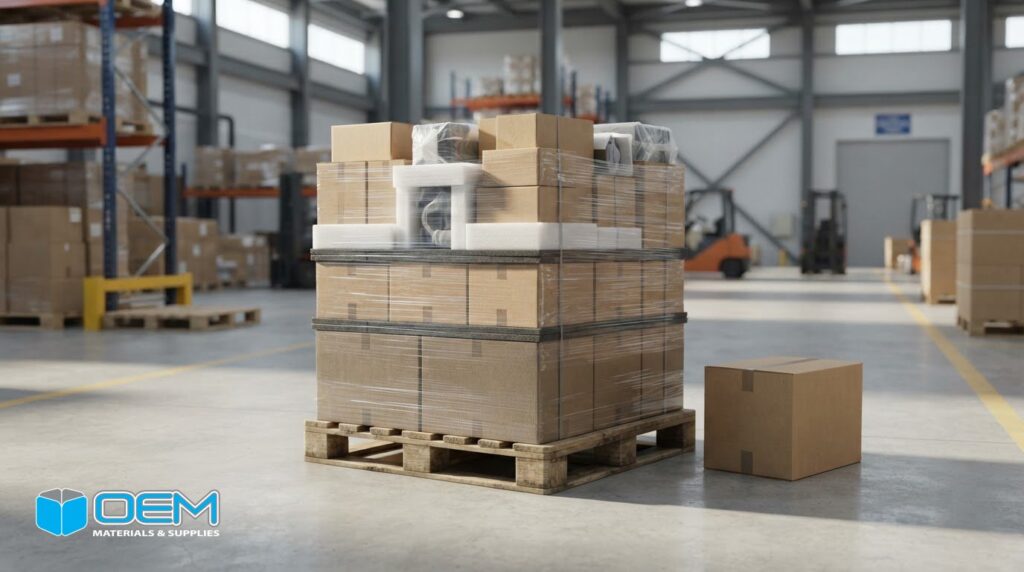
More stretch film is not a reliable fix for an unstable pallet. Poor stability often starts with uneven weight distribution, product overhang, a damaged pallet, or a stacking pattern that lets cases move. Effective pallet load stability improvement starts with the load itself, then uses suitable restraint to keep it secure during handling and transport.
When a pallet shifts, it is understandable to focus on wrapping, but restraint is only part of the solution. This article explains how load balance and center of gravity affect stability, when friction mats can reduce sliding between layers, and how packaging and restraint should match the load and its journey.
You’ll also learn why adding more film may not fix the underlying problem, and how pallet condition, packaging strength, stacking, and transport demands work together. The goal is a practical way to identify the cause of movement and develop a more stable pallet solution.
Key Takeaways
- Identify whether movement starts with pallet damage, load geometry, packaging weakness, or restraint before changing the wrap.
- Keep the load centered and distribute heavier products toward the bottom to reduce the chance of shifting or tipping.
- Choose columnar or interlocked stacking based on the balance between compressive strength and lateral stability.
- Use friction mats to help reduce sliding between load layers, while recognizing they address friction rather than poor load construction.
- Match packaging and restraint to the equipment and transport conditions the pallet will encounter.
What Causes Poor Pallet Stability?
Pallet loads become unstable when packaging, load geometry, or pallet condition fails to control movement. A cracked deck board, missing support block, or damp pallet can weaken the base before transport begins. Product overhang exposes edges that can catch during forklift handling. Beverage cases illustrate the risk: shifting can lead to breakage, spillage, or contamination. An unstable load may also collapse, require repacking, and add labor to warehouse operations.
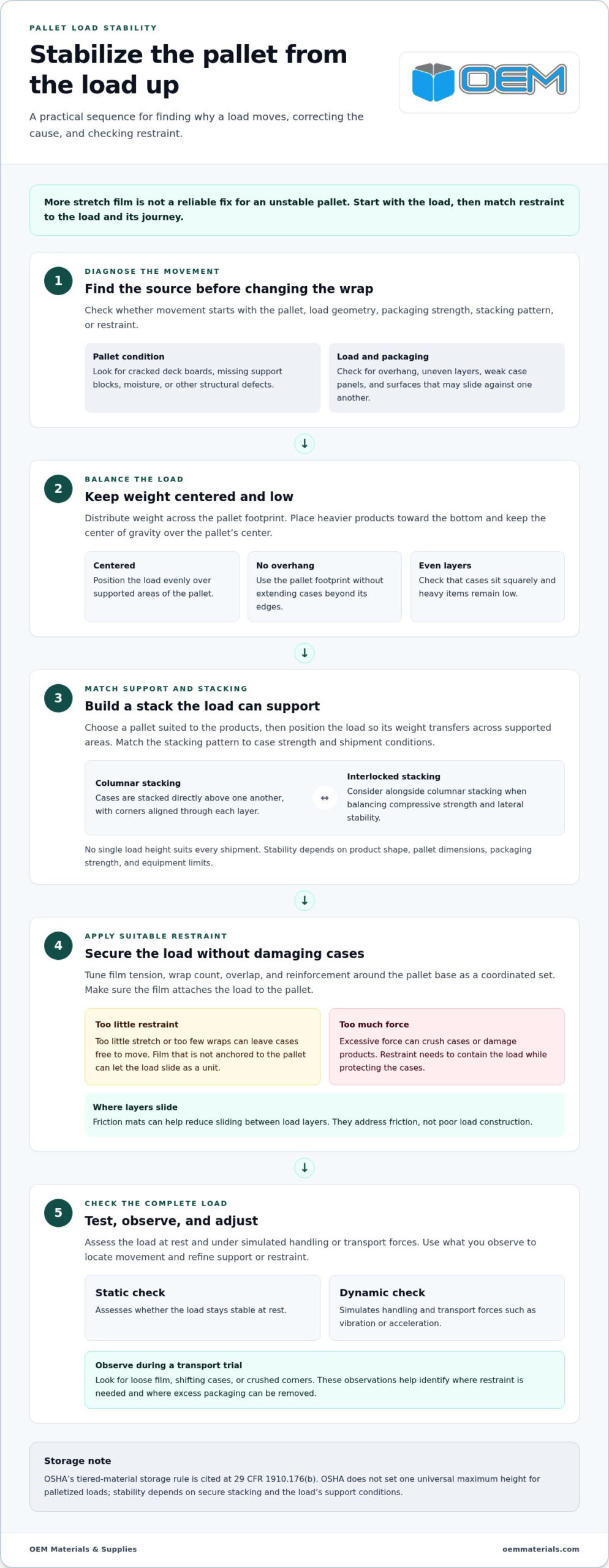
Stretch-wrap containment depends on both the film and how it is applied. Too little stretch or too few wraps can leave cases free to move; excessive force can crush cases or damage products. Film tension, wrap count, overlap, and reinforcement around the pallet base all affect restraint. The film must also attach to the pallet. A tightly wrapped load can still slide as a unit if the bottom wrap does not secure it to the pallet. Adding film alone will not fix that attachment failure.
Stretch film and shrink wrap can secure a beverage pallet and help prevent products from shifting during transport. Stretch-wrap performance depends on packaging surfaces, case strength, and pallet pattern. Smooth cartons may slide against each other, while weak case panels can give way under pressure. Perforations through vertical case edges can further reduce strength. Stretch film needs sufficient tension to contain the load; film applied with too little stretch may extend during transit and become loose. Effective restraint balances containment with case protection.
For warehouse storage, OSHA’s tiered-material storage rule is cited at 29 CFR 1910.176(b), and OSHA does not set one universal maximum height for palletized loads. Storage stability instead depends on secure stacking and the load’s support conditions. To test stability, static testing assesses a load at rest, while dynamic testing simulates handling and transport forces such as vibration or acceleration. The International Safe Transit Association provides standardized test procedures, including evaluations of unitized-load stability under horizontal impacts.
Film reduction should follow a stability assessment, not an assumption that fewer wraps are always better. First inspect the pallet for broken boards, missing blocks, moisture, and other structural defects. Then check whether the load fills the footprint without overhang and whether the wrap anchors the load to the base. Adjust film tension, overlap, wrap count, and base reinforcement as a coordinated set. A transport trial can reveal loose film, shifting cases, or crushed corners. These observations help identify where restraint is needed and where excess packaging can be removed. Review the stretch film options in relation to the load and its handling conditions.
Weight distribution and center of gravity
Even weight distribution balances a pallet load across its support surface. The center of gravity should remain over the pallet’s center to reduce movement during forklift handling or transport.
Load Weight Distribution
Weight distribution describes how a shipment’s mass is spread across the pallet footprint. Place heavier products toward the bottom and distribute their weight across the base instead of concentrating it at one edge. This lowers the center of gravity and helps reduce tipping when a forklift starts, stops, or turns. An off-center load can shift during movement even when its individual cases remain intact.
Pallet Design and Load Distribution
Pallet design determines how well the base supports the load’s weight and shape. Choose a pallet suited to the products, then position the load so its weight transfers across supported areas. A compact, heavy shipment needs stable support beneath its footprint, while irregular products may create uneven pressure. Inadequate support concentrates force and can make the stack less stable during handling.
Overhang and Load-Height Limits
Overhang occurs when cases extend beyond the pallet edge, while load height affects the stack’s center of gravity. Use as much of the pallet footprint as possible without extending beyond it. No single height suits every load: stability depends on product shape, pallet dimensions, packaging strength, and equipment limits. Taller loads, especially on narrow pallets, have more opportunity to move during handling.
Before wrapping, compare the load’s footprint with the pallet deck. Confirm that cases sit squarely, layers are even, and heavy items remain low. If one side carries more weight, reposition products before securing the load. These checks reveal imbalance early, before transport vibration or a forklift turn exposes it.
Pallet selection also matters in wet or humid operations. Plastic pallets do not absorb water, which helps them maintain their size, weight, and shape in those conditions. That can support consistent load positioning when moisture affects other pallet materials. The plastic pallet options are relevant where moisture resistance is part of the handling requirement.
Test how the complete load behaves, not just how it looks at rest. Static checks show whether the stack stays balanced while stationary; dynamic testing can reveal movement under simulated acceleration or vibration. For a recurring shipment, compare the same product arrangement across pallet types and stacking patterns. Record where shifting begins, then adjust weight distribution or support design before the next shipment.
Looking to Improve Your Pallet Stability?
Stacking pattern affects how cases support one another and resist movement during handling. Columnar and interlocked arrangements have different strengths, so match the pattern to case strength and shipment conditions.
Columnar and Interlocked Stacking
Columnar stacking places each case directly above the one beneath it, aligning corners through each layer. This provides strong compressive support and can help prevent lower cases from buckling under upper layers. Interlocked stacking alternates case direction between layers, tying the stack together and improving lateral strength. Choose a pattern based on the main risk: compression in storage or sideways movement during transport.
Stacking Patterns and Case Support
A stacking pattern determines whether each case rests on supported panels or spans gaps below. Column stacking can align vertical edges, but cases with weak panels or perforations may yield under pressure. Interlocking can limit lateral movement, but misaligned cases may leave edges unsupported. A cardboard interlayer sheet can separate products and help prevent contact damage. Inspect every layer, not just the finished stack.
Product Arrangement to Prevent Shifting
Arrange products in even layers, center the load, and keep each case within the pallet footprint. Use a repeated case pattern that matches the pallet dimensions; a 48 × 40-inch pallet provides a reference size for controlling overhang. Place heavier products lower in the stack, and avoid gaps that let cases move. These practices help keep the shipment stable through forklift handling and transport.
For mixed products, group cases by size and weight before stacking. Place cases with similar dimensions together so each layer has consistent support. The United States Postal Service advises that bundles form pallet layers of consistent thickness; bundles with nonuniform thickness should be counter-stacked. This principle helps prevent uneven surfaces from transferring pressure to only a few cases.
Use a locking pattern when lateral restraint is the main concern, rather than relying on block stacking alone. Interlock adjacent layers so case edges help resist sliding, while ensuring corners remain supported. For compression-sensitive cartons, columnar placement may better preserve vertical load paths. Case construction matters too: cut-through perforations along vertical edges can weaken cartons and allow them to yield.
Check the pattern against the full handling route, including warehouse storage, forklift transfer, and shipment movement. A static inspection can identify visible gaps or uneven layers, while simulation can show whether the arrangement holds under vibration or acceleration. If cases shift during testing, adjust the pattern or layer support, then evaluate the revised stack under the same conditions. Stability depends on the case, pattern, pallet, and forces acting together.
Friction mats for pallet restraint
Friction adds resistance where smooth packaging surfaces let products slide against each other or the pallet. First identify the slipping interface, then choose a restraint method suited to that contact point.
Friction Between Product Layers
Friction between product layers helps cases stay in position when movement acts on a pallet. Smooth cartons can slide during a forklift turn or vehicle braking, even when the stack looks aligned in the warehouse. A high-friction layer sheet between tiers can increase resistance at those interfaces. It complements other restraint measures but cannot correct uneven stacking or a poorly built load.
Match the friction solution to where movement begins. If upper tiers shift over lower cases, interlayer sheets address contact between those layers. If the entire load slides relative to the truck bed, a load-restraint rubber mat creates friction between the pallet base and the bed. These materials work at different interfaces, so placing a mat in the wrong position will not resolve the observed movement.
Anti-Slip Sheets
Anti-slip sheets are placed between products to increase friction compared with conventional layer sheets. They can help keep smooth cases from sliding against one another during transport. Choose sheet coverage that supports the contacting products, and keep each layer flat so cases sit evenly. A folded or displaced sheet can create an uneven support surface instead of consistent friction.
Rubber load-restraint mats serve a different purpose. Positioned between the pallet and truck bed, they create friction at the base and work passively, without inflation or active tensioning. They do not pull cases together or attach stretch film to the pallet. Use them as one part of a restraint design that also accounts for load construction and effective securing.
For a warehouse trial, record where movement occurs before changing materials. Mark the slipping interface, then compare the same pallet arrangement with and without an appropriate friction layer. If only the top tier shifts, for example, test an anti-slip sheet between that tier and the layer below. If the complete pallet moves against the vehicle bed, assess a base mat instead. Keep the load pattern and wrapping consistent during the comparison.
Friction materials complement suitable wrapping and load restraint; they do not replace them. Stretch film contains cases, while friction sheets resist sliding at specific contact surfaces. Film tension and placement still matter, and a mat cannot secure loose film or stabilize damaged packaging. Evaluate the combined arrangement under the handling conditions required across the supply chain, including forklift movement, braking, and vibration. The goal is an aligned load that does not rely on one restraint component to withstand every force.
Designing stability solutions
Start a stability design with a clear description of the shipment and its operating path. Record the product configuration, packaging arrangement, pallet type, and each handling transition. A pallet may move from a packing line to warehouse storage, then through a conveyor and vehicle loading. Documenting these interfaces helps the team design for the actual system instead of treating the pallet as an isolated unit.
Build a design brief around constraints that affect compatibility. Note the dimensions the load must fit, the equipment that will handle it, and the storage or transport environments it will encounter. Include differences between shipment profiles, such as a product traveling by road on one route and by container on another. This gives engineering and operations teams a shared basis for evaluating the packaging configuration.
For pallet load stability improvement, connect each observed issue to a specific stage in the process. A shifted load found at receiving may have moved during earlier forklift handling, conveyor transfer, or vehicle transport. Document where the issue first appeared and what changed between shipments. This record helps distinguish a recurring design concern from a one-time handling variation without assuming the restraint caused the problem.
Keep configuration records precise enough for repeat production. Identify the product arrangement, packaging components, pallet type, and securing method for each shipment profile. When a design changes, record the revision and the reason. This is especially useful for mixed-SKU operations, where similar-looking pallets may contain products with different dimensions or packaging that behaves differently during the same handling sequence.
Coordinate the design with warehouse and logistics teams before implementation. A load must fit its shipping unit and pass through the equipment and storage systems it will encounter. Conveyors, racks, and forklifts each impose different operating boundaries. Reviewing those interfaces early can prevent a packaging change from creating a new handling conflict downstream.
Use trial results to refine the design, then tie the successful configuration to its shipment conditions. If a change improves one route but fails on another, maintain separate configurations rather than assuming one setup suits every movement path. Pallet load stability improvement becomes more repeatable when teams can trace decisions from the observed problem to a design revision and recorded outcome. This turns shipment feedback into a controlled input for future packaging decisions.
Effective pallet load securing combines a properly built pallet, increased friction between layers, suitable securing, and correctly adjusted stretch wrapping.
OEM Materials & Supplies: Corrugated Boxes
OEM Materials & Supplies can address packaging weaknesses that contribute to shifting or damage during pallet handling. Corrugated boxes provide an outer structure for products that need consistent case support, while foam packaging can cushion items inside. Packaging kits bring components together for a repeatable packing process.
Consider packaging support when cases deform under stacking pressure, products need added cushioning, or packing variations affect load consistency. The right combination depends on product dimensions, weight, and shipping requirements. Corrugated packaging supports case formation, but pallet stability still depends on the complete load design, including stacking pattern, pallet condition, and restraint.
For packaging options suited to your shipment, contact OEM Materials & Supplies or visit oemmaterials.com.
Build the Next Shipment Around What You’ve Learned
Use movement or damage from previous shipments as design input. Record where cases shifted, which packaging failed, and what handling conditions preceded the problem. This evidence gives your team a practical starting point for the next pallet configuration and makes pallet load stability improvement part of a repeatable packaging process.
OEM Materials & Supplies offers Corrugated Boxes, Foam Packaging, and Packaging Kits to support product protection and consistent packing. Corrugated boxes provide case structure, foam packaging cushions products inside, and packaging kits bring packing components together. The right combination depends on the product and shipping requirements.
Bring your product dimensions, weight, and shipment details into the packaging discussion to help shape a relevant solution. Contact OEM Materials & Supplies about your packaging requirements and take the next step toward a more dependable shipment.
Frequently Asked Questions
What Is a Stable Pallet Load?
A stable pallet load stays intact and upright through storage, handling, and transportation. In practice, assess the shipment after normal warehouse movement: cases should remain in position, the stack should not lean, and packaging should not show signs of crushing that compromise support. Stability is about the complete unit, including the products, cases, pallet, and restraint, not just whether the top layer looks level before dispatch.
What are the best ways to improve pallet load stability?
Start by identifying where movement or damage occurs, then adjust the part of the system linked to that failure. For a recurring shipment, compare the current load with a revised arrangement under similar handling conditions. Record whether movement begins within a layer, between layers, or at the pallet base. This helps operations teams prioritize a targeted change instead of changing several packaging variables at once.
What pallet wrapping patterns and stretch film settings provide the best load stability?
No single wrap pattern or film setting suits every load. The right tension, number of wraps, overlap, and base reinforcement depend on case strength, load geometry, and handling conditions. Film should contain the cases without crushing them, and the bottom wrap must secure the load to the pallet. Evaluate changes using the actual shipment configuration, checking both restraint and visible packaging damage.
When should corner boards, straps, or anti-slip sheets be used for pallet loads?
Use corner boards when exposed case edges need support or straps could concentrate pressure on cartons. Straps can add restraint when a load must resist shifting or tipping, while anti-slip sheets suit interfaces where product layers slide against each other. If shifting is confined to upper tiers, consider interlayer friction; if the entire unit moves, review base restraint and attachment.
How do pallet type, condition, and size affect load stability?
The pallet must support the shipment’s footprint and weight without structural defects. A size mismatch can leave cases unsupported or cause overhang, while broken boards, missing blocks, or moisture can weaken the base. Choose a pallet suited to the product and handling environment, then inspect it before loading. For shipments moving through Orange County, Los Angeles, San Diego, or Riverside, include the equipment and storage conditions along the route in that assessment.