

A local address is not proof of a reliable packaging partner. Knowing how to choose a local packaging supplier starts with evidence: relevant industry experience, product samples, a record of dependable fulfillment, and technical recommendations that fit your product and shipping needs. The supplier should be able to explain why its proposed packaging is suitable, not just make a broad promise.
It’s reasonable to expect responsive service and consistent supply, but those claims should match your operation’s actual needs. A sample shows whether packaging fits and protects your product. Clear answers about order quantities, lead times, and customization reveal how well a supplier understands your requirements.
This guide explains how to assess experience, service, reliability, and technical guidance before choosing a local packaging supplier. Learn what evidence to look for, how to compare value beyond unit cost, and which questions can uncover gaps before they affect production or shipping.
Key Takeaways
- Look for specific evidence behind service and reliability claims, not assurances alone.
- Assess whether the supplier understands your industry, product risks, and packaging requirements.
- Compare packaging samples for fit, protection, and consistency before making a commitment.
- Evaluate how the supplier handles supply interruptions and keeps packaging available for your operation.
- Use technical guidance to align packaging materials and design with product compatibility and shipping conditions.
1. Customer service, consultations, and account managers
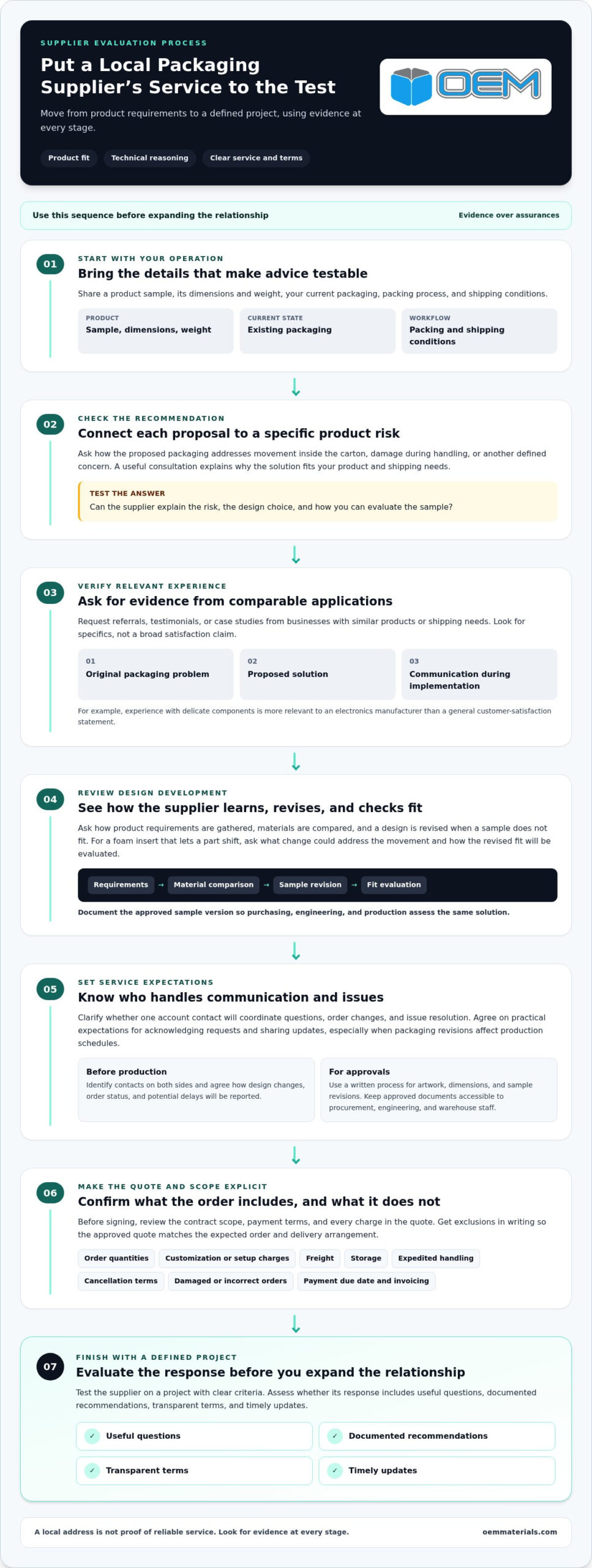
A useful consultation starts with your product, packing process, and shipping conditions. Bring a product sample, its dimensions and weight, and your current packaging. Ask how each recommendation addresses a specific risk, such as movement inside the carton or damage during handling. That makes the advice testable rather than a general sales pitch.
References can help you assess service claims. Request referrals, testimonials, or case studies from businesses with comparable products or shipping needs. Look for details about the original packaging problem, the proposed solution, and communication during implementation. A case study about delicate components, for example, is more relevant to an electronics manufacturer than a general customer-satisfaction claim.
Clarify who will manage communication after the initial consultation. Ask whether one account contact will coordinate questions, order changes, and issue resolution. Agree on practical expectations for acknowledging requests and sharing updates, especially when a packaging revision affects production schedules. A packaging partner should explain how concerns reach the people responsible for design or fulfillment.
Evaluate research and development by examining the supplier’s process, not its terminology. Ask how it gathers product requirements, compares materials, and revises a design when a sample does not fit. If a foam insert lets a part shift, for example, ask what design change would address the problem and how the revised fit will be evaluated. Document the approved sample version so purchasing, engineering, and production assess the same solution.
Local suppliers may offer corrugated packaging, foam packaging, cushioning materials, and packaging kits. Customization can include a package’s shape, size, color, messaging, or printed design. The right options depend on the product and packing task. For example, foam packaging options can be evaluated against the part’s geometry and the required fit.
Before signing, review the contract scope, payment terms, and every charge in the quote. Check order quantities, customization or setup charges, freight, storage, expedited handling, cancellation terms, and responsibility for damaged or incorrect orders. Confirm when payment is due and what triggers invoicing. Get exclusions in writing so the approved quote matches the expected order and delivery arrangement.
Set communication practices before production begins. Identify how the supplier will report design changes, order status, and potential delays, and name the contacts on both sides. A written approval process for artwork, dimensions, and sample revisions can prevent teams from working to different specifications. Keep the latest approved documents accessible to procurement, engineering, and warehouse staff.
A practical way to assess how to choose a local packaging supplier is to test its service on a defined project before expanding the relationship. Share relevant product details and evaluate the response against clear criteria: useful questions, documented recommendations, transparent terms, and timely updates. Strong communication makes decisions easier to track and repeat.
2. Industry-specific packaging experience
Packaging requirements vary with the product, production process, and shipping environment. An electronics component may need protection from impact and static, while an automotive assembly may need packaging that supports repeatable handling. These examples are starting points, not universal specifications. Ask the supplier which application details inform its recommendations.
Experience in aerospace, medical devices, electronics, automotive, and general manufacturing can expose a supplier to varied packaging challenges. That breadth may offer useful approaches, but experience in several industries does not prove expertise in yours. Ask how the supplier’s work relates to your product, handling steps, storage conditions, and distribution route.
Make the discussion specific to your operation. Describe how products move from production to packaging, how workers handle them, and where damage or slow packing occurs. If a component has delicate edges, for example, ask how the proposed packaging prevents contact during transit. A useful response connects the design to that risk and explains how it will be evaluated.
Look for relevant application knowledge, not just familiarity with industry labels. For medical devices, explain the packaging requirements set by your engineering and quality teams. For electronics, describe the product and handling needs, then assess whether the recommendations address those conditions. The supplier’s role is to align packaging with defined requirements.
Industry experience also matters as production changes. A plant adding product variations may need packaging that accommodates different part geometries without adding unnecessary packing steps. Discuss how the supplier would handle a design revision, additional product sizes, or a change in shipment configuration. This shows whether the relationship can adapt as your operation grows.
Use a practical review process. First, match the supplier’s relevant experience to your product and shipping conditions. Next, ask for the reasoning behind its material and design recommendations. Then compare a sample with your actual packing workflow. For a fragile machined part, assess fit, movement, and ease of removal. For a multi-component kit, check that contents stay organized during handling.
Packaging solutions should reflect the application rather than copy a design from another industry. Foam packaging can be considered for parts that need shaped support, while packaging kits can group materials for a defined packing task. Share product dimensions, weight, and handling steps when discussing a project. A packaging project quote can help frame those requirements and the next design discussion.
3. How to Choose a Packaging Supplier?
Packaging quality starts with clear acceptance criteria. Define dimensions, material, closure, and product fit before comparing samples. A box with excess space, for example, may let a component shift during transit. Packaging that is difficult to assemble can also slow production. Evaluate protection and packing efficiency against the same requirements.
Ask how the supplier maintains consistency between samples and production orders. The answer should explain how specifications are recorded, changes approved, and defects identified. For recurring orders, compare incoming packages with the approved sample and note differences in dimensions, fit, or closure. This gives your team a practical baseline for reviewing quality across orders.
Physical samples reveal issues a product description cannot. Test the package with the actual product and packing method. Check structural rigidity, closure integrity, and whether contents stay secure during normal handling. For a package with multiple components, confirm that each item stays in its intended position. Record your findings so purchasing, engineering, and warehouse teams assess the same design.
Packaging suppliers vary in product categories, sizes, and specialty options. Compare their ranges with your current materials and expected manufacturing needs, then ask how they manage availability for recurring items. A supplier with suitable packaging choices may simplify sourcing, but variety matters only when quality and application fit remain consistent.
For sustainability, ask which materials contain recycled content, which can be recycled through your intended recovery system, and what documentation supports those claims. Recycled cardboard boxes and other eco-friendly options are worth evaluating against product protection needs and local recycling practices.
Before requesting a quote, ask what information the supplier needs to recommend packaging, including product dimensions, weight, shipping conditions, and expected order volume. Clarify available sizes, minimum quantities, lead times, sample evaluation, customization, and any charges beyond the quoted unit price.
To compare packaging suppliers serving Orange County, Los Angeles, San Diego, and Riverside, shortlist candidates based on local coverage and the packaging categories your operation uses. Send each the same requirements, then compare sample quality, specification control, availability, and the clarity of its recommendations.
Quality assurance should link a written specification to repeatable checks. Agree on which dimensions and features matter, how changes are approved, and how nonconforming packaging is handled. If a carton closure fails during a packing trial, for example, document the issue and assess a revised sample before using it in production.
Review value across the full packing task, not just the material. Compare fit, protection, assembly steps, and waste for each sample. A suitable design supports product protection and consistent manufacturing practices, giving procurement a clear basis for supplier selection and operational success.
4. Supplier reliability and supply-chain disruption
A supplier’s reliability affects production schedules, warehouse space, and shipping continuity. In facilities where bulky packaging materials demand optimized floor and pallet storage, resources from warehouse racking specialists like colbydandenong.com.au illustrate practical layout and capacity solutions. Packaging lead times can fluctuate because of material shortages, transportation delays, seasonal demand, and manufacturing constraints. Map critical packaging items to the production lines that depend on them to identify which delays could stop packing or postpone outbound orders.
Compare lead times, delivery costs, and order flexibility using the same product specifications, quantities, and delivery locations for each supplier. Ask about standard and expedited fulfillment, applicable charges, minimum order quantities, and rules for changing or splitting orders. For example, compare how each supplier handles a change in shipment quantity before production starts.
Ask about fulfillment records and how the supplier communicates delays. A useful answer explains how it flags a material shortage, shares a revised delivery schedule, and coordinates alternatives. Review references from customers with similar order patterns or packaging needs. Ask about missed deliveries, issue resolution, and communication during disruptions.
Proximity alone does not ensure supply continuity. Ask where inventory is held and how a shortage at one distribution point affects your orders. Regional warehouse networks and multiple stocking centers can support lead-time management and provide backup inventory when a location runs short. Frequent restocking from a nearby distribution center may also reduce stockout risk.
Build a continuity plan around the packaging items most likely to constrain operations. Identify products that are difficult to replace, approved alternatives, and the contact responsible for decisions. If a box size is unavailable, for example, an alternative still needs to protect the product and work with the packing station. Record approval requirements before a disruption occurs.
Supplier relationships with multiple manufacturers may offer alternative inventory sources and coordinated logistics during shortages. Ask how a substitute is evaluated before use, including fit, protection, and compatibility with the packing process. Do not assume similar-looking materials perform the same function. Keep the approved specification accessible to purchasing, engineering, and warehouse teams.
Evaluate customer service through a real operational issue, not just a sales conversation. Ask how staff handle an order discrepancy, delayed shipment, or sudden increase in demand. Confirm who shares updates and how order status is communicated. A clear escalation path helps purchasing respond when a supply-chain change affects production.
Assess reliability using fulfillment records, relevant customer references, and documented disruption procedures. Compare those findings with your plant’s usage patterns and replenishment needs. A supplier’s delivery approach should support operational efficiency without forcing unnecessary inventory or leaving critical materials exposed to interruptions.
5. Technical guidance on compatibility and compliance
Packaging must suit the product, its environment, and its transportation route. Document contact conditions, storage needs, handling steps, and shipping destinations. A component exposed to oils or cleaning agents, for example, may need a material compatibility review before packaging is selected. The supplier’s recommendation should connect these details to a specific material and design.
Ask for technical guidance on chemical compatibility, closure systems, product protection, and transportation requirements. For consumer brands fulfilling bottled liquids such as oodle dog shampoo, specialized seals and cushioning prevent leakage and container deformation during transit. If packaging will contain a regulated or sensitive product, define applicable requirements with your quality and compliance teams. Then ask how the proposed materials and closures support those requirements. A clear scope prevents a general packaging suggestion from being mistaken for compliance approval.
For packaging that may contact food or chemicals, request material safety data sheets and relevant third-party testing for food safety or chemical migration. Match each document to the exact material and intended use. A test report for one film or coating, for example, does not automatically establish suitability for another material or application.
To verify quality certifications and compliance, request current certificates and supporting documents. Review their scope, covered materials or facilities, and validity dates. Compare those details with your product, process, and applicable customer requirements before approval.
Transportation can introduce different technical challenges. Ask whether the packaging guidance accounts for the route, handling conditions, and national or international shipping requirements. For hazardous materials, discuss relevant UN testing and certification or recertification needs with the supplier and your compliance team. The packaging configuration must match the specific shipment and applicable requirements.
Review technical documents alongside a physical sample. Confirm that the closure works with your packing process and that the package protects the product during expected handling. A package that seals correctly during a sample review, for example, may still need to be checked on the production line. Record the approved material, design, and revision so teams use consistent specifications.
Ask how technical recommendations change when your product or process changes. A new coating, cleaning method, or shipping destination can alter compatibility needs. Agree on who reviews those changes and what documentation supports an updated recommendation. This gives engineering and quality teams a defined way to evaluate packaging changes while keeping approved specifications under control.
Technical guidance is most useful when it resolves a defined challenge, such as material interaction, closure performance, or product movement. Prepare product details, intended use, and shipping conditions for a focused discussion. Share your packaging requirements to begin a project review.
OEM Materials & Supplies: Corrugated Boxes
OEM Materials & Supplies helps manufacturing teams match packaging to product and packing requirements. Corrugated boxes support shipping and handling when dimensions and product fit matter. Foam packaging and cushioning materials help protect items that need added cushioning, while packaging kits bring components together for a defined packing task. Mailing tubes and cores suit products designed for cylindrical packaging.
Turn to OEM Materials & Supplies when you’re ready to turn your evaluation criteria into a packaging request. Share product dimensions, weight, shipping conditions, and annual usage so the discussion starts with the operational details that shape a suitable recommendation.
Contact OEM Materials & Supplies to discuss your packaging requirements.
Put Your Packaging Evaluation Into Practice
Use your supplier review to set a clear baseline for future packaging decisions. Document product requirements, approved specifications, and service expectations. This gives procurement, engineering, and operations a shared reference as production needs change.
OEM Materials & Supplies offers Corrugated Boxes, Foam Packaging, and Packaging Kits for manufacturing and shipping applications. If you’re deciding how to choose a local packaging supplier, turn your criteria into a focused project brief with product dimensions, weight, shipping conditions, and annual usage.
Share that information to start a practical discussion about packaging needs and suitable options. Request a packaging quote from OEM Materials & Supplies and take the next step with clear requirements in hand.
Frequently Asked Questions
Can they back up their claims?
Ask which conditions a performance claim covers and where its limits begin. A claim about package durability, for example, should identify the product type and handling conditions it addresses. Broad claims without a defined use case are difficult to assess. Compare the supplier’s explanation with your plant’s actual packaging and shipping environment before relying on it for a purchasing decision.
Can they tailor to my brand?
Yes. OEM Materials & Supplies offers printed corrugated boxes with up to four-color printing inside or outside. Consider how branding will work alongside operational information. Leave space for shipping labels and handling instructions, for example, and ensure important package markings remain readable. This lets your brand presentation coexist with the information warehouse and transportation teams need.
How to Choose a Packaging Supplier?
Set evaluation criteria before requesting proposals, and have the spend owner approve them. This prevents teams from changing priorities after quotes arrive. Procurement may prioritize order flexibility, for example, while engineering focuses on application fit. Agree on how to assess each criterion, then use the same method for every candidate. This makes the final decision easier to explain internally.
Why Shop Locally?
A supplier serving Orange County, Los Angeles, San Diego, and Riverside may be easier to include in plant-level planning. A local visit can help a buyer understand receiving constraints, dock access, or how packaging moves between storage and production. Use the discussion to identify practical coordination needs, not to assume proximity guarantees faster delivery. Local service matters when it supports your facility’s actual workflow.
Will they be on hand when I need help?
Clarify what support your teams may need after ordering. A purchasing contact may need help with order administration, while a line supervisor may need guidance during a packaging changeover. Ask how the supplier routes different requests and what information each team should provide. Defining roles helps staff direct questions efficiently instead of relying on one person to handle every issue.
Will they leave me waiting?
Some delays begin within the buyer’s approval process. Identify who approves artwork, specifications, purchase orders, and production changes, then plan those handoffs before a new package enters use. An order can stall, for example, if purchasing is waiting for engineering to approve a drawing. Clear internal ownership helps prevent avoidable pauses a supplier cannot resolve alone.
What factors should I compare when choosing a local packaging supplier?
Consider how well each supplier fits your purchasing and receiving workflow. Compare its ability to process your ordering requirements, provide usable shipping documents, and support the packaging categories your plant sources together. If multiple departments or facilities will use the same supplier, include their needs in the review. A practical fit can reduce administrative friction across procurement, accounts payable, and receiving.