
A packaging supply single point of failure is a supplier, material, or process whose disruption can stop packaging operations when no workable fallback is available. Identifying single points of failure in packaging supply means tracing the materials and dependencies that keep products moving, then finding where one interruption could halt packing or shipping.
A supplier delay is only one possible weak point. A packaging line may also depend on a material with a long replenishment lead time, a single source for a critical component, or a workflow with no approved substitute. The key risk is whether operations can recover in time, including for manufacturers in Orange County and nearby Southern California communities.
This guide explains how to identify these dependencies and assess their operational impact. It covers practical ways to reduce disruption, including alternative sources, appropriate spare inventory, recovery planning, and clear risk records, without adding unnecessary complexity.
You’ll learn how to map packaging materials and processes, evaluate backup options against required volume and recovery time, and document remaining exposures. The result is a more disciplined way to protect continuity across purchasing, warehouse, and production operations.
Key Takeaways
- Spot dependencies in materials, suppliers, processes, and specialized know-how that could interrupt packaging operations.
- Assess backup suppliers by whether they can meet required volume within the recovery timeframe.
- Match the mitigation to the failure: redundancy, spare inventory, documentation, or a tested recovery plan may each play a role.
- Record each risk’s operational impact, likelihood, recovery time, and mitigation status to support clear prioritization.
- Review critical packaging dependencies when suppliers, processes, or production requirements change.
What is a Single Point of Failure (SPOF)?
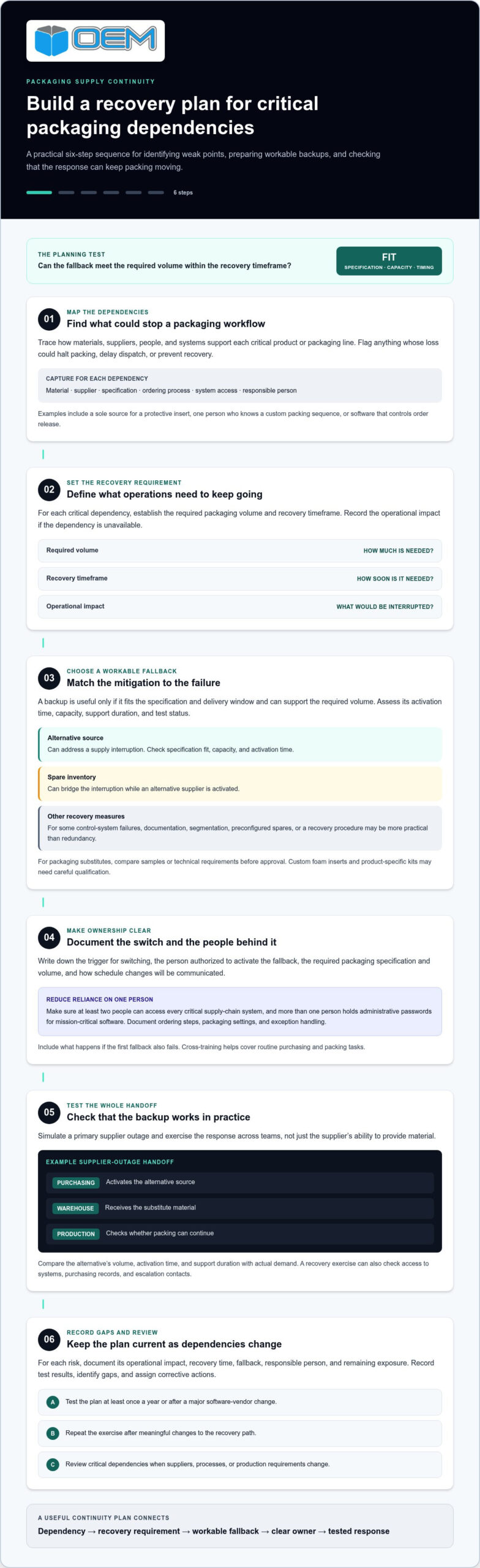
A single point of failure is a component whose loss can stop a connected operation when no immediate fallback is available. In packaging, it could be the sole supplier of a protective insert, one employee who knows a custom packing sequence, or software that controls order release. Identify these dependencies by tracing how materials, people, and systems support each shipping workflow. If losing one element could halt packing, delay dispatch, or prevent recovery, document it for review.
Start with a dependency map for each critical product or packaging line. Record the material, supplier, specification, ordering process, system access, and responsible person. Then determine whether an alternative source can meet the required volume within the recovery timeframe. A backup that cannot meet the specification or delivery window is not a workable alternative. Custom foam inserts and packaging kits built around a specific product may require careful qualification before a switch.
In the United States, review supplier changes against regulations that apply to the product and its end use, as well as customer quality requirements. Requirements vary by application and package, so compare specifications, approvals, and testing needs before switching suppliers.
People and knowledge can also be critical dependencies. For each essential supply-chain function, ask whether someone else could perform it if its owner were unavailable for a month. Make sure at least two people can access every critical supply-chain system, and that more than one person holds administrative passwords for mission-critical software. Document ordering steps, packaging settings, and exception handling to reduce reliance on memory. Cross-training helps cover routine purchasing and packing tasks.
Software backups address data loss, but they do not automatically preserve the knowledge needed to use that data. Test whether the business can restore records and resume work after an outage. Map the build infrastructure as well: source-code hosting, CI/CD, artifact storage, container registries, deployment, and monitoring can all affect software delivery. A missing build component may delay a system change needed to keep packaging operations running. Identify who can restore each component and where the recovery instructions are stored.
Supplier diversification can reduce dependence on a sole source, but alternatives must be assessed for specification fit, capacity, activation time, and support duration. For software, keeping local copies of critical dependencies can help during upstream unavailability; vendoring does not protect against compromise in the copied version. For packaging, compare samples or technical requirements before approving a substitute. For example, foam packaging may need evaluation against the product’s dimensions and protection needs before an alternate design is adopted. Record the remaining exposure, the fallback, and the person responsible for activating it.
Redundancy, spares, and recovery planning
A continuity plan links backup resources to clear activation steps, so teams know what to do when a supplier, material, or system fails. For each critical packaging dependency, define the required volume, recovery timeframe, decision owner, and communication path.
Redundancy and Spare Resources
Redundancy means having an alternative resource or route available when the primary one is unavailable. Spare inventory is ready-to-use material or parts that can bridge an interruption. The right choice depends on the failure: a secondary supplier may address a supply interruption, while spare inventory can cover the time needed to activate that supplier.
Compare each option with operational needs. A backup must support the required volume within the recovery timeframe, not merely appear on a supplier list. Record its activation time, capacity, support duration, and test status. Redundancy may not be the best response to every control-system failure; documentation, segmentation, preconfigured spares, or a recovery procedure may be more practical.
Testing Recovery Alternatives
Test recovery alternatives by exercising a backup process to confirm that people, materials, and systems can support operations during a disruption. For example, simulate a primary supplier outage: purchasing activates the alternative, warehouse staff receive the substitute, and production checks whether packing can continue.
Test the handoffs, not just the supplier’s ability to provide material. Compare the alternative’s volume, activation time, and support duration with actual demand. A disaster recovery simulation can also confirm that system access, purchasing records, and escalation contacts are available. Document gaps, assign corrective actions, and repeat the exercise after meaningful changes to the recovery path.
Continuity Plan Steps
A packaging supply continuity plan records each dependency, its operational impact, the fallback, and who is authorized to activate it. This gives purchasing, operations, and warehouse teams a shared response instead of leaving decisions to an improvised handoff during an outage.
Include the trigger for switching, the required packaging specification and volume, the alternative source or spare, and instructions for communicating schedule changes. Define what happens if the first fallback also fails. Test the plan at least once a year or after a major software-vendor change, and review the business continuity framework every year as suppliers, systems, and staffing change.
For a practical review of packaging continuity needs, share your packaging requirements and the constraints that affect recovery planning.
Documenting residual supply-chain risk
A risk record captures the exposure that remains after mitigation, including its impact, owner, and recovery time. To assess supplier concentration, compare each source’s share of critical packaging volume. Map supplier locations to reveal geographic exposure and shared disruption points.
SPOF Identification and Risk Ranking
Risk ranking compares a failure’s impact, likelihood, and recovery time to establish which dependencies need attention first. A source failure that stops a packaging line and takes a long time to recover ranks ahead of a delay another workflow can absorb. Record the affected material, dependent products, customer impact, fallback, and remaining exposure. This makes priorities clear to purchasing and operations teams.
System Audits and Risk Assessments
A system audit maps packaging workflows, infrastructure, resources, and dependencies to reveal where a disruption could stop work. Trace an order from material purchasing through packing and dispatch, noting the systems and roles involved at each stage. A business impact analysis identifies critical dependencies and time sensitivity; a risk assessment evaluates exposure. Failure Mode and Effects Analysis can connect a component failure to its downstream effects.
Risk Metrics and Review
Risk metrics show whether mitigation exists, whether it has been tested, and how quickly operations could recover. Record the number of identified single points of failure, the share with documented mitigations, the last test date for each mitigation, and estimated recovery time. Leadership should review these measures quarterly. Manufacturers should review critical control systems at least annually and after architecture changes, capacity additions, modernization, or unexpected downtime.
Measuring Supplier and Geographic Risks
Measure supplier concentration by calculating each source’s share of the required volume for a critical material. Compare that share with an alternative source’s capacity and activation time. To assess geographic exposure, map supplier and distribution locations, then note dependencies that share a region, route, or facility. If all packaging materials pass through one distribution center, an incident there could interrupt multiple workflows.
Technology can strengthen risk records when monitoring flags changing conditions before they cause disruption. Link alerts to the affected source, material, infrastructure, and response owner. Document how purchasing, warehouse, and production teams should communicate. For example, a supplier delay alert should prompt a review of available inventory, expected recovery time, and the alternative source’s capacity. Update the risk record after each test or material change.
Redundancy and backup systems
Redundancy gives an organization an alternate component or route when a primary system fails. In packaging operations, this could mean backup access to order records, an alternate label-generation path, or a separate network connection for warehouse systems. The goal is continued operation or controlled recovery, not simply duplicated equipment. A backup that shares the same power, network, or access dependency may preserve the original vulnerability.
Design failover around the actual failure mode. A secondary system may take over automatically, or staff may need to switch processes manually. For example, if a packing workstation loses access to order data, an approved recovery method should make the necessary instructions available without relying on that workstation. Document what triggers failover, who authorizes it, and how teams confirm the alternate component is working.
Shared dependencies can undermine apparent resilience. Two servers in one location may still rely on the same power source, network path, or administrative account. Map those connections before treating a duplicate as independent. For physical packaging workflows, confirm that backup equipment can use available materials, settings, and operator instructions. A spare component that cannot connect to the required infrastructure will not restore the process.
Software delivery systems also need a dependency map. Track source-code hosting, continuous integration and continuous delivery (CI/CD), artifact storage, container registries, deployment tools, and monitoring. If a registry becomes unavailable, teams may be unable to retrieve the software required for a system update. A mirrored source repository, portable build infrastructure, and replicated artifact storage can reduce reliance on one provider or platform.
Test each backup path under realistic conditions. Confirm that a team can retrieve a stored artifact, build or deploy the required software, and restore access to operational records. For a packaging system, simulate losing its primary network connection and document how staff resume order processing. Record missing permissions, outdated instructions, or unavailable components, then address them before relying on failover.
Backups and redundancy serve different needs. A backup preserves information for restoration; redundancy provides an alternate component or route for continuity. Data replication across separate systems can support recovery, but it does not replace a tested restoration process. Match the control to the potential impact: a manual workaround may suit a short interruption, while a critical production dependency may require an independently accessible backup and a practiced failover procedure.
Single points of failure in packaging and vendor supply
A packaging supply risk becomes a single point of failure when one supplier, facility, material, or process cannot be replaced before operations are affected. For example, a sole source for a product-specific insert can stop packing if production is interrupted and no qualified alternative is ready. Supplier count alone is not the key measure. The question is whether an alternative can meet the required specification, volume, and recovery timeframe.
A disciplined approach to identifying single points of failure in packaging supply connects each critical packaging item to the products and workflows it supports. Record its supplier, replenishment lead time, usage pattern, and dependent orders. Then assess whether a delay would stop packing, force a schedule change, or affect shipment commitments. This helps purchasing prioritize exposure by operational impact rather than treating every sole-source item as equally urgent.
Supplier concentration can also be hidden behind separate company names. If two vendors rely on the same upstream source, facility, or transportation route, they may share a failure point. Map known dependencies and identify events that could affect both sources. Routing finished goods through one distribution center creates similar exposure: an incident there could interrupt shipments across multiple product lines.
For each exposure, define a practical response. Options include qualifying an alternative, holding appropriate spare inventory, changing the workflow, or documenting the remaining risk. A substitute packaging material must meet the product’s functional requirements. For example, evaluate a replacement insert for fit and protective performance before relying on it during a supplier outage.
Evaluate alternatives against actual recovery needs. Compare capacity, activation time, support duration, and readiness through a test or exercise. A supplier able to provide a sample but not the required production volume may not protect continuity. Document the switching criteria, approval owner, purchasing steps, and how warehouse and production teams will receive revised instructions.
Technology can create a less visible vendor dependency. If a server or ordering platform holds the only current specifications, an outage may prevent purchasing from releasing a substitute order. Keep critical specifications and supplier contact details accessible through an approved recovery process. Test retrieval during a simulated disruption, then assign owners and due dates to any access gaps.
For procurement teams identifying single points of failure in packaging supply, review the risk record whenever a supplier changes, a specification is revised, or an interruption reveals a new dependency. Track which alternatives have been tested and whether their capacity still matches current demand. This keeps recovery assumptions aligned with operating conditions and gives teams a clear response when circumstances change.
To discuss packaging requirements that need an alternative or continuity review, request a packaging quote.
Product-specific inserts can be difficult to replace because an alternative must meet the required fit and protective performance. Any substitute must also meet the packaging material’s functional requirements.
OEM Materials & Supplies: Corrugated Boxes
OEM Materials & Supplies provides corrugated boxes, foam packaging, packaging kits, and mailing tubes and cores to support packaging needs. These options can help when reviewing material requirements, planning a suitable backup, or aligning packaging components with your packing workflow.
Corrugated boxes can serve as a primary or alternate packaging component when their dimensions and performance meet the product and shipping requirements. Foam packaging offers a fitted protective option, while packaging kits group components used together. Evaluate any change against product fit, protection needs, and packing steps before adopting it as a continuity measure.
Contact OEM Materials & Supplies to discuss your packaging requirements.
Make the Next Packaging Decision More Resilient
Use risk records to turn a general concern into a specific procurement decision. Select one critical packaging item, identify the disruption that could affect it, and define what a workable alternative must support. This gives purchasing, operations, and engineering teams in Orange County and across Southern California a shared basis for reviewing supplier options and packaging requirements.
Keep the review grounded in real production conditions. Product dimensions, protection needs, packing methods, and shipping requirements all affect whether a substitute can perform as intended. Update your continuity plan whenever specifications or workflows change. This keeps identifying single points of failure in packaging supply tied to current operations rather than outdated records.
OEM Materials & Supplies can discuss packaging requirements involving corrugated boxes, foam packaging, and packaging kits. Bring the product details and operational constraints relevant to your review, such as dimensions, weight, and usage patterns.
Contact OEM Materials & Supplies to discuss your packaging requirements and take the next step toward a more deliberate supply plan.
Frequently Asked Questions
How do you identify a SPOF?
Identify a single point of failure by tracing a critical workflow and finding any step without a workable substitute. For example, follow a finished order from packaging specification through material release, packing, and shipment. Note the people, equipment, systems, and suppliers involved, then consider what would happen if each became unavailable. A dependency that could stop the workflow before a replacement takes over warrants a documented risk and response.
What are examples of SPOF?
Examples include one employee who alone knows a packing procedure, one source for a product-specific insert, or one server that stores current packaging instructions. A single machine required for a packing operation can also create a bottleneck. In each case, the defining issue is the absence of a practical alternative. The business impact depends on which orders rely on that dependency and how quickly it can be restored.
What is the impact of SPOF on business?
A single point of failure can delay production, interrupt shipments, and force teams into unplanned workarounds. If a packaging component is essential to protecting a product, shipping without it may not be acceptable. Purchasing may need to expedite an alternative, while operations reschedule work and customer service revises delivery expectations. The consequences extend beyond downtime when an interruption affects customer commitments or downstream production.
What is a single point of failure in packaging supply?
A single point of failure is a packaging material, supplier, process, or system whose loss can prevent required packing or shipment because no suitable fallback is ready. For example, a packaging specification may rely on a specialized insert available from only one source. If the insert is needed to protect the product and no approved substitute is available, that sourcing dependency creates a continuity risk.
How do you map packaging suppliers, materials, and production dependencies?
Build a visual map connecting each finished product to its packaging components, suppliers, receiving locations, storage points, and packing operations. Include internal dependencies such as the machine, work instruction, or system needed to use each material. For a product shipped in a box with a protective insert, show both materials and their sources, then connect them to the packing station and shipment process. Mark shared sources or facilities for review.
What data and metrics identify packaging supply vulnerabilities?
Useful measures include each supplier’s share of critical material volume, replenishment lead time, available inventory, alternative-source capacity, and estimated recovery time. Track whether an alternative has been evaluated and when its recovery process was last tested. For example, prioritize a material with low inventory and a long replenishment lead time if no substitute can support production. Review these measures alongside customer and schedule impacts.
How do you assess packaging supplier financial, capacity, and operational risks?
Assess financial exposure by reviewing available financial information and signs that could affect continued supply. Compare the supplier’s stated capacity with your required volume and recovery window, then examine operational factors such as production locations, key equipment, staffing dependencies, and documented recovery procedures. A supplier may have adequate nominal capacity but rely on one facility or process. Record the evidence, potential impact, and mitigation owner.
What are common packaging supply disruptions and their business impacts?
Disruptions can include a supplier’s production interruption, delayed transportation, unavailable raw materials, equipment failure, quality problems, or an ordering-system outage. A delayed box shipment may leave finished goods waiting to be packed; a defect in a protective component may require inspection or a revised packing method. These events can affect schedules, labor allocation, shipment timing, and customer communication. The impact depends on the material involved and whether a workable response is available.