

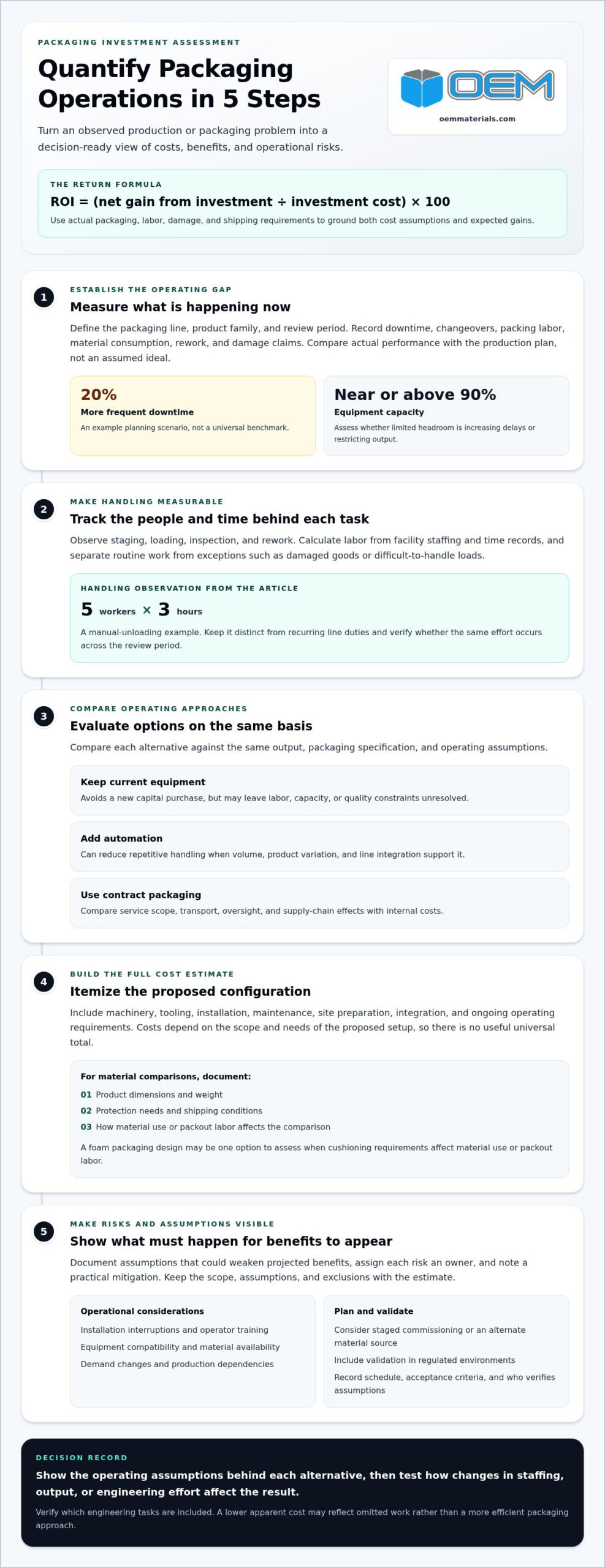
A business case for new packaging investment should connect a documented operational problem to measurable benefits and a clear financial return. Calculate ROI as net gain from the investment divided by its cost, multiplied by 100. The calculation is only useful when the cost assumptions and expected gains reflect actual packaging, labor, damage, and shipping requirements.
It’s reasonable to expect a proposed change to show more than a lower material cost. Packaging can also affect packing time, product protection, space use, and handling and distribution demands. A stronger business case for new packaging investment makes those effects visible and explains the assumptions behind the numbers.
This guide explains how to quantify current challenges, define the investment scope, and build a practical return model. You’ll also learn to test how changing assumptions affect results and weigh financial outcomes alongside product sensitivity, safety, compliance, and sustainability requirements. The goal is a decision-ready case that clearly presents costs, benefits, risks, and operational impact.
Key Takeaways
- Build a reliable baseline by documenting where packaging affects damage, labor, material use, and production flow.
- Use targeted questions to determine whether the problem calls for a packaging change or a broader operational response.
- Compare the full investment with measurable benefits, then test how shifts in key assumptions affect the projected return.
- Include safety, compliance, and sustainability criteria alongside financial measures when comparing packaging options.
- Make the case easier to evaluate by stating assumptions clearly and aligning finance, operations, and executive stakeholders.
Quantifying production and cost challenges
- Measure the current operating gap. Start with a defined packaging line, product family, and review period. Record downtime, changeovers, packing labor, material consumption, rework, and damage claims. Compare actual performance with the production plan, not an assumed ideal. One planning example examines downtime occurring 20% more often than projected. Treat that as a scenario, not a universal benchmark. If equipment runs near or above 90% capacity, assess whether limited headroom is increasing delays or restricting output.
- Convert handling and labor into measurable exposure. Track the people and time required for each packaging task, including staging, loading, inspection, and rework. One material-handling example describes manual unloading that takes five workers three hours. Use a comparable observation at your facility, then calculate labor from actual staffing and time records. Separate routine work from exceptions, such as damaged goods or difficult-to-handle loads, to distinguish recurring costs from occasional disruptions.
- Compare automation, contract packaging, and current equipment. Keeping current equipment avoids a new capital purchase but may leave labor, capacity, or quality constraints unresolved. Automation can reduce repetitive handling when volume, product variation, and line integration support it. Contract packaging moves some work outside the facility, so compare its service scope, transport, oversight, and supply-chain effects with internal costs. Model each option against the same output, packaging specification, and operating assumptions.
- Build a complete cost estimate. Typical costs for packaging machinery, tooling, installation, and maintenance depend on equipment scope, required tooling, site preparation, integration, and service needs. There is no useful universal total: itemize those components for the proposed configuration and include ongoing operating requirements. For packaging material comparisons, document product dimensions, weight, protection needs, and shipping conditions. A foam packaging design may be one option to assess when cushioning requirements affect material use or packout labor.
- Document operational and implementation risks. List assumptions that could weaken projected benefits, such as production interruptions during installation, operator training, equipment compatibility, material availability, and demand changes. Assign each risk an owner and a practical mitigation, such as staged commissioning or an alternate material source. In regulated environments, include validation as a critical project activity. Record the expected schedule, dependencies, and acceptance criteria so decision-makers can see what must happen before benefits appear.
Carry the assessment through to a decision record: identify the operating assumptions behind each alternative, then show how changes in staffing, output, or engineering effort affect the result. For labor modeling, enter the unloading case as 5 workers over 3 hours and keep that observation distinct from recurring line duties. This makes the handling estimate visible without treating one observation as a facility-wide rate. Use actual work records to test whether the same effort occurs across the review period and whether another process step would remain after a change.
Treat the estimate as a planning input tied to the work description, and verify which engineering tasks are included before comparing options. Keep the scope, assumptions, and exclusions with the estimate. Otherwise, a lower apparent cost may reflect omitted work rather than a more efficient packaging approach. Record who will validate the assumptions and revisit them if operating conditions change.
Questions to assess whether a business case is needed
- Does the packaging problem affect a business priority? Connect the issue to a defined objective, such as protecting product quality, maintaining output, or reducing avoidable handling. For example, recurring rework may matter more when it disrupts a customer order or constrains a production schedule. Identify the affected product, process, and team. If the impact is limited to a local preference, a full investment case may be unnecessary. If it affects strategic performance, document the connection.
- Is the proposed change large or cross-functional? Consider whether the decision requires capital approval, production process changes, or coordination across operations, procurement, engineering, and finance. Executive sponsors can align a business case with strategic priorities and secure early buy-in. Name the sponsor and decision-makers before developing detailed projections. A contained process adjustment may need only a shorter justification. A major investment calls for a broader assessment of costs, benefits, risks, and delivery requirements.
- Can the organization establish a credible baseline? Confirm that current records cover material consumption, labor, damage, throughput, or other relevant measures. Separate observed results from estimates, and identify who owns each data source. For example, operations may track packout time while finance validates labor assumptions. If the baseline is incomplete, define how the team will capture the missing information. A projected improvement has little decision value without a clear comparison point.
- What expertise and approval are required? Ask finance to validate cost estimates, return calculations, and budget implications. Ask technical or IT teams to assess feasibility, timelines, and resource requirements when the proposed equipment or process depends on them. These reviews can reveal dependencies before approval. Record who will evaluate installation, workflow fit, training, and validation. For equipment projects, implementation often takes 6-12 months, depending on complexity, so timing can influence capacity plans and the benefits schedule.
- What level of documentation fits the decision? A major investment business case may run 20 or more pages, while its executive summary should present the decision clearly on one page. A comprehensive case can organize evidence around the Five Case Model’s five interconnected elements. Match the depth to the investment’s scale, uncertainty, and approval process. Before drafting, define the decision requested, alternatives considered, key assumptions, and evidence needed. A clear scope prevents analysis from expanding beyond the decision.
For a packaging review, organize product dimensions, weight, annual usage, and shipping conditions before outlining the options. Share packaging requirements for a project review when you’re ready to discuss a specific application.
ROI calculations and sensitivity analysis
Evaluate the proposal by gathering investment costs, expected operating gains, and timing assumptions, then test how changes to those assumptions affect returns. Finance can validate cost estimates and ROI calculations before approval.
-
Calculate Investment Returns
Calculate ROI by subtracting investment cost from net gain, dividing by investment cost, then multiplying by 100. Include relevant gains and costs across the same review period. For packaging, assess labor, materials, damage, and operating expenses where they apply. Avoid counting the same benefit twice, or treating projected savings as achieved results.
-
Analyze Sensitivity
Test how changed assumptions affect the projected return before presenting one forecast. Compare an aggressive 20% improvement scenario and a less aggressive 5% scenario against a 10% assumption. Also assess how a 10% increase in energy costs would affect overall savings. Keep each scenario’s assumptions visible so decision-makers can distinguish robust returns from results dependent on best-case conditions.
- Build a time-phased model. Map when investment costs occur and when benefits begin. A phased model can assume no change in the first 3 months, a 5% paid-conversion increase in month 4, and another 5% increase in month 6. For packaging, use the same structure to represent a planned ramp, but tie benefits to observed operating milestones rather than conversion metrics.
- Separate one-time and recurring effects. List the initial investment separately from ongoing costs and recurring benefits. Identify the assumptions behind each line, such as implementation timing, material consumption, or labor requirements. Then test each driver independently. If the return depends mainly on one projected benefit, show how the model changes if that benefit arrives later or is smaller than expected.
- Set approval criteria before comparing scenarios. Define the financial measures, operating outcomes, and evidence required for approval. Finance should review cost estimates, ROI calculations, and budget impact. Operations can connect projected benefits to measurable process changes. Present the preferred scenario alongside alternatives, assumptions, and risks so approvers can see what supports the expected return.
Safety, compliance, and sustainability benefits
Assess these outcomes alongside financial returns, using evidence tied to the product, packaging process, and destination. Record the criteria each proposed design must meet before comparing options.
-
Assess Safety Benefits
Map the handling steps that create risk, from packing and lifting through warehouse movement and delivery. Check whether a proposed change reduces awkward handling, sharp edges, unstable loads, or repeated manual adjustments. For example, compare how workers position a product in its package and transfer it onto a pallet. Avoid claiming a safety improvement unless the new process addresses an identified hazard and the operating team can evaluate it.
-
Assess Compliance Benefits
List the product, customer, and destination requirements that apply to the packaging decision. Ask quality and compliance teams to identify required records, material controls, labeling, and approval steps for the specific product. In a regulated environment, treat validation as a critical equipment investment activity. Document who approves the packaging specification and how changes will be controlled. Do not assume a design meets a requirement simply because a similar package has been used elsewhere.
-
Assess Sustainability Benefits
Compare packaging options using the same product protection and shipping assumptions. Record material quantity, package dimensions, damage outcomes, and relevant disposal or reuse considerations. A design that uses less material may not provide a net benefit if it increases product damage or requires additional protective components. Evaluate the full package system, including cushioning and outer packaging, rather than judging one material in isolation.
- Connect each benefit to evidence. Assign an owner to collect supporting information, such as incident observations, quality records, packaging specifications, or material-use data. Separate measured results from estimates in the business case. For example, describe a handling improvement as a proposed outcome until a controlled trial demonstrates its effect. This distinction helps reviewers weigh safety and sustainability alongside projected financial returns.
- Define acceptance criteria before implementation. Write down what the new package or process must accomplish, who will evaluate it, and which records will demonstrate successful performance. Include product protection, handling steps, required approvals, and disposal considerations. Keep criteria specific to the application. A package for a fragile electronic component may need different evaluation measures from one designed for a durable manufactured part.
- Include tradeoffs in the decision record. Summarize the benefits and possible drawbacks of each alternative, including changes to packing work, material use, product protection, and handling. Identify assumptions that still need operational validation. A balanced record gives executives and technical reviewers a clear basis for approval and prevents one attractive metric from overshadowing safety, compliance, or sustainability requirements.
Business case financials and return on investment
- Set a consistent financial boundary. Define which product families, packaging lines, and operating costs belong in the analysis. Keep shared expenses separate unless the proposal changes them directly. For example, a packaging change may affect labor on one line while leaving warehouse staffing unchanged. Assign each cost or benefit to the process it actually affects, so the proposal doesn’t claim savings from unrelated activities.
- Model costs by shipped unit and product mix. Compare the financial effect across the orders or products expected to use the packaging, rather than relying on one average item. A small part and a large assembly can have different packaging needs and shipment profiles. Identify where volume is concentrated and show how a change in product mix could affect the projected result. This makes the financial case relevant to actual production.
- Include inventory transition effects. Account for packaging already in stock when a specification changes. The transition may require using existing inventory, holding old and new materials at the same time, or addressing packaging that no longer suits the revised process. Map these effects to the proposed changeover plan. This avoids presenting the new-state economics as if they begin immediately upon approval.
- Review cash timing alongside annual results. A favorable annual projection can still strain a budget if spending happens before operating benefits begin. Lay out the expected sequence of purchasing, installation, changeover, and steady operation. Show when the old process ends and the new one begins. This schedule gives approvers a clearer view of cash requirements during the transition.
- Use more than one decision measure. Payback period shows how long recovery takes, while annual operating impact shows the recurring effect after implementation. These measures answer different questions, so present them using the same scope and timing assumptions. Avoid relying on a single headline return if it hides a slow ramp-up, an uneven product mix, or transition expenses.
- Make the financial record auditable. Connect each model input to a record, an owner, or a clearly stated planning assumption. Keep the calculation logic visible and label estimates separately from booked expenses. For example, procurement can trace material usage to purchasing records, while operations can document how the selected packaging configuration changes the process. This gives reviewers a clear path from source data to the requested decision.
To discuss packaging options for a defined application, request a packaging quote with product dimensions, weight, and annual usage.
These examples can be assessed with the same boundary and timing discipline. In the example, customer lifetime value is $400k per customer, and the conversion example estimates an additional $2.4M in value over a year.
In the churn example, winning 5 accounts per month generates an additional $220k of value per month, or over $2.6M per year. Keep each estimate connected to its stated assumptions so reviewers can see which benefits are relevant to the proposal and avoid combining separate examples into one unsupported return.
OEM Materials & Supplies: Corrugated Boxes
OEM Materials & Supplies can help connect a packaging investment decision with practical packaging options. Its corrugated boxes can support applications where the business case focuses on package fit, product protection, or packing efficiency. Foam Packaging, Packaging Kits, and Mailing Tubes & Cores address other packaging needs within the approved scope.
Consider these options when your analysis identifies a specific packaging challenge and defines the product dimensions, weight, shipping conditions, and usage patterns involved. Those details help shape a relevant packaging discussion without assuming savings before operational requirements are understood. Compare options against the same protection and handling criteria used in your investment assessment.
Contact OEM Materials & Supplies to discuss your packaging requirements, or visit oemmaterials.com.
Turn the Investment Decision Into a Measurable Next Step
A business case for new packaging investment should continue guiding decisions after approval. Set a clear ownership plan for implementation, define how the team will track performance, and compare operating results with the assumptions used to secure funding. This creates a practical feedback loop and helps identify when a process needs adjustment before small deviations become routine.
For a proposed packaging change, prepare the application details that shape a useful review: product dimensions, weight, shipping conditions, current packaging, and annual usage. Clear inputs connect the investment rationale to packaging requirements on the floor and in distribution. They also give purchasing, engineering, and operations a shared basis for evaluating next steps.
OEM Materials & Supplies can discuss packaging requirements for your application. Request a packaging review and bring the details that inform your decision. A well-supported case gives your team a stronger foundation for moving from analysis to action.
Frequently Asked Questions
What should a business case for new packaging investment include?
Include the requested decision, the problem it addresses, options considered, financial assumptions, implementation requirements, and measures for reviewing results. A useful case also names the teams responsible for operating changes and follow-up. For example, assign operations ownership of packout performance and procurement ownership of material-use records. State what falls outside the proposal, such as unrelated warehouse upgrades, so reviewers can compare alternatives consistently.
How can new packaging reduce material, labor, shipping, and waste costs?
A packaging redesign can reduce costs when it fits the product and shipping process more effectively. For example, a protective insert that holds a component securely may reduce extra fill and repacking work. Review material usage, packout steps, shipment dimensions, and damage outcomes together. Using less material alone does not establish lower total cost if the package requires more labor or fails to protect the product.
What production volume and demand forecasts justify investing in new packaging?
No single production volume justifies every packaging investment. Compare forecast demand with the break-even run rate: divide incremental investment and operating costs by expected savings per packaged unit. Then test the result against product mix, forecast changes, and available production capacity. For Southern California operations shipping among Orange County, Los Angeles, San Diego, and Riverside, account for the actual order mix and destinations.
How do sustainability goals and packaging taxes affect investment decisions?
Translate sustainability goals into measurable criteria, such as material use per shipment, package dimensions, or damage-related waste. Identify packaging taxes or fees that apply to the business’s materials, products, and sales jurisdictions, then model them separately from operational savings. This keeps the comparison clear. A package with less material may support a waste-reduction target, but its overall value also depends on product protection and distribution requirements.