
The right replacement isn’t necessarily another national supplier. Finding a replacement for a national packaging supplier in Los Angeles means comparing how well each option supports your actual packaging requirements, service needs, delivery workflows, and operational experience.
Consistent materials and dependable deliveries matter, but a supplier’s size or name alone won’t show whether it fits your operation. Compare packaging performance and the support behind it: how materials are selected, orders are managed, and changing supply needs are handled.
This guide explains how to assess packaging, logistics, and supplier experience when evaluating alternatives in Los Angeles. Consider how product and shipping requirements shape the comparison, and how a supplier’s capabilities can affect packing labor, product protection, and inventory continuity. The goal is to choose a partner that fits your operation, not simply replace one vendor with another.
Key Takeaways
- Compare suppliers by how their materials and services fit your products, packing process, and shipping requirements, not by catalog breadth alone.
- Assess distribution support by looking at delivery coordination, inventory needs, and how well the supplier can serve your Los Angeles operations.
- Use relevant packaging experience to evaluate whether a supplier understands your product’s handling, protection, and production requirements.
- Identify the certifications and regulatory requirements that apply to your packaging and end use before settling on a supplier.
- Discuss quality controls and sustainability practices in terms of the materials, packaging performance, and processes that matter to your operation.
Comparing packaging suppliers by materials and services
Compare suppliers against the packaging tasks your operation performs, not just catalog size. Material fit, service scope, and transition planning all affect the change.
Start by documenting each package’s dimensions, product weight, handling conditions, and shipping route. Then match those requirements to materials and packing methods. For example, a component that shifts inside a corrugated box may need cushioning or a fitted insert. A foam packaging solution can be assessed by how its shape supports the product and fits the packing process.
To switch without disrupting operations, map current items to potential replacements, trial samples in your actual packing workflow, and phase in approved materials. Coordinate the change with purchasing, production, and warehouse teams so orders and work instructions stay aligned.
Certifications and Regulatory Requirements
Requirements depend on the product, its end use, and its destination. Identify applicable customer specifications and regulatory obligations before approving a material or package. Review documentation for the specific item and intended use, rather than treating a general company credential as proof that every material meets your requirements. For medical-device or electronics packaging, document the relevant handling and protection criteria.
Quality Control and Sustainability Practices
Assess quality controls by reviewing written specifications, inspection processes, and how the supplier addresses nonconforming materials. Compare samples with approved dimensions, fit, closure, and packing instructions. For sustainability, consider material composition and package design together: a lighter package may use less material, but it still needs to protect the product during handling and shipment.
A supplier change can create risks such as poor fit, product damage, incompatible materials, or order gaps. Reduce them with sample trials, documented approval criteria, clear inventory handoffs, and a phased transition. Keep the existing supply available until replacements perform as required.
Pricing, Contracts, and Service-Level Agreements
When finding a replacement for a national packaging supplier, compare the full requirements, not just unit price. Product dimensions, materials, order quantities, and shipping needs all shape a proposal. Request pricing tied to clear specifications, so changes to board grade, foam design, or order volume don’t create confusion later.
Use the contract and service-level agreement to define approved specifications, ordering procedures, delivery expectations, issue escalation, and revision approvals. Set review points for quality and delivery performance. Before the transition, assign each task, from sample approval to updating purchasing records, so the agreement supports daily operations.
Packaging distribution and national logistics
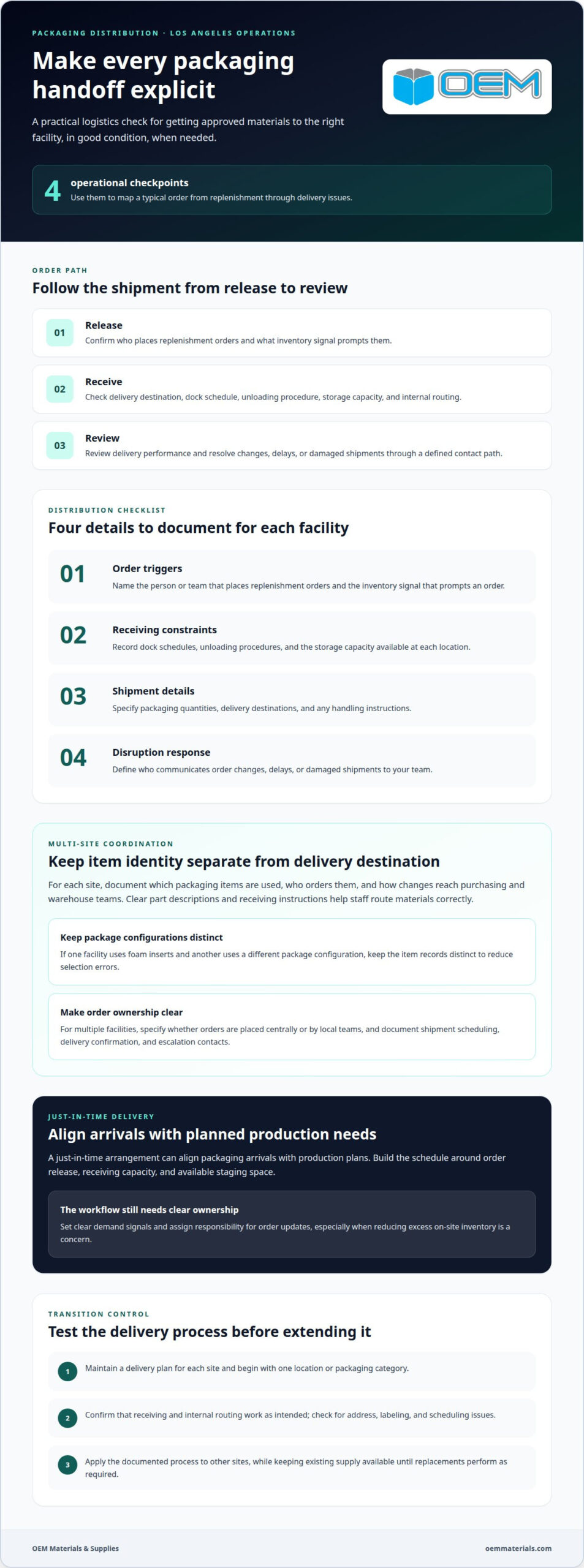
Distribution affects whether approved packaging reaches each facility in good condition and when it’s needed. For operations in Los Angeles, map delivery points, receiving hours, storage limits, and how packaging moves from the dock to the production line.
Compare the supplier’s distribution model with your order patterns. A central shipping point may suit one location, while multiple plants may need coordinated deliveries to separate receiving docks. Document which items each site uses, who places orders, and how changes reach purchasing and warehouse teams. This can reveal handoff gaps before the transition.
Trace a typical order from release through receipt to review logistics requirements. Include:
- Order triggers: Identify who places replenishment orders and what inventory signal prompts them.
- Receiving constraints: Record dock schedules, unloading procedures, and storage capacity at each location.
- Shipment details: Specify packaging quantities, delivery destinations, and any handling instructions.
- Disruption response: Define who communicates order changes, delays, or damaged shipments to your team.
For example, a Los Angeles facility receiving boxes for several production lines should distinguish item identification from delivery destination. Clear part descriptions and receiving instructions help warehouse staff route materials correctly. If one site uses foam inserts and another uses a different package configuration, keep item records distinct to reduce selection errors.
National distribution also requires clarity about what the supplier coordinates and what your team manages. Document order approval, shipment scheduling, delivery confirmation, and escalation contacts. For multiple facilities, specify whether orders are placed centrally or by local teams. This affects purchasing visibility and helps prevent duplicate or missed orders during a supplier change.
A just-in-time delivery arrangement can align packaging arrivals with planned production needs. The schedule should account for order release, receiving capacity, and the space available for staging. Just-in-time packaging support can be considered when excess on-site inventory is a concern, but the workflow still needs clear demand signals and ownership for order updates.
During the transition, maintain a delivery plan for each site. Start with one location or packaging category, confirm receiving and internal routing work as intended, then apply the documented process elsewhere. This staged approach can uncover address, labeling, and scheduling issues before they affect every facility.
For a logistics review, share delivery locations, receiving constraints, packaging types, and order patterns through a packaging and delivery quote request. Those details help frame a practical distribution plan for your operation.
Packaging supplier experience
Relevant experience shows in how a supplier connects packaging design to product handling and production needs. Aerospace components, medical devices, electronics, and automotive parts each present different demands. Start with your products, packing steps, and shipping conditions, then assess whether the proposed approach addresses them.
Look for evidence of problem-solving, not just years in business or a broad catalog. For a fragile electronic assembly, for example, the packaging plan should explain how the item is restrained and protected during movement. For a production line, the plan should also account for how quickly workers can load and close each package.
Review the supplier’s approach to four practical points:
- Application knowledge: Does the packaging recommendation reflect product geometry, handling, and shipping conditions?
- Design process: Are package drawings, samples, or prototypes used to evaluate fit before rollout?
- Operational fit: Does the proposed package work with existing packing stations and warehouse routines?
- Issue resolution: Is there a clear process for addressing poor fit, material variation, or recurring damage?
Experience matters when packaging changes affect labor. A package with several separate components may slow packing or increase assembly errors. The supplier’s process should account for how materials arrive, how operators handle them, and how finished cartons move through the facility. These details matter especially for product lines with multiple configurations or frequent production changes.
Use a representative package as a practical test case. Share its dimensions, weight, orientation, and handling steps, then review how the proposed design addresses each constraint. A sample trial can show whether the package is easy to assemble, holds the product securely, and fits the shipping carton. Record operator feedback and observed issues before approving a broader change.
Communication is another measure of experience. During a transition, clear item descriptions, revision records, and assigned decision owners help prevent outdated specifications from reaching production. If engineering changes a component’s dimensions, for example, purchasing and warehouse teams need the approved packaging revision before ordering or picking materials.
Assess whether the supplier can explain tradeoffs without relying on generic claims. Thicker protective material may add package bulk, while a tighter fit may complicate loading. A useful recommendation connects those choices to the product, shipping route, and work sequence. This gives procurement and operations teams a specific basis for evaluating the supplier’s approach and approving the transition.
What certifications and regulatory requirements apply to packaging suppliers in the United States?
No single supplier credential answers every packaging compliance question. Start with the product, packaging material, intended use, and destination, then identify the requirements for that combination. Packaging for an industrial component may face different customer specifications from packaging for a medical device or electronic assembly.
Distinguish supplier qualifications from requirements for a particular material or package. A company-wide certificate may describe a management system, while a customer specification may address material composition, handling, or documentation. Review the certificate’s scope, issuing organization, covered facility, and validity period, then compare those details with the purchasing specification for the item.
Use a documented review process for each packaging category:
- Define the application: Record the product, intended use, shipping conditions, and destination.
- Identify requirements: Gather applicable customer specifications and internal quality criteria.
- Review evidence: Match supplier documents to the material, facility, and scope they cover.
- Approve the item: Record the accepted specification and retain its supporting documentation.
For example, an electronics manufacturer may require packaging that meets its handling and product-protection criteria. Identify the specific packaging component, its approved specification, and the documents required for purchasing approval. If the product or destination changes, revisit the requirements rather than carrying forward an approval automatically.
For medical-device packaging, distinguish the supplier’s qualifications from requirements tied to the device, packaging system, or customer. A supplier credential alone doesn’t establish that a particular package suits a specific application. Procurement and quality teams should align the purchase specification, approved materials, and required records before a new item enters production.
Keep the approval trail easy to use. Link each document to a clear item description and revision so receiving and quality personnel can identify the applicable record. If a supplier proposes a material substitution, use the same review process before updating purchasing records or work instructions. This helps keep unreviewed changes off the packing line.
During supplier qualification, request documents relevant to the packaging in scope, not a general assurance. Confirm which facility and materials the records cover, how revisions are communicated, and who handles documentation questions. A focused review lets Los Angeles purchasing and quality teams compare evidence relevant to their products, rather than treating unrelated credentials as interchangeable.
How can a business assess a packaging supplier’s quality control and sustainability practices?
Assess quality and sustainability using records, samples, and production-floor performance. For a corrugated carton, compare incoming dimensions and construction with the approved specification. For a foam insert, check its shape and fit against the product drawing. Connect documented controls to the packaging item your operation actually receives.
Ask how the supplier controls revisions, inspects materials, and handles defects. Trace one item from its approved specification through receiving and shipment. Check that the item description, revision, and inspection records align. If a shipment arrives with inconsistent carton dimensions, determine how the issue is recorded, contained, and resolved.
Use a practical review sequence:
- Set acceptance criteria: Define the dimensions, fit, material, and performance requirements for each package.
- Review documentation: Compare specifications, inspection records, and revision controls for the selected item.
- Evaluate samples: Run sample packaging through the actual packing station and handling steps.
- Track exceptions: Record defects, damage, rework, and corrective actions during the evaluation.
Production trials can uncover problems that paperwork misses. A carton may meet its drawing but slow packing because its closure is difficult to handle. Record assembly steps, operator feedback, and product movement inside the package. These observations help distinguish a material defect from a design or workflow issue.
For sustainability, start with measurable packaging attributes rather than broad environmental claims. Compare material quantity, package dimensions, and whether components can be separated after use. A right-sized carton may reduce unused space, but it still needs to protect the product during handling and shipment. Review the complete package, including inserts and cushioning, rather than judging one material alone.
Ask how sustainability claims are documented and which packaging items they cover. Request material descriptions and relevant supporting records, then compare them with your purchasing and disposal requirements. Recycling options may depend on local collection and processing, so assess the actual waste stream at each facility. Don’t assume a material is recyclable in practice solely because it is described that way.
Use a scorecard to record quality results, material use, damage observations, and packing labor. Compare the same package under the same operating conditions. This gives procurement, engineering, and warehouse teams a shared basis for approval and highlights tradeoffs to resolve before a wider rollout.
For a packaging review, request a quote with package dimensions, product weight, and shipping requirements to support a recommendation grounded in your operation.
OEM Materials & Supplies
OEM Materials & Supplies helps businesses in Los Angeles evaluate packaging against product protection, packing workflows, and supply needs. Its corrugated boxes, foam packaging, packaging kits, and mailing tubes and cores support different product formats and handling requirements. Share the challenges identified in your supplier comparison to focus the discussion on practical fit.
For a transition review, provide product dimensions, weight, current packaging details, and annual usage. This information helps shape recommendations around your operation rather than a generic substitute. Contact OEM Materials & Supplies to discuss your packaging requirements.
Build a Transition Plan Your Team Can Use
A supplier change succeeds when the decision becomes a clear operating plan. Assign responsibility for approving specifications, updating purchasing records, and communicating changes to production and warehouse teams. That coordination helps prevent a packaging decision from disrupting work on the floor.
A disciplined approach to finding a replacement for a national packaging supplier keeps the transition focused on your operation’s priorities. Use your evaluation findings to define the first items to transition, the teams involved, and the criteria for reviewing results. Clear ownership makes it easier to address issues and control future packaging changes.
OEM Materials & Supplies can discuss packaging requirements for operations in Los Angeles and help identify options suited to your products and workflow. Share product dimensions, weight, and annual usage to make the conversation more specific.
Contact OEM Materials & Supplies to request a quote and take the next step toward a packaging plan that fits your operation.
Frequently Asked Questions
What criteria should businesses use to evaluate a replacement packaging supplier?
Evaluate whether the supplier can support your packaging specifications, purchasing process, and operating priorities. Compare how it handles item changes, ordering responsibilities, and coordination between procurement and production. A manufacturer with frequent product revisions, for example, may value a clear process for updating packaging records. Consider whether the supplier supports the materials and package formats your operation uses, rather than choosing by catalog size alone.
Which packaging suppliers serve businesses in Southern California?
OEM Materials & Supplies serves businesses in Southern California, including Orange County, Los Angeles, San Diego, and Riverside. Geographic coverage is only one part of the decision. For a Los Angeles facility, consider how the supplier’s products and service model fit local purchasing, receiving, and production needs.
How do packaging suppliers compare on product range, service, and reliability?
Compare suppliers using the same representative packaging items and service needs. One company may offer a broader range of materials, while another may better match specialized packaging requirements or order coordination. Judge reliability against your operation’s priorities, such as consistent specifications and effective communication when requirements change. For instance, compare how each supplier handles a new product configuration, not just a routine reorder.
How do shipping costs, lead times, and delivery coverage compare between suppliers?
Compare these factors using the same shipment profile for each supplier: packaging type, order quantity, destination, and receiving requirements. Shipping costs depend on the shipment and delivery terms, while lead times depend on the item and order process. For a business in Los Angeles, Orange County, San Diego, or Riverside with multiple receiving locations, distinguish coverage from delivery coordination. Record what each proposal includes and how order changes affect fulfillment.