

Switching to a packaging VMI provider changes who monitors stock and initiates replenishment, not the packaging your operation uses. In a vendor-managed inventory program, the provider uses inventory and usage data to plan deliveries against agreed stock levels. For manufacturers in Orange County, Los Angeles, San Diego, and Riverside, the transition also changes how purchasing and inventory decisions are coordinated.
Switching to a packaging VMI provider can reduce routine ordering, but success depends on reliable demand information, clear replenishment expectations, and regular communication. Delivery releases, stock checks, and forecasts need to align with production schedules so packaging stays available without creating unnecessary inventory.
This guide explains packaging VMI and what changes during a transition. It covers delivery schedules, stock monitoring, usage-based replenishment, and the purchasing tasks that may become less frequent. It also outlines practical steps for keeping packaging supply aligned with production needs.
Key Takeaways
- VMI shifts routine stock monitoring and replenishment decisions to the supplier, guided by agreed inventory levels and usage information.
- Delivery releases can be coordinated with production needs, while the supplier plans replenishment to maintain agreed stock levels.
- Accurate usage and demand data help align forecasts with changing production volumes and reduce the risk of excess or insufficient packaging stock.
- With fewer routine purchase orders to manage, purchasing teams can focus more on reviewing supply performance and exceptions.
- Clear responsibilities, stock visibility, and regular communication help keep a packaging VMI arrangement aligned with plant operations.
What Is Vendor-Managed Inventory (VMI)?
Vendor-managed inventory (VMI) shifts packaging stock monitoring and routine replenishment decisions to a supplier, using the manufacturer’s inventory and usage data. Agreed stock thresholds help coordinate deliveries with production needs.
Packaging VMI Fundamentals
In packaging VMI, a supplier monitors a manufacturer’s packaging inventory and plans replenishment using actual usage and shared data. This matters when boxes, foam inserts, or packaging kits support production and must be available as orders are packed. Unlike a model where the buyer initiates each purchase, the vendor takes a more active role in deciding when and how much to deliver. A packaging VMI program can use inventory counts or shared usage information to guide those decisions.
Compared with buyer-managed purchasing, VMI moves routine reorder decisions to the supplier. Unlike a simple standing order, replenishment responds to inventory levels and usage rather than following only a fixed calendar. Supplier-managed inventory describes the same practical arrangement: a supplier monitors stock and replenishes it as needed.
When evaluating providers, compare the packaging items they can support, how they use inventory data to plan replenishment, and which service measures they report. Assess pricing against the program’s inventory and delivery requirements. Useful measures include fill rate, stockouts, and delivery performance.
Replenishment and Inventory Thresholds
Minimum and maximum inventory levels define the range used to plan replenishment. The minimum signals when stock needs replenishing, while the maximum sets the agreed upper level. Set thresholds based on item usage, demand variability, and lead times. A high-use box and a slower-moving foam insert, for example, may need different levels. Suitable limits help balance availability with the amount of packaging kept on hand.
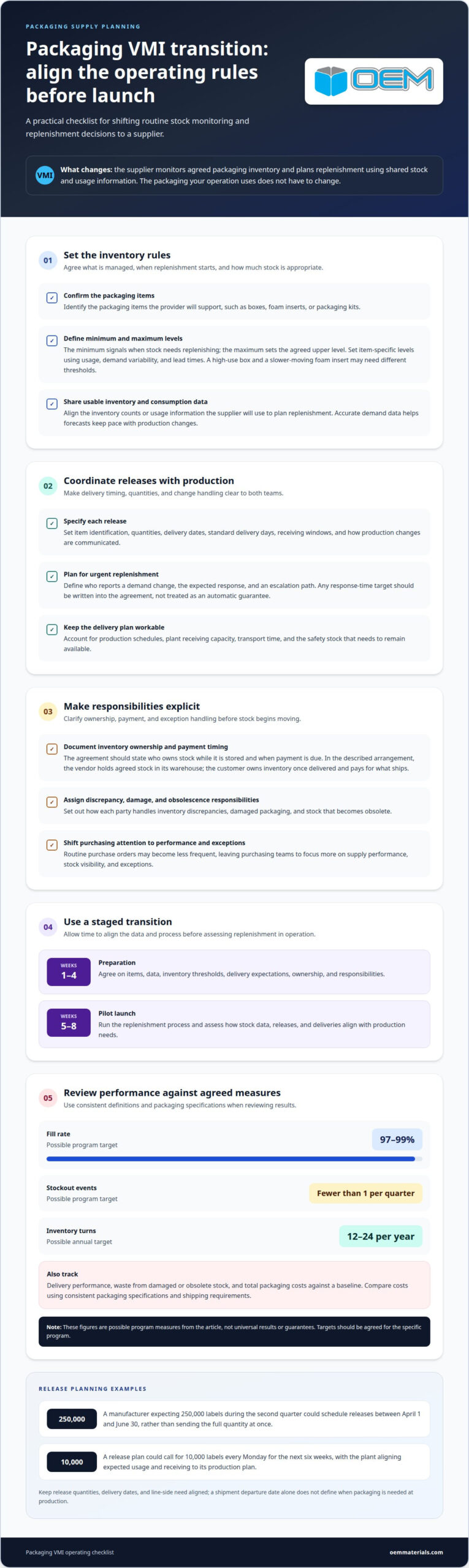
Switching to a packaging VMI provider involves agreeing on packaging items, sharing usable inventory or consumption data, and setting thresholds and delivery expectations. A practical transition can allocate weeks 1-4 to preparation and weeks 5-8 to pilot launch. The schedule gives teams time to align data and processes before assessing replenishment in operation.
The agreement should define inventory ownership, payment timing, and responsibility for discrepancies, damage, or obsolete packaging. In the arrangement described here, the vendor holds agreed stock in its warehouse; the customer owns inventory once it is delivered and pays for what ships. Clear terms explain each party’s responsibilities while stock is stored and after delivery.
Performance measurement can combine fill rate, stockouts, waste, and total packaging costs against a baseline. A 97-99% fill-rate target and fewer than 1 stockout event per quarter are possible program measures; inventory turns can also be tracked against a target of 12-24 turns per year. Track waste from damaged or obsolete stock, then compare costs using consistent packaging specifications and shipping requirements.
Delivery schedules and release orders
Packaging VMI schedules connect release orders to production demand, inventory levels, and agreed delivery windows. They specify what ships, when it arrives, and how much safety stock remains available.
Rapid and Frequent Deliveries
An agreed rapid-response process covers demand changes or urgent replenishment, while frequent deliveries divide supply into smaller shipments. This can help a plant limit onsite inventory without relying on one large delivery. Define who communicates changes, how releases are submitted, and what response time the supply chain expects.
For example, a manufacturer expecting 250,000 labels during the second quarter could schedule releases between April 1 and June 30. The release plan turns a projected need into deliveries aligned with production, rather than sending the full quantity at once. Under a minimum and maximum arrangement, a release that draws the supplier’s in-house stock below the agreed minimum can trigger production to replenish it.
Smaller, recurring releases also need practical limits. Teams can define standard delivery days, quantities, receiving windows, and an escalation path for an unexpected production change. A VMI program might set a maximum stockout response time, such as emergency delivery within 24 hours. That is a planning target to define in the agreement, not an automatic guarantee. Include plant receiving capacity and transport time when setting the schedule.
Just-in-Time Packaging Delivery
Just-in-time (JIT) packaging delivery holds safety stock in a supplier’s warehouse and ships packaging as production requires it. This can reduce the quantity stored at the plant while keeping material available for scheduled work. For labels, teams can plan releases around a forecast period and divide them into quantities that match expected line consumption.
For example, a release plan could call for 10,000 labels every Monday for the next six weeks. The supplier schedules each shipment to that cadence, while the plant’s team aligns expected usage and receiving with its production plan. Custom packaging can also be held in a supplier warehouse near the plant and shipped on short notice, supporting a tighter delivery window.
JIT requires clear release instructions and a workable recovery plan. A schedule should specify item identification, quantities, delivery dates, and how changes are communicated. For packaging tied to a production run, the release should account for when materials are needed at the line, not only when they leave the warehouse. JIT packaging delivery can be structured around those timing requirements.
For a delivery schedule based on your production cadence, share your packaging and release requirements for a practical review.
VMI stock monitoring and replenishment
VMI programs monitor packaging on hand through inventory counts or shared usage data, then use that information to trigger replenishment. Choose a monitoring method that matches the data the plant and supplier can reliably share.
Implementation requires item-level inventory balances, consumption records, and agreed minimum and maximum levels. An ERP system can track packaging quantities and lot codes in real time, including customer-supplied materials. If systems do not exchange data directly, standardized data rules and a centralized platform can help keep item identifiers and quantities consistent.
Set a review cadence that fits the data flow. Inventory balances and consumption can be reviewed daily or weekly, depending on the sharing approach. During startup, compare recorded stock with physical counts and adjust initial minimum and maximum levels within the first 2-3 replenishment cycles. This helps correct thresholds before routine replenishment relies on them.
First-in, first-out (FIFO) rotation means using the oldest received stock before newer stock of the same item. Warehouse teams can support FIFO by marking receipt dates, arranging stock locations in issue order, and recording withdrawals. For packaging with lot codes, recording each lot at receipt and issue supports traceability and makes older inventory easier to identify.
Stockouts can result from inaccurate counts, delayed updates, unexpected demand, or a replenishment signal sent too late. A missing custom partition, insert, or box can interrupt production even when every product component is available. A finished part, for example, may have no protected place to go while its required insert is out of stock. Monitoring actual consumption and setting suitable thresholds helps reduce this risk.
Transition risks include inconsistent item data, missed replenishment signals, and uncertainty over who updates inventory records. Reduce these risks by assigning responsibility for counts and data corrections, sharing usage information consistently, and reviewing discrepancies before the next release. Regular communication helps teams respond when production changes affect packaging demand.
Measure performance against a baseline using stockouts, waste, inventory turns, and replenishment accuracy. A VMI inventory-turns target is 12-24 turns per year, and a stockout target is less than 1 stockout event per quarter. Review damaged or obsolete stock alongside these measures; low stock alone does not show whether the program is maintaining appropriate inventory or simply risking production interruptions.
Packaging kits managed under VMI can be replenished as complete units, with lot-level traceability. Define the components in each kit and monitor the complete unit as the replenishment item. Keep component and lot information aligned with receipt and issue records so teams can identify available kits and trace their movement. Agree how changes to kit contents will be communicated and recorded before using the revised definition for replenishment decisions. When investigating discrepancies, compare the recorded kit balance with the physical number of complete units on hand, rather than counting loose components as available kits. This keeps replenishment signals tied to usable packaging and supports traceability through receipt, storage, and issue.
Forecasting and demand planning
Packaging demand planning connects historical usage with expected production, helping align stock levels, inventory levels, and shipment schedules. In a VMI arrangement, the supplier uses shared data to coordinate replenishment with anticipated packaging needs.
Start with item-level usage history and compare it with the production plan. Past consumption provides a baseline; upcoming orders and schedule changes show where demand may shift. Forecasts can cover a month, quarter, or half-year, depending on how far ahead the operation plans packaging requirements. The supplier can use that view to coordinate packaging production and shipment timing with expected needs.
Compare forecasts regularly with actual consumption. If production increases, packaging use may rise; if a line slows or a product is paused, expected demand may fall. Sharing updated schedules helps the supplier distinguish short-term variation from sustained change. This matters because inventory levels should reflect current requirements, not just an older forecast.
For example, a manufacturer can share its planned production mix and expected packaging use for the coming quarter. The supplier can compare those projections with recent usage and identify items where projected demand differs. Teams can then adjust planned releases or stock thresholds before the gap affects packaging availability. Forecast reviews also give purchasing and operations a shared basis for discussing upcoming shipments.
Forecasting custom labels requires attention to artwork changes. A label tied to a product design or printed information can become obsolete when the artwork changes. Account for this risk in inventory planning instead of treating all forecasted label demand as interchangeable. Coordinating production schedules and label revisions helps limit the chance of holding stock that no longer matches the product.
Demand planning also needs clear ownership of updates. Operations can provide production changes, while purchasing shares order patterns and communicates item substitutions. The supplier can use these inputs to revise forecasts and replenishment plans. For example, an item replaced in the production schedule should not continue receiving shipments based on the old plan.
Useful forecast reviews compare planned demand with actual consumption and record the reasons for significant differences. Teams can note schedule changes, new product introductions, pauses, and artwork revisions. This record improves the next planning cycle and helps explain inventory changes. When switching to a packaging VMI provider, a shared review process connects demand signals to stock and shipment decisions.
Purchasing-related administrative costs
Vendor-managed inventory changes purchasing work by shifting routine replenishment decisions to the supplier. Buyers still manage the relationship, review performance, and resolve exceptions, but may place fewer individual purchase orders. The administrative impact depends on which packaging items enter the program and how orders are approved, received, and invoiced.
To understand the internal workload, track staff time spent creating purchase requests, issuing orders, expediting shipments, reconciling invoices, and correcting inventory records. A buyer handling recurring box orders, for example, may repeat the same steps each cycle. VMI can reduce that transactional work, while forecast reviews, supplier communication, and exception handling remain.
Inventory management also includes work beyond procurement. Warehouse employees count stock, record receipts, rotate materials, and flag damaged or obsolete items. The VMI process should assign responsibility for each task and explain how the supplier receives accurate updates. If the supplier monitors inventory but plant records remain incomplete, the buyer may still need to reconcile discrepancies before relying on replenishment decisions.
How much does packaging VMI cost, including service fees and inventory carrying costs? Pricing depends on the program and is provided after a quote request. Relevant factors include packaging specifications, usage, storage arrangements, delivery frequency, and agreed service responsibilities. Compare the charges with internal labor, inventory carrying requirements, and the purchasing work the program is expected to change.
Assess the impact against a baseline before implementation. Record time spent on purchase transactions and inventory tasks, then compare those measures once the VMI process is operating. Also track order corrections, invoice discrepancies, and urgent purchases. A lower order count alone does not demonstrate value if receiving errors or production interruptions increase.
Clear contract terms prevent administrative work from shifting without ownership. Define who approves item changes, updates forecasts, investigates count differences, and handles obsolete stock. Specify the invoice basis and when delivered inventory becomes payable. These responsibilities help purchasing, warehouse, and supplier teams resolve exceptions without duplicating work.
Buyers remain responsible for reviewing service performance, even when the supplier manages replenishment. Schedule regular reviews of delivery accuracy, stock availability, inventory records, and unresolved exceptions. A recurring mismatch between receipts and invoices, for example, may indicate a data or process issue rather than a purchasing delay. Documenting the cause helps both parties correct the workflow.
To assess packaging requirements and purchasing needs for a potential program, request a quote for your packaging needs. Include item specifications, usage patterns, and delivery requirements so the proposed scope reflects actual operations.
OEM Materials & Supplies
OEM Materials & Supplies helps manufacturers align packaging choices with inventory and replenishment needs. Its corrugated boxes, foam packaging, packaging kits, and mailing tubes and cores can support a coordinated packaging supply plan.
For teams evaluating a VMI transition, start by identifying the packaging items that support production, how they are used, and which delivery pattern fits operations. This context connects packaging requirements with inventory planning without treating every item as interchangeable.
Contact OEM Materials & Supplies to discuss your packaging and supply requirements.
Put Your Packaging Plan Into Practice
Before switching to a packaging VMI provider, turn the inventory approach into clear operating expectations. Identify the packaging items most important to production, define how usage information will be shared, and agree how teams will respond when schedules change. These decisions give purchasing, warehouse, and operations staff a common framework for the transition.
Packaging specifications also shape the plan. Corrugated boxes, foam packaging, and packaging kits serve different packing needs, so usage patterns and replenishment requirements should reflect the actual application. OEM Materials & Supplies helps industrial teams consider these packaging requirements alongside their supply needs.
Bring together the item list, recent usage information, and delivery requirements as a starting point for a practical discussion. Contact OEM Materials & Supplies to discuss your packaging requirements and identify a suitable next step for your operation.
Frequently Asked Questions
How does supplier warehousing help?
Supplier warehousing can keep packaging close to a plant without requiring the manufacturer to store all of it onsite. It may also buffer the operation against lead-time changes for materials such as board, resin, or lumber. For example, a manufacturer with limited warehouse space may arrange for finished packaging to be held offsite and released as production requires it.
What Are the Benefits of VMI and SMI?
Vendor-managed inventory (VMI) and supplier-managed inventory (SMI) describe essentially the same practical arrangement: a third party monitors inventory and manages restocking. Both can reduce routine ordering work and help keep packaging available based on usage. Their value depends on accurate inventory information, clear responsibilities, and a replenishment plan that matches operations. Buyers still need to review performance and resolve exceptions.
What is packaging vendor-managed inventory (VMI) and how does it work?
Packaging VMI is an arrangement in which a supplier uses a manufacturer’s inventory or usage information to make replenishment decisions. For example, a plant can share counts for boxes and protective inserts, allowing the supplier to plan restocking against agreed stock limits. The agreement also defines which items are included, how information is shared, and when delivered packaging becomes the manufacturer’s inventory.
What are the benefits and drawbacks of switching to a packaging VMI provider?
Switching can reduce repetitive purchase-order work and connect replenishment more closely to packaging use. It also requires dependable data, agreed responsibilities, and coordination among purchasing, warehouse, production, and supplier teams. Poor item records or delayed updates can lead to incorrect replenishment decisions. A focused pilot using a packaging category with stable demand can reveal data gaps and workflow issues before the program expands.
How do packaging VMI providers compare on pricing, product range, and service levels?
Compare the packaging items each provider supports and how inventory data guides replenishment. Assess pricing against your inventory and delivery requirements, and compare service measures such as fill rate, stockouts, and delivery performance.