
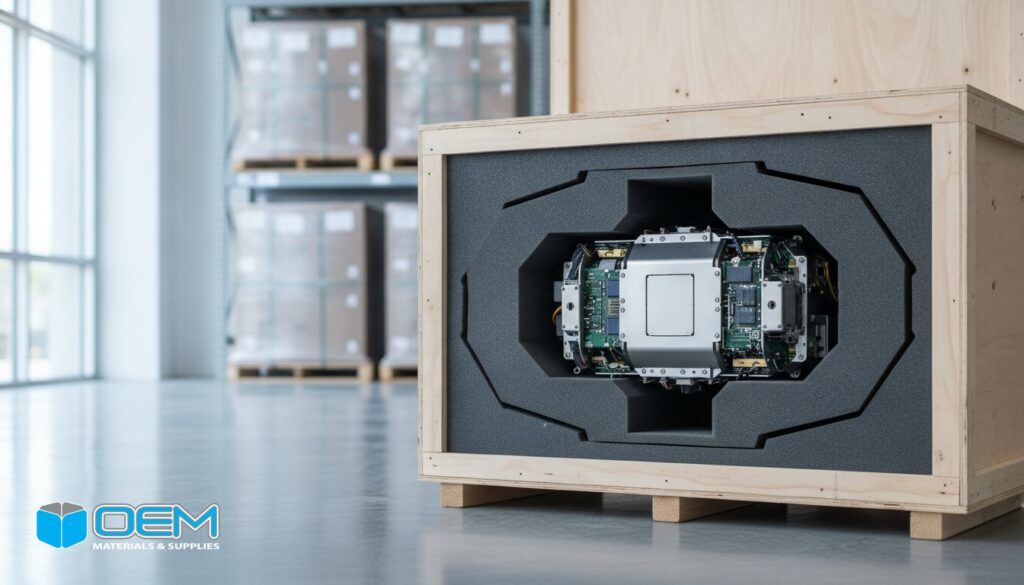
A single hairline fracture on a high-value avionics sensor does more than ruin a component; it halts production lines and threatens mission-critical timelines. For manufacturers in Southern California, the stakes of transit damage are too high to rely on generic shipping solutions. You understand that protecting sensitive aerospace hardware requires more than just a sturdy box. It demands precise engineering that accounts for vibration, electrostatic discharge, and rigorous regulatory standards like MIL-SPEC or AS9100.
Partnering with a dedicated aerospace packaging company in Orange County ensures your logistics strategy is as sophisticated as the technology you produce. This article explains how specialized engineering and local expertise protect mission-critical components across the region. We will look at how custom foam inserts, integrated kitting services, and vendor-managed inventory (VMI) can eliminate shipping damage while reducing your internal overhead. By prioritizing a local partner for rapid prototyping and just-in-time delivery, you can transform your packaging from a logistical hurdle into a competitive advantage for your supply chain.
Key Takeaways
- Learn how engineered foam densities and custom cushioning mitigate shock and vibration to protect sensitive avionics during transit.
- Understand the role of an aerospace packaging company in Orange County in maintaining compliance with MIL-SPEC and ESD requirements for mission-critical components.
- Discover how Vendor-Managed Inventory (VMI) and just-in-time delivery models reduce warehouse footprint and lower operational overhead.
- See how integrated kitting and assembly services streamline production lines by providing ready-to-use packaging kits for Tier 1 and Tier 2 suppliers.
- Identify the technical criteria for selecting a local partner capable of rapid prototyping and scalable production for high-value logistics.
The Strategic Importance of Aerospace Packaging in Orange County
Orange County acts as a primary hub for the global aerospace and defense supply chain. For Tier 1 and Tier 2 suppliers, packaging is not an afterthought. It is a technical requirement. High-precision components and sensitive avionics demand validated protection systems. Standard containers do not suffice when mission success is at stake. This regional density of manufacturing means that logistical failures have a ripple effect across the entire defense sector. Moving from commodity packaging to engineered solutions is necessary to maintain the integrity of these high-value assets.
The Southern California Aerospace Ecosystem
Proximity defines supply chain resilience in Southern California. Major OEMs from Huntington Beach to San Diego operate on lean schedules. A local aerospace packaging company in Orange County provides the agility these manufacturers need to meet stringent delivery windows. When engineering specifications change, a local partner can adjust a custom packaging design and deliver prototypes for physical testing immediately. This reduces lead times and supports just-in-time (JIT) packaging strategies. By sourcing locally, manufacturers minimize the carbon footprint of their logistics while ensuring that their packaging partner understands the specific regional transit challenges.
Risks of Subpar Packaging in Aviation Logistics
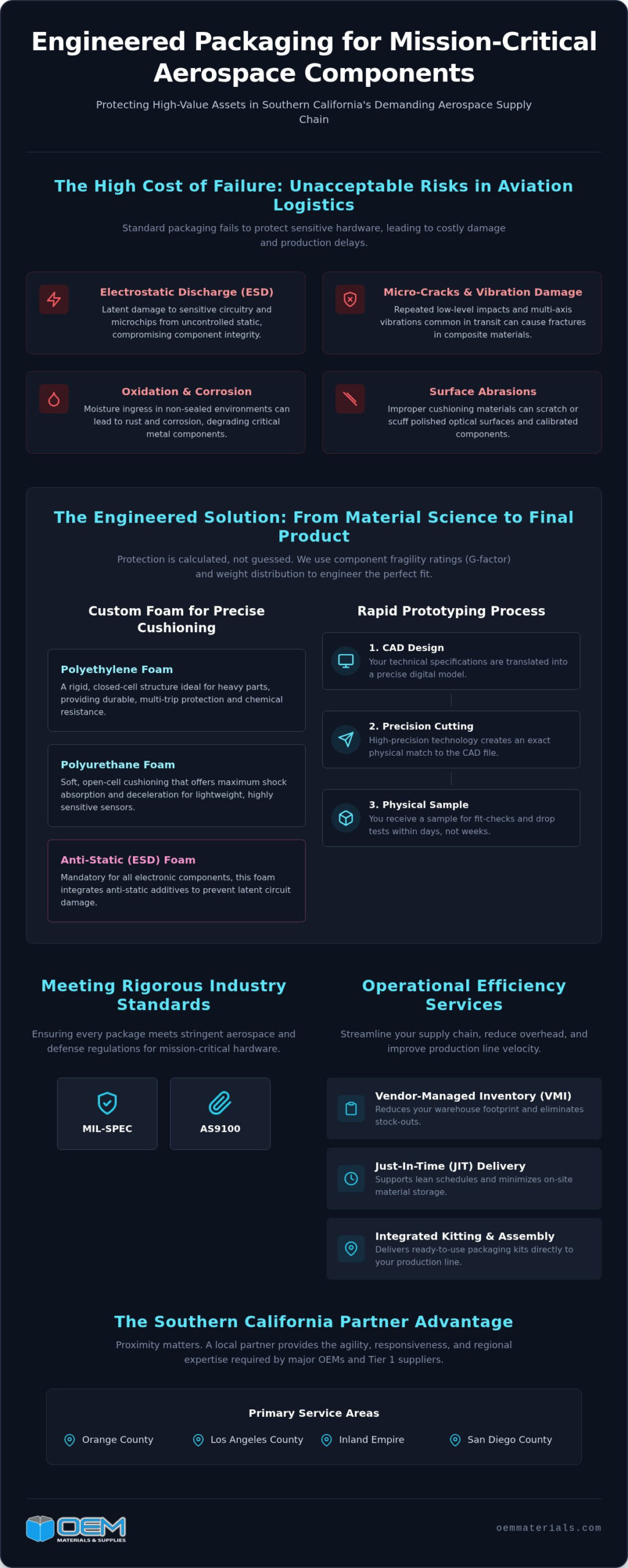
Subpar packaging introduces unacceptable risk into aviation logistics. The cost of a damaged flight sensor is not just the replacement value. It includes lost testing windows and production line stoppages that can derail multi-year contracts. Generic corrugated boxes fail to mitigate the multi-axis vibrations common in air and ground transit. Aerospace hardware requires specific foam densities to absorb energy rather than transferring it to the delicate internal components. Without an engineered approach, manufacturers face several failure points:
- Electrostatic discharge (ESD) that compromises sensitive circuitry.
- Micro-cracks in composite materials from repeated low-level impact.
- Oxidation and corrosion from moisture ingress in non-sealed environments.
- Surface abrasions on polished optical components from improper cushioning materials.
Relying on a specialized aerospace packaging company in Orange County ensures that every material, from the outer wood crates to the internal anti-static foam, meets the rigorous standards required for flight-critical hardware. This proactive approach to protection eliminates the hidden costs of damage and keeps mission-critical projects on schedule.
Engineering Custom Protection for Sensitive Aerospace Components
Engineering protection for aerospace hardware starts with data. You don’t guess at cushion thickness; you calculate it based on the fragility rating (G-factor) of the component. An experienced aerospace packaging company in Orange County uses these technical specs to design systems that mitigate multi-axis vibration and drop impacts. By analyzing the weight distribution and center of gravity, engineers create custom enclosures that prevent internal shifting during transit. This engineering-first approach ensures that your logistics plan is built on physics rather than trial and error.
Custom Foam Inserts and Cushioning Materials
Material selection is a critical variable in avionics protection. Polyethylene foam provides a rigid, closed-cell structure ideal for heavy parts or multi-trip applications. It’s durable and resistant to chemicals. In contrast, polyurethane foam offers soft, open-cell cushioning for lightweight, highly sensitive sensors that require maximum deceleration upon impact. For electronic components, integrating anti-static (ESD) additives into the foam is mandatory to prevent latent damage to circuit boards. Utilizing custom foam packaging ensures that every cutout matches the exact geometry of your hardware, providing 360-degree support.
Rapid Prototyping: From CAD to Physical Sample
The transition from digital design to a physical sample is where many logistics plans falter. We bridge this gap by utilizing high-precision cutting technology that mirrors CAD specifications exactly. This rapid prototyping capability allows your team to perform drop tests and fit-checks within days. It ensures that the final production run is optimized for both protection and packing speed, reducing labor costs on your assembly line. If you have a complex assembly, you can request a prototype evaluation to see how the materials perform under simulated stress before committing to high-volume production.
Engineered Corrugated and Wood Crating
Oversized assemblies or high-precision metal parts often require multi-material solutions. Integrating heavy-duty corrugated boxes with internal foam bracing provides a lightweight yet durable option for domestic shipping. For international transit or heavy landing gear, custom crates built from heat-treated wood provide the necessary structural integrity. These crates are often designed with integrated foam cradles or shock-mounted bases to isolate the part from the harsh realities of maritime or air freight handling. Choosing a specialized aerospace packaging company in Orange County gives you access to engineers who understand the balance between container weight and structural durability.
Compliance and Standards for Aerospace Packaging Orange County
Compliance in the aerospace sector is a non-negotiable prerequisite for doing business. Whether you are fulfilling a Department of Defense contract or shipping high-value avionics to an international OEM, your packaging must adhere to specific regulatory frameworks. An aerospace packaging company in Orange County serves as a technical consultant in this area, ensuring that every shipment meets MIL-SPEC, AS9100, and ISPM 15 standards. Failure to comply results in rejected shipments, contract penalties, and potential damage to sensitive hardware. You need a partner that understands the intersection of engineering and regulation.
Navigating MIL-SPEC and AS9100 Requirements
Meeting MIL-SPEC requirements involves more than selecting a heavy-duty box. It requires precise documentation of materials, preservation methods, and specialized marking. Defense contracts often dictate specific barrier materials and cushioning levels to withstand long-term storage in varied climates. Accurate identification is equally critical. Utilizing high-quality labels and ribbons ensures that barcodes and shipping data remain legible through harsh transit conditions. This level of detail supports the traceability and quality management systems required by AS9100 standards, ensuring your logistics process stands up to rigorous audits.
ESD Protection and Cleanroom Packaging
Electronic components such as flight controllers and radar sensors are vulnerable to static electricity and environmental contaminants. ESD protection requires a multi-layered approach. Static shielding bags create a Faraday cage around the component, while conductive or anti-static foam inserts prevent charge buildup during movement. For moisture-sensitive parts, desiccants and humidity indicator cards are integrated into the vacuum-sealed environment to maintain component integrity during long-term storage. In cleanroom applications, packaging materials must be low-outgassing and particle-free to prevent contamination of optical or precision mechanical assemblies.
International Shipping and ISPM 15 Certification
For global logistics, all wood packaging must be ISPM 15 certified to prevent the international spread of timber pests. This involves verified heat treatment processes for every crate and pallet used in your shipment. Working with an aerospace packaging company in Orange County that provides certified wood crates simplifies the export process. It ensures your shipments pass through customs without delay or quarantine. By integrating these compliance measures into the initial design phase, you protect both the physical product and your standing as a reliable supplier in the global aerospace market.
Operational Efficiency: VMI and Kitting for Manufacturers
Operational success in aerospace manufacturing depends on a lean supply chain. Managing dozens of packaging SKUs, from custom foam to specialized corrugated, can distract your team from core production goals. Partnering with a specialized aerospace packaging company in Orange County allows you to outsource these logistical burdens. By integrating value-added services, you reduce the footprint of packaging materials on your warehouse floor and ensure your assembly team has exactly what they need at the right moment. This transition from a vendor-client relationship to a solutions partnership is essential for scaling high-volume aerospace programs.
Implementing a Vendor-Managed Inventory Program
Packaging inventory management is often reactive, leading to emergency orders and production delays. A packaging VMI program shifts the responsibility of monitoring stock levels to your supplier. We analyze your usage patterns and replenish stock before it reaches critical levels. This system eliminates stockouts of essential items like stretch film or custom inserts. It also improves cash flow by reducing the amount of capital tied up in excess inventory. Real-time tracking provides your procurement team with total visibility without the need for manual cycle counts or administrative overhead.
Kitting and Assembly for Aerospace Production
Efficiency on the production floor is measured in seconds. When an assembly technician has to source a box, a foam insert, and a static-shielding bag from three different locations, it creates a bottleneck. Custom kitting solves this by consolidating all protective elements into a single, ready-to-use unit. Consider the process of packing an avionics module. With a pre-assembled kit, the task becomes a single-step process rather than a multi-stage assembly. This reduces labor costs and minimizes the risk of human error during the final packing phase. By having an aerospace packaging company in Orange County handle the kitting off-site, you free up valuable floor space for high-value manufacturing activities.
Just-in-time (JIT) delivery models further enhance this efficiency. Instead of storing months of bulky crates, you receive only what is required for the current production schedule. This methodical approach to material handling ensures that your logistics are as precise as the aerospace components you manufacture. If you are looking to optimize your warehouse operations and reduce assembly times, you can request a quote to discuss a custom VMI or kitting strategy tailored to your facility’s requirements.
Selecting the Right Aerospace Packaging Partner in SoCal
Selecting a logistics partner in Southern California requires more than comparing price lists. For aerospace OEMs, the primary metric is the partner’s ability to solve complex engineering challenges under tight deadlines. A qualified aerospace packaging company in Orange County must offer a blend of technical expertise, rapid prototyping, and scalable production. You need a partner that functions as an extension of your engineering team rather than a vendor that merely delivers pallets. Evaluating these capabilities early in the procurement process prevents costly transit damage and supply chain bottlenecks later on.
Full-Service Capabilities vs. Commodity Reselling
Commodity resellers often lack the internal resources to provide technical support. When you encounter a specific vibration or shock requirement, a reseller can only offer off-the-shelf sizes that may not fit your component’s G-factor needs. In contrast, a full-service provider offers custom packaging design to create a validated solution from the ground up. Sourcing your corrugated boxes, foam inserts, and wood crates from a single local partner ensures that all components of the packaging system work together. This integration reduces the risk of material incompatibility and simplifies your vendor management process across Orange County, Los Angeles, and the Inland Empire.
Next Steps for Orange County Operations Managers
To facilitate an accurate initial consultation, your operations team should prepare specific data points. Accurate recommendations depend on the physical characteristics of the component and the logistical path it takes. Providing this information upfront allows an aerospace packaging company in Orange County to calculate material densities and structural requirements accurately. Be prepared to discuss the following details:
- Exact product dimensions and weight.
- Fragility ratings or specific shock and vibration requirements.
- Anticipated annual usage and typical batch sizes.
- Shipping methods and environmental exposure during transit.
If you are ready to evaluate your current logistics strategy, we recommend a comprehensive packaging audit. Our team can review your existing processes to identify areas for material cost reduction or damage prevention. Contact us today with your product dimensions and annual usage requirements to request a custom prototype or a technical consultation for your Southern California facility.
Optimizing Your Aerospace Logistics Strategy
Securing mission-critical components requires a shift from standard shipping practices to engineered logistics. By prioritizing technical design, Southern California manufacturers can eliminate the financial risks associated with transit damage and regulatory non-compliance. Integrating custom foam inserts, MIL-SPEC labeling, and ESD protection ensures that every component reaches its destination in flight-ready condition. It’s a process that demands precision and localized expertise.
Beyond physical protection, operational tools like vendor-managed inventory and custom kitting allow your team to reclaim warehouse space and reduce labor overhead. Partnering with a dedicated aerospace packaging company orange county provides the rapid prototyping and supply chain agility necessary to maintain a competitive edge in the defense and aviation sectors. This partnership transforms your packaging from a cost center into a strategic asset that supports your broader manufacturing goals.
Ready to evaluate your current protection systems? Contact OEM Materials & Supplies for an Aerospace Packaging Consultation to discuss your product dimensions and annual usage. We look forward to helping you streamline your high-value logistics operations.
Frequently Asked Questions
What are the common MIL-SPEC requirements for aerospace packaging?
MIL-SPEC requirements involve specific preservation methods and barrier materials designed for long-term storage and harsh environmental exposure. For defense contracts, packaging must often meet MIL-STD-2073, which dictates the level of protection against moisture, corrosion, and physical impact. Accurate labeling and identification are also mandatory. Working with a specialized partner ensures that these technical standards are documented and met for every shipment, preventing rejected loads at government receiving facilities.
How does custom foam density protect sensitive avionics?
Foam density is selected based on the fragility rating and weight of the avionics component. Higher density foams provide rigid support for heavy landing gear or structural parts, while lower density foams offer softer cushioning for sensitive sensors that require maximum shock absorption. Engineers calculate the exact thickness needed to isolate the part from vibration during transit. This precision prevents micro-cracks and internal mechanical failures that standard off-the-shelf cushioning materials often fail to stop.
Why should Orange County manufacturers use a local packaging supplier?
Local proximity allows for faster response times and reduced shipping costs. When engineering changes occur, an aerospace packaging company in Orange County can deliver physical prototypes for fit-testing within days. This agility is vital for Tier 1 and Tier 2 suppliers in Southern California who operate on lean schedules. Additionally, local partners facilitate face-to-face consultations and on-site packaging audits, ensuring that the logistics strategy remains aligned with your specific production floor requirements.
What is the difference between VMI and JIT in industrial packaging?
Vendor-Managed Inventory (VMI) focuses on inventory ownership and replenishment, where the supplier monitors your stock levels and refills them automatically. Just-In-Time (JIT) delivery focuses on the timing of shipments, providing materials only when they are needed on the production line. While VMI reduces administrative overhead and stockouts, JIT minimizes the physical footprint of packaging in your warehouse. Many manufacturers integrate both to optimize cash flow and floor space in high-volume aerospace programs.
How does ESD packaging prevent damage to aerospace electronics?
ESD packaging utilizes conductive or dissipative materials to protect sensitive electronics from static discharge. Static shielding bags create a Faraday cage to block external electrical fields, while anti-static foam prevents the buildup of triboelectric charges during movement. These materials are essential for flight controllers and circuit boards where a single spark can cause latent damage. Using integrated ESD solutions ensures that components maintain their electrical integrity throughout the entire transit and storage cycle.
What information is needed to get a quote for custom aerospace crates?
To provide an accurate quote for custom aerospace crates, we require the exact dimensions and weight of the component. You should also provide the G-factor or fragility rating if known, as this determines the internal cushioning requirements. Details regarding the shipping method, such as air or maritime freight, and the anticipated annual usage help in selecting the right structural materials. Providing these data points ensures the quote reflects a solution optimized for both protection and cost efficiency.
Are your wood crates compliant with ISPM 15 for international shipping?
Yes, all wood crates and pallets intended for international transit are compliant with ISPM 15 standards. This involves a verified heat treatment process that eliminates timber pests, followed by the application of the official IPPC mark. This certification is mandatory for global exports to prevent quarantine delays at international customs. Sourcing heat-treated wood packaging from a local partner ensures your shipments meet global regulatory requirements without the need for additional third-party processing.
Can you provide rapid prototyping for aerospace packaging designs?
We provide rapid prototyping services to bridge the gap between CAD designs and physical testing. Utilizing high-precision cutting technology, an aerospace packaging company in Orange County can produce custom foam inserts and corrugated samples that match your technical specifications exactly. This allows your engineering team to perform drop tests and fit-checks before committing to a full production run. Rapid prototyping is a standard part of our design process, ensuring that the final system is fully validated.