
The global vented stretch wrap market is projected to reach $2.0 billion by the end of 2026. This surge reflects a critical shift in industrial logistics as manufacturers move away from traditional sealing methods that trap moisture. You likely recognize the frustration of opening a container only to find “container rain” has softened your corrugated boxes or triggered rust on precision metal components. Integrating a high-performance anti-condensation pallet wrap is now the standard for protecting high-value loads. Standard films often create a greenhouse effect. This compromises the structural integrity of your packaging.
It’s a common challenge for professionals in the aerospace and medical sectors where strict moisture control is mandatory. This guide demonstrates how to eliminate these risks using engineered breathable stretch film. You’ll learn how to maintain load stability while preventing mold growth and product loss. We’ll analyze the latest technical specifications of macro-perforated films, the impact of the 2026 EU Packaging and Packaging Waste Regulation (PPWR) on your operations, and strategies to optimize packaging costs for temperature-sensitive shipments.
Key Takeaways
- Understand the mechanics of container rain and how it compromises the structural integrity of corrugated boxes during transit.
- Discover how anti-condensation pallet wrap facilitates essential airflow to prevent rust, mold growth, and packaging failure.
- Compare technical performance metrics between standard stretch film and breathable alternatives to ensure maximum load containment and stability.
- Follow a systematic evaluation process to select the optimal film based on your product’s moisture sensitivity and specific transit temperature profiles.
- Learn how tailored film specifications and local Southern California distribution support the rigorous requirements of the aerospace and medical sectors.
The Industrial Impact of Condensation and Container Rain
Container rain is a physical phenomenon where moisture trapped inside a shipping container or palletized load condenses on the interior surfaces and drips back onto the product. This occurs when the air temperature inside the packaging drops below the dew point, a common occurrence during night cycles or transit through varying climate zones. Standard stretch wrap is designed to unitize loads, but its high-barrier properties often create a greenhouse effect. This traps humidity and prevents evaporation. For industrial shipments, this trapped moisture is a primary cause of packaging failure and product degradation.
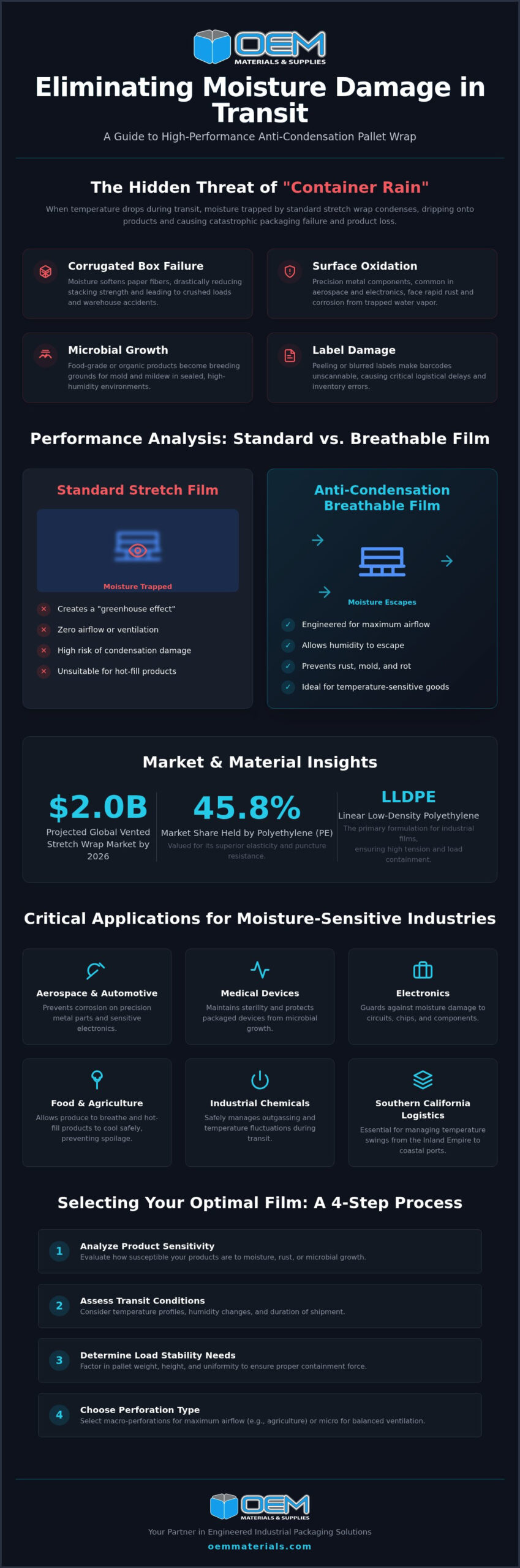
The financial consequences of moisture damage extend beyond simple product loss. When humidity accumulates, it triggers several critical failure points:
- Corrugated Box Failure: Moisture softens paper fibers, reducing the stacking strength of your primary packaging. This leads to crushed loads and warehouse accidents which often result in costly insurance claims.
- Surface Oxidation: Metal components, particularly in the aerospace and electronics sectors, face rapid rust and corrosion when exposed to trapped water vapor.
- Microbial Growth: Organic products or food-grade items become breeding grounds for mold and mildew when sealed in high-humidity environments.
- Label Damage: Peeling or blurred labels make barcodes unscannable, causing significant logistical delays and inventory errors.
Moisture Risks for Southern California Manufacturers
Manufacturers in the Inland Empire frequently face extreme temperature swings. A pallet loaded in a 100-degree warehouse in Riverside may reach a coastal port in Long Beach where the temperature is 20 degrees cooler and the humidity is significantly higher. This thermal shift forces moisture out of the air and onto your goods. Without an anti-condensation pallet wrap, this moisture has no escape route. Local logistics teams must account for these microclimates when moving freight through the San Pedro Bay port complex. Aerospace and medical manufacturers in Orange County must be particularly vigilant, as how corrugated boxes protect heavy loads depends entirely on keeping the material dry to maintain structural integrity.
The Science of the Dew Point in Palletized Loads
The dew point is the temperature at which air can no longer hold its water vapor. As warm air trapped inside a pallet cools, it releases that water. This is especially problematic for “hot-fill” products, such as industrial chemicals or beverages, which are often palletized while still radiating heat. This residual heat creates a high-humidity microclimate within the film. Using an anti-condensation pallet wrap allows this vapor to exit the load before it reaches the dew point. Proper pallet configuration also plays a role. Creating air channels within the load helps move saturated air away from the product surface, but the film must be breathable for this ventilation to be effective.
What is Anti-Condensation Pallet Wrap?
Anti-condensation pallet wrap is a high-performance breathable stretch film specifically engineered to facilitate airflow through a unitized load. While standard high-clarity stretch wrap acts as a continuous moisture barrier, breathable films feature an intentional pattern of perforations or vents. This design allows internal humidity to escape before it condenses on the product surface. Despite these voids, the film maintains the necessary containment force to keep heavy industrial loads secure during transit. This balance between ventilation and stability is achieved through advanced polymer engineering.
Polyethylene remains the dominant material for these specialized films. In 2026, polyethylene accounts for 45.8% of the vented stretch wrap market due to its superior elasticity and puncture resistance. Industrial formulations often utilize Linear Low-Density Polyethylene (LLDPE) to ensure the film can withstand the high-tension requirements of automated wrapping equipment without losing its breathable properties. These films are not simply “holey” plastic; they are precision-manufactured tools designed to manage the microclimate of a pallet.
Macro-Perforated vs. Micro-Perforated Technology
The choice between macro and micro-perforations depends on your specific ventilation requirements. Macro-perforations involve large, visible holes that provide maximum airflow. These are ideal for agricultural products that need to breathe or hot-fill chemicals that must cool rapidly to prevent label damage. Micro-perforations utilize smaller vents that allow moisture vapor to escape while offering a higher degree of protection against dust and debris. For a deeper dive into film selection, consult our Industrial Guide to Stretch Film. Selecting the wrong perforation size can either lead to insufficient cooling or excessive dust contamination.
Reinforced Breathable Films
One common concern with perforated films is the potential for tearing at the vent sites. Reinforced breathable films address this by integrating high-strength fibers into the film structure. This reinforcement prevents the “zipper effect” where a small puncture expands across the entire width of the wrap. These films allow for higher tension levels. This makes them suitable for heavy-duty industrial applications like machinery parts or bulk chemical drums. If you are unsure which perforation style fits your equipment, you can request a quote for a technical consultation on anti-condensation pallet wrap specifications. Using reinforced film ensures that your load remains stable even when subjected to the rigors of long-haul transit.
Breathable Stretch Film vs. Standard Wrap: A Performance Analysis
Standard stretch film is designed to provide a total barrier, which is ideal for dust protection but detrimental in temperature-sensitive supply chains. It traps 100 percent of internal humidity. Conversely, anti-condensation pallet wrap is engineered to regulate the internal microclimate by facilitating continuous vapor evacuation. While standard film may have a lower initial price point per roll, it often leads to higher total landed costs due to product damage. For manufacturers in Southern California, the choice between these materials determines whether a load arrives intact or compromised by moisture-induced packaging failure.
The economic shift toward breathable solutions is supported by current market data. The global vented stretch wrap market is projected to reach $2.0 billion by the end of 2026, growing at a CAGR of 7.0 percent. This growth is driven by the need for mono-material solutions that comply with the 2026 EU Packaging and Packaging Waste Regulation (PPWR). Polyethylene remains the dominant material, accounting for 45.8 percent of the market. Choosing a high-performance breathable film allows you to meet these sustainability standards while significantly reducing insurance claims related to mold or corrosion.
Load Containment and Safety Standards
There is a common industry misconception that perforations reduce the structural integrity of a pallet. High-quality breathable wraps are precision-engineered to meet ASTM standards for load stabilization. They offer the necessary elastic recovery to secure heavy industrial components during sudden transit shifts. Cheaper mesh alternatives often fail because they lack the “memory” of a true stretch film, leading to pallet leaning. Our technical team focuses on optimizing wrap patterns to ensure that airflow never comes at the expense of safety or containment force.
Application Efficiency and Labor Costs
Implementing a specialized breathable film can lead to significant operational savings. Machine-applied films offer higher consistency and tension control than hand-wrap methods, which is critical for high-volume distribution centers. Using anti-condensation pallet wrap often eliminates the need for labor-intensive secondary moisture absorbers like desiccant packs. This reduction in extra materials is a primary strategy for optimizing packaging costs. It simplifies your warehouse workflow while providing superior protection for sensitive aerospace and medical shipments.
Selecting the Right Breathable Film for Your Supply Chain
Selecting the ideal anti-condensation pallet wrap requires a methodical analysis of your logistical environment. It’s not a one-size-fits-all commodity. You must first identify the moisture sensitivity of both your product and its primary packaging. For instance, medical devices with sterile barriers are highly susceptible to humidity-induced failure. Next, evaluate the temperature profile of your transit route. If your shipments move from the high heat of the Inland Empire to the humidity of the Port of Los Angeles, the risk of container rain increases significantly.
Load-holding force is the third critical factor. Heavier pallets containing industrial machinery or bulk chemicals require films with higher tensile strength to prevent shifting. You must then choose between hand-applied or machine-grade film. While hand-wrapping works for low-volume operations, machine-grade breathable film provides the consistent tension necessary for high-volume Southern California distribution centers. Finally, always conduct a trial run. This verifies that the chosen film effectively manages moisture without compromising load stability during actual transit conditions.
Industrial Application Case Studies
Medical device manufacturers use breathable films to protect sterile barrier systems from humidity that could compromise product integrity. In the aerospace sector, these films are essential for preventing oxidation on precision metal components during long-duration sea freight. Similarly, food-grade industrial chemical shippers utilize anti-condensation pallet wrap to manage the “hot-fill” condensation that occurs when products are palletized immediately after production. These applications demonstrate that specialized film is a functional requirement for high-value industrial sectors.
Optimizing Your Stretch Wrap Equipment
Optimizing your stretch wrap equipment is vital when transitioning to breathable materials. You must adjust tension settings on your pallet wrappers to account for the perforation pattern. Standard settings designed for solid film may cause perforated films to overstretch or tear. Pay close attention to the pre-stretch ratios. High-performance breathable films are engineered to maximize yield, but they require precise calibration to maintain their structural integrity. If you’re ready to modernize your moisture control strategy, you can Request a Consultation for Your Pallet Wrapping Process. Proper machine calibration ensures that you achieve maximum containment without sacrificing the ventilation properties of the film.
Custom Moisture Control Solutions from OEM Materials & Supplies
OEM Materials & Supplies operates as a technical consultant rather than a simple vendor. We recognize that preventing moisture damage requires more than just a breathable film; it requires a calculated strategy. Our team analyzes your specific supply chain variables, including transit duration and environmental exposure, to provide tailored film specifications. By integrating high-performance anti-condensation pallet wrap with our high-strength corrugated boxes and custom foam packaging, we create a synergistic barrier that protects the structural integrity of your shipments. This holistic approach ensures that every component of your pallet is optimized for the rigors of global logistics.
Packaging VMI Services
Managing specialized film inventory can be a logistical burden for growing operations. Our Packaging VMI Services ensure that your facility never faces a stockout of critical moisture control supplies. We utilize a just-in-time delivery model to reduce your warehouse overhead and free up valuable floor space. This is particularly beneficial for high-volume manufacturers in Southern California who must balance tight production schedules with fluctuating shipping demands. We manage the inventory levels so your procurement team can focus on core manufacturing goals without worrying about supply chain interruptions.
Partner with a Southern California Industrial Expert
Our local presence in Orange County, Los Angeles, and San Diego allows for rapid on-site support and technical troubleshooting. OEM Materials & Supplies has built a reputation on serving the aerospace and medical sectors, where the margin for error regarding moisture is zero. We don’t guess; we use data to determine the exact perforation density and containment force required for your specific load dimensions. Our experts evaluate the specific risks associated with your transit routes, from Inland Empire heat to coastal humidity. If you’re ready to eliminate container rain and reduce product loss, you can Contact OEM Materials & Supplies for a Quote on Anti-Condensation Wrap.
Optimizing your warehouse operations starts with a comprehensive assessment of your current packaging failures. OEM Materials & Supplies helps you move beyond reactive measures toward a proactive moisture management system. This approach not only protects your products but also optimizes your total packaging spend by reducing the need for secondary desiccants and preventing insurance claims. By partnering with a seasoned industry expert, you gain access to the latest film technologies and a dependable supply chain that values precision above all else. Our goal is to ensure your shipments arrive in factory-perfect condition, regardless of the climate challenges they face.
Modernizing Your Industrial Moisture Control Strategy
Protecting high-value industrial loads requires a strategic shift from simple containment to active airflow management. By implementing a high-performance anti-condensation pallet wrap, you eliminate the risk of container rain and ensure the structural integrity of your primary packaging. This specialized film is a functional requirement for manufacturers who cannot afford the high costs of rust, mold, or collapsed pallets during temperature-sensitive transit. It’s about maintaining stability while allowing your products to breathe.
OEM Materials & Supplies has served the rigorous needs of aerospace and medical manufacturers since our inception. Our local presence in Orange County and Los Angeles ensures rapid support and technical expertise for your specific facility requirements. We also provide specialized VMI programs to maintain a consistent supply of industrial films without increasing warehouse overhead. This methodical approach to packaging logistics helps you reduce product loss and optimize your total landed costs. Request a Quote for Custom Anti-Condensation Pallet Wrap to modernize your shipping process. Secure your supply chain with precision-engineered solutions today.
Frequently Asked Questions
What is the main difference between anti-condensation wrap and standard stretch film?
Standard stretch wrap acts as a total moisture barrier that often creates a greenhouse effect by trapping humidity inside the load. Anti-condensation pallet wrap features engineered vents or perforations that allow internal moisture to escape before it reaches the dew point. In the high-humidity coastal zones of Los Angeles and Long Beach, this continuous airflow is essential to maintain the structural integrity of your corrugated boxes during transit.
Can anti-condensation pallet wrap be used with automatic stretch wrap machines?
Yes, machine-grade breathable films are designed specifically for high-speed automated wrappers. These films often incorporate reinforced fibers to prevent tearing at the perforation points under high tension. For high-volume manufacturers in Riverside and Orange County, using machine-grade anti-condensation pallet wrap ensures consistent containment force without sacrificing ventilation. It’s important to calibrate your equipment’s pre-stretch settings to match the specific technical properties of the perforated film.
How much airflow does perforated pallet wrap actually provide?
The specific airflow percentage depends on the perforation density and the size of the openings. Macro-perforated films provide maximum ventilation for products that radiate heat or require rapid cooling. Micro-perforated films offer a more balanced approach by allowing moisture vapor to escape while providing a degree of protection against dust. Our technical consultants analyze your specific transit risks to determine the optimal airflow requirements for your industrial components.
Is breathable stretch film strong enough for heavy industrial loads?
Breathable films are engineered to meet strict ASTM standards for load stabilization and containment. Reinforced versions use high-strength polymer strands to maintain the integrity of the wrap even when it’s under significant tension. This makes it strong enough for heavy aerospace parts or industrial machinery moved through San Diego logistics hubs. You don’t have to choose between breathability and safety; modern film technology provides both in a single solution.
Does using breathable film eliminate the need for desiccants?
In many industrial applications, switching to a breathable film significantly reduces or eliminates the need for secondary moisture absorbers. By preventing the initial accumulation of humidity inside the wrap, you remove the primary cause of condensation. This is a key strategy for reducing packaging costs and labor in high-volume production environments. However, products with extreme sensitivity may still require a hybrid approach involving both breathable film and specialized cushioning materials.
Is anti-condensation pallet wrap recyclable in standard plastic streams?
Most anti-condensation films are manufactured from Linear Low-Density Polyethylene (LLDPE), which is fully recyclable in standard plastic streams. This mono-material construction aligns with the 2026 EU Packaging and Packaging Waste Regulation (PPWR) standards. For Southern California OEMs focusing on sustainability, using a recyclable breathable film helps meet corporate environmental goals while ensuring product protection. Always check your local recycling facility’s specific requirements for perforated plastic materials.
What industries benefit most from using breathable pallet wrap?
The aerospace, medical, and electronics sectors benefit most due to their strict moisture control requirements. These industries often deal with precision metal components susceptible to rust or sterile packaging that fails when exposed to high humidity. Additionally, food-grade industrial chemical manufacturers in the Inland Empire use these films to manage condensation during the cooling phase of production. Any sector using high-strength corrugated boxes for heavy loads gains a significant advantage.
How do I determine if my moisture problem requires macro or micro-perforated film?
Macro-perforated film is the correct choice for “hot-fill” products or items requiring maximum ventilation to prevent spoilage. Micro-perforated film is better suited for electronics or medical devices that need moisture escape but require protection from warehouse dust and debris. We provide custom consultations to evaluate your product’s sensitivity and the temperature swings of your transit routes. This ensures you receive a film specification tailored to your specific logistical challenges.