
What if the very film you use to secure your pallet is actually the primary cause of your product damage? Most operations managers in Southern California accept trapped moisture as an unavoidable reality of temperature-sensitive storage or long-distance shipping. You have likely dealt with the frustration of corrosion on precision metal parts, mold on organic materials, or barcodes that won’t scan because standard stretch wrap created a greenhouse effect during transit. These logistical failures do not just waste time; they increase the total cost of ownership through scrapped inventory and rejected shipments.
This article explains how anti-fog ventilated film serves as a precision engineering tool to eliminate these risks. You will learn how this specialized material prevents moisture damage and maintains critical product visibility across complex industrial supply chains. We will examine how to maintain load stability while allowing essential airflow, ensuring your products arrive in peak condition. From protecting medical devices to streamlining electronics distribution in Orange County and the Inland Empire, utilizing the right atmospheric control is a requirement for modern manufacturing excellence. We provide a technical overview of how this film balances structural integrity with moisture management to protect your bottom line.
Key Takeaways
- Understand how condensation forms in industrial pallets and how anti-fog ventilated film eliminates the greenhouse effect to prevent corrosion and mold.
- Discover the technical difference between surface tension reducing additives and precision engineered ventilation patterns for optimal airflow.
- Learn why breathable film prevents load shifting by protecting corrugated boxes from moisture weakened structural failure during transport.
- Identify best practices for selecting perforation sizes and wrapping techniques to maintain load stability without sacrificing breathability.
- Explore the logistical advantages of sourcing specialized materials through Southern California partners who offer vendor managed inventory and just in time delivery.
The Challenge of Condensation in Industrial Supply Chains
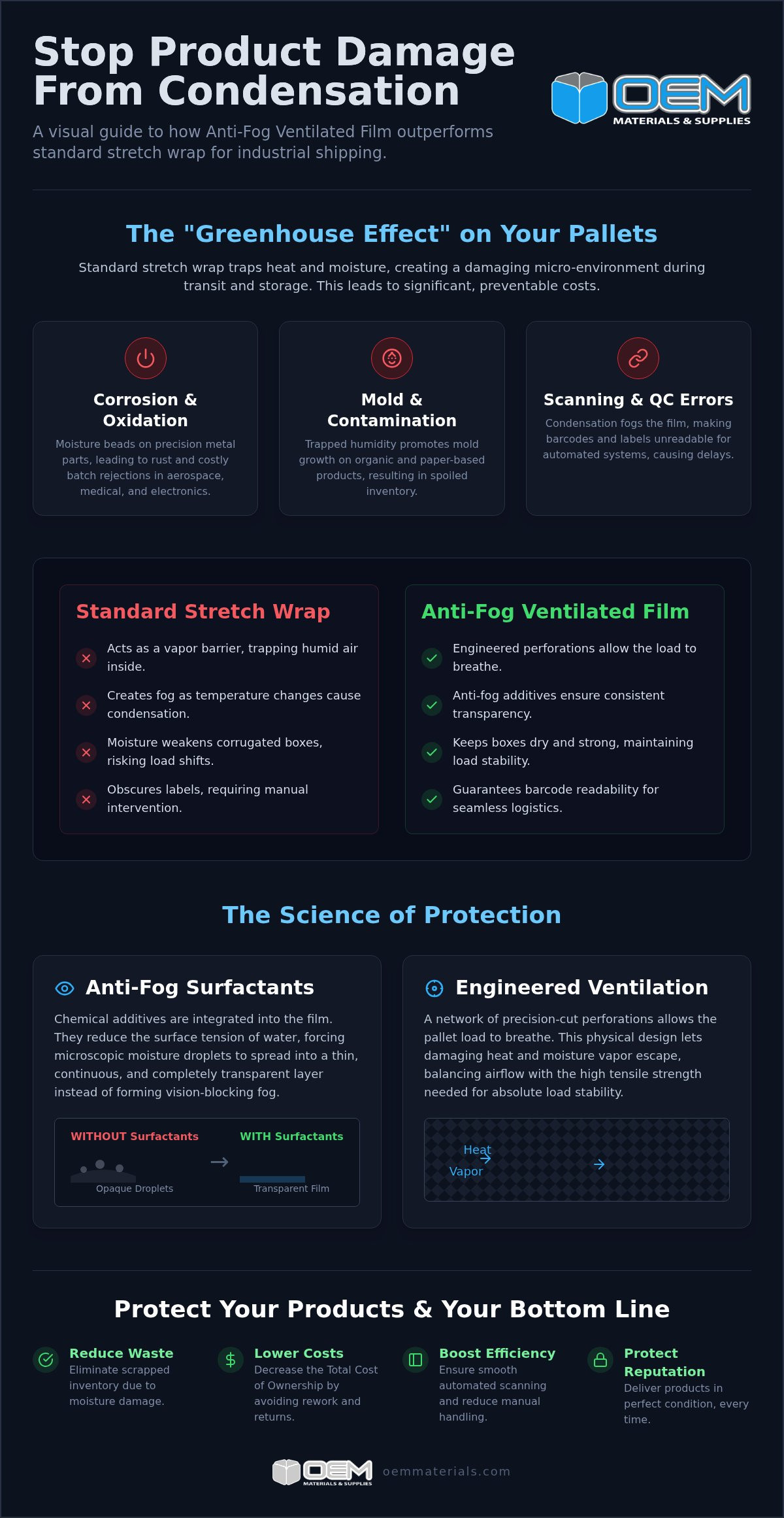
Condensation is a persistent disruptor in the industrial supply chain. It occurs when warm, moist air is trapped inside non-breathable packaging. As temperatures fluctuate during transit, this trapped air reaches its dew point, causing water to bead on the interior surface of the wrap. In standard palletizing, this creates a literal greenhouse effect. For manufacturers shipping from Southern California hubs like San Diego or Los Angeles, these temperature swings are common. Standard stretch film provides a secure hold but acts as a vapor barrier that locks humidity in. This trapped moisture leads to rapid corrosion on metal components and mold growth on organic substrates like wood or paper-based products. Fogged film also obscures critical shipping information. When condensation builds up, automated warehouse scanners cannot read barcodes or shipping labels, leading to significant delays and manual sorting errors.
Defining Anti-Fog Ventilated Film
This specialized packaging solution combines physical engineering with chemical science. Anti-fog ventilated film utilizes a network of precision-cut perforations that allow heat and moisture to escape the load. Unlike standard perforated wraps, it also incorporates anti-fog agents. These surfactants reduce the surface tension of water, preventing the formation of large, opaque droplets. This dual approach ensures the film remains transparent while maintaining the tension required for load stability. High transparency is critical for industrial quality control. It allows warehouse teams to verify part numbers and scan barcodes without removing the protective layer, keeping the supply chain moving efficiently.
The Cost of Moisture Damage for Manufacturers
The financial impact of trapped moisture extends far beyond the initial product loss. Direct costs include the replacement of oxidized metal components or mold-contaminated materials. However, the indirect costs often weigh heavier on the bottom line. Operations managers must account for the labor required to unpack, clean, and repackage affected goods. In industries with high precision standards, such as aerospace or medical device manufacturing, even minor surface oxidation can lead to total batch rejection. Consistent moisture issues damage your supplier reliability ratings and can jeopardize long-term contracts. Implementing anti-fog ventilated film is a proactive strategy to lower the total cost of ownership by eliminating these preventable logistical failures and ensuring your brand’s reputation for quality remains intact.
Mechanics of Anti-Fog and Ventilation Technologies
The performance of anti-fog ventilated film depends on the synergy between material science and structural design. Most industrial films are manufactured using high-performance polyethylene. This base material provides the high tensile strength and tear resistance necessary to secure heavy loads while stretched to its limit. However, polyethylene is naturally hydrophobic. It repels water and causes it to form spherical beads that obstruct vision. Engineering a solution for the dangers of moisture condensation involves modifying this surface behavior while simultaneously providing an exit path for humid air.
How Surfactants Prevent Fogging
Industrial surfactants are integrated into the film during the extrusion process. These additives are designed to migrate to the surface over time, creating a microscopic layer that alters surface tension. When moisture contacts the film, it doesn’t form individual droplets that scatter light and create a “fog.” Instead, the water spreads into a thin, continuous, and transparent layer. This layer allows light to pass through clearly. It ensures that labels remain legible and scanners can read barcodes without interference. These additives remain active throughout extended storage cycles, providing consistent performance even when pallets are moved between different thermal zones. This chemical stability is vital for long-term inventory management.
Ventilation Patterns for Airflow Optimization
Physical ventilation completes the system by allowing the load to breathe. Choosing between micro-perforations and large-hole ventilated film depends on the specific moisture sensitivity of your product. Micro-perforations offer a balance of dust protection and breathability. Larger holes maximize the exchange of air. This is particularly vital in cold storage environments where products must reach set-point temperatures quickly to maintain safety and quality. The airflow rate is defined as the volume of air moving through the film, measured in cubic feet per minute per pallet.
Optimizing these patterns reduces the time required for thermal stabilization. It prevents the internal “sweating” that occurs when warm products are palletized. Our stretch film options are engineered to maintain high containment force even with these perforations. If you are managing complex logistics in the Inland Empire or Orange County, matching the right ventilation density to your specific product is critical. You can request a technical consultation to determine the optimal hole pattern for your specific load dimensions.
Comparing Ventilated Film to Standard Stretch Wrap
Standard stretch wrap is a reliable commodity for securing loads against dust and debris, but its lack of breathability creates a significant vapor barrier. For manufacturers in Orange County or Los Angeles, anti-fog ventilated film offers a functional alternative by balancing load containment with atmospheric control. While standard films trap humidity inside the pallet, this specialized material allows vapors to exit, ensuring that internal moisture does not accumulate as temperatures fluctuate across the Southern California supply chain.
Protecting the integrity of corrugated boxes is a primary reason to choose a breathable option. When moisture is trapped under standard wrap, cardboard fibers absorb the condensation and lose their compression strength. This softening often leads to pallet collapse or load shifting during transit. Ventilated film ensures these boxes remain dry and structurally sound, which is essential for stabilizing high-value shipments such as aerospace components or medical devices.
Evaluating the transition to a specialized film requires a focus on the total cost of ownership rather than just the price per roll. Reducing product damage and the labor required for repackaging can lead to significant operational improvements. It is important to note that actual cost savings and performance results will depend on variables such as your specific product dimensions, the materials being wrapped, and your unique shipping requirements.
When to Choose Ventilation Over Total Encapsulation
Total encapsulation is appropriate for stable, dry environments where temperature shifts are minimal. However, ventilation is necessary when goods are palletized while still warm from production or when shipping through diverse climate zones. Selecting the wrong material can lead to immediate condensation issues. You can find more information on how to optimize stretch film for pallet wrapping to ensure your material choice aligns with your logistical needs.
Load Stability and Tensile Strength
A common concern among operations managers is that the perforations in anti-fog ventilated film might weaken the wrap. In reality, these films are engineered with reinforced edges and high-tensile resins to maintain a secure grip on the load. The high memory and snap-back properties of these resins ensure that the pallet remains stable and secure, even under the physical stress of long-haul shipping or frequent warehouse movements.
Best Practices for Implementing Ventilated Film
Successful deployment of anti-fog ventilated film requires more than just a purchase order. It demands a structured approach to application on the warehouse floor. Operations managers in the Inland Empire and Orange County must ensure that the transition from standard wrap to breathable materials doesn’t compromise load safety. The primary goal is to maintain maximum containment force while allowing for the precise airflow required by the specific product. This balance is achieved through careful calibration of both the material and the machinery.
Begin by selecting a perforation size that matches the moisture output of your load. High-respiration organic products require larger openings, while precision electronics or aerospace components may benefit from micro-perforations that offer a higher degree of dust protection. During the wrapping process, ensure a consistent 20% to 30% overlap. This overlap provides the structural ribs necessary to stabilize the pallet without completely sealing the ventilation paths. If you are using automated wrappers, monitor the tension settings closely. Excessive tension can cause the film to tear at the perforation points, a failure known as “zippering,” which can lead to total load failure during transit.
Selecting the Right Film Specifications
Your choice of film gauge should be dictated by the weight and height of the pallet. Heavier loads require a higher gauge to prevent stretching beyond the material’s elastic limit. You also need to evaluate whether your application requires adhesive-backed film for a tighter cling or a non-adhesive version for easier removal. While ventilated film manages external condensation, internal moisture can still be a risk for sensitive parts. We recommend reviewing the industrial guide to foam inserts to understand how to combine internal cushioning with external breathability for a complete moisture protection strategy.
Training Personnel for Specialized Film Use
Personnel training is the most effective way to reduce material waste and product damage. A common mistake is “over-wrapping” the top or bottom of the pallet, which effectively seals the load and defeats the purpose of the ventilation. Implement a visual inspection checklist that includes checking for uniform hole distribution and proper base-wrap anchoring. Additionally, ensure that your wrapping equipment is free from nicks or burrs on the rollers. Even a tiny snag can cause anti-fog ventilated film to fail under tension. For a customized assessment of your current wrapping efficiency, contact us for a packaging audit to identify potential cost savings in your operation.
Sourcing Specialized Packaging Solutions in Southern California
Procuring specialized materials like anti-fog ventilated film requires a supply chain partner that understands the regional logistics of Southern California. Manufacturers in Orange County, Los Angeles, and San Diego often face unique challenges, including high humidity near the coast and extreme heat in the Inland Empire. Standard commodity resellers often lack the technical inventory required to solve these specific atmospheric problems. By working with a local supplier, you gain access to just-in-time (JIT) delivery programs that reduce the need for large on-site storage footprints. This proximity ensures that your production lines never stall due to a lack of specialized high-performance wrap.
Implementing a vendor-managed inventory (VMI) program for your film and protective materials offers a significant operational advantage. VMI allows your team to focus on manufacturing while we monitor your usage levels and replenish stock automatically. This is particularly valuable for specialized films that aren’t always available for immediate pickup from general office supply vendors. A dedicated partner ensures that the exact gauge and perforation pattern your engineers specified is always in the rack when you need it.
The Role of a Solution-Oriented Packaging Partner
Modern industrial packaging has moved beyond simple commodity sales. It now requires technical consulting to address complex logistical risks. When you are choosing a wholesale industrial packaging supplier, look for a partner that can integrate various protective components. For instance, we recently assisted a medical device manufacturer in San Diego by combining anti-fog ventilated film with custom foam packaging. This integrated approach ensured that sterile kits remained visible and free of moisture beads while maintaining the structural integrity of the internal components during cross-climate transit.
Requesting a Consultation and Prototype
The transition to a new packaging material should always be data-driven. To provide an accurate recommendation, we typically require specific data points, including product dimensions, total pallet weight, and the expected transit conditions. Understanding whether your goods will face refrigerated storage or unconditioned shipping containers allows us to specify the correct surfactant concentration and ventilation density. We believe in the value of real-world performance testing to verify that the film meets your containment and breathability requirements.
Testing a prototype in your actual shipping environment is the most reliable way to prevent moisture-related losses. Our team is ready to help you analyze your current palletizing process and identify areas where atmospheric control can reduce your total cost of ownership. Contact OEM Materials & Supplies today for a professional consultation on stretch film and comprehensive moisture control solutions tailored to your Southern California operations.
Optimizing Your Atmospheric Control Strategy
Transitioning to anti-fog ventilated film is a strategic move to protect high value inventory from the hidden costs of moisture damage. By addressing the greenhouse effect within your pallets, you ensure that medical kits remain sterile and aerospace components stay free of oxidation. This technical approach to packaging does more than just secure a load; it stabilizes your entire supply chain by preventing corrugated failure and barcode scanning errors. Success in the Southern California market requires a partner who understands local logistics from Orange County to Los Angeles.
OEM Materials & Supplies provides the technical expertise and local support needed to implement these advanced solutions effectively. Our vendor managed inventory programs ensure you maintain a constant supply of specialized materials without bloating your warehouse footprint. We are ready to help you refine your wrapping process to achieve maximum containment with optimal airflow. To get started, please provide your product dimensions, weight, and annual usage. Contact OEM Materials & Supplies for a custom stretch film quote and take the first step toward a more resilient packaging operation. We look forward to engineering a solution that meets your specific industrial requirements.
Frequently Asked Questions
What is anti-fog ventilated film used for?
Anti-fog ventilated film is primarily used to secure palletized loads that are sensitive to moisture or require rapid temperature stabilization. It is essential for products that are palletized while warm or shipped through varying climate zones, such as those moving between the Inland Empire and the coast. The film prevents the greenhouse effect that causes condensation, protecting high value components in the aerospace and medical sectors from corrosion and mold.
Does ventilated film provide enough strength for heavy pallets?
Yes, modern ventilated film is engineered with high performance resins and reinforced edges to provide significant containment force. It is specifically designed to maintain its structural integrity and memory even with the presence of precision perforations. This ensures that heavy industrial loads remain stable during the rigors of Southern California transport. While it allows for breathability, it does not sacrifice the tensile strength required to secure large or irregularly shaped pallets.
How do anti-fog additives prevent condensation?
Anti-fog additives are surfactants integrated into the film that migrate to the surface to reduce the surface tension of water. Instead of moisture forming individual, opaque beads that scatter light and create fog, the water spreads into a thin, continuous transparent layer. This layer remains clear, ensuring that barcodes and shipping labels are easily readable by automated scanners. This chemical approach works alongside physical ventilation to manage the internal atmosphere effectively.
Can ventilated film be used with automated pallet wrappers?
Anti-fog ventilated film is fully compatible with most automated pallet wrapping equipment used in modern warehouses. However, it is critical to calibrate the tension settings on your wrappers to prevent zippering or tearing at the perforation points. When applied correctly with the proper overlap, the film provides a secure, consistent wrap that facilitates high speed production. We recommend testing the film on your specific machinery to find the optimal balance of containment.
Is ventilated film more expensive than standard stretch wrap?
The per-roll cost of specialized ventilated film is typically higher than standard commodity stretch wrap due to the additional engineering and surfactants. However, the total cost of ownership is often lower when you account for reduced product losses. By preventing corrosion on metal parts or mold on organic materials, the film eliminates the high costs of rejected shipments and repackaging labor. It represents an investment in supply chain reliability for manufacturers.
Which industries benefit most from anti-fog ventilated film?
Industries that handle moisture sensitive or high precision components benefit most from this technology. This includes medical device manufacturers who must maintain sterile packaging and aerospace companies protecting metal parts from oxidation. Electronics distributors also utilize the film to ensure that moisture does not interfere with sensitive circuitry or barcode scanability. Any operation shipping goods through Southern California’s varied thermal zones will find value in the atmospheric control provided by anti-fog ventilated film.
How does ventilation affect the cooling time of packaged products?
Ventilation significantly reduces the time required for palletized products to reach their set-point temperatures. By allowing for a higher airflow rate, the film prevents heat from being trapped within the load, which is critical in cold storage or just-in-time manufacturing environments. Faster thermal stabilization prevents the internal sweating that occurs when warm products are wrapped. This efficiency helps maintain product quality while reducing the energy costs associated with extended cooling cycles.
Can anti-fog film be recycled along with other plastic materials?
Most anti-fog ventilated films are manufactured from polyethylene and can be recycled within existing industrial plastic recycling streams. It is important to verify the specific resin grade with your supplier and check local regulations in cities like Riverside or San Diego. As California plastic reduction mandates continue to evolve, staying informed about producer responsibility for packaging is essential. We help our clients select materials that balance high performance with regional recycling requirements.