
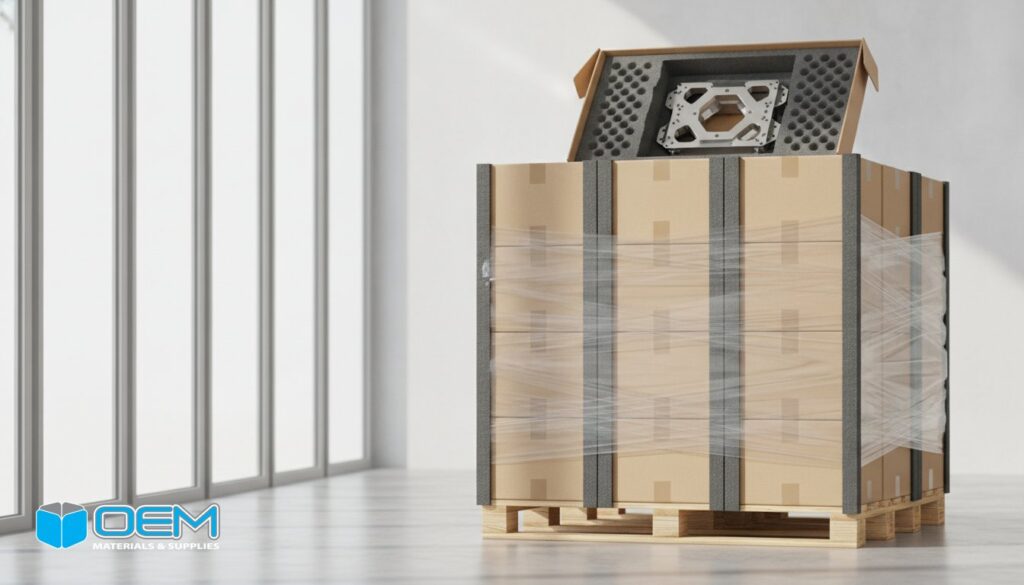
A standard stretch wrap application often conceals structural vulnerabilities that lead to load failure during multi-modal transit. For manufacturers in Southern California handling high-value aerospace or medical components, a single crushed corner represents more than just a damaged container; it signifies a significant disruption in the supply chain. You understand that maintaining the integrity of a pallet requires more than just surface-level tension. It requires strategic reinforcement at the points of highest stress to ensure the load remains unitized from the warehouse floor to the final destination.
This guide explains how to select and implement heavy duty edge protectors for shipping to eliminate transit damage and improve pallet stability for industrial loads. By choosing the correct caliper and material, you can prevent strapping from biting into your corrugated boxes while creating a rigid frame for safer warehouse stacking. We will examine how to optimize your material use to lower per-unit packaging costs and streamline packing processes across your operations in Los Angeles, Orange County, and the Inland Empire. This technical overview provides the data necessary to upgrade your shipping standards and achieve consistent zero-damage reports.
Key Takeaways
- Understand how rigid profiles distribute vertical and horizontal pressure to prevent corner collapse in stacked corrugated boxes.
- Compare the performance characteristics of recycled paperboard and high-density plastic to match the material to your specific shipping environment.
- Determine the correct caliper and leg length for your heavy duty edge protectors for shipping to support the weight and dimensions of your industrial pallets.
- Learn how to integrate edge protection with stretch film to prevent film punctures and significantly increase overall load stability.
- Explore the logistical benefits of sourcing from a Southern California partner to implement vendor-managed inventory and eliminate shipping supply shortages.
Structural Reinforcement: The Role of Heavy Duty Edge Protectors in Transit
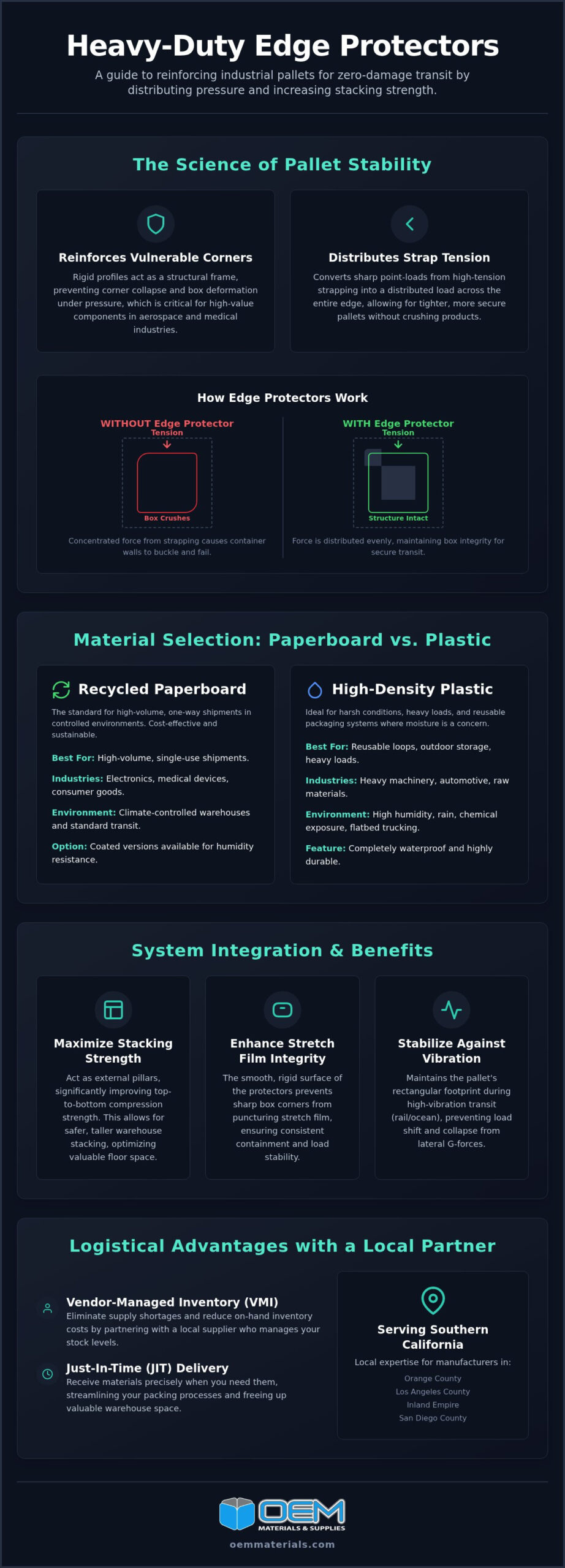
Heavy duty edge protectors are rigid profiles engineered to distribute both vertical and horizontal pressure across the perimeter of a load. In high-performance tertiary packaging systems, these components serve as the primary defense against the crushing forces encountered during long-haul transit. An edge protector is a structural packaging component that allows for increased strap tension without product deformation. By reinforcing the vulnerable corners of corrugated boxes, these protectors ensure that the stacking strength of the entire pallet isn’t compromised by localized stress points.
Implementing heavy duty edge protectors for shipping is particularly vital during high-vibration transit, such as rail or ocean freight. Vibration often causes loads to shift, which concentrates pressure on the edges of the packaging. Without rigid reinforcement, the friction and shifting weight can cause box walls to buckle, leading to a complete collapse of the unitized load. These protectors act as a stabilizer, maintaining the rectangular footprint of the pallet even when subjected to the lateral G-forces common in multi-modal transport.
Load Distribution and Strap Tension
Effective pallet securement often requires high tension levels in polyester or steel strapping to prevent load shifting. However, applying this tension directly to a corrugated container creates a point-load that can easily crush the box and damage the internal product. Edge protectors facilitate a critical transition in physics; they convert that sharp point-load into a distributed load across the entire vertical or horizontal edge. This allows warehouse teams to apply the necessary tension for stability without risking the integrity of high-value aerospace or medical components. By spreading the force, the material maintains its shape, and the strapping remains tight throughout the journey.
Stacking Strength and Vertical Support
When integrated into a packaging system, edge protectors act as external or internal pillars that significantly improve top-to-bottom compression strength. This structural boost is essential for high-density warehouse storage in Riverside and Los Angeles facilities, where vertical stacking is necessary to optimize floor space. By absorbing the weight of the pallets stacked above, the protectors prevent the bottom-tier boxes from bulging or failing. This vertical support ensures that warehouse stacking remains safe for personnel and prevents the costly product loss associated with pallet lean or collapse. For Southern California manufacturers, this means more efficient use of expensive square footage without compromising safety standards.
Material Selection: Comparing Paperboard and Plastic Edge Protectors
Selecting the right material for your heavy duty edge protectors for shipping is a balance between protection requirements and logistical costs. While many purchasing managers default to the most familiar option, the choice between recycled paperboard and high-density plastic should be driven by the specific variables of your supply chain. These variables include the total load weight, the mode of transit, and the potential for environmental exposure. Adhering to ASTM International standards for material testing ensures that whichever material you choose meets the rigorous demands of industrial handling.
A functional selection framework often follows these parameters:
- Recycled Paperboard: Best for high-volume, one-way shipments of electronics, medical devices, and consumer goods stored in climate-controlled environments.
- High-Density Plastic: Ideal for heavy machinery, flatbed trucking, and outdoor storage where moisture or chemical exposure is likely.
- Coated Paperboard: A middle-ground solution for humid transit routes, utilizing moisture-resistant coatings to prevent the material from softening.
Heavy Duty Paperboard Protectors
Paperboard thickness is measured using a caliper system, where each point represents one-thousandth of an inch. Heavy-duty applications typically utilize calipers ranging from .120 to .400, providing significant stacking strength for edge and corner protectors. One of the primary advantages of paperboard is its natural friction, which offers superior grip to prevent strap slippage during transit. For companies in Los Angeles or Orange County focused on corporate sustainability goals, paperboard is 100% recyclable and often made from high-percentage post-consumer waste. This makes it an excellent choice for medical device packaging where disposal ease is a priority for the end-user.
Plastic Corner Guards for Specialized Loads
Plastic protectors are the standard for heavy machinery and flatbed trucking applications across the Inland Empire and San Diego County. Unlike paperboard, high-density plastic guards won’t degrade when exposed to rain or road salt, making them essential for open-trailer transit. These components are often designed for longevity and reusability within closed-loop supply chains, allowing manufacturers to recover and reuse the guards multiple times. Many plastic models feature built-in strap guides that lock polyester or steel strapping into place, ensuring the securement remains centered on the protector even under extreme tension. If you’re unsure which material fits your current pallet configuration, you can request a quote to get a professional recommendation based on your load weight and shipping frequency.
Sizing and Specification for Industrial Pallet Loads
Precise measurement is more than a clerical task; it is a structural requirement. For manufacturers navigating the port-to-warehouse corridors of Southern California, selecting the wrong dimensions can lead to immediate load failure during transit. Adhering to international packaging standards provides a baseline for these specifications, ensuring your load unitization remains consistent across global supply chains. When you match the protector size to the specific stressors of your route, you significantly reduce the risk of product deformation.
Calculating Necessary Caliper and Width
The caliper, or thickness, of your heavy duty edge protectors for shipping must correlate directly with the total pallet weight and the intended stacking height. For industrial loads exceeding 2,000 pounds, a caliper of at least .225 is generally recommended to prevent the protector from buckling under the extreme tension of polyester or steel strapping. Leg width also plays a critical role in stability. While a standard 2×2 inch profile works for many applications, taller or more unstable loads often require 3×3 or even 4×4 inch leg lengths to increase the surface area contact with the corrugated boxes. This extra width prevents the protector from “rolling” or shifting when the pallet is subjected to lateral forces.
You should also consider the profile shape. Most applications utilize equal-leg profiles, but unequal-leg protectors are available for specialized needs. These are particularly useful when you need to protect a wide top surface while maintaining a narrow vertical profile, a common requirement for certain automotive body panels or aerospace wing components.
Standard vs Custom Lengths
Vertical support is most effective when the protector spans the full height of the pallet load. Using stock lengths like 48 inches or 72 inches is efficient for standard pallet configurations found in Los Angeles and San Diego warehouses. However, non-standard components often require a custom packaging design approach. Using a protector that is too short leaves the top tiers of your load vulnerable to strap damage, while one that is too long can interfere with stacking and warehouse safety.
OEM Materials provides custom-cut lengths to eliminate the need for on-site trimming. This reduces labor costs and material waste in your facility. When identifying custom sizing needs for non-standard parts, use this checklist:
- Does the product height exceed standard 48-inch or 96-inch shipping increments?
- Are you using heavy-gauge strapping that requires a .400 caliper for maximum crush resistance?
- Does the load have irregular protrusions that require unequal-leg profiles?
- Is the pallet intended for double-stacking in a Riverside or Inland Empire distribution center?
Integrating Edge Protection into a Complete Packaging System
Relying on a single packaging component to secure a complex industrial load is a common logistical error. True load integrity comes from a system-wide approach where each material complements the mechanical properties of the others. In high-performance shipping environments, heavy duty edge protectors for shipping serve as the structural skeleton of the pallet. They provide a rigid frame that allows other materials, such as stretch film and strapping, to perform at their maximum engineered capacity. This synergy is what separates a standard pallet from a high-stability unitized load capable of surviving multi-modal transit.
Load Stabilization with Stretch Film
Edge protectors serve as a rigid chassis for the palletized unit. When you apply stretch film over reinforced corners, you can achieve significantly higher pre-stretch levels without risking box collapse. Without these supports, high-tension film often “rounds” the corners of corrugated boxes, which reduces the internal volume and puts direct pressure on the product inside. By maintaining a sharp 90-degree corner, the film applies uniform pressure across the entire load face, creating a superior unitizing effect.
Additionally, these protectors solve the frequent problem of film punctures caused by sharp box corners or irregular pallet edges. Rigid edges prevent the film from tearing during the wrapping process or while being handled by forklifts in busy Los Angeles distribution centers. For a deeper analysis of maximizing these benefits, refer to our guide on how to optimize stretch film for pallet wrapping. Using this combination reduces material waste because the film can be applied at its full stretch capacity without breaking, ensuring the load remains secure from the Inland Empire to its final destination.
Synergy with Custom Corrugated and Foam
Industrial packaging for high-value sectors like medical devices and aerospace often requires a layered defense. Placing edge protectors inside corrugated containers provides a massive boost to vertical compression strength. This technique essentially turns the corners into internal pillars, allowing for safer stacking in high-density warehouses. It’s a strategic way to improve performance without necessarily paying for a higher-test double-wall board for the entire box.
For fragile electronics, external protection complements engineered foam inserts. While the foam handles internal shock and vibration, the edge protectors absorb the external crushing forces of strapping and stacking. This dual-layer approach is also effective when using wood crates for heavy machinery. The protectors provide a buffer that prevents steel strapping from splintering the wood or losing tension due to crate shifting. To develop a system tailored to your specific product weight and dimensions, request a quote for a complete packaging consultation.
Sourcing and Inventory Management for Southern California Manufacturers
Sourcing heavy duty edge protectors for shipping requires a logistical strategy that accounts for the high-speed requirements of Southern California manufacturing. When your operations are centered in hubs like Los Angeles, Orange County, or the Inland Empire, the proximity of your packaging supplier directly impacts your bottom line. Local sourcing minimizes the freight overhead that often inflates the per-unit cost of bulky protective materials. Beyond simple delivery, a regional partner provides the agility needed for rapid prototyping when a new aerospace component or medical device requires a unique structural profile.
Local Logistics in Orange County and San Diego
Manufacturers in San Diego medical device labs or Riverside distribution centers face unique transit challenges. Sourcing from a supplier within the region ensures that your supply chain remains resilient against port congestion and local traffic disruptions. Rapid response times are essential for custom edge protection needs. If a new product line requires an unequal-leg profile or a specific moisture-resistant coating, a local partner can deliver prototypes and production runs significantly faster than an out-of-state vendor. This proximity reduces the need for massive on-site safety stocks, freeing up valuable warehouse floor space.
Procurement Efficiency and VMI
The administrative burden of tracking multiple packaging SKUs can lead to costly stockouts or inefficient overstocking. Implementing vendor-managed inventory (VMI) eliminates these risks by shifting the responsibility of stock levels to the supplier. Under a VMI program, OEM Materials monitors your usage of edge protectors, stretch film, and corrugated boxes, triggering automatic replenishment before inventory reaches a critical low. This ensures that your shipping department never grinds to a halt due to a lack of essential supplies.
Coupled with just-in-time (JIT) delivery, these programs allow high-volume manufacturing centers to maintain lean operations. You receive only the material you need for immediate production cycles, which significantly reduces warehouse overhead and improves cash flow. We encourage procurement professionals to consult with our team for a total packaging cost analysis. This review considers your specific product dimensions, pallet weights, and annual usage to identify the most efficient material specifications.
To receive a detailed recommendation and pricing, please contact us for a quote. Providing data such as your typical product dimensions, average pallet weight, and annual usage will allow us to design a more accurate and cost-effective inventory solution for your facility.
Optimizing Your Industrial Shipping Standards
Implementing heavy duty edge protectors for shipping is a technical decision that impacts the structural integrity of your entire load. By distributing vertical pressure and increasing strap tension capacity, you move beyond basic cushioning to true structural reinforcement. Whether you utilize recycled paperboard for high-volume electronics or high-density plastic for heavy machinery, the correct specification eliminates the crushed corners and shifted loads that disrupt industrial supply chains. This systematic approach ensures that your pallets remain unitized and stable from the warehouse floor to the final destination.
OEM Materials serves as an experienced partner for the aerospace and medical sectors throughout Orange County, Los Angeles, and San Diego. We offer custom sizing and rapid prototyping to meet your unique product dimensions. By integrating our VMI and JIT services, you can reduce warehouse overhead while ensuring you never face a stockout of essential shipping supplies. Our team understands the precision required for high-value components and the efficiency needed for high-volume distribution.
To optimize your packaging design and achieve zero-damage transit reports, Request a Quote for Heavy Duty Edge Protectors today. Providing your product dimensions, weight, and annual usage allows our team to develop a precise solution for your facility. We look forward to supporting your operational efficiency.
Frequently Asked Questions
What is the standard thickness for heavy duty edge protectors?
Standard heavy-duty thickness typically ranges from .120 to .400 caliper points. For most industrial applications in Southern California, a .225 caliper is the baseline for securing pallets that weigh over 2,000 pounds. Choosing the right thickness ensures the material doesn’t buckle under the high tension required for load stability. Engineers in the aerospace sector often specify thicker calipers to provide maximum crush resistance for high-value components during multi-modal transit.
Can edge protectors be recycled after use?
Most heavy duty edge protectors for shipping are fully recyclable, particularly those manufactured from high-percentage post-consumer paperboard. These materials can be disposed of in standard industrial recycling streams alongside corrugated boxes. High-density plastic versions are often designed for reusability within closed-loop supply chains. This sustainability factor is a key consideration for medical device manufacturers in San Diego and Orange County who are working toward reducing their overall environmental footprint.
Do I need different edge protectors for plastic vs steel strapping?
While the protectors themselves are versatile, the caliper must match the tension requirements of your strapping material. Steel strapping exerts significantly more pressure than polyester or polypropylene, requiring a thicker protector to prevent the metal from biting into the packaging. We recommend a minimum .225 caliper for steel applications. For plastic strapping, a standard heavy-duty protector provides a rigid surface that allows for higher tension without deforming the underlying corrugated containers.
How do edge protectors improve the stacking strength of my pallets?
Edge protectors act as vertical pillars that significantly increase the top-to-bottom compression strength of a pallet. They distribute the weight of upper pallets across the entire vertical edge rather than concentrating it on the box walls. This structural reinforcement allows for safer double-stacking in high-density Los Angeles and Riverside distribution centers. By preventing the bottom tier from bulging or collapsing, these components protect your inventory and improve overall warehouse safety.
Are custom lengths available for non-standard shipping containers?
Custom lengths are a standard offering at OEM Materials to help reduce on-site labor and material waste. While 48-inch and 72-inch lengths are common for standard pallets, we provide precision-cut protectors tailored to your specific aerospace or automotive parts. This capability is essential for non-standard shipping containers or oversized crates. Custom lengths ensure that the structural reinforcement spans the entire height of the load, providing uniform protection from the base to the top tier.
What is the difference between a corner guard and an edge protector?
In the industrial packaging sector, these terms are often used interchangeably, but they can refer to different applications. Edge protectors typically describe long, rigid profiles that span the full length of a pallet or box edge. Corner guards often refer to shorter pieces designed specifically to protect the eight corners of a container. Both serve the same primary function of distributing pressure and preventing damage from strapping or impact during transit and storage.
Can edge protectors be used for international export shipping?
Yes, heavy duty edge protectors for shipping are ideal for international export because they are generally exempt from ISPM 15 heat-treatment regulations. Both paperboard and plastic protectors are considered highly processed materials, making them compliant for global transit without additional certification. This simplifies the documentation process for manufacturers in the Inland Empire and San Diego who are shipping medical devices or automotive components to international markets, ensuring loads remain stable during long voyages.
How do I determine the right leg length for my application?
Leg length is determined by the surface area required to stabilize the load and the width of your strapping. A standard 2×2 inch leg is sufficient for most uniform pallet loads. However, if you are handling taller or more unstable products, 3×3 or 4×4 inch legs provide a larger contact area to prevent the protector from shifting. Matching the leg length to the dimensions of your boxes ensures that the structural pressure is distributed evenly across the pallet face.