

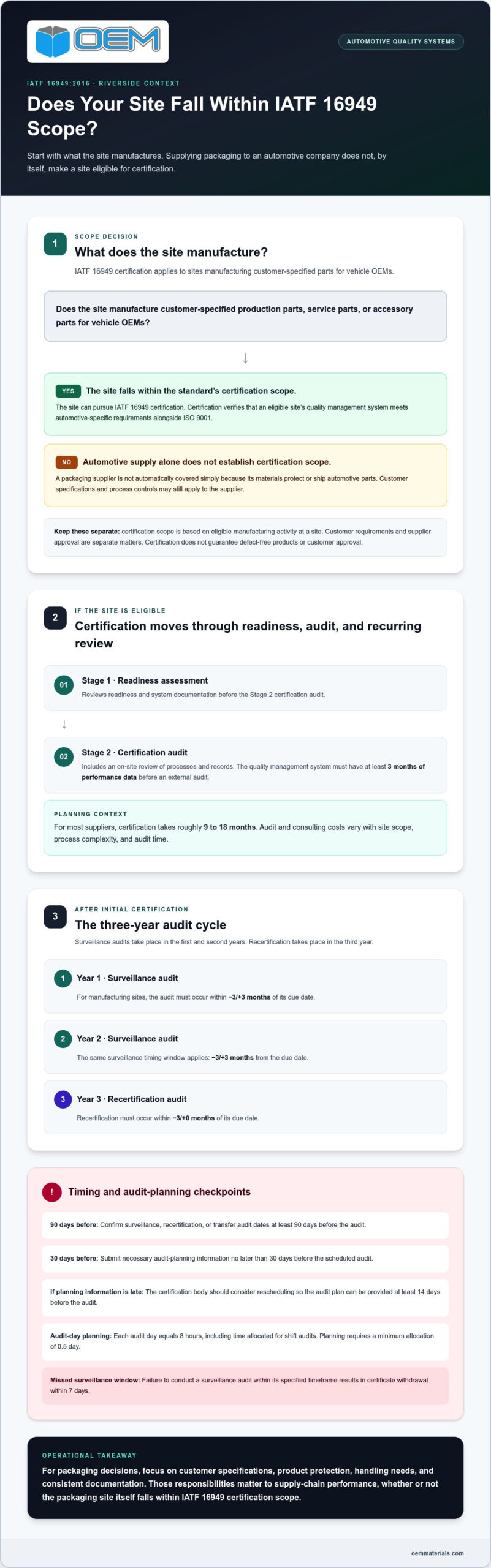
IATF 16949:2016 is a global automotive quality management standard built on ISO 9001:2015 with additional automotive requirements. Certification applies to sites that manufacture customer-specified production parts, service parts, or accessory parts for vehicle OEMs. For automotive packaging IATF 16949 compliance in Riverside, the key distinction is whether a site falls within that manufacturing scope, not simply whether it supplies packaging to an automotive company.
Packaging suppliers still need to understand how customer quality requirements affect their operations. Packaging specifications, product protection, and consistent documentation can all matter to supply-chain performance, even when a supplier’s role differs from manufacturing vehicle parts. The scope of certification and the customer’s expectations are related, but they aren’t interchangeable.
This article explains who IATF 16949 applies to, how its three-year certification cycle works, and how ISO 9001, APQP, and PPAP fit the automotive quality system. It also clarifies what those requirements mean for packaging decisions and supplier relationships in Riverside.
Key Takeaways
- Determine whether a site falls within IATF 16949’s scope by examining what it manufactures and the customer requirements it serves.
- Understand how surveillance audits and recertification fit into the standard’s three-year cycle.
- See how ISO 9001 works alongside automotive-specific quality requirements in an integrated system.
- Recognize how APQP and PPAP support planning, approval, and documented quality evidence.
- Connect packaging choices, including corrugated boxes, to the protection and handling needs of automotive supply chains.
What is IATF 16949 and who is it for?
IATF 16949:2016 is a global automotive quality management standard built on ISO 9001:2015. Automotive packaging IATF 16949 compliance in Riverside starts with determining whether a manufacturing site falls within its scope.
Certification Benefits and Quality Management
Certification verifies that an eligible site’s quality management system meets automotive-specific requirements alongside ISO 9001. It gives the organization a structured way to manage processes, monitor performance, and address quality issues.
For purchasing and operations teams, the benefit is a shared framework for evaluating automotive quality and satisfaction. Certification supports consistent process management, but it doesn’t guarantee defect-free products or customer approval. IATF 16949 was published in 2016 and replaced ISO/TS 16949 in October 2016.
Automotive Supplier Requirements
IATF 16949 certification applies to sites manufacturing customer-specified production parts, service parts, or accessory parts for vehicle OEMs. A customer’s supplier requirements may extend beyond certification, so companies should distinguish contractual expectations from the standard’s scope.
For example, an automotive customer may require a supplier to follow defined quality controls or provide records. Certification can demonstrate that a qualifying site operates an automotive quality management system, but supplier approval remains a separate customer decision.
Packaging Supplier Applicability
IATF 16949 applies to eligible manufacturing sites, not automatically to every company supplying the automotive industry. Packaging manufacturers therefore aren’t covered simply because their materials protect or ship automotive parts.
Packaging suppliers may still need to meet customer specifications and maintain appropriate process controls. Packaging that protects components during handling, for example, must suit the customer’s requirements. Certification eligibility depends on what the site manufactures and whether it produces customer-specified parts for vehicle OEMs.
The standard doesn’t establish whether Riverside County has certified automotive packaging suppliers. It defines certification scope by eligible manufacturing activity and site, rather than by county.
Riverside teams seeking training and certification support can use internal quality personnel to map processes and prepare records. Training providers can support standard interpretation, while certification bodies conduct formal assessments. The certification process includes a Stage 1 readiness assessment before the Stage 2 certification audit.
Certification follows a three-year cycle, with recertification in the third and final year. A certificate may be transferred once per three-year certification cycle. If a site relocates, its management system scope, processes, and records need to reflect the new operating location for audit planning.
Packaging design is a separate operational consideration from certification scope. For parts needing cushioning, foam packaging can be selected around the component’s shape and handling requirements.
Three-year certification cycle and surveillance audits
IATF 16949 certification uses recurring audits to assess whether an organization maintains its quality management system. The cycle combines initial certification, surveillance, and recertification with ongoing production evidence.
The initial certification process includes a Stage 1 readiness assessment before the Stage 2 certification audit. Stage 1 reviews readiness and system documentation. Stage 2 includes an on-site review of processes and records. Before an external audit, the quality management system must have at least 3 months of performance data.
For most suppliers, certification takes roughly 9 to 18 months. Audit and consulting costs vary with factors such as site scope, process complexity, and audit time. An accurate budget depends on those project factors, not on a packaging supplier’s product purchases.
In Riverside, the relevant certification bodies are those recognized by IATF. The audit scope and schedule determine which body can conduct an organization’s certification audit. The auditor assesses the defined site and its processes.
Audit failure risks include production practices that differ from documented procedures, incomplete records, and corrective actions that fail to address root causes. If a recorded inspection frequency differs from the inspection performed on the floor, for example, an auditor can identify a gap between the management system and actual work. Missing performance data can also undermine readiness.
Once certified, the organization enters a three-year cycle. Surveillance audits take place in the first and second years, followed by a recertification audit in the third year. Surveillance audits for manufacturing sites must occur within a window of -3/+3 months from the due date. Recertification must occur within -3/+0 months.
Timing is strict. Failure to conduct a surveillance audit within its specified timeframe results in certificate withdrawal within 7 days. Audit dates for surveillance, recertification, or transfer audits must be confirmed at least 90 days before the audit.
Planning begins before the auditor arrives. Submit necessary audit-planning information no later than 30 days before the scheduled audit. If that information is late, the certification body should consider rescheduling to provide the audit plan at least 14 days before the audit. Each IATF audit day equals 8 hours, including time allocated for shift audits, and planning requires a minimum allocation of 0.5 day.
Riverside teams can support audit readiness by keeping process records current, reviewing performance data, and tracking corrective actions between audits. These routines connect written procedures to production activity and make recurring certification assessments more manageable.
The IATF Rules 6th Edition requirements for achieving and maintaining IATF 16949 certification took effect on January 1st, 2025. A corporate audit scheme may allow a 15% reduction in the minimum required IATF audit days.
If additional time for reviewing actions in response to poor IATF OEM customer performance cannot be added to the regular audit, a special audit must be scheduled within 60 days after the regular audit.
ISO 9001 relationship and automotive-specific requirements
IATF 16949 certification combines ISO 9001 quality management with automotive-specific requirements. The integrated system is assessed in a single audit, connecting a global quality framework with the needs of the international automotive supply chain.
One Integrated Quality Management System
ISO 9001 provides the quality management foundation, while IATF 16949 adds requirements tailored to automotive organizations. A site seeking IATF 16949 certification must satisfy both standards through one integrated system and audit.
This relationship matters because teams shouldn’t manage parallel systems for overlapping quality tasks. For example, a corrective action process can be managed within the integrated system, with records showing how the organization identifies issues, responds, and evaluates improvement. The system must address both ISO 9001 and IATF 16949 requirements.
Customer-Specific Requirements
Automotive OEMs may set customer-specific requirements that supplement the standards. These requirements can shape how a supplier documents processes, reports performance, or handles changes. The applicable details depend on the customer’s documented expectations and the supplier’s role.
A practical control is to link each customer requirement to an owner, process, and record. If an OEM specifies a reporting format, for example, the organization can define who prepares it and where the completed record is kept. This makes customer-specific requirements actionable rather than leaving them as isolated documents.
Customer expectations don’t replace ISO 9001 or IATF 16949. They add another layer for the supplier to manage. A quality team can compare customer documents with internal procedures, identify gaps, and assign actions before the next audit or customer review. That comparison supports consistent execution across relevant processes.
Extended Manufacturing Site Distance
IATF Rules 6 sets a location limit for an extended manufacturing site: it must be no more than 10 miles (16 km) or a 60-minute drive from the main site. The rule helps define which nearby locations can be treated as extended sites within the certification structure.
For a Riverside organization with multiple operating locations, map the main site and each proposed extended manufacturing site by both distance and drive time. The requirement uses “or,” so the stated limit can be met by distance or drive time. Document site roles and activities clearly for audit planning.
These location criteria are distinct from customer-specific requirements. A customer may define expectations for a product or process, while IATF Rules 6 addresses the relationship between manufacturing sites. Keeping those records separate helps the quality team assign each requirement to the right owner and take corrective action when a gap appears.
APQP and PPAP documentation
APQP and PPAP connect automotive quality planning with documented evidence that production processes can meet requirements. For packaging teams, the practical focus is linking customer specifications, risk controls, and approval records.
APQP and PPAP Records
Advanced Product Quality Planning (APQP) organizes quality planning, while the Production Part Approval Process (PPAP) documents approval evidence. Automotive quality planning may involve tools such as APQP, PPAP, FMEA, MSA, and SPC.
PPAP requires assembling 18 specific elements. The records support a customer’s review of whether defined requirements are understood and production controls are established. For a packaging process, relevant evidence may connect approved specifications to inspection records and process documentation.
Documentation should let a team trace requirements to the controls and records that address them. An approved packaging specification, for example, can be linked to its revision, relevant work instructions, and inspection results. This supports consistent work and gives auditors a clear path through the evidence.
Packaging Quality Controls and Documentation
Packaging-specific quality controls are controls selected to meet customer-defined packaging requirements and manage related process risks. IATF 16949 does not create one universal packaging checklist for every supplier; the necessary controls depend on the product, customer specification, and supplier’s role.
A packaging team can start with the customer’s documented requirements, then identify characteristics that affect fit, protection, identification, or handling. It can link each characteristic to an appropriate control, such as a documented inspection or defined packing instruction. The supporting record should identify the requirement and show that the control was performed.
If a customer specifies how a component must be oriented in a package, for example, the work instruction can show the required orientation. A production record can then demonstrate that employees followed the instruction. If damage, incorrect identification, or inconsistent packing occurs, the organization can document containment, corrective action, and follow-up as part of continual improvement.
Packaging suppliers should distinguish customer requirements from assumptions. A customer’s drawing, specification, or approved sample can define what the packaging process must achieve. The organization can maintain the applicable revision and communicate changes to employees who perform or inspect the work, reducing the risk of using outdated instructions.
Digital quality management systems can reduce PPAP documentation time by up to 50%. Regardless of the system used, records need clear ownership, revision control, and retrieval for certification body reviews and surveillance audits. Organized evidence helps connect APQP planning, PPAP approval, and actual packaging operations without treating documentation as a substitute for effective process control.
IATF 16949 purpose and automotive supply-chain applicability
IATF 16949 gives eligible automotive manufacturing sites a shared quality management framework. Its purpose is to support consistent processes, defect prevention, and customer-focused improvement across the automotive supply chain. The standard is global, but certification scope depends on the site’s manufacturing activity, not its location in Riverside.
Certification applies to sites that manufacture customer-specified production parts, service parts, or accessory parts for vehicle OEMs. That scope is the key distinction for suppliers. A company’s connection to the automotive industry alone doesn’t establish that its site qualifies for IATF 16949 certification.
For example, a site producing a customer-specified vehicle component may fall within the defined scope. A packaging supplier that protects or transports that component doesn’t automatically become an eligible production-part manufacturer. Its customer may still impose packaging specifications, documentation, or process expectations through the commercial relationship. Those expectations matter, but they aren’t the same as IATF certification scope.
This distinction helps purchasing and quality teams assign requirements correctly. Identify the site’s products and the customer’s stated requirements, then separate requirements for the manufactured part from expectations for packaging, handling, and delivery. A supplier can document how packaging controls support customer needs without describing those controls as IATF certification.
IATF 16949 supports a consistent approach to quality management across a complex supply chain. Its emphasis on controlled processes can help organizations identify risks, respond to nonconformities, and pursue continual improvement. Defect prevention depends on how the organization implements its controls in actual work, not simply on maintaining a certificate.
For a Riverside-area buyer, the practical takeaway is to clarify three things during supplier qualification: what the site makes, which customer requirements apply, and what evidence the customer expects. A packaging specification, for instance, can define how a product must be protected or identified. The supplier’s records can then show how its process follows that specification.
Certification has a defined lifecycle. After initial certification, surveillance audits and a recertification audit assess continued conformity. This cycle supports ongoing oversight, while customer-specific requirements remain tied to each customer relationship. Neither certification nor a successful recertification audit replaces clear communication about packaging requirements.
Use this scope distinction when reviewing an automotive supplier’s qualification documents. Confirm that claims about IATF 16949 refer to the relevant manufacturing site and activity. Treat packaging controls as part of the supplier’s documented customer requirements, rather than assuming every automotive packaging supplier must hold the certification.
For packaging decisions that support part protection and handling, request a packaging quote based on the product and shipping requirements.
OEM Materials & Supplies: Corrugated Boxes
OEM Materials & Supplies supports automotive and manufacturing teams in Riverside, Orange County, Los Angeles, and San Diego with corrugated boxes, foam packaging, packaging kits, and mailing tubes and cores. These products help contain parts, cushion components, and organize items for shipment. Select packaging based on the product’s dimensions, handling conditions, and customer requirements.
Turn to OEM Materials & Supplies when your team needs packaging options for a defined part or shipping process. Share the product details and applicable packaging requirements so the right materials can be considered. Packaging support is separate from IATF 16949 certification and does not replace a supplier’s quality management obligations.
Contact OEM Materials & Supplies to discuss your packaging needs, or visit oemmaterials.com.
Turn Packaging Requirements Into a Practical Next Step
Use customer packaging requirements as working input for procurement and operations. Translate them into a clear specification that identifies the part, its dimensions and weight, how it will be handled, and relevant shipping conditions. This gives engineering, purchasing, and warehouse teams a shared basis for evaluating packaging options and documenting decisions.
For teams planning automotive packaging IATF 16949 compliance in Riverside, keep packaging decisions distinct from certification scope while aligning them with customer expectations. Clear specifications can help reduce ambiguity during purchasing and make packaging requirements easier to communicate across shifts and supply-chain partners.
To discuss packaging for your operation, contact OEM Materials & Supplies with your part dimensions, weight, and expected usage. A well-defined starting point helps move the packaging discussion forward.
Frequently Asked Questions
What does IATF 16949 require for automotive packaging suppliers?
For packaging operations, start with the customer’s stated requirements, not an assumed universal packaging recipe. Purchasing and quality teams can identify which documents govern each shipment, then resolve conflicts before production or dispatch. An approved packaging drawing and a purchase order, for example, may contain different instructions. A controlled review establishes which direction applies and prevents teams from relying on outdated or conflicting paperwork.
How can an automotive packaging supplier become IATF 16949 certified?
Begin by assigning leadership responsibility for the certification effort and identifying owners for relevant processes, records, and corrective actions. The organization then develops and operates a quality system that addresses applicable requirements, gathers evidence from actual operations, and arranges an external assessment through an IATF-recognized certification body. Treat certification as an operating-system project, not a document-preparation exercise. Process owners need to show that written controls match how work is performed.
What automotive packaging requirements do Riverside-area OEMs and Tier 1 suppliers impose?
Requirements vary by customer and program, so Riverside-area suppliers should manage each account’s documents as distinct inputs. Supplier manuals, purchase-order notes, and approved packaging drawings may each affect a shipment. Review document owners, revision status, and conflicting instructions before materials are released. Keep a record of resolved changes so purchasing, engineering, and warehouse teams follow the same direction across order fulfillment.
How do IATF 16949 and ISO 9001 differ for automotive packaging suppliers?
ISO 9001 is a general quality management standard used across industries; IATF 16949 adds automotive-specific expectations. The distinction matters when a customer’s contract or supplier requirements call for automotive-sector controls or certification. An ISO 9001 certificate alone shouldn’t be presented as IATF 16949 certification. For packaging suppliers, confirm which standard the customer requires and keep any statements about certification accurate for the organization and site involved.