
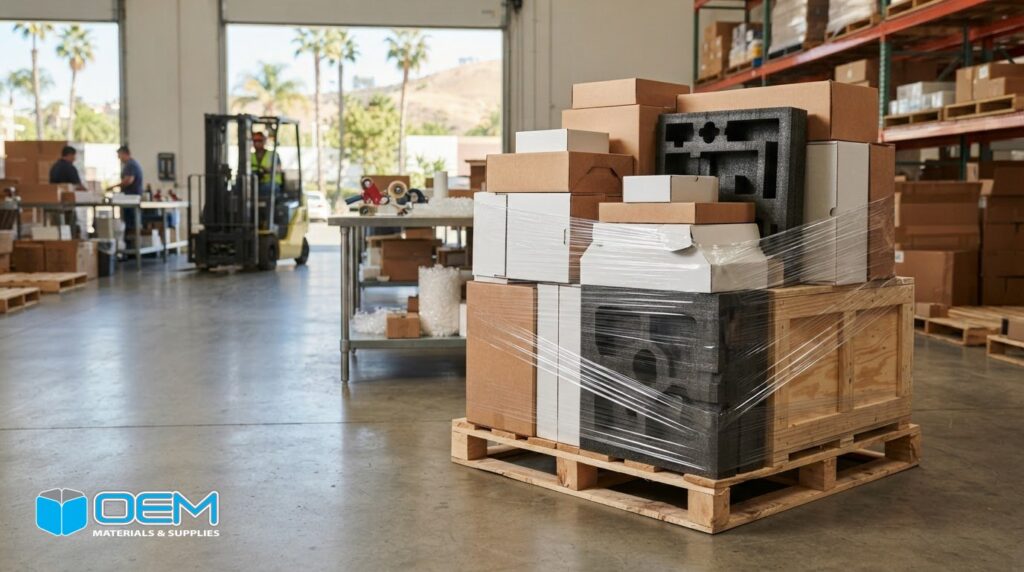
Rush packaging is most useful when a missed delivery date could disrupt production, fulfillment, or a customer commitment. Expediting custom packaging orders can help keep time-sensitive plans moving; custom mailer boxes, folding cartons, and corrugated boxes can be rush-produced in 3-5 business days. Faster delivery usually costs more and leaves less room to revise an order once it’s in process.
That tradeoff matters. A rush timeline can support customer service, but only when packaging specifications, artwork, and delivery plans are ready to move together.
This article explains why businesses expedite custom packaging orders, what to consider before choosing a rush schedule, and how timing varies by packaging format. You’ll also learn how production time differs from transit time, which details affect the schedule, and how to plan around an operational deadline.
Key Takeaways
- Use expedited delivery when a packaging delay could affect production, fulfillment, or a customer commitment, and weigh the faster arrival against higher shipping costs and less flexibility for order changes.
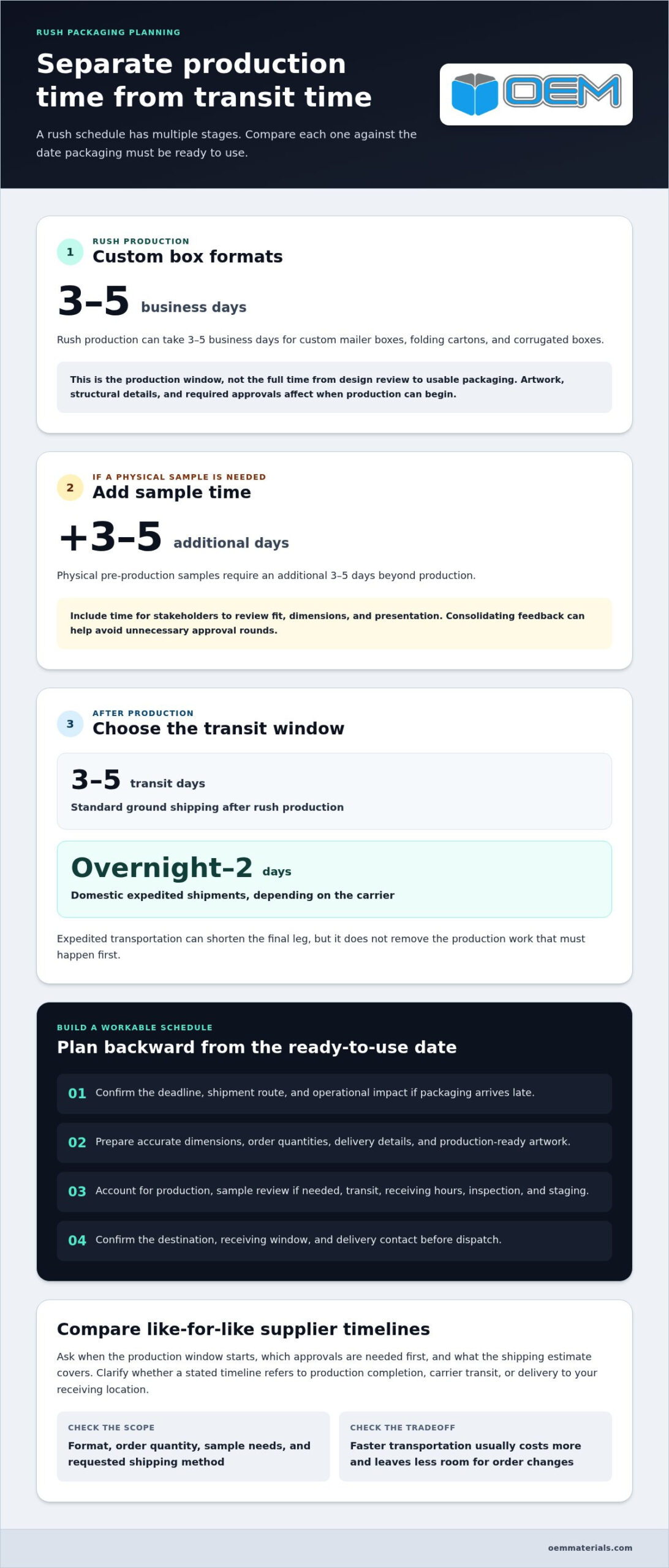
- Separate production time from transit time when planning a deadline. Rush production for custom mailer boxes, folding cartons, and corrugated boxes can take 3-5 business days.
- Allow for physical pre-production samples in the schedule, since they require an additional 3-5 days beyond production.
- Help keep a rush order moving by preparing accurate dimensions, order quantities, delivery details, and production-ready artwork before submitting it.
- Compare supplier timelines by packaging format and ask how the production schedule and shipping method fit your required arrival date.
Benefits and challenges of expedited delivery
Expedited delivery can protect a production schedule or customer commitment when standard transit would arrive too late. The decision depends on the deadline, shipment route, and cost of delay.
Expedited Delivery Benefits
For a delayed product launch, priority shipping can move packaging to the fulfillment site sooner than standard ground service. Domestic expedited shipments generally take from overnight to two days, depending on the carrier. The shorter transit window can help operations teams align packaging arrivals with production runs, scheduled shipments, or customer delivery dates.
Faster service can also support customer experience when packaging is part of a time-sensitive order. For example, a manufacturer facing a planned replenishment date may use expedited shipping to reduce the risk of an empty packing station. Teams coordinating just-in-time packaging schedules can compare the arrival date against material consumption and the next scheduled run.
Expedited Delivery Challenges
Priority transportation costs more than standard shipping, so weigh the added expense against the operational impact of waiting. A delay might require rescheduling a packing shift or holding finished goods. If neither outcome threatens a customer commitment or production plan, standard transit may be more practical.
Rush delivery also leaves less time to revise an order once production begins or the shipment is underway. Changes to quantity, destination, or delivery instructions can complicate a tight schedule. For example, a warehouse that discovers a receiving constraint after dispatch may have fewer options than it would on a standard timeline.
Separate production time from transit time before comparing delivery options. After rush production, standard ground shipping adds 3-5 transit days. Expedited transportation can shorten that final leg, but it does not remove the production work that must happen first. A realistic schedule accounts for both stages, plus the time needed to receive and stage the shipment.
Start with the date the packaging must be ready to use, then work backward. Account for receiving hours, internal inspection, and any preparation needed before the first production run. Packaging arriving on a Friday, for example, may not help a facility whose receiving team is scheduled to accept freight later. Set the required arrival date according to the facility’s actual operating plan.
Next, identify why the deadline matters. A line stoppage, a committed customer shipment, and a planned promotional release carry different consequences. Operations and purchasing teams can compare the cost of delay with the premium for faster transportation, including practical effects such as overtime, rescheduling, or holding completed products.
Finally, coordinate the shipment plan with the receiving location before dispatch. Confirm the destination, receiving window, and person responsible for the delivery. These steps help prevent avoidable handoff problems at Southern California facilities where multiple sites may share purchasing or warehouse teams. Faster carrier service works best when the receiving process is ready too.
Rush production timelines by packaging format
Rush production timing depends on the packaging format and the work required before a production run begins. Assess the production schedule separately from sample approval and transportation.
To compare rush-order policies, fees, and guarantees, request the production window, order cutoff, fee basis, and shipping estimate in writing. Check what each guarantee covers: production completion, carrier transit, or delivery to your receiving location.
For custom mailer boxes, folding cartons, and corrugated boxes, rush production can take 3-5 business days. That timeline helps with planning, but it is not the full path from design review to usable packaging. Artwork, structural details, and approval steps affect when production can start. A deadline should account for those steps rather than treating the production window as the entire order schedule.
Physical pre-production samples require an additional 3-5 days beyond production. For example, a team that needs to inspect a sample before approving a run should add that review stage to its schedule. The sample gives stakeholders a chance to assess fit, dimensions, and presentation before committing to the full production run. Consolidate feedback so revisions do not create unnecessary approval rounds.
Different formats have different production requirements, so don’t apply box timelines to every packaging component. Foam packaging, for example, may involve shaping protection around the product’s dimensions and contact points. A packaging kit may combine multiple components, so each item’s readiness affects the complete kit. Establish which components must arrive together and which can be used independently.
Compare suppliers using the same specifications and deadline. Ask for the production window, when it begins, and any customer approvals required beforehand. Then compare the delivery method and how its timing is described. A schedule that starts after final artwork approval differs from one that includes design review. Record these assumptions alongside the promised completion date.
Check how rush fees are calculated before comparing proposals. Format, order quantity, schedule, and requested shipping method can affect the quoted total. Clarify whether revisions, sample approval, or destination changes affect the schedule or fee. The comparison is useful only when each proposal covers the same packaging scope and delivery point.
Build a practical schedule backward from the date the packaging must be ready to use. Include artwork approval, sample review when needed, production, receiving, and internal inspection. If a shipment supports a specific manufacturing run, align its arrival with the facility’s receiving hours and staging plan. This turns the timeline into a usable operating plan, not just a production estimate.
Expedited custom packaging orders
Urgent packaging schedules depend on production readiness, approval speed, and carrier transit. Separate each stage before setting an arrival date.
Shipping Options and Delivery Times
Urgent orders can ship by overnight, two-day, or other expedited carrier service. Typical estimates range from 2 to 3 days, while some shipments take 3 to 4 days. The carrier and destination affect transit time, so compare the promised arrival date, not just the service name.
Ask whether the estimate begins at production completion or carrier pickup. A shipment leaving a facility late in the day, for example, may follow a different transit schedule from one collected earlier. Include receiving hours and the final delivery location in your plan.
Rush and Same-Day Production Suppliers
Packaging suppliers may offer rush production for selected formats, but same-day production and same-day shipping are different services. Rush-produced custom mailer boxes, folding cartons, and corrugated boxes can take 3-5 business days. Define the required format and delivery date before comparing suppliers.
Ask what “same-day” means in the specific offer: production completion, dispatch, or delivery. The stated schedule should identify the production start point and any required approvals. This distinction prevents same-day dispatch from being mistaken for same-day arrival.
Order Information and Required Files
Prepare the details needed to define the packaging and schedule: product dimensions, quantity, destination, required arrival date, and packaging format. For printed packaging, provide final artwork and the relevant design files. Clear inputs reduce clarification cycles during a short production window.
Also explain how the product will be packed and handled. A fragile component, for example, may need protective inserts, while a multi-item shipment may require coordinated packaging components. Identify any fit, presentation, or assembly requirements that could affect design or approval.
Proof Approval and Delay Prevention
To approve proofs efficiently, assign one decision-maker and consolidate feedback before responding. Check the proof against the approved dimensions, artwork, copy, and packaging configuration. Send one clear approval or a coordinated revision list so production can proceed from an agreed version.
If an order is delayed, contact the supplier with the order details and deadline at risk. If packaging arrives with defects, document the issue, separate affected units, and share clear photos and quantity details. Report a specific problem, such as a damaged corner or incorrect print area, rather than describing the shipment only as defective.
Keep the approved proof and order specifications with the receiving records. These documents help purchasing and warehouse teams compare delivered packaging with the agreed requirements and identify the next corrective step.
What packaging suppliers offer rush or same-day production in the United States?
In the United States, rush packaging typically comes from manufacturers or converters that can schedule custom production. Regional distributors may also coordinate packaging supply and delivery. Same-day production differs from same-day shipment, so compare the exact work included before planning around a deadline.
Start with the packaging format. Corrugated converters produce custom box styles, while folding-carton manufacturers handle printed carton formats. Other packaging manufacturers may specialize in protective components or packaging kits. A supplier’s fit depends on the materials, design, quantity, and production steps your order requires. A rush option for one format does not establish the same schedule for another.
Ask what “same-day” means in the supplier’s schedule. It could mean production is complete, an order is ready for pickup, or available stock is dispatched. A ready-to-ship box and a newly printed custom box involve different work, for example. Get the production milestone and delivery estimate separately, so the team can plan for the actual arrival.
Compare suppliers using the same project details. Provide the packaging dimensions, quantity, artwork status, destination, and required arrival date. Then ask when production can begin, which approvals must come first, and what shipping method the schedule includes. A proposal based on finished artwork is not directly comparable to one that includes design revisions.
- Manufacturers and converters: Ask which custom formats they can produce on a rush schedule.
- Regional distributors: Clarify whether the timeline covers available inventory, custom production, or both.
- Packaging specialists: Match their production capabilities to the components and protection your product needs.
For operations in Orange County, Los Angeles, San Diego, or Riverside, include the receiving location in the comparison. An order going to Los Angeles County may follow a different delivery plan from one headed to San Diego County. Confirm receiving hours, dock requirements, and who will accept the shipment. These details distinguish a workable delivery schedule from a production estimate alone.
Before choosing a supplier, review the schedule alongside the order’s technical requirements. Check the approved dimensions, material description, print files, and any required sample review. If a rush schedule leaves no time to resolve design questions, a stock packaging option may better fit the immediate need. Custom production is the better match when packaging must meet project-specific dimensions or presentation requirements.
Finally, get the schedule in writing, including production start conditions, completion point, and shipping assumptions. Keep approved specifications and delivery details together for purchasing, production, and warehouse teams. A shared record helps each group work from the same deadline and reduces confusion during a compressed order cycle.
What information and files are needed to place a rush custom packaging order?
A complete order package helps purchasing, engineering, and production work from the same specifications. Gather product details, packaging requirements, artwork, quantity, and delivery information before requesting a rush schedule.
Start with the product itself. Provide its dimensions and weight, along with any fragile surfaces, protrusions, or handling concerns. Explain how it will sit inside the package and whether protective components are needed. A finished assembly with a projecting connector, for example, may need a different interior layout from a flat component.
- Packaging format: Identify the requested box, foam packaging, or packaging kit.
- Product dimensions and weight: Provide measurements and note the orientation inside the package.
- Order quantity: State the required quantity and any planned repeat orders.
- Delivery details: Provide the destination, receiving contact, and required arrival date.
- Artwork: Send the current approved design files for printed packaging.
- Handling requirements: Describe stacking, storage, or assembly needs relevant to use.
For custom foam packaging, describe the product shape and the areas needing support. A clear product image or drawing can show contours that dimensions alone may not convey. For a packaging kit, list every component and explain how the items should be grouped. These details clarify what the finished package needs to contain.
Make sure artwork matches the packaging version you intend to order. Include current copy, logos, and placement instructions, then identify the person authorized to approve the proof. If the design is still changing, flag open decisions. A late text or graphic revision can interrupt an otherwise ready production schedule.
State the required arrival date and explain the operational deadline behind it. Packaging for a scheduled production run, for example, should arrive before staging begins. Include facility receiving hours and delivery instructions. These details distinguish the requested delivery date from the date the shipment leaves production.
Before submitting, compare the files and order details. Confirm that the artwork matches the packaging version and that the quantity matches purchasing records. Keep one current specification set instead of sending conflicting drafts. One decision-maker can consolidate corrections and return clear proof feedback.
For a quote, submit your packaging requirements with dimensions, weight, quantity, artwork, and delivery details. A well-organized request gives the production team the information needed to assess the order scope and schedule.
OEM Materials & Supplies: Corrugated Boxes
OEM Materials & Supplies provides corrugated boxes for businesses with custom packaging needs in Orange County, Los Angeles, San Diego, and Riverside. Turn to the team when product dimensions, shipment handling, or packing workflows call for packaging suited to your operation. Sharing product size, weight, order quantity, and delivery requirements helps frame a useful discussion.
For products needing added protection, foam packaging can address fit and cushioning needs. Packaging kits bring components together for a defined packing process, while mailing tubes and cores suit products designed for tube-style packaging. The right option depends on the product and how it moves through storage, packing, and shipment.
Contact OEM Materials & Supplies to discuss your packaging requirements or visit oemmaterials.com.
Make the Next Packaging Deadline Easier to Manage
Use the next urgent order to establish a clearer process for future packaging decisions. Keep approved specifications, current artwork, product dimensions, and receiving instructions in one accessible file. Purchasing, engineering, and warehouse teams can then work from the same information when schedules tighten.
For operations in Orange County, Los Angeles, San Diego, and Riverside, connect packaging decisions to the production or fulfillment date they support. This gives your team a practical basis for setting priorities, coordinating approvals, and planning receiving. A consistent order record also helps identify which details are ready and which still need a decision before production can proceed.
OEM Materials & Supplies can help with packaging needs involving corrugated boxes, foam packaging, and packaging kits. Share your product dimensions, weight, order quantity, and delivery requirements when you request a packaging quote. A well-prepared request gives the conversation a clear starting point for expediting custom packaging orders. Take the next step with a defined requirement and a schedule your team can plan around.
Frequently Asked Questions
How can I expedite a custom packaging order?
Expedite an order by separating the immediate production need from later replenishment. Identify the minimum packaging quantity needed to keep a specific product or line moving, then consider whether the remaining quantity can follow separately. Remove optional design changes that don’t affect product protection or handling. This focused scope helps purchasing prioritize the urgent requirement without changing the packaging’s essential function.
What is the typical turnaround time for rush custom packaging orders?
There’s no single turnaround time for every custom packaging format. A custom die, uncommon material, or complex print setup can add work before production begins, while an established design may follow a more direct path. Use a schedule tied to the exact packaging configuration. Ask which milestone marks completion, such as finished goods ready for carrier pickup, so the estimate has a clear endpoint.
How do order quantity, packaging materials, and printing complexity affect turnaround time?
Quantity affects the length and organization of a production run. Material selection can affect setup if the chosen stock requires different processing or sourcing. Printing complexity may add preparation for multiple colors, print locations, or detailed artwork. A large run with several print elements, for example, may need more production coordination than a simple, unprinted design. Provide the final configuration when requesting a schedule.
What risks or quality trade-offs should I consider when expediting custom packaging?
A compressed schedule can leave less room for rework, so focus quality checks on critical requirements. Confirm that the finished package protects the product and works with the intended packing process. For example, inspect a first completed unit for fit and closure before releasing the full run. Don’t skip a check that protects product integrity just to save time; resolve functional issues before packaging enters regular use.