

Your returnable container loop isn’t what usually triggers severe assembly plant chargebacks; it’s the backup expendable packaging you rushed onto the trailer when totes ran short. Meeting strict automotive supplier packaging requirements means engineering one-way corrugated containers and custom foam inserts that mirror your approved returnable systems down to the millimeter.
You already know the frustration of managing tight production schedules while deciphering conflicting packaging manuals between domestic automakers and foreign transplant facilities. A single scuffed Class-A component, unapproved pallet footprint, or mislabeled barcode can trigger an immediate non-conformance chargeback and stall an entire line-side shift.
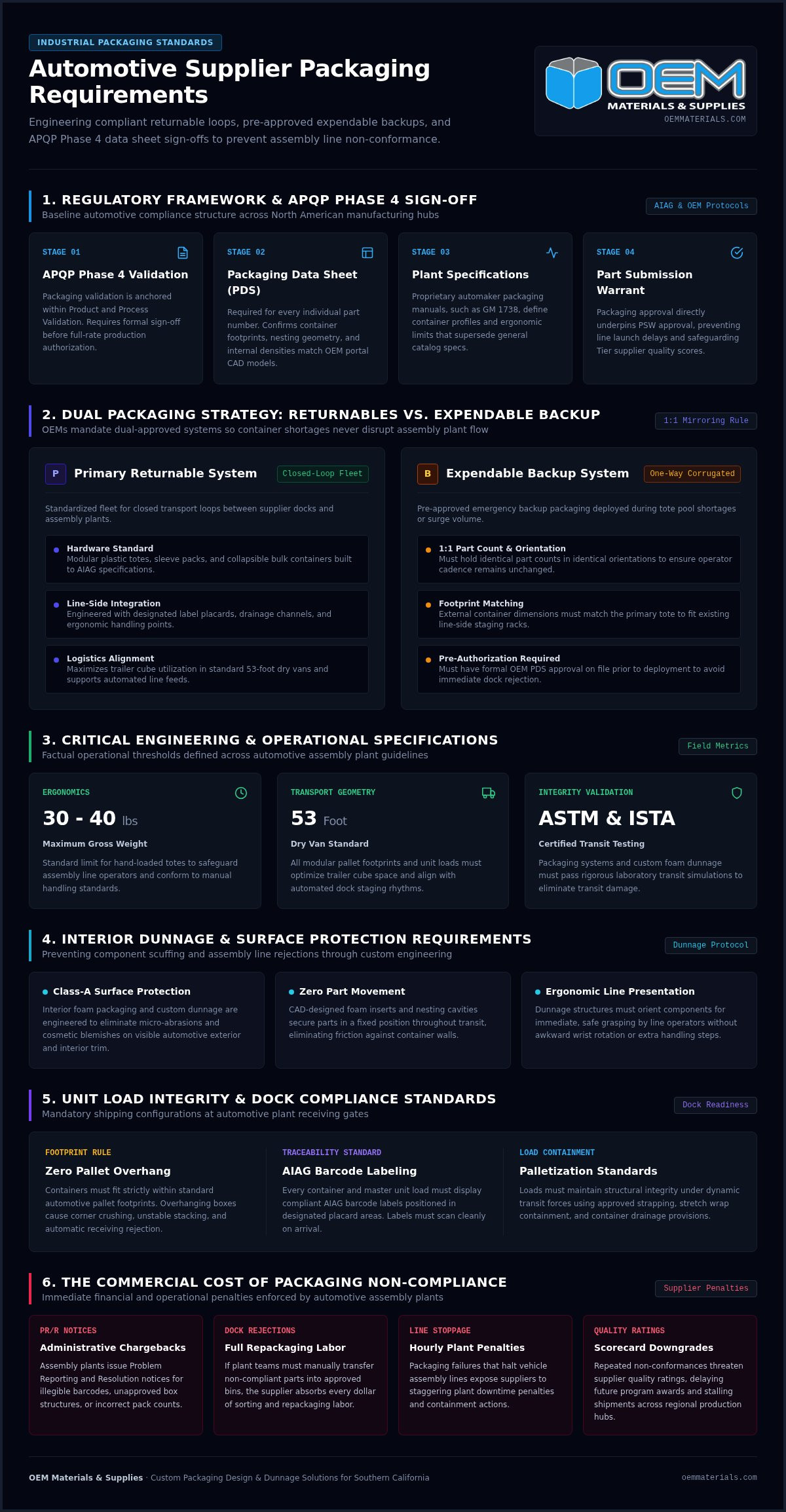
This guide covers the testing standards, interior dunnage specifications, and APQP Phase 4 steps required to secure OEM packaging data sheet sign-offs on your first pass. We will walk through the exact tier-level checklist you need to prevent transit damage, stabilize backup packaging loops, and keep shipments moving reliably into automotive assembly facilities across Southern California.
Key Takeaways
- Mastering automotive supplier packaging requirements protects Tier 1 and Tier 2 suppliers from costly OEM non-conformance chargebacks and line stoppage penalties.
- Expendable backup packs must mirror primary returnable containers in part count, exterior footprint, and orientation to maintain line-side efficiency during container shortages.
- Interior foam packaging and custom dunnage must be engineered to prevent Class-A surface abrasions while passing rigorous ASTM and ISTA laboratory transit tests.
- Unit loads require strict adherence to standard automotive footprints, zero pallet overhang, and compliant AIAG barcode labeling before arriving at plant receiving docks.
- Securing early OEM Packaging Data Sheet sign-offs during APQP Phase 4 ensures a smooth Part Submission Warrant approval before full production ramps up.
Core Standards Governing Automotive Supplier Packaging Requirements
Automotive assembly plants run on tightly synchronized delivery rhythms. On the plant floor, packaging serves as an active tool for line-side staging rather than simple storage. Automakers enforce rigorous packaging manuals specifying exterior container dimensions, load limits, and ergonomic guidelines. Hand-loaded totes, for example, are typically capped at a 30 to 40-pound maximum gross weight to safeguard line operators. Failing to meet automotive supplier packaging requirements disrupts part sequencing at the receiving dock, triggering rapid containment actions and billing penalties.
Understanding AIAG Guidelines and OEM Packaging Manuals
The Automotive Industry Action Group (AIAG) establishes the structural baseline across North American supply chains. Under the AIAG APQP framework, packaging validation sits in Phase 4 (Product and Process Validation), requiring formal sign-offs before full-rate production authorization. Most production programs rely on closed loops of reusable transport packaging such as standardized plastic totes and bulk bins to streamline container cycling and reduce line-side waste.
Individual automakers build upon these baseline standards with plant-specific manuals, such as General Motors’ GM 1738 specifications. These guidelines require an approved Packaging Data Sheet (PDS) for every single part number. Engineering teams must verify that container footprints, nesting profiles, and internal part densities align precisely with the CAD geometry logged in OEM logistics portals. Aligning early with an experienced partner in custom packaging design ensures that Tier suppliers satisfy both general AIAG guidelines and proprietary automaker standards without facing repeated submission rejections.
The True Cost of Supplier Non-Compliance and Rejections
Packaging failures directly threaten production velocity and trigger severe commercial consequences. Assembly plants issue immediate administrative chargebacks through Problem Reporting and Resolution (PR/R) notices whenever shipments arrive with illegible barcodes, unapproved box structures, or incorrect pack counts. If receiving teams must manually transfer components into compliant bins, the supplier absorbs every dollar of repackaging labor.
The stakes climb dramatically if substandard packaging leads to part damage. Defective or compromised components can halt a high-speed vehicle assembly line, exposing the supplier to staggering hourly plant downtime penalties. Rigorous adherence to automotive supplier packaging requirements protects component integrity, secures Part Submission Warrant (PSW) approvals, and preserves supplier quality ratings across Southern California manufacturing hubs.
Returnable Containers Versus Expendable Packaging Requirements
Meeting automotive supplier packaging requirements demands a balanced strategy for both returnable container loops and backup expendable packaging. High-volume automotive manufacturing runs primarily on closed-loop returnable containers. When logistics delays, maintenance cycles, or surge volumes leave suppliers short on empty bins, parts cannot sit idle on the factory floor. Automotive OEMs require Tier suppliers to maintain formal approval for dual packaging designs: the primary returnable system and an expendable corrugated backup that mimics the primary pack identically.
Managing Standard Returnable Totes and Bulk Bins
Automotive supply chains depend on returnable plastic containers, sleeve packs, and collapsible bulk bins that comply with AIAG packaging and labeling guidelines. Standardizing these modular units ensures perfect trailer cube utilization in standard 53-foot dry vans and supports automated line-side delivery systems. To maintain fleet longevity, returnable containers must include drainage channels, designated label placard areas, and ergonomic handholds for plant operators.
Managing an active returnable fleet requires disciplined tracking to counter shrinkage across assembly networks. When empty totes fail to return on schedule from assembly plants, suppliers must immediately pivot to expendable alternatives without disrupting the production line or compromising part safety.
Designing Pre-Approved Expendable Backup Packaging
An expendable pack isn’t just an off-the-shelf brown box. Automotive OEMs mandate that backup expendable designs mirror their returnable counterparts in three critical areas:
- Identical Part Density: The expendable pack must hold the exact same number of parts as the returnable tote, preserving automated inventory counts.
- Operator Orientation: Components must present in the same orientation to allow line-side operators to maintain their established assembly cadence.
- Line-Side Compatibility: Taped flaps on regular slotted containers (RSCs) are widely barred line-side. Expendables typically require half-slotted containers (HSCs) with drop-on lids for quick, knife-free access.
To prevent container crushing under static and dynamic transit loads, expendables rely on heavy-duty corrugated boxes engineered with high edge crush test (ECT) ratings, often starting at 44 ECT or 275 psi burst strength. If you need assistance qualifying secondary expendable packs to satisfy strict OEM audits, you can request a quote from our engineering team to review box geometry and compression ratings.
Part Protection and Interior Dunnage Compliance Checklist
Outer containers provide structural stacking strength, but interior dunnage ensures parts arrive undamaged. Meeting strict automotive supplier packaging requirements depends on how effectively internal components isolate parts from vibration, shock, and metal-to-metal contact during dynamic transit. ASTM D4169 and ISTA 3E laboratory simulation profiles test for repetitive road vibration, sudden deceleration, and multi-axis drops. Cushioning that shifts or allows delicate parts to rub against rough walls will fail quality audits long before shipments reach assembly lines.
Engineered Foam Inserts and Custom Part Dividers
Selecting interior materials requires matching chemical and mechanical properties to the part’s finish. For exterior trim and painted surfaces, Class-A protection is mandatory to eliminate scuffing. Cross-linked polyethylene (XLPE) offers a non-abrasive, closed-cell surface that protects high-gloss parts under sustained friction. For heavier structural castings, machined powertrain components, or stamped brackets, custom-routed and die-cut foam packaging absorbs repeated shock loads without permanent cell collapse.
Corrugated partitions and engineered dividers provide economical segregation for non-painted stamped metal assemblies. Aligning these dividers to common industrial baselines mirrors the sustainability metrics documented in EPA container and packaging data regarding curbside-recyclable fiberboard. Custom precision-cut cavities ensure parts sit in identical orientations, allowing plant operators to extract pieces using one hand or letting robotic end-effectors pick components without optical misalignment.
Corrosion Prevention and Static Dissipation Requirements
Environmental control inside the pack is just as critical as mechanical protection. Precision-ground steel gears, brake assemblies, and bare engine blocks require Volatile Corrosion Inhibitor (VCI) protection. Bags, sheets, or chipboard treated with VCI emit active molecular compounds that bond with metal surfaces, creating an invisible shield against rust during humid transit through the Midwest or ocean freight staging.
Electric vehicle powertrain electronics and sensitive control modules require certified electrostatic discharge (ESD) protection. These components mandate anti-static foam inserts, conductive corrugated dividers, and integrated desiccant packs to prevent latent electrical damage. Ensuring your interior dunnage combines physical cushioning, corrosion prevention, and static mitigation keeps your parts compliant with tier-level quality standards.
Palletization, Unit Load Integrity, and Labeling Standards
Unit load stability determines whether parts clear the assembly plant receiving dock or get rejected on arrival. Plant handling equipment operates on strict tolerances. When stretch wrap relaxes or boxes lean, automated guided vehicles (AGVs) and de-palletizing cells fault out instantly. Ensuring your shipments comply with automotive supplier packaging requirements means building rigid, uniform pallet loads that survive intermodal transit forces without shifting or deflecting.
Unit Load Assembly and Pallet Footprint Rules
Unlike broader commercial retail networks that rely heavily on the 48 by 40-inch grocery footprint, North American automotive assembly plants mandate a standard 48 by 45-inch base. This footprint allows two units to sit side by side across the width of a standard 53-foot trailer, locking out dead space. For heavy structural components, battery modules, and transmissions, Tier suppliers rely on high-capacity plastic pallets engineered with 4-way forklift entry and perimeter retaining lips.
Overhang is entirely unacceptable. Even a half-inch of box edge protruding past the pallet boundary compromises stacking strength and risks puncturing adjacent loads during trailer loading. Tier suppliers must also eliminate underhang, as excessive deck gaps cause shifting when trailers brake or turn sharply.
Securing Loads with Stretch Film, Strapping, and Edge Boards
Preventing horizontal load drift requires controlled film pre-stretch and dedicated corner stabilization. Heavy-gauge solid fiberboard edge protectors shield the top and vertical edges of corrugated boxes from crushing when operators tension plastic strapping. Polyester strapping provides reliable continuous tension without the dangerous snap-back or surface biting common to steel banding.
Wrapping unit loads requires high-tensile machine-grade film applied under calibrated pre-stretch levels to lock the bottom layer of containers directly to the pallet deck. Discover the best practices for wrapping heavy industrial loads in our technical guide on stretch film for pallet wrapping.
Automotive Shipping Label Placement and Scannability
Automakers follow AIAG B-10 and B-16 global transport label specifications, requiring standard 4 by 6-inch placards. Plant receiving mandates precise placement to avoid manual scanning bottlenecks:
- Dual Side Placement: Identical labels must appear on two adjacent sides, typically the leading face and the right-hand corner, allowing operators to scan pallets from either angle.
- Height Consistency: Place labels within the automaker’s prescribed vertical band, generally between 16 and 36 inches from the floor, to align with fixed optical line scanners.
- Film Readability: Never apply stretch film directly over paper barcode labels, as film glare, reflections, and wrinkles scatter laser beams and cause scan errors. Position labels in designated exterior sleeves or apply them over the final film wrap.
If you want to secure your supply chain and eliminate dock rejections, request a quote for automotive-grade pallets, edge boards, and high-performance machine stretch wrap.
How to Secure OEM Packaging Approval and Streamline Staging
Securing production sign-off requires documented engineering proof before commercial trailers roll. Automakers do not grant full Part Submission Warrant (PSW) clearance until you satisfy every element of their automotive supplier packaging requirements during Phase 4 APQP. Partnering with a specialist in custom packaging design ensures container geometries, compression tolerances, and dunnage cavities are fully qualified on the first submission, eliminating protracted engineering revisions.
Navigating the Packaging Data Sheet Submission Process
The Packaging Data Sheet (PDS) serves as your binding contractual commitment to the automaker. Uploaded directly to OEM supplier portals, this document links container specs to the active bill of materials. Submitting a complete PDS package requires specific verified parameters:
- Tare and Gross Mass: Calculate individual container tare, full unit load tare, and gross weight down to fractional pound increments.
- Dimensional Stack Calculations: Provide container footprints, nested heights, and maximum pallet tier configurations.
- Photographic and CAD Documentation: Submit 3D exploded views of interior partitions alongside color photos showing empty and fully loaded packs.
- Transit Test Reports: Include certified laboratory test documentation covering ASTM D4169 multi-axis vibration profiles and rotational drop cycles.
Staging Packaging Inventory for Southern California Suppliers
Suppliers across Los Angeles County, Orange County, the Inland Empire, and San Diego County face unique operational constraints. Regional industrial real estate carries premium square-footage costs, making on-site staging of bulky corrugated Gaylords and foam assemblies highly inefficient. Tying up prime manufacturing floors with empty packaging threatens production flow.
Managing inventory through localized vendor-managed inventory (VMI) buffers your operations against unexpected supply shocks. Under a VMI structure, your packaging supplier monitors min-max consumption levels and holds safety stock in regional warehouses. When production surges or returnable container loops experience transit delays back from assembly plants, pre-approved expendable packaging arrives via just-in-time delivery within hours.
Whether you need rapid physical prototypes for upcoming PPAP reviews or dependable staging for high-volume programs, our team provides complete packaging support. Take the next step toward zero-chargeback shipments by requesting an industrial packaging quote with your component dimensions, tare constraints, and annual volume estimates.
Build a Zero-Chargeback Automotive Packaging Strategy
Protecting your supplier quality rating comes down to disciplined execution across every shipment. Complying with automotive supplier packaging requirements demands more than matching basic box dimensions. It requires strict geometric parity between your returnable and expendable packs, custom dunnage that prevents Class-A surface abrasions, and stable 48 by 45-inch unit loads that feed seamlessly into line-side staging cells.
OEM Materials & Supplies supports Tier 1 and Tier 2 manufacturers with custom packaging design, rapid prototyping, and an industrial catalog of heavy-duty corrugated containers, engineered foam inserts, and durable plastic pallets. Through regional warehousing and vendor-managed inventory programs across Los Angeles County, Orange County, the Inland Empire, and San Diego County, we ensure pre-approved backup packs are staged and ready whenever container loops stall.
Keep your shipments moving without the threat of receiving rejections or line-down chargebacks. Request a quote for compliant automotive packaging today. Share your part dimensions, piece weights, and annual shipping volumes, and let our engineering team build a dependable packaging system for your vehicle programs.
Frequently Asked Questions
What is an automotive packaging data sheet?
An automotive packaging data sheet (PDS) is a formal compliance document that details the engineering specifications of a part’s primary and backup packaging system. Submitted through OEM supplier portals during Phase 4 APQP, the PDS logs container dimensions, tare weights, part quantities per pack, interior dunnage materials, and pallet stacking configurations. Automakers review and sign off on this data before granting production part approval warrants, establishing a legally binding standard for all future production shipments.
Why do automotive OEMs require expendable backup packaging?
Automotive OEMs mandate expendable backup packaging to ensure assembly lines continue running when returnable container loops experience transit delays or fleet shortages. If empty returnable totes fail to cycle back from assembly plants, suppliers must immediately ship parts in pre-approved corrugated containers. To satisfy automotive supplier packaging requirements, this expendable packaging must duplicate the part orientation, pack count, and line-side presentation of the returnable container without requiring knife cuts or re-handling by line workers.
What are the standard dimensions for automotive shipping pallets?
The standard automotive shipping pallet in North America measures 48 inches by 45 inches. Unlike standard 48 by 40-inch grocery pallets, the 48 by 45-inch footprint maximizes floor space across 53-foot dry vans by fitting two unit loads side by side with minimal slack. Automakers strictly require that parts and boxes remain flush with pallet deck edges, prohibiting any overhang that could cause load instability or puncture damage during transit.
How do automotive suppliers avoid packaging chargebacks?
Automotive suppliers avoid packaging chargebacks by strictly adhering to approved packaging data sheets and maintaining disciplined quality control before staging trailers. Critical steps include applying scannable AIAG B-10 barcode labels on adjacent pallet faces, eliminating container overhang, and verifying gross weight limits. For suppliers in Los Angeles, Orange County, and Riverside, partnering with a local industrial packaging vendor for pre-tested materials and just-in-time delivery ensures backup supplies remain fully compliant with automotive supplier packaging requirements.
What types of foam dunnage are acceptable in automotive packaging?
Cross-linked polyethylene (XLPE), expanded polypropylene (EPP), and polyurethane foams are the primary dunnage materials accepted in automotive packaging. Closed-cell XLPE is widely specified for Class-A painted surfaces and delicate instrument trim because it provides non-abrasive cushioning without shedding particles. High-density expanded polypropylene trays provide multi-impact durability for heavier powertrain parts, while anti-static or conductive foams are mandated for sensitive electric vehicle modules and electronic control units to prevent electrostatic discharge.
Can suppliers use wood pallets for automotive shipments?
Suppliers can use wood pallets for automotive shipments if they meet OEM structural standards, though heavy-duty plastic pallets remain standard for closed loops. When expendable wood pallets are approved, they must adhere to the 48 by 45-inch footprint and feature heavy deck boards to support industrial weights. For shipments crossing into Mexico or Canada, solid wood pallets must comply with ISPM 15 heat-treatment guidelines and carry an authentic IPPC stamp.