
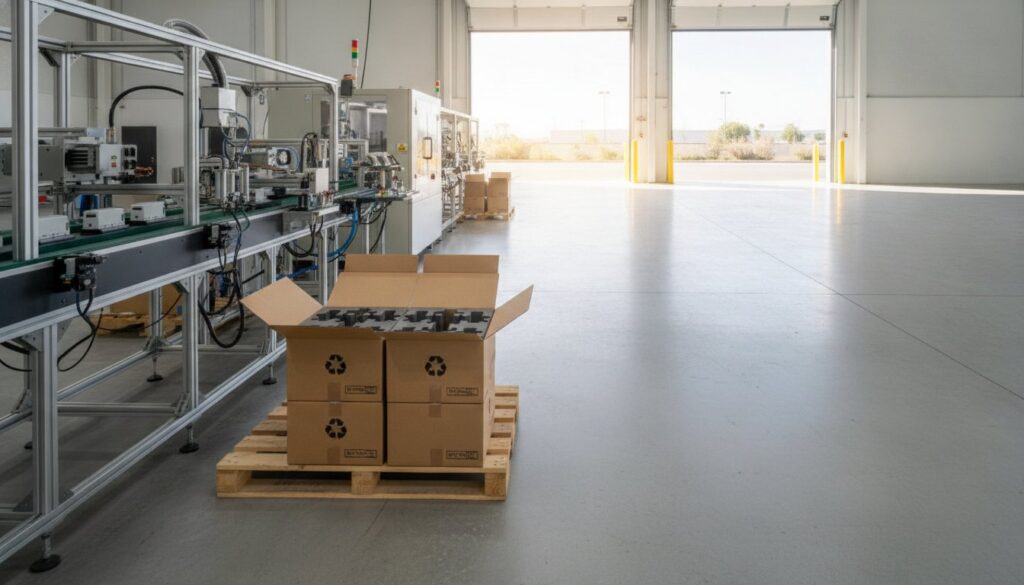
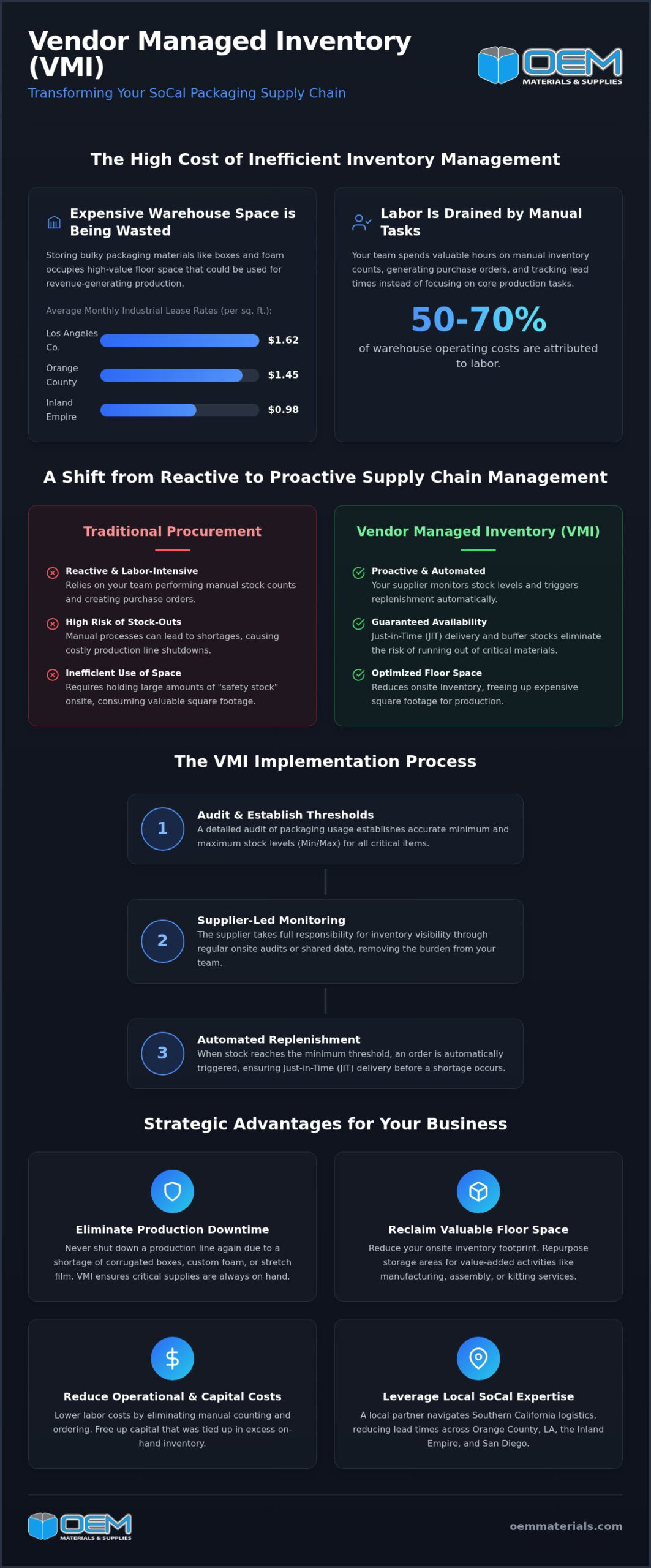
In Orange County, industrial lease rates average $1.45 per square foot, while Los Angeles County space costs nearly $19.47 per square foot annually as of 2026. It’s a significant financial burden to see high-value floor space occupied by stacks of empty corrugated boxes rather than revenue-generating production lines. You likely already know that labor accounts for 50% to 70% of your warehouse operating costs, and spending those hours on manual inventory counts is a constant drain on your bottom line.
Optimizing your packaging supply chain management southern california strategy requires more than just a reliable vendor; it requires a partner that takes the inventory burden off your shoulders. This article explains how a Vendor Managed Inventory (VMI) program reduces warehouse overhead and eliminates the risk of stock-outs for critical materials like custom foam and shipping containers. We’ll examine how transitioning to a VMI model provides guaranteed availability and streamlines your procurement process, allowing your team to focus on manufacturing excellence rather than tracking box counts.
Key Takeaways
- VMI shifts the burden of stock monitoring and replenishment to your supplier, ensuring critical materials are always available without manual intervention.
- Reducing onsite inventory of bulky items like corrugated boxes allows manufacturers to reclaim expensive square footage in high-cost regions like Los Angeles and Orange County.
- Effective packaging supply chain management southern california relies on just-in-time delivery and buffer stocks to eliminate the risk of production line shutdowns.
- Successful implementation starts with a detailed audit of packaging usage to establish accurate minimum and maximum stock levels for custom and stock items.
- Partnering with a local supplier provides a strategic advantage by leveraging regional logistics expertise to navigate traffic patterns and reduce lead times across San Diego and the Inland Empire.
What is Vendor Managed Inventory for Industrial Packaging?
Vendor Managed Inventory (VMI) is a strategic supply chain model where the supplier takes full responsibility for maintaining agreed-upon stock levels at the customer facility. In the context of industrial packaging, this means your vendor doesn’t just deliver an order; they actively manage the shelf. Instead of your warehouse team spending hours counting corrugated boxes or checking stretch film levels, the supplier monitors the inventory and triggers replenishment automatically.
This shift fundamentally changes the dynamic of packaging supply chain management southern california manufacturers rely on. It moves the vendor from a simple commodity seller to a deeply integrated solutions partner. By taking ownership of the monitoring and ordering process, the supplier ensures that critical supplies are always on hand, preventing the costly downtime associated with packaging shortages.
VMI vs. Traditional Procurement Models
Traditional procurement is reactive and labor-intensive. It relies on internal personnel to perform manual stock counts, generate purchase orders, and follow up on lead times. This process often leads to fluctuations between expensive overstock and critical shortages. VMI eliminates this administrative friction. By utilizing scheduled onsite audits or integrated data sharing, the supplier automates the replenishment cycle. This reduces the lead-time risk and removes the burden of managing dozens of individual purchase orders for recurring items.
Core Components of a Packaging VMI Program
A robust VMI program is built on visibility, precision, and design consistency. This structured approach ensures that the packaging supply chain management southern california facilities require remains stable even during seasonal demand spikes. Key components include:
- Inventory Visibility: Achieved through regular physical audits by the supplier or through digital inventory tracking systems.
- Min/Max Thresholds: Agreed-upon stock levels that trigger automatic replenishment before a shortage occurs.
- Design Integration: Direct alignment with custom packaging design teams to ensure that any specification changes are immediately reflected in the inventory.
Precision in stock levels is vital for manufacturers using specialized materials. Because custom items have specific manufacturing lead times, VMI ensures that production for the next batch begins before the current stock hits the “danger zone.” This protects your operations from the volatility of the regional market and ensures your packaging specifications remain consistent across every delivery.
Financial Advantages: Reclaiming Expensive Southern California Square Footage
Industrial real estate in Southern California remains some of the most expensive in the nation. As of mid-2026, average asking lease rates in Orange County sit at approximately $1.45 per square foot (NNN) per month. In Los Angeles County, annual rates have reached nearly $19.47 per square foot. When a manufacturer dedicates thousands of square feet to storing empty corrugated boxes or bulky cushioning materials, they are essentially paying a premium for air. This is an inefficient use of capital that directly impacts the bottom line.
A structured Vendor Managed Inventory (VMI) Program transforms this dynamic. Instead of maintaining a three-month safety stock onsite, VMI allows you to shrink your storage footprint by shifting the inventory burden back to the supplier. This reclaimed space can be repurposed for additional production lines, assembly stations, or high-value finished goods. Effective packaging supply chain management southern california relies on treating floor space as a finite, high-cost asset that must be optimized for revenue, not just storage.
The Cost of Excess Inventory Storage
Storing bulky items like plastic pallets, wood crates, and large foam inserts significantly impacts warehouse density. If a facility in the Inland Empire, where rates are roughly $0.98 per square foot, stores 50 pallets of packaging, the monthly cost is measurable and high. Beyond the base rent, hidden costs include the labor required for manual cycle counting and the constant repositioning of materials to reach newer stock. By moving to a VMI model, you reduce these carrying costs and potentially lower insurance premiums by decreasing the volume of combustible materials kept onsite. If you’re looking to optimize your footprint, you can request a quote to see how a tailored program fits your specific dimensions and usage.
Improving Cash Flow and Reducing Waste
VMI often facilitates a transition from bulk upfront purchasing to more efficient consumption-based billing models. This improves liquidity by ensuring capital isn’t tied up in packaging that won’t be used for months. Furthermore, tighter control over custom packaging runs helps eliminate the risk of obsolete inventory when product specifications change. Because materials aren’t sitting in a corner for extended periods, the risk of damaged stock due to moisture, dust, or forklift accidents during long-term storage is virtually eliminated. This precision ensures that every dollar spent on packaging is directly tied to a shipped product.
Operational Efficiency: JIT Delivery and Stock-Out Prevention
A production line shutdown due to missing packaging is one of the most expensive operational failures a manufacturer can face. When an assembly line stops because a specific corrugated box or custom insert isn’t available, the financial impact extends far beyond the cost of the missing item. In Southern California, where warehouse associate wages typically range between $20.00 and $27.00 per hour as of 2026, every minute of idle time for a full shift results in significant labor loss. Effective packaging supply chain management southern california requires a proactive safety net to ensure these bottlenecks never occur.
Integrating a VMI program with JIT packaging delivery provides this safety net. By maintaining a buffer of critical supplies at the supplier’s warehouse and delivering them exactly when needed, manufacturers eliminate the risk of stock-outs. This model also removes the need for emergency freight shipments and rush order surcharges, which often carry a heavy premium in the regional logistics market. It ensures that your focus remains on output rather than tracking down missing components.
Eliminating Production Bottlenecks
High-volume assembly lines, particularly in the medical device and electronics sectors, rely on precision. If custom foam packaging is not ready when a product comes off the line, the entire workflow stalls. A VMI partner monitors your production spikes in real-time or through frequent onsite audits, adjusting replenishment cycles before a shortage becomes a crisis. For example, if a seasonal surge increases your packaging consumption by 30%, the VMI system identifies the trend and triggers a larger production run of custom materials automatically. This prevents the thousands of dollars in labor downtime that occur when teams are forced to wait for supplies.
Streamlining Warehouse Operations
Operational efficiency also depends on the smooth movement of goods through your receiving docks. Traditional procurement models often lead to dock congestion as multiple vendors deliver small, uncoordinated orders. VMI streamlines this by consolidating deliveries and reducing the frequency of inbound shipments. It also allows for the standardization of core materials. For instance, by standardizing high-performance stretch film and tape across all departments, you simplify the training for warehouse staff and reduce the variety of SKUs that need to be tracked. Additionally, utilizing kitting and assembly services from your packaging partner further reduces onsite labor requirements, as components arrive pre-assembled and ready for immediate use on the production floor.
Implementing a VMI Program with a Packaging Supplier
Transitioning to a Vendor Managed Inventory model is a systematic process designed to stabilize your operations and ensure the packaging supply chain management southern california facilities require is both predictable and scalable. A successful implementation is not a generic transition; it is a collaborative framework built on five specific stages:
- Step 1: Conduct a comprehensive audit of current packaging usage, storage capacity, and SKU variety.
- Step 2: Define minimum and maximum stock thresholds for every custom and stock item to prevent both shortages and overstock.
- Step 3: Establish a reporting and replenishment schedule that aligns with your specific production cycles and shift patterns.
- Step 4: Formalize the service level agreement, including billing terms, consumption-based triggers, and delivery logistics.
- Step 5: Launch the program with a dedicated account manager who provides ongoing optimization and quarterly business reviews.
By following this roadmap, manufacturers move from a reactive purchasing cycle to a proactive, data-driven system. This structured approach ensures that every stakeholder, from the procurement office to the warehouse floor, understands the replenishment triggers and delivery expectations. To begin this process for your facility, you can request a quote for a professional packaging audit and program design.
The Importance of the Initial Packaging Audit
The audit is the foundation of the entire program. It involves evaluating current SKU proliferation to identify consolidation opportunities. For example, if a manufacturer uses twelve different sizes of corrugated boxes, an audit might reveal that eight sizes could fulfill the same requirements, reducing inventory complexity and increasing bulk purchasing power. This stage also includes assessing storage conditions. Sensitive materials like corrugated board or specialty tapes require protection from high humidity and dust to maintain structural integrity. Analyzing historical usage data during this phase ensures that replenishment triggers are based on actual consumption rather than outdated estimates.
Establishing Key Performance Indicators (KPIs)
A VMI program must be measured against concrete performance metrics to prove its value. Primary KPIs include inventory turnover rates and the frequency of stock-out events. Tracking the reduction in administrative labor, such as time spent on manual cycle counts and purchase order generation, provides a clear view of the program’s return on investment. The “perfect order” metric is central to this evaluation. In a VMI context, a perfect order is defined as a delivery that arrives in the correct quantity, meets all technical specifications, and is placed at the exact moment the inventory threshold is reached. Monitoring these data points ensures the packaging supply chain management southern california manufacturers depend on remains efficient and cost-effective over the long term.
Strategic Partnership: Why Local SoCal Expertise Matters
The success of a VMI program depends heavily on the physical proximity of the supplier to the manufacturing facility. In a region where diesel fuel averages $6.43 per gallon and traffic congestion in the Inland Empire can delay shipments by hours, a local partner is a strategic requirement rather than a convenience. When your packaging supply chain management southern california partner is located within the same region, lead times for critical materials like custom corrugated boxes or stretch film drop from weeks to days or even hours. This proximity allows for a level of agility that national distributors simply cannot match.
Local suppliers understand the specific logistical hurdles of the Port of Los Angeles and the unique traffic patterns of the 405 and 5 Freeway corridors. This regional knowledge ensures that delivery schedules are realistic and resilient, even when local conditions change. By partnering with a vendor that operates within the same time zone and geography, manufacturers in Orange County and San Diego gain a partner that is as invested in the local industrial economy as they are.
The Value of Onsite Support
Direct access to technical expertise is a primary benefit of a local partnership. Instead of managing complex design changes over email, you can have engineers onsite for face-to-face consultations. This is particularly valuable when optimizing foam inserts for sensitive aerospace or medical components. If a production line encounters a quality control issue or a sudden change in product dimensions, a local VMI partner can provide an immediate response and rapid prototyping. These frequent onsite audits build a foundation of long-term trust. They ensure that your packaging specifications remain consistent and your inventory levels remain accurate without the friction of long-distance communication.
Sourcing Wholesale Industrial Packaging Locally
Working with a supplier that maintains regional warehouses across Orange County, San Diego, and Riverside provides a significant buffer against global supply chain volatility. By sourcing your wholesale industrial packaging from a local partner, you also reduce the carbon footprint associated with long-haul freight. A local VMI partner acts as a knowledgeable consultant, helping you navigate regional regulatory requirements while maintaining peak operational efficiency. If you’re ready to reclaim your warehouse space and eliminate the risk of production shutdowns, contact OEM Materials & Supplies for a VMI program consultation. Our team can help you design a tailored program that meets the rigorous standards of Southern California’s manufacturing sector.
Optimizing Your Manufacturing Footprint with VMI
Transitioning to a Vendor Managed Inventory program is a strategic shift that converts expensive warehouse square footage into productive manufacturing space. By automating the replenishment of critical materials like custom foam and corrugated boxes, you eliminate the administrative burden of manual stock counts and the high cost of production line shutdowns. This level of precision is essential for maintaining a competitive edge in the regional market.
Effective packaging supply chain management southern california requires a partner that understands the nuances of local logistics from San Diego to Los Angeles. OEM Materials & Supplies specializes in custom corrugated and foam solutions, providing proven cost-reduction strategies for high-volume manufacturers across Orange County and the Inland Empire. Our team is ready to help you streamline your procurement process and protect your bottom line from the volatility of regional real estate and labor costs.
Take the first step toward a more efficient operation by scheduling a professional review of your current inventory levels. Request a VMI Consultation and Packaging Audit to receive a tailored recommendation based on your product dimensions, annual usage, and shipping requirements. We look forward to helping you build a more resilient supply chain.
Frequently Asked Questions
How does vendor managed inventory (VMI) differ from just-in-time (JIT) delivery?
VMI focuses on who manages the inventory, while JIT refers specifically to the timing of the delivery. In a VMI model, the supplier takes responsibility for monitoring stock levels and triggering replenishment orders. JIT is the delivery strategy used to ensure those materials arrive exactly when the production line requires them. Most successful packaging supply chain management southern california programs integrate both to maximize efficiency.
Will I lose control over my packaging specifications with a VMI program?
You maintain complete authority over all design specifications and material requirements. The VMI program is built around your established technical standards for items like custom foam packaging or corrugated boxes. Any modifications to the packaging design or material grades only occur after your engineering or procurement team provides formal approval. The supplier simply manages the flow of these pre-approved items.
What types of packaging materials can be included in a VMI program?
Most industrial packaging materials are eligible for VMI, ranging from bulky stock items to high-precision custom components. Common inclusions are custom corrugated boxes, foam inserts, plastic pallets, wood crates, and stretch film. Many manufacturers also include kitting services in their VMI programs to ensure that all components for a specific product arrive pre-assembled and ready for the line.
How often does the supplier perform inventory audits at my facility?
Audit frequency is customized based on your production volume and the volatility of your demand. For high-volume manufacturers in Los Angeles and Orange County, audits are typically performed on a weekly or bi-weekly basis. This consistent schedule ensures that stock levels stay within your agreed-upon min/max thresholds and allows for immediate adjustments if production spikes occur.
Is VMI cost-effective for small to mid-sized manufacturers in Southern California?
VMI is particularly effective for smaller manufacturers because it addresses the high cost of regional industrial real estate. With average lease rates in Orange County reaching $1.45 per square foot as of 2026, smaller facilities can’t afford to waste space on bulky inventory. VMI allows these companies to reclaim floor space for production while eliminating the labor costs associated with manual inventory management.
What happens if my production volume suddenly increases?
A structured VMI program utilizes buffer stocks and min/max thresholds to handle sudden increases in demand. If your consumption rates spike, the supplier identifies the trend during regular audits and accelerates the replenishment cycle. Because local suppliers maintain their own regional warehouses, they can quickly pull from onsite safety stock to prevent any interruption to your production line.
Can VMI help reduce the risk of damaged or obsolete packaging inventory?
VMI significantly lowers the risk of both physical damage and material obsolescence. By maintaining leaner onsite stock levels, packaging materials spend less time in the warehouse where they could be subject to forklift accidents or environmental degradation. Tighter inventory control also ensures that when specifications change, old stock is depleted before the new design is introduced, preventing the accumulation of unusable materials.
Does a VMI program require expensive software integration?
Expensive software integration is not a prerequisite for a functional VMI partnership. While some programs utilize EDI or ERP data sharing for real-time visibility, many effective programs rely on manual onsite audits and simple usage reporting. The primary goal is the accuracy of the replenishment cycle and the reliability of the supplier, which can be achieved through various levels of technological integration.