

Resilience doesn’t come from simply holding more boxes. Building a resilient supply chain for corrugated boxes starts with identifying single-source dependencies, improving visibility into orders and inventory, qualifying backup suppliers, and setting targeted buffers for critical box requirements. Standardizing specifications where practical can also make it easier to shift sourcing when disruptions occur.
A supply interruption can affect more than packaging availability. Without the right box, production, warehouse operations, and outbound shipments may all be affected. Prepare before a disruption by setting clear priorities and identifying alternatives that meet your packaging needs.
This guide covers practical ways to assess supplier and logistics risks, monitor supply conditions, and build contingency plans. It also explains how to evaluate backup options and decide where inventory buffers can protect operations without adding stock indiscriminately.
Key Takeaways
- Map single-source dependencies across box specifications, suppliers, and transportation routes to see where a disruption could constrain supply.
- Improve visibility by tracking order status, inventory levels, and delivery exceptions so teams can respond before shortages affect operations.
- Prepare backup suppliers and document who makes decisions, what alternatives are available, and how operations will recover.
- Assess supplier stability, production capacity, logistics, and risks beyond direct suppliers before relying on a backup source.
- Place inventory and capacity buffers around critical box requirements, rather than increasing stock across every packaging item.
1. What are some proven strategies to build supply chain resilience and outsmart disruption?
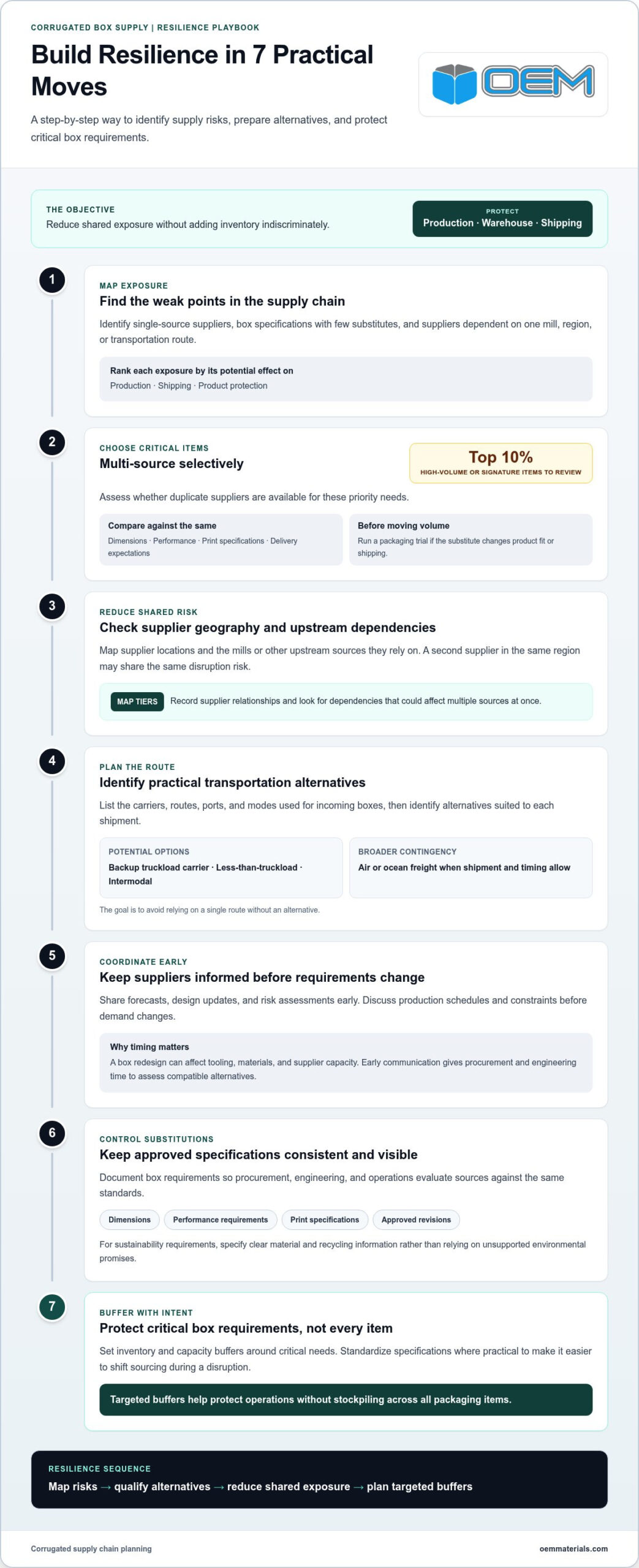
Start with a risk map of your corrugated box supply chain. Identify single-source suppliers, box specifications with few substitutes, and suppliers that depend on one mill, region, or transportation route. Rank each exposure by its potential effect on production, shipping, and product protection. A standard shipping box may have alternatives, while a box designed for a specific product or packing line may require qualification before substitution. This assessment shows where additional sourcing options could improve your response.
Use multi-sourcing selectively. Review the top 10% of high-volume or signature items and assess whether duplicate suppliers are available for those critical needs. Compare alternatives against the same box dimensions, performance requirements, print specifications, and delivery expectations. If a substitute changes how a product fits or ships, run a packaging trial before moving volume. Keep the approved specifications together so procurement, engineering, and operations teams evaluate sources against the same requirements.
Supplier diversification also means reducing geographic concentration. Map supplier locations and the mills or other upstream sources they depend on. A second supplier in the same region may not protect against a regional disruption. Sourcing from different regions can reduce shared exposure, while mapping supplier tiers can reveal dependencies hidden behind a direct vendor. Record those relationships and identify disruptions that could affect multiple sources at once.
Review transportation alongside supplier locations. List the carriers, routes, ports, and modes used for incoming boxes, then identify practical alternatives. A backup truckload carrier may help on one lane, while less-than-truckload or intermodal service may suit another shipment. Air and ocean freight may also belong in a broader contingency plan when the shipment and timing allow. The goal is not to use every mode, but to avoid relying on a single route without an alternative.
Strong supplier relationships make these options practical. Share forecasts, design updates, and risk assessments early, then discuss production schedules and constraints before demand changes. An upcoming box redesign, for example, can affect tooling, materials, and supplier capacity. Early communication gives procurement and engineering time to assess compatible alternatives without last-minute specification changes.
For U.S. packaging, identify requirements tied to the product and customer, and document specifications before approving a box. Corrugated packaging is made from renewable resources and is recyclable. Treat sustainability claims as part of the specification, with clear material and recycling information rather than unsupported environmental promises. Teams seeking a consistent starting point can review corrugated box options against their product and shipping needs.
2. Supply chain visibility and real-time monitoring
Visibility starts with a shared view of box demand, open orders, inventory, and delivery status. Bring procurement, production, and warehouse records together using consistent box identifiers. Each box code should connect to its approved dimensions, order history, supplier, and destination. Warehouse staff can then compare available stock with planned production needs without manually reconciling separate item descriptions. This gives teams a consistent picture for replenishment decisions.
Connect data where decisions happen. Link purchase orders to supplier acknowledgments, shipment updates, and receiving records. Match received quantities against the original order and flag discrepancies. If one system calls an item a “shipping carton” and another uses a part number, map both to the same identifier. Clear data relationships help teams distinguish a genuine supply constraint from a recordkeeping mismatch.
Real-time monitoring should focus on useful events, not a screen full of activity. Track order acceptance, shipment movement, expected delivery, and inventory changes. Automated exception alerts can flag a missed shipment milestone, a delayed delivery, or stock below a planned threshold. Assign each alert to a role, such as the buyer for supplier delays or the warehouse lead for receiving discrepancies. Actionable alerts support building a resilient supply chain for corrugated boxes.
Set thresholds around operational needs. A box used daily on a production line warrants closer monitoring than an occasional-use carton. Set its threshold based on consumption, replenishment timing, and the impact of running short. If available inventory falls below what scheduled orders require, procurement can review open purchase orders and current delivery estimates before production needs the boxes.
Keep box specifications and revisions visible alongside inventory. A count alone can mislead if it combines different dimensions, print requirements, or approved versions. A new box design, for example, may replace an older one while both remain in storage. Use revision-controlled records to show which specification applies to each order, and clearly mark obsolete stock so it isn’t mistaken for usable supply.
Set a regular rhythm for reviewing supply conditions. At each planning meeting, compare forecast demand with open orders, on-hand quantities, and delivery updates. Record an owner and next action for every exception. A supplier delay might require a revised production plan; a receiving discrepancy might call for a recount and corrected inventory entry. Close an issue only after the underlying record reflects the actual status.
Finally, test whether your visibility process supports real decisions. Trace one box order from forecast through purchase, shipment, receipt, and use. Note where data becomes stale, where teams rely on email, and which alerts arrive too late. Use the findings to prioritize specific fixes, such as improving item records or assigning ownership for delayed-order follow-up.
3. Contingency planning and backup suppliers
A continuity plan should identify which packaging requirements keep production moving during a disruption. Rank box requirements by the product or process they support, available substitutes, and the consequences of a shortage. A line-side carton used every shift may need earlier intervention than a box for occasional shipments. Document each critical requirement’s priority, acceptable alternatives, and decision owner.
Build scenarios around specific disruptions rather than a generic emergency label. Test what happens if a supplier becomes unavailable, a warehouse shuts down, a carrier shortage delays deliveries, or severe weather blocks a route. Global events can also affect trade policy or material access. For each scenario, identify the first operational impact, the teams affected, and the information needed to choose a response.
Write a playbook that someone can use under pressure. Include the trigger for action, decision-makers, approved alternatives, inventory and capacity needs, customer communication steps, and recovery actions. A missed shipment milestone, for example, could trigger a review of available stock and scheduled production. Name who contacts the supplier, who approves a substitute, and who updates affected teams.
Separate plans by planning horizon. Immediate scenarios cover 0-6 months, when teams may need to use available inventory or activate an existing alternative. Near-term scenarios cover 6-24 months, allowing procurement to adjust sourcing plans and production schedules. Long-term scenarios cover 2+ years and can inform specification changes, supplier development, or facility planning. Each horizon requires different decisions and lead-time assumptions.
Continuous monitoring keeps the plan aligned with changing conditions. Assign an owner to review supplier notices, shipment exceptions, inventory status, and production changes. Define which signals require action, such as a supplier’s revised schedule or a warehouse capacity constraint. During an active disruption, set a regular update cadence, record decisions, and communicate changes to operations, procurement, and customer-facing teams.
Review performance during routine operations and after disruptions. Track supplier and carrier performance, transportation cost and service trends, warehouse capacity and throughput, and recovery time. Compare actual responses with the playbook’s intended actions. If a backup source cannot meet the required specification or volume, update the approved alternatives and address the gap before the next event.
Test backup suppliers before relying on them during a shortage. Confirm that their box specifications meet approved requirements, determine the capacity they can support, and document the steps for placing an order. A controlled trial can reveal differences in dimensions, print, or packing-line fit. Add the results to the playbook, then repeat the review when specifications, suppliers, routes, or production needs change. This makes contingency planning an ongoing operating process, not a document used only after a disruption begins.
4. Assessing supplier capabilities, costs, and logistics
Assess suppliers against the packaging requirement, not a general capability statement. For each box, compare approved dimensions, construction, print needs, order quantities, and delivery locations. Then assess production capacity, scheduling flexibility, quality controls, and communication practices. A supplier that can make a similar box may still need validation before replacing the current specification. Record the evidence and identify who approves any change.
Map risk beyond direct partners. Trace each supplier’s production locations, upstream material sources, country of origin, and transportation dependencies. Review component lifecycle status, environmental and export compliance, and supplier stability as part of the same assessment. In the five years before publication of the cited research, 89% of companies experienced a supplier risk event. A Tier 1 supplier’s continuity plan may not reveal a disruption at an upstream source.
Move risk assessment earlier in product development. Bring procurement and operations into packaging design discussions before specifications are finalized. Early collaboration helps teams identify supply constraints, evaluate alternatives, and align box design with production and delivery needs. For a proposed change, document validation results, material and origin details, and expected lifecycle. This gives decision-makers time to address sourcing risks before a design reaches production.
Assess logistics as carefully as production capability. Review delivery locations, shipment frequency, carrier arrangements, warehouse capacity, and how the supplier handles schedule changes. Discuss forecasts for the next four to six months with suppliers, including available production windows, and compare those commitments with demand plans. A sourcing option that cannot align its production schedule with the receiving operation may not provide useful backup capacity.
Compare costs across the full operating requirement, not just the quoted unit price. Include order quantities, freight, handling, storage needs, packaging changes, and the operational effect of delays or stockouts. A different box specification, for example, may affect packing speed or require changes to product protection. Make cost comparisons using the same dimensions, order assumptions, delivery points, and service expectations.
Structured collaboration can broaden a supplier search. The collaboration for Topsoe’s Virginia facility identified 35 suppliers that met the company’s needs, according to MEP National Network. Use a similar disciplined process internally: define the requirement, document evaluation criteria, compare candidate capabilities, and record the outcome. Nearly two-thirds of companies were delayed in responding to supplier risk events because they lacked a comprehensive risk management framework. A consistent review gives the organization a clearer basis for sourcing decisions and future reassessment.
5. Building targeted inventory and capacity buffers
Prevent shortages without excessive storage by buffering high-risk boxes rather than every packaging item. Set each buffer based on demand patterns, replenishment timing, available substitutes, and the operational impact of a stockout. Review these inputs together, then adjust inventory when production schedules or box specifications change.
Start by ranking box types by production criticality and sourcing risk. A box required for daily shipments with no approved substitute deserves closer attention than an occasional-use carton. Compare its demand history with planned production and open orders. This helps distinguish a genuine shortage risk from a temporary dip in on-hand inventory.
For high-risk requirements, a just-in-case inventory model can provide extra coverage when normal replenishment is disrupted. Set the target against the time needed to receive and approve replacement supply, while accounting for storage limits and box usage. A buffer that exceeds likely demand can take up valuable warehouse space and complicate handling.
Use inventory controls that clearly identify usable supply. Separate approved box revisions from obsolete or pending stock, and reconcile physical counts with inventory records. If a revised box replaces an earlier design, for example, label and track each version separately. Otherwise, reported quantities may include boxes that no longer meet current packing requirements.
Review stockout signals alongside changes in demand. A sudden production increase, delayed replenishment, or unusually high consumption can make an existing buffer inadequate. Assign an owner to compare forecasts, purchase orders, available inventory, and scheduled usage during regular planning reviews. Record the reason for each adjustment so buyers can distinguish a temporary exception from a lasting demand shift.
Inventory is only one form of protection. Capacity buffers can include reserved transportation, backup warehouse space, and flexible fulfillment labor. Match each option to the constraint it addresses. Extra warehouse capacity, for instance, won’t resolve a carrier shortage, while reserved transportation won’t help if boxes aren’t ready for pickup.
Position inventory where it can support production or customer demand without creating unnecessary transfers. Review which facilities use each box type and how quickly they can receive replenishment from another location. Adjust placement when shipping patterns or production schedules change. This can improve availability while keeping storage decisions tied to operational needs.
To set a buffer around a specific box requirement, request a quote for corrugated boxes with dimensions, weight, and annual usage. Those details help frame the packaging requirement for a practical supply discussion.
OEM Materials & Supplies: Corrugated Boxes
OEM Materials & Supplies provides corrugated boxes for businesses reviewing box requirements, replenishment plans, or supply options. Share box dimensions, product weight, shipping needs, and annual usage to start a practical discussion about your packaging requirements.
For operations that need coordinated packaging components, Packaging Kits bring related items together for a defined packing application. Foam Packaging can also provide added cushioning inside a box. These options are useful when reviewing both box availability and how packaging performs during handling and shipment.
Contact OEM Materials & Supplies to discuss your corrugated box requirements, or visit oemmaterials.com.
Make resilience part of your packaging plan
Make supply chain resilience an operating practice by assigning ownership for packaging risks and revisiting decisions as requirements change. A new product, production schedule, or shipping pattern can alter which box specifications need the most attention. Keep those changes connected to purchasing plans so packaging decisions support the operation, not just the next shipment.
Building a resilient supply chain for corrugated boxes is an ongoing process. Start with the box requirements that matter most to production and customers, then use them to guide sourcing and replenishment decisions. Corrugated boxes, foam packaging, and packaging kits can each help meet specific packaging needs.
For a discussion about your packaging requirements, share the box dimensions, product weight, shipping needs, and annual usage. Request a quote to take the next step toward a supply plan that fits your operation.
Frequently Asked Questions
What are some proven strategies to build supply chain resilience and outsmart disruption?
Build resilience by deciding in advance how limited box supply will be allocated if normal replenishment fails. Set priorities around customer commitments, production requirements, and packaging alternatives that have already passed operational review. For example, reserve the approved box type for shipments that cannot use a substitute, while directing flexible orders to another validated format. Clear allocation rules help prevent competing teams from making inconsistent decisions during a shortage.
How does adopting modern technology like supply chain intelligence boost resilience?
Supply chain intelligence helps planners connect packaging activity with business changes that affect it. Systems linking sales orders, production schedules, and purchasing records can reveal when a customer order change affects box requirements. Teams can then update plans before outdated assumptions carry into replenishment decisions. Technology works best when staff maintain accurate item records and agree on who owns each update.
How does supplier diversification improve resilience?
Diversification can reduce the operational impact of losing one supplier, but only if alternatives remain viable. A secondary source that receives no forecasts or production updates may lack the context to respond effectively. Keep approved specifications and current demand expectations available to qualified suppliers. Periodically review whether the alternate source still meets business requirements, especially after packaging designs or production processes change.
Why is supply chain visibility important?
Visibility helps teams distinguish committed box requirements from estimates. A planner, for example, can separate orders tied to confirmed production from forecast demand that may still change. That distinction supports better allocation when supply is constrained and helps prevent every projected need from being treated as equally urgent. It also gives purchasing a clearer basis for discussing schedule changes with production and customer-facing teams.
What are the biggest supply chain risks for corrugated boxes in the United States?
Risks include supplier or carrier disruption, severe weather, warehouse shutdowns, demand surges, and changes to trade conditions. A less obvious exposure is specification rigidity: a box designed around one product or packing process may be difficult to replace quickly. Assess this by identifying which requirements are essential for fit and protection, and which could change without disrupting operations.
How can businesses qualify and diversify corrugated box suppliers?
Make qualification repeatable by defining who reviews samples, who approves specification changes, and where final approval records are stored. For a business operating across Orange County, Los Angeles, the Inland Empire, San Diego, or Riverside, include each receiving site’s packaging and dock requirements in the review. A shared approval record helps teams avoid using an unreviewed box version at another facility.
How can companies forecast corrugated box demand and manage seasonal peaks?
Pair shipment history with forward-looking business inputs, such as customer release schedules, planned promotions, and product launches. Separate recurring demand from one-time projects so an unusual order does not distort the ongoing forecast. After a peak, compare actual usage with the plan and note which assumptions changed. This record can improve the next seasonal forecast and clarify which box types need earlier planning.
How should companies compare corrugated box suppliers on quality, capacity, and resilience?
Compare suppliers using evidence from actual operating interactions, not just proposal documents. Review how clearly each partner communicates schedule changes, resolves order discrepancies, and handles specification revisions. Apply the same acceptance criteria to samples or production runs. For capacity, compare stated availability with the timing and destinations your operation requires. Document the results so future reviews have a consistent basis.