
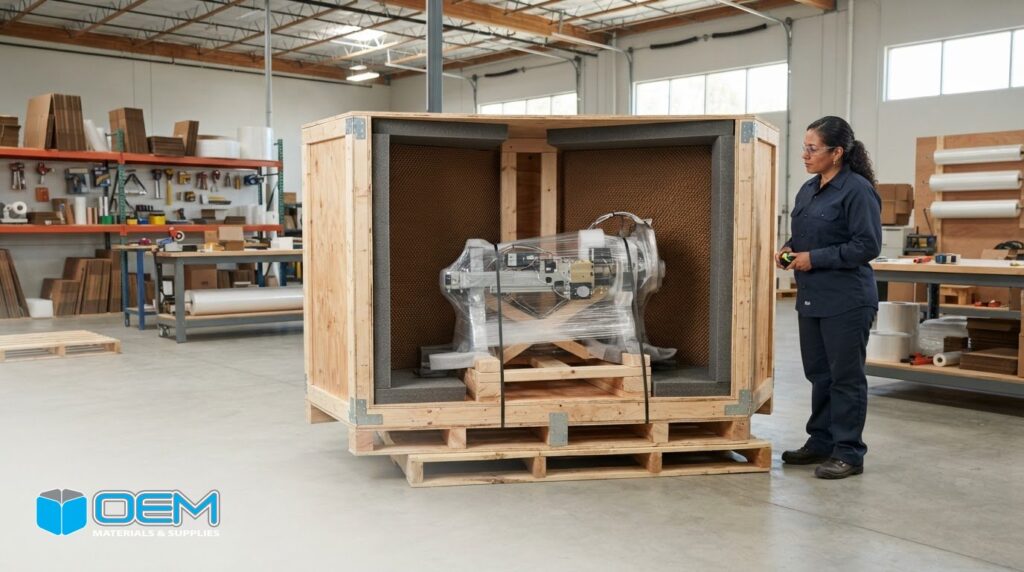
A crate should be designed around the item it protects, not treated as a standard container. Honeycomb crating solutions in Los Angeles start with the item’s dimensions, weight, and fragility, then account for cushioning, bracing, and handling needs. For large or delicate products, the crate, internal supports, and any skid or pallet should work together to limit movement during transit.
That planning matters when an item’s shape, weight, or sensitive surfaces make ordinary packaging a poor fit. A close-fitting crate alone is not enough if the contents can shift or strike vulnerable points.
This article explains how measurements and handling requirements guide crate design, how cushioning and bracing support different loads, and which packaging options can suit large or delicate items. It also covers how to assess whether a honeycomb-based approach fits your shipment and what information helps shape a practical packaging plan.
Key Takeaways
- Use the item’s dimensions, weight, and fragile points to guide crate layout and support placement.
- Plan protection around the item type, from delicate surfaces to machinery with concentrated weight.
- Combine cushioning and bracing to limit movement and help manage impacts during handling.
- Choose packaging materials and formats based on the shipment’s size, handling needs, and damage risks.
- For oversized shipments, consider how the crate base and handling equipment will work together.
Crate planning based on item dimensions, weight, and fragility
For shipments in Los Angeles, crate planning starts with the item’s measurements, load-bearing points, fragile surfaces, and handling route.
Dimension and Weight-Based Crate Design
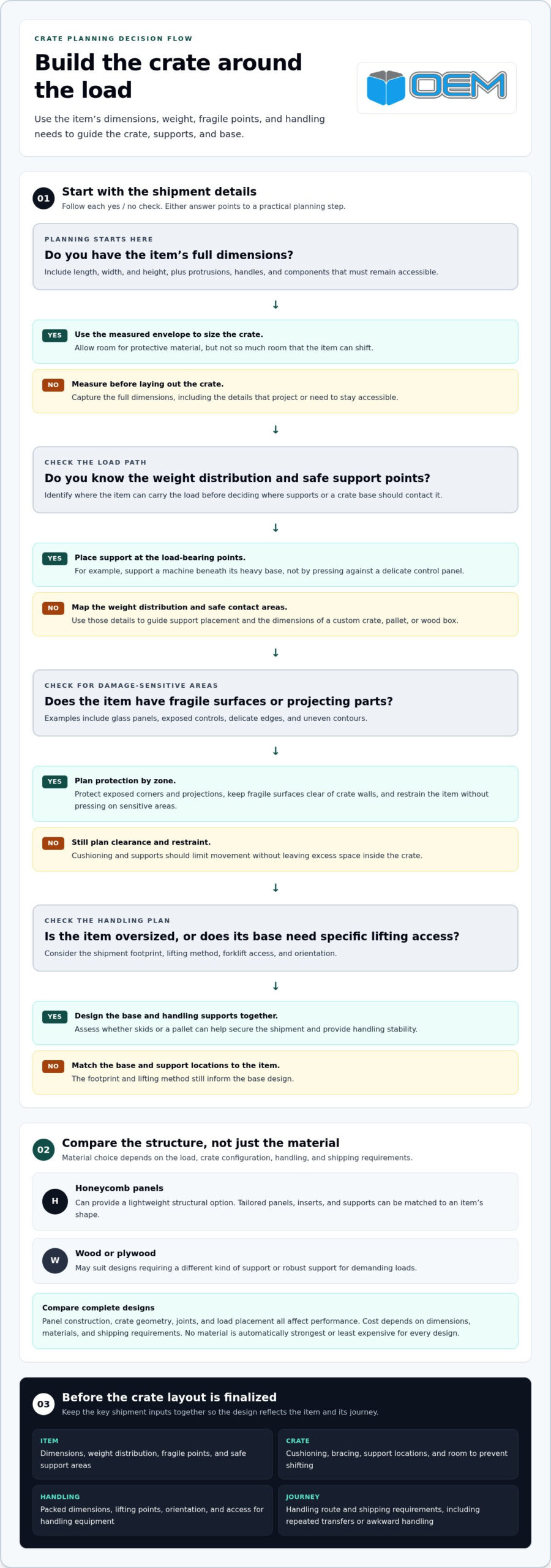
Measure the item’s length, width, and height, including protrusions, handles, and components that must remain accessible. Identify its weight distribution and the points that can safely carry the load. For example, a machine with a heavy base needs support beneath that base, not pressure against a delicate control panel. These details guide the dimensions of a custom crate, pallet, or wood box.
Allow space for protective material without leaving room for the item to shift. The crate base and support locations should suit the item’s footprint and lifting method. Skids or pallets can help secure the shipment and provide handling stability. Forklift access and shipment orientation also inform the base design.
Fragility-Based Crating Options
Fragility determines where the crate needs clearance, cushioning, and restraint. A glass panel may need protected edges and separation from the crate walls, while a heavy component may need firm support beneath its load-bearing points. For oversized items, plan protection by zone, such as exposed corners, projecting parts, and areas vulnerable to pressure.
Honeycomb panels can provide a lightweight structural option, while wood or plywood may suit designs requiring different support. The right choice depends on the load, crate configuration, handling, and shipping requirements. No material is automatically strongest or least expensive for every design. Compare the required structure and the shipment’s overall needs, not material weight alone.
Honeycomb crating options for fragile, heavy, or oversized items include tailored panels, protective inserts, and support structures matched to the item’s shape. A delicate assembly may need separated contact points; a dense component may need a base designed around its weight. For oversized freight, assess how the packed dimensions affect lifting, staging, and transport access.
Honeycomb crates are generally lighter than comparable wood constructions, while plywood and wood can provide robust support in designs built for demanding loads. Performance depends on panel construction, crate geometry, joints, and load placement, so material alone does not determine strength. Cost also depends on dimensions, materials, and shipping requirements. Compare complete designs rather than assuming one material always costs less.
International shipping adds handling and routing considerations. Record the item’s packed dimensions, weight, lifting points, and orientation so the crate can be planned for its journey. A design for a stable, compact shipment may differ from one exposed to repeated transfers or awkward handling. Restrain fragile components without putting pressure on sensitive surfaces.
Open-sided wooden crates can work when an item needs support and restraint but not full enclosure. For example, an assembly with a sturdy base and delicate exposed controls may need a protected platform and localized blocking. Identify which sides must remain accessible, then position braces to prevent movement without touching vulnerable parts. The final layout should match the item and handling plan.
Crating for art, antiques, furniture, and machinery
Artwork, antiques, furniture, and machinery need different packing procedures, even when they use similar crate materials. The item’s finish, construction, and removable features determine the differences. A framed canvas, an inlaid cabinet, an upholstered chair, and a precision assembly each need a plan tailored to their surfaces and components.
For paintings and framed prints, prevent contact with the face and keep glazing from rubbing against adjacent materials. Use a clean separation layer, then arrange the package so labels and handling marks remain visible. Sculptures may have narrow projections or uneven contours. Map the components before packing, identifying fragile extensions and pieces that detach for transport.
Antique finishes can be vulnerable to abrasion, residue, or pressure from unsuitable packing materials. Avoid placing adhesive directly on wood, lacquer, gilding, or original labels. Wrap removable hardware separately, and keep screws or fittings together in a clearly identified packet. For a glass-fronted display cabinet, treat the glass and cabinet interior as separate protection concerns.
Furniture often needs a packing sequence that respects its assembly. Remove legs, shelves, or drawer contents only when the shipping plan calls for it. Keep each item’s hardware with the correct piece, and document the original configuration for receiving staff. A clean protective cover can help protect upholstered furniture, while polished tables need a surface layer to prevent scuffs in transit.
Machinery presents another concern: parts that can shift, leak, or become contaminated. Secure loose accessories in labeled containers instead of leaving them attached to the machine. Protect exposed ports and openings from dust or packing debris. For a precision instrument, organize cables and detachable sensors separately, then identify their connection points in the packing record. This makes receiving inspection and reassembly more controlled.
In Los Angeles, packing and delivery timing depends on the item’s preparation needs, crate construction, material readiness, and pickup coordination. A framed artwork ready for packing involves different steps from machinery that needs accessory separation or documentation. Providing the shipment date and item condition helps align the packing sequence with freight arrangements.
Internal cushioning, bracing, and shock absorption
Select internal packaging as a system, not as a single filler material. Cushioning, separators, and restraints each serve a different purpose. A useful design review asks what each material must do, where it contacts the product, and how packers will install it consistently.
Cushioning for Fragile Items
For delicate products, assess cushioning by its fit and interaction with the item’s surface. A polished housing may need a clean, nonabrasive interface, while a fragile assembly may need shaped foam around its profile. Avoid relying on loose material alone when the product needs a consistent position inside the package.
Product geometry can guide insert design. A shallow recess can locate a flat component, while a contoured cavity can keep a finished part from rubbing against neighboring items. For a multi-piece instrument set, separate components so metal fittings do not mark lenses or coated surfaces. Foam packaging and cushioning materials can be selected to suit these different contact points.
Consider the full packing sequence, too. An insert that protects a product but takes excessive effort to load can lead to inconsistent packing on a busy line. Document each insert’s orientation and the order of components. A packaging kit can group the materials needed for repeat packing, reducing the chance that a small separator or protective layer is skipped.
Protective Bracing and Shock Absorption
Bracing organizes the internal pack and limits unwanted contact between components. Cushioning helps manage how impacts are transmitted through the package. For a shipment containing a delicate meter and its accessories, separate compartments can prevent tools or cables from striking the instrument during routine handling.
Choose materials based on the amount and type of cushioning required. A product that needs a snug nest differs from one that needs a flexible protective wrap. Excess material can complicate packing and unpacking, while a poor fit can leave the product exposed to repeated contact. Review a packed sample with the people who will handle it, including warehouse staff and receiving teams.
Use the review to check practical details: can the packer identify each insert, remove the item without damaging its finish, and return components to their assigned positions? For reusable packaging, inspect inserts for compression, tears, or contamination before each cycle. Replace damaged pieces and keep packing instructions aligned with the current product configuration. This makes protection easier to reproduce across shipments.
Packaging options for preventing product damage
Product damage can start outside the crate, during staging, transfer, or storage. Review the full route, from packing station to receiving dock, and identify risks such as puncture, compression, moisture, or incorrect orientation. A shipment exposed to open-air staging needs different outer protection from one moved directly between controlled warehouse areas.
Choose the outer package for the handling conditions. A rigid crate may suit equipment exposed to rough transfers, while a corrugated container can work for smaller, unitized shipments. For a product with a broad finished panel, use an outer design that prevents other freight from pressing directly against that face. Consider package dimensions alongside the pallet footprint and warehouse storage arrangements.
Closure method matters, too. A well-designed package can still be compromised by weak seams, loose fasteners, or a lid that shifts during handling. Establish a consistent closing method and inspect the completed package before it leaves the packing area. For a reusable crate, examine hinges, latches, and panel connections before each shipment.
Clear handling information reduces avoidable mistakes. Mark the orientation and identify lifting or opening points where needed. If a shipment contains several related components, label each package so receiving staff can match it to the correct order or assembly. Keep labels visible and away from seams or removable panels.
Damage prevention also depends on how the package is handled after packing. Record recurring issues, such as punctured panels or crushed corners, and use those observations to revise the package or loading procedure. A receiving inspection can help identify where damage occurred, especially when the package condition is documented before opening.
Honeycomb packaging may offer a recycling option when local programs accept its paper components. Separate non-paper materials, such as plastic film or metal fasteners, where practical, and follow local sorting guidance. Recyclability depends on the package’s material mix and local acceptance, so assess the complete package rather than assuming every component follows the same route.
For repeat shipments, standardize package identification and packing instructions. A clear work instruction can show closure points, label placement, and the order for packing components. When a product revision changes its shape or accessories, update the instruction before the next run. This helps teams avoid using an outdated package configuration and supports consistent handling from warehouse to receiving dock.
Large-item crating
Large equipment creates packaging challenges beyond its footprint. A wide industrial cabinet, production line component, or oversized fixture can complicate lifting, staging, and loading. Plan the crate around the item and its route. Record the packed dimensions, weight, center of gravity, and required orientation before choosing the base and enclosure.
Start by mapping the handling sequence. Identify where the item will be picked up, set down, turned, or transferred. A long machine frame, for example, may need fork access along a particular side and support beneath its main rails. Skids or pallets can help secure the shipment and provide handling stability. Align the base design with the equipment’s support points.
Next, account for protrusions and removable components. A control arm extending beyond a machine’s frame can be damaged if the crate wall is too close. Protect it with clearance and localized support, or pack it separately when the shipping plan allows. Mark the component’s position and orientation so the packing layout stays clear during loading and unpacking.
Crate construction should balance access with enclosure. A fully enclosed design can shield equipment from contact, while an open-sided wooden crate can allow access to robust areas. The right format depends on exposure risks, handling needs, and vulnerable surfaces. Keep braces away from delicate controls, cables, and finished panels. Use closure points that remain accessible for inspection and unloading.
For oversized machinery, divide the packing plan into practical zones. The base supports the load, internal restraints control movement, and outer panels protect exposed areas. A machine with a broad footprint and projecting motor may need separate support for each section. Do not place the motor’s weight on the machine’s cover or on a panel designed only for protection.
Before closing the crate, confirm the final configuration against the handling plan. Check fork entry, lifting access, clearance around projections, and the location of loose parts. Compare packed dimensions with available staging and transport space. If the shipment must pass through a narrow doorway or loading area, account for that restriction before packing, not after the crate is complete.
Clear documentation supports consistent handling. Label the crate’s orientation, identify lifting points, and list components packed separately. For repeat shipments of the same equipment, retain a packing diagram showing support locations and access panels. Share dimensions, weight, lift points, and destination details when requesting a quote for large-item crating.
OEM Materials & Supplies: Corrugated Boxes
OEM Materials & Supplies can match corrugated boxes and related packaging to shipment needs. For smaller components accompanying a large crate, corrugated boxes can keep parts organized and separated during handling. Foam packaging and cushioning materials can protect delicate surfaces inside those containers, while packaging kits can group components for repeat packing tasks.
These options are useful when a shipment includes oversized equipment and smaller accessories, or when warehouse teams need a consistent way to pack recurring orders. Share the product dimensions, weight, fragile areas, and shipping requirements to support a practical packaging recommendation.
Contact OEM Materials & Supplies to discuss packaging for your shipment.
Set the Next Shipment Up for Success
A protective package is most effective when the packing method is repeatable. Before the next shipment, record the approved configuration in a concise work instruction. Note the item revision, orientation, support locations, cushioning placement, and closure method. This gives warehouse staff a practical reference and helps purchasing teams identify changes when the product or shipping route changes.
For a new or revised shipment, bring together the people who know the product and the people who pack it. Engineering can identify sensitive components; operations can explain available handling equipment; shipping can flag route or loading constraints. This input helps turn honeycomb crating solutions in Los Angeles into a packaging plan grounded in the actual shipment, rather than a generic template.
OEM Materials & Supplies can discuss packaging requirements for your application. Share the item’s dimensions, weight, fragile areas, and shipping conditions to support the conversation. Contact OEM Materials & Supplies to discuss your packaging needs and take the next step toward a clear, repeatable shipping plan.
Frequently Asked Questions
What honeycomb crating companies serve Los Angeles?
OEM Materials & Supplies serves industrial customers in Los Angeles and surrounding Southern California markets, including Orange County, San Diego, and Riverside. Its packaging offerings include crates, corrugated boxes, foam packaging, and packaging kits. Share the product type and packaging requirements to develop a suitable combination for specialized protection.
What honeycomb packaging and crating solutions are available in Los Angeles?
For honeycomb crating solutions in Los Angeles, consider how the crate works with cushioning and secondary packaging. OEM Materials & Supplies offers crates, foam packaging, corrugated boxes, and packaging kits. For example, a crate can protect an industrial assembly while a foam insert secures a smaller component inside. The right combination depends on product geometry, handling needs, and shipment configuration.
Which Los Angeles providers offer honeycomb crates for export shipping?
OEM Materials & Supplies provides crates and pallets for export applications, including ISPM-15 compliant options. Export packaging plans should distinguish the crate’s structural material from any wood components, pallet, or blocking used in the shipment. For a mixed-material package, document each component and its purpose. This gives shipping and procurement teams a clearer basis for matching packaging to the shipment’s export requirements.
How are custom honeycomb crates designed, manufactured, and ordered?
A custom packaging project typically starts with product dimensions, weight, drawings, and handling requirements. The design accounts for support locations, access, and protective inserts before manufacturing. OEM Materials & Supplies supports custom packaging design, prototypes, short runs, and production programs. For a useful project brief, include product images or drawings, the shipping destination, and any constraints on lifting, storage, or package orientation.
What are the weight limits and load capacities of honeycomb crates?
There is no universal load capacity for honeycomb crates. Capacity depends on panel construction, dimensions, base support, joints, load distribution, and handling method. A concentrated machine load places different demands on the base than a broad, evenly supported product. Use the packed item’s weight and footprint to evaluate the complete crate design, including supports and pallet, rather than relying on material type alone.
Do honeycomb crates meet ISPM 15 or other export shipping requirements?
Honeycomb construction alone doesn’t establish whether an entire export package meets a shipment’s requirements. OEM Materials & Supplies offers ISPM-15 compliant crates and pallets. The packaging plan should identify the crate, pallet, and any wood components separately, then account for destination and buyer specifications. For international shipments, provide those details with the product information so the package can be matched to the applicable shipping needs.