

FMCG VMI programs are reported to reduce inventory carrying costs by 15–25%. A practical VMI program implementation guide starts by identifying the procurement costs and inventory problems the program should address, then tests whether supplier-managed replenishment improves those measures. VMI can reduce stockouts and emergency shipments, but it won’t automatically outperform a traditional supplier relationship.
That makes the business case as important as the replenishment process. Before changing inventory management, purchasing and operations teams need a clear picture of manual reorder effort, emergency deliveries, excess stock, and the service levels critical items require. This VMI program implementation guide compares VMI with VMR and SMI, explains potential customer benefits, and shows how to set measurable objectives, pilot selected items, and review performance against procurement goals.
Key Takeaways
- Distinguish VMI, VMR, and SMI by who monitors stock, makes replenishment decisions, and manages inventory responsibilities.
- Assess potential customer benefits by tracking stockouts, emergency shipments, carrying costs, and warehouse space use.
- Start a pilot with selected items or one warehouse area, then use the results to guide any expansion.
- Set measurable objectives from current procurement costs, reorder effort, and inventory challenges before launch.
- Review performance regularly against agreed metrics, and adjust replenishment settings as demand and operating needs change.
1. Vendor Managed Inventory (VMI), Vendor Managed Replenishment (VMR), and Supplier Managed Inventory (SMI)
Vendor managed inventory (VMI) shifts routine inventory monitoring and replenishment to a supplier. The vendor uses agreed stock data and demand signals to maintain inventory within buyer-approved limits. In the VMI model described here, the supplier is 100% responsible for meeting customers’ inventory replenishment demands. VMI systems came into vogue in the 1990s to help decrease supply chain costs. The purpose is practical: keep required materials available while reducing manual reorder work.
VMI, vendor-managed replenishment (VMR), and supplier-managed inventory (SMI) are related arrangements, but the agreement determines who controls each task. VMI typically gives the vendor inventory visibility and authority to trigger replenishment within agreed rules. VMR emphasizes the supplier’s role in replenishing stock, while the buyer may retain more control over reorder decisions. SMI assigns inventory management to the supplier, but ownership and payment terms still depend on the commercial agreement. Before launch, define responsibility for monitoring, ordering, stock ownership, and exceptions.
Min/max parameters make automated replenishment operational. The minimum is the trigger for action; the maximum sets the target quantity after replenishment. Set minimums using supplier lead time, customer-demand variability, and desired service levels. For example, a component with variable weekly usage needs a different buffer from a stable packaging item. Review historical sales and consumption before setting thresholds, then define how the system handles unusual demand or inaccurate stock records. A VMI replenishment process works best when those rules and inventory signals are clear.
For fast-moving consumer goods (FMCG), inventory may include raw materials, packaging, work in process, finished goods, and maintenance, repair, and operations (MRO) parts. Each category has different demand patterns and consequences if stock runs short. A VMI program might replenish parts more frequently in just-in-time quantities to match weekly usage. Two-bin Kanban is a common setup for C-parts: each part has two dedicated bins, and using one signals that it needs replenishment. This visual trigger gives warehouse teams a straightforward control point.
Implementation risks often begin with inaccurate inventory data, unclear replenishment responsibilities, or unshared forecasts. Incompatible tracking systems and poorly calibrated minimum stock levels can also cause shortages or excess inventory. Define data ownership, exception handling, and performance measures before activation.
Choose an approach by mapping the current process: identify who owns the inventory, who can reorder, and how the supplier must respond. Confirm that inventory tracking works with the warehouse management system; integrations may use Electronic Data Interchange (EDI) or APIs. A VMI program implementation guide should also define stockroom access, replenishment frequency, reporting cadence, and discrepancy handling. These operating details turn a broad inventory arrangement into a process teams can monitor and improve.
2. How does VMI benefit customers?
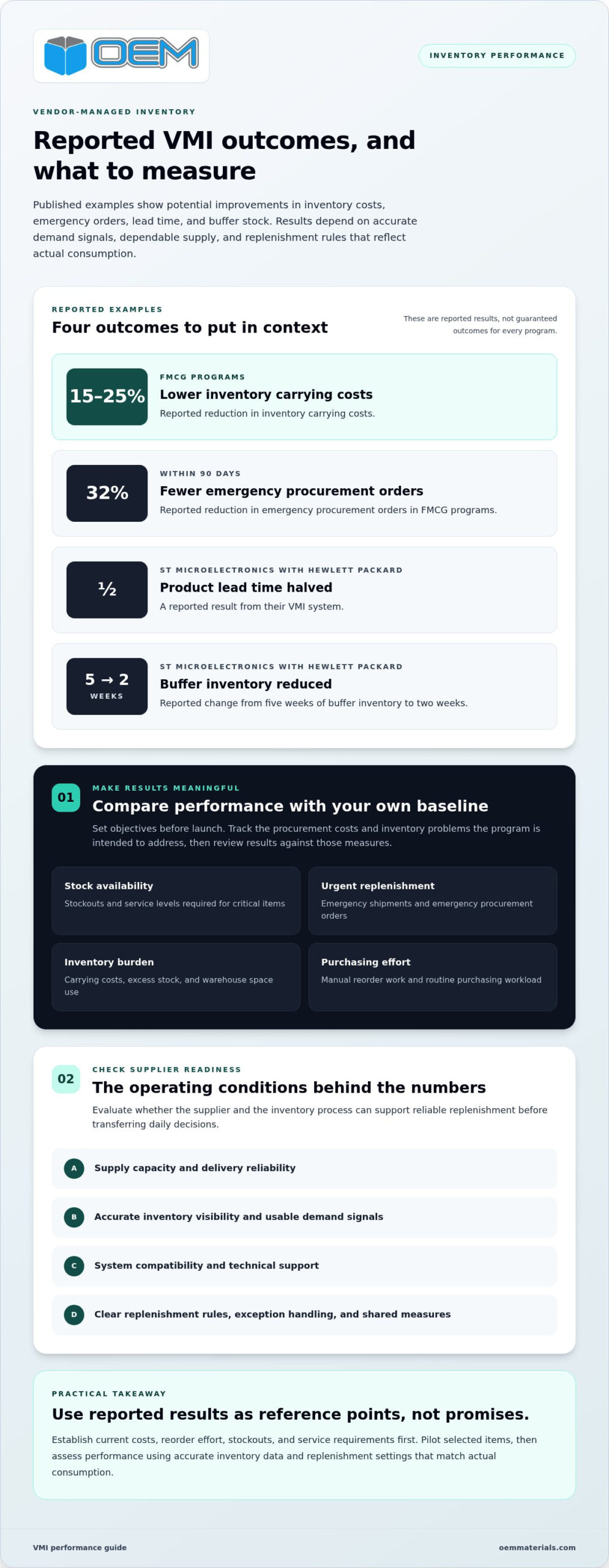
A well-run VMI arrangement can improve product availability while reducing routine purchasing work. In reported FMCG programs, inventory carrying costs fell by 15–25%, and emergency procurement orders fell by 32% within 90 days. These outcomes depend on accurate demand signals, dependable supply, and replenishment rules that reflect actual consumption. Buyers gain more visibility into stock status, while suppliers can plan deliveries against clearer usage patterns.
Replenishment can benefit production and end customers when it prevents a missing component from delaying an order. ST Microelectronics reported that its VMI system with Hewlett Packard halved product lead time and reduced buffer inventory from five weeks to two weeks. This example shows how coordinated inventory data can reduce both waiting and excess stock. Manufacturers should measure results against their own baseline, including delivery performance, stockouts, and inventory held.
Supplier readiness matters as much as the model itself. Evaluate the vendor’s supply capacity, delivery reliability, inventory visibility, system compatibility, and technical support. Assess whether the supplier can handle demand changes, communicate exceptions promptly, and meet the agreed replenishment frequency. Forecast collaboration works best when both parties trust the information and share responsibility for resolving discrepancies.
Align expectations before transferring daily decisions. Define which inventory records the supplier can see, how often data is shared, who approves exceptions, and how shortages are escalated. The buyer may prioritize service continuity and lower administrative effort; the supplier needs usable forecasts and reliable inventory signals. Agree on shared measures such as fill rate, on-time delivery, stock accuracy, and emergency orders. This makes the benefits visible to both sides instead of leaving them to assumptions.
Supplier, distributor, and third-party logistics (3PL) roles should also be explicit. The supplier may set replenishment quantities, while a distributor consolidates products or coordinates delivery. A 3PL may store or move inventory, but its role does not automatically include forecasting or reorder authority. Map each handoff from demand signal to receipt, then assign an owner for missing data, delayed shipments, and count differences. Clear ownership prevents gaps between the system record and physical stock.
For manufacturers in Orange County, Los Angeles, San Diego, and Riverside, logistics planning should account for delivery routes, receiving capacity, and inventory location. A VMI relationship works best when the supplier’s logistics capabilities match the buyer’s operating schedule and demand pattern. Set expectations for shipment coordination and escalation before expanding the program. This helps purchasing teams assess whether a supplier can support consistent replenishment, not just provide products.
3. Monitoring and optimizing performance
Set the scorecard before the first replenishment cycle. Track fill rate, inventory turnover, on-time delivery, stock accuracy, and critical-part stockouts. These measures show whether availability is improving without simply shifting excess stock into the warehouse. Assign an owner to each measure, define how it is calculated, and agree how often the buyer and supplier will review results. Both parties need a shared view of the same data, not separate reports with conflicting counts.
Use targets as operating controls, then adjust them to the item’s demand pattern. A recommended target is 15–30 days of inventory on hand for each SKU. For MRO inventory, the stated benchmark is 6–8 turns per year, with critical-part stockouts kept under 2% per quarter. The suggested fill-rate target is 97% or higher; mature VMI programs are reported to average 97.4%. Track each measure by SKU or product group to identify where results diverge.
Inventory tracking tools can show product location, quantity, and movement in real time. VMI software may monitor inventory weekly or every other week, depending on the agreed operating cadence. Compare recorded balances with physical counts, receipts, and issues. When a discrepancy appears, document its cause, correct the source record, and determine whether it affected a replenishment decision. Clear procedures prevent one count error from triggering repeated over-ordering or a shortage.
Review performance in light of demand conditions, not just a monthly total. Examine seasonal trends, consumption rates, supplier performance, and changes in production schedules. For example, rising usage alongside stable inventory may indicate that a minimum needs adjustment. A low fill rate paired with strong stock accuracy points to a supply or replenishment issue. Share reports on an agreed schedule, and define who handles exceptions, delayed deliveries, and disputed counts.
Measure success against the procurement objectives set before launch. Compare current results with the baseline, including inventory turnover, on-time delivery, stock accuracy, and emergency replenishment activity. Assess results over at least one to two business quarters while inventory levels are being optimized. This helps teams distinguish a lasting operating change from a short-term demand shift. Make controlled changes: adjust one replenishment parameter at a time, record the reason, and review its effect in the next reporting cycle.
Optimization is ongoing. When a target repeatedly falls short, identify whether the cause is poor data, changing consumption, delayed supply, or an unsuitable parameter. Assign a corrective action and review date. This disciplined cycle gives buyers, suppliers, and distributors a practical way to improve performance while keeping service levels and inventory exposure in view.
4. Piloting VMI on a production cell
Start with a limited group of items or one warehouse area, not the entire facility. A production cell gives purchasing, warehouse, and operations teams a contained setting to test inventory management. Choose items with repeatable consumption, clear storage locations, and visible replenishment needs. Avoid mixing unrelated product groups at launch. For example, a team might pilot commonly used components at one cell while managing other stock as before. Record the pilot’s scope, owner, start date, and operating rules before the first replenishment order.
Set a defined test window. A VMI pilot typically runs for 30 to 90 days, while one implementation plan schedules the pilot phase for 7–10 weeks. These are planning references, not interchangeable measures. Choose a window that captures normal ordering and consumption cycles for the selected items. Before launch, record the current ordering process, inventory balances, stockouts, and manual work. This baseline lets the team compare the pilot with the previous process rather than relying on impressions.
Prepare the cell before integration begins. Confirm item identifiers, units of measure, storage locations, and inventory counts in both the buyer’s system and the supplier’s records. Test how a consumption signal triggers replenishment, how receipt updates inventory, and how teams flag exceptions. Use a controlled test order to uncover missing data or unclear handoffs. Assign a contact for purchasing, warehouse operations, and the supplier. Train employees who receive, move, or count pilot stock, and explain how to report discrepancies.
Keep the process visible to the people using it throughout the pilot. Review replenishment activity on the agreed schedule, compare physical stock with system records, and log late orders, excess deliveries, or unexpected demand. If a cell’s production schedule changes, record the change alongside its inventory effect. This helps distinguish a setup issue from a genuine shift in consumption. Keep existing purchasing controls available for exceptions, with named approval owners and a clear route for urgent orders.
At the end of the test, compare results with the baseline and document needed adjustments. Separate process issues, such as delayed data entry, from supplier issues, such as missed replenishment. Decide whether to continue, revise item selection, adjust operating rules, or stop. Expand only after ownership, integration, and replenishment steps work consistently. Then roll out area by area, using lessons from the first cell to update training and procedures. Ongoing review during expansion helps catch problems before they affect more orders.
5. Assessing current procurement costs and setting objectives
Build the business case from actual purchasing records, not estimates. Review 12 to 24 months of purchase and consumption data to identify demand patterns, reorder frequency, and supplier variation. Separate planned orders from emergency purchases, then calculate the labor spent creating, approving, and tracking each order. Include receiving and inventory adjustments. This baseline shows which costs a VMI program should address and which reflect production changes or supplier performance.
Unplanned spare-part purchases are reported to cost 4.8 times as much as planned purchases. Manual procurement can take 5–12 business days to restock inventory, including approvals. Record how often that cycle contributes to production delays, expedited orders, or excess safety stock. FMCG plants are reported to carry 30–40% excess inventory as a safety buffer, while 12–18% of spare-parts inventory becomes obsolete before use. These figures are prompts for analysis, not targets for every manufacturer.
Administrative effort is another measurable input. Supplier fragmentation is reported to create 15–20 hours of administrative overhead per week at an average FMCG plant. Calculate time spent placing orders, resolving invoice or receipt discrepancies, and coordinating deliveries. Then compare the effort across the specific items proposed for VMI. A frequently reordered, stable-use component may offer a clearer case than an item with irregular demand or frequent engineering changes.
Translate the baseline into objectives with a measure, scope, and review period. For example, set a goal to reduce on-hand inventory by 30 percent or procurement administration by 50 percent, then specify which SKUs and activities count. Pair each target with service safeguards, such as stockout frequency and on-time replenishment. Check that the demand data is accurate and account for lead time, production schedules, and seasonal variation before adjusting inventory parameters.
Implementation costs depend on system integration, training, data cleanup, item scope, and logistics responsibilities. Some described VMI systems have required hundreds of thousands of dollars for IT and training, particularly when integration is extensive. Ongoing fees and operating costs depend on reporting, replenishment frequency, inventory handling, and the supplier’s agreed role. Implementation pricing is case-specific and provided after a quote request; the scope and operating requirements shape the estimate.
Use a decision worksheet to compare expected benefits with the full process burden. Include inventory carrying costs, obsolete stock, emergency orders, staff time, integration, and ongoing coordination. Review the measures with procurement, finance, warehouse operations, and production before launch. This VMI program implementation guide is most useful when every objective has an owner, a baseline, and a defined way to track results.
OEM Materials & Supplies: Corrugated Boxes
OEM Materials & Supplies helps manufacturers meet packaging needs with corrugated boxes, foam packaging, packaging kits, and mailing tubes and cores. Evaluate these materials alongside procurement objectives when packaging availability, product protection, or packing consistency affects operations.
For example, a manufacturer tracking packaging usage can review box dimensions, product weight, shipping conditions, and annual demand before choosing a packaging approach. Foam packaging can cushion products that need protection, while packaging kits group materials used together during packing. Matching packaging to the application helps teams assess fit without assuming one material suits every product.
If packaging inventory is part of your VMI planning, contact OEM Materials & Supplies to discuss your requirements, or visit oemmaterials.com.
Turn procurement objectives into an operating plan
The next step is to connect inventory policy with the materials your production and shipping teams use every day. Translate your objectives into item-level requirements, clear replenishment ownership, and a review process that purchasing, warehouse, and production teams can maintain. A VMI program implementation guide is most valuable when it informs these practical decisions, not just the launch plan.
For packaging needs, OEM Materials & Supplies offers corrugated boxes, foam packaging, and packaging kits. Product dimensions, weight, annual usage, and shipping conditions help frame a useful discussion about packaging requirements alongside your inventory goals. That information can clarify which materials to prioritize and how to assess their fit with your operation.
Bring your packaging requirements and procurement priorities together for the next planning conversation. Contact OEM Materials & Supplies to discuss your requirements and take a practical next step toward a more organized supply process.
Frequently Asked Questions
How does VMI benefit customers?
Customers can gain more predictable access to recurring materials and spend less staff time chasing routine orders. Clearer coordination between procurement and production is another practical benefit: when a scheduled build changes, teams can identify affected materials and prioritize decisions before packing or assembly begins. Buyers should also consider whether VMI improves the work experience for receiving and warehouse teams, not just purchasing efficiency.
How does technology support VMI programs?
Technology helps teams identify process exceptions and determine who needs to act. For example, a dashboard can distinguish an item awaiting supplier action from one awaiting a buyer decision. Access permissions can limit sensitive inventory details to appropriate roles, while audit histories help explain changes after a discrepancy. These controls help teams resolve questions without relying on informal messages or searching through separate spreadsheets.
What makes VMI work?
VMI works best when everyone understands the limits of their authority. The supplier should know which decisions it can make independently, while the buyer needs a clear route for unusual demand, substitutions, or production changes. Define those boundaries in operating instructions and review them with employees who handle exceptions. This prevents routine replenishment from becoming confusing when an unusual situation arises.
How do you implement a successful VMI system?
Prepare for the handoff, not just the launch. Document how open purchase orders, existing stock, and pending receipts will be handled on the transition date. Name who resolves each exception and establish a process for returning to the prior ordering method if the new workflow is interrupted. A controlled transition helps production teams avoid uncertainty as staff learn their revised responsibilities.
What does VMI stand for?
VMI stands for vendor-managed inventory. “Vendor-managed” describes the supplier’s assigned role, while “inventory” refers to the stock covered by the arrangement. The acronym alone does not establish who owns the goods, how invoices are handled, or whether the buyer must approve each shipment. Set those commercial and operating details out in the agreement instead of assuming them from the name.
What is the purpose of VMI?
VMI is intended to make recurring material supply easier to coordinate between a manufacturer and its supplier. It can help teams focus purchasing attention on exceptions and changing requirements rather than repeatedly processing predictable needs. For example, procurement staff may devote more time to supplier development or production planning when routine transactions follow an agreed process. Set objectives that reflect the buyer’s actual operational priorities.
What data is needed for VMI to work?
Useful data also includes item status, approved substitutes, location identifiers, and product specification changes. Buyers can prevent confusion by maintaining one clear identifier for each eligible item and documenting whether obsolete or restricted stock remains usable. Supplier calendars and receiving constraints also help teams plan workable deliveries. Before launch, identify who maintains each data field and how corrections are shared with everyone who uses it.
What is a vendor-managed inventory (VMI) program and how does it work?
A VMI program is a defined working arrangement for coordinating selected inventory with a supplier. The buyer and supplier first agree on eligible items and operating boundaries. The supplier then performs its assigned inventory tasks, while the buyer handles decisions reserved for its team. For manufacturers, the key point is that the arrangement covers only the scope both parties define, not every purchased item automatically.