
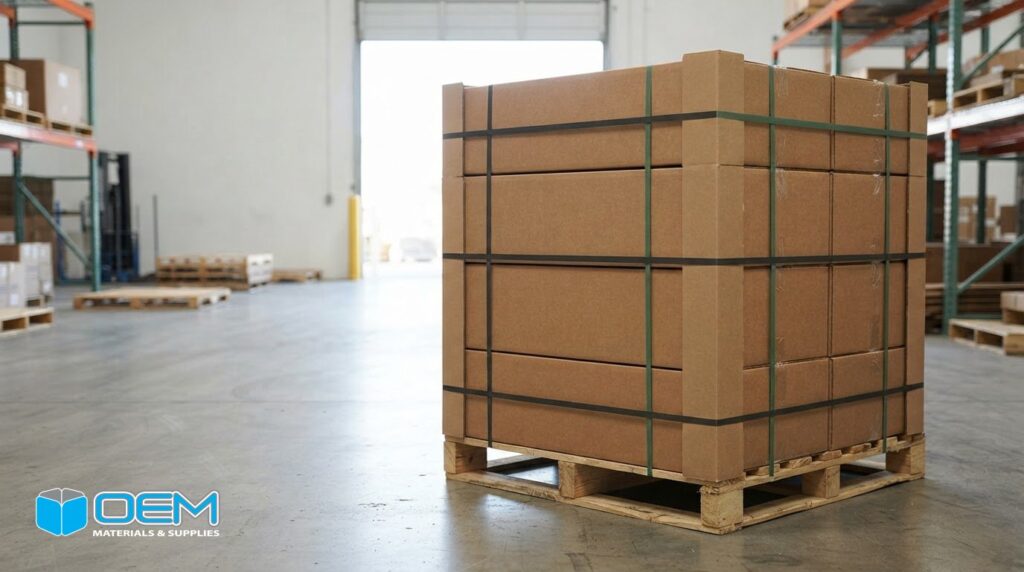
The thickest corner protector isn’t automatically the right choice. Cardboard edge protectors for shipping reinforce pallet corners and distribute compression, while the right thickness depends on load weight and strap tension: .12-inch protectors suit light- to medium-weight loads, and .16-inch options add rigidity for heavier shipments or higher strap tension.
That balance matters. A protector that is too light may not support the load, while choosing by thickness alone overlooks the effects of protector length and pallet configuration.
This guide explains how length, thickness, load weight, and strap tension affect pallet stability and shipping damage. Learn how to match protector dimensions to a load, integrate protectors into a securement plan, and select cardboard edge protectors for shipping.
Key Takeaways
- Match protector length to the pallet load so the corners receive support where stacking pressure and straps act.
- Use load weight and strap tension to guide thickness selection. The article compares .12-inch and .16-inch options and the support each is suited to provide.
- Cardboard and paperboard edge protectors help spread compression along pallet corners, reducing the risk of crushed edges and shifting.
- Secure protectors with stretch film or strapping, and avoid stacking protectors on top of one another.
- Consider edge protection alongside the rest of the packaging system to improve pallet stability and reduce shipping damage.
Why Use Cardboard Edge Protectors?
Cardboard edge protectors reinforce exposed pallet corners and create a firmer surface for straps. Their main function is to help distribute pressure, not simply cover a sharp edge. A vertical protector, for example, can span several stacked cartons to support aligned corners during handling and storage. Choose a profile that fits the load rather than relying on a generic corner pad.
Fiber-based protectors are commonly made from formed paperboard or laminated cardboard. Profiles include V-shaped angles, U-channel guards, and short corner pieces. A V-board can run along a pallet’s vertical edge, while a short piece can protect a specific strap contact point. For irregular cargo, match the profile to the contact area and keep it seated against the load.
Paperboard can support recyclable packaging goals, but recyclability depends on local collection rules and the material’s condition. Keep protectors clean and dry, and separate them from materials excluded by your recycling program. For dust- or odor-sensitive operations, specify clean, dry paper-based material and assess it in the packing area. Do not assume that every coating or adhesive is accepted in the same recycling stream.
Compared with plastic and foam corner guards, cardboard provides a rigid, fiber-based surface for edge reinforcement. Plastic is a nonpaper alternative, while foam cushions localized impacts. These materials serve different packaging functions, so choose according to the load’s exposure, contact points, and handling needs rather than treating them as interchangeable.
No single carrier requirement applies to every shipment; packaging expectations depend on carrier service, cargo, and handling conditions. Treat protectors as part of the load’s packaging and securement plan, and follow the applicable shipping instructions for the shipment.
Common mistakes include choosing a protector that stops short of the vulnerable edge, placing it away from the strap path, or using damaged material. Check each corner before wrapping or strapping, then confirm the protector stays aligned as tension is applied. Keep hands clear of tensioned straps and sharp edges during packing. For specifications and profiles, review edge and corner protectors suited to the load’s contact points.
For cardboard edge protectors for shipping, begin with the pallet’s exposed edges and the way the load will be restrained. A 36-inch protector, for instance, covers a different vertical span than a short strap guard. Match length and profile to the cargo, then check whether the selected paperboard remains clean and properly positioned through packing.
Edge protector lengths and thicknesses
Choose dimensions by comparing protector coverage with pallet height, exposed edges, and strap placement. Compare length, leg dimensions, and board thickness to find a profile suited to the load configuration.
Protector Length Options
Available examples include lengths of 24, 36, 40, 48, 60, and 72 inches. A 36-inch protector covers a shorter vertical span than a 72-inch option, so compare the protector length with the stacked product height. The goal is to support the vulnerable edge where cartons meet and restraints contact the load.
Leg dimensions affect how much of each corner face the protector covers. Listed options include 2-by-2-inch legs and wider 3-by-3-inch legs. A 2-by-2-by-48-inch protector has a different footprint from a 3-by-3-by-48-inch protector, even though both are 48 inches long.
Shorter protectors can address localized contact points, while longer pieces cover more of a pallet’s vertical edge. For example, listed 2-by-2-inch strapping protectors measure 3 or 6 inches long. Compare these with full-length options, such as a 72-inch corner protector, based on the area needing reinforcement.
Protector Thickness Options
Thickness is a separate measurement from length and leg size. Listed examples include .120-inch and .160-inch board, with a heavy-duty white protector listed at .225 inches thick. A medium-duty 36-by-2-by-2-inch protector measures .12 inches thick; the dimensions describe length, leg size, and board thickness.
Compare like dimensions when reviewing thickness. For instance, listed light-duty protectors measuring 2-by-2-by-48 inches are .120 inches thick, while a medium-duty protector in that length and leg size is .160 inches thick. The thicker option provides additional rigidity, which can matter with heavier shipments or higher strap tension.
Wider profiles also change corner coverage. Listed extra-wide protectors measure 3-by-3 inches, with lengths of 24, 36, or 48 inches, and thickness of .16 inches. Match leg size to the corner surface, then match length to the edge span. Don’t use thickness alone as the selection criterion.
Before ordering, record pallet height, protector length, leg dimensions, and thickness as separate specifications. Then compare those measurements against the load and strap path. Review edge and corner protector options alongside those dimensions to identify a suitable configuration.
Specific listings provide additional reference points across duty levels and profiles. A medium-duty American Quality cardboard edge protector measures 36 by 2 by 2 inches and is 0.12 inches thick. A listed heavy-duty white edge protector is 72 inches long, 2 inches wide, and 0.225 inches thick. A listed medium-duty white edge protector is 40 inches long and 2-1/2 inches wide by 2-1/2 inches deep, with a thickness of 0.16 inches.
Pack quantity and starting price can also be part of the comparison. A listed pack of white paperboard edge protectors measuring 60 inches by 3 inches contains 25 pieces. A listed pack of white paperboard edge protectors measuring 72 inches by 3 inches contains 20 pieces. Compare each listing’s dimensions and pack details with the coverage required for the load.
Pallet load stability and damage prevention
A stable pallet depends on how cartons, corner support, and restraints work together. Edge protectors reinforce vertical corners and help distribute compression along the load, which can reduce crushed edges and help limit leaning or shifting in transit. For example, a protector placed against aligned carton corners supports those edges where stacking pressure and straps act.
Stacking strength starts with vertical alignment. If cartons sit unevenly, upper layers may transfer pressure to a small area instead of the corners. Position protectors along exposed vertical edges, in contact with the load from the lower cartons upward. This provides a firmer path for stacking pressure along the corners instead of concentrating it on one carton edge.
Strap tension also affects stability. A strap can compress carton corners, particularly when it crosses an unsupported edge. Place a protector between the strap and the load to spread pressure across the protector’s face, and keep it aligned as you apply tension. If it slips or sits away from the corner, the strap may press directly into the packaging.
Use this packing sequence to check support before shipment:
- Align cartons so the pallet load has consistent vertical edges.
- Position protectors against the corners exposed to stacking pressure or restraint contact.
- Apply strapping or stretch film while keeping protectors in place.
- Inspect each protected edge for gaps, crushed areas, or movement.
Stretch film and strapping can secure protectors to the load, but they serve different roles. Film holds the unit together around the exterior, while straps apply direct restraint along selected paths. After securing the load, inspect the protectors. A shifted corner piece may no longer distribute pressure where the strap or stacked load needs support.
Stacking support also depends on avoiding misplaced or doubled protectors. Layering one protector over another may reduce effectiveness rather than provide reliable reinforcement. Use a single protector that fits the edge and contact area. A long vertical protector and a short strap guard support different areas, so place each according to the pressure path.
Before dispatch, review the finished pallet from every side. Confirm the corners remain aligned, straps do not cut into exposed cartons, and protectors stay seated under tension. Check for leaning, gaps, or visible edge compression. These checks connect protector placement to the load’s actual condition and help the shipping team identify instability before handling begins.
Cardboard edge protector thickness options
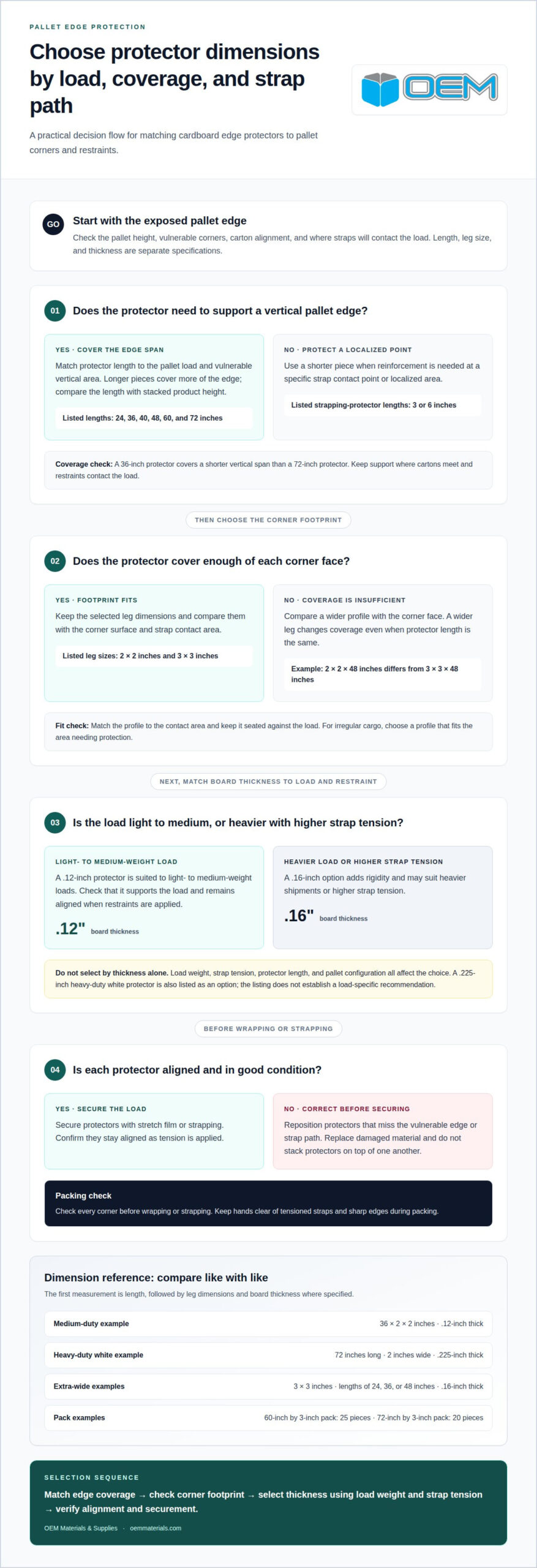
Thickness affects rigidity and resistance to compression, but it should match the load rather than serve as a stand-alone strength rating. Listed options include .12-inch and .16-inch board, plus a heavy-duty white protector at .225 inches thick. Compare thickness alongside load weight, stacking height, strap tension, and protector dimensions.
A .12-inch protector is described as an economical choice for light- to medium-weight pallet loads. It can suit shipments where corner reinforcement is needed without the additional rigidity of a thicker board. For example, listed light-duty protectors measuring 2 by 2 by 36 inches are .120 inches thick. Similar 2-by-2-by-48-inch protectors also measure .120 inches.
For heavier shipments or higher strap tension, .16-inch board provides additional rigidity and compression resistance. A listed medium-duty protector measuring 2 by 2 by 48 inches is .160 inches thick. Compared with the same length and leg dimensions in .120-inch board, the .160-inch option increases thickness while keeping the listed footprint consistent.
Other dimensions show why thickness needs context. A listed heavy-duty white protector measures 72 inches long, 2 inches wide, and .225 inches thick. Extra-wide American Quality examples measure 3 by 3 inches, come in 24-, 36-, and 48-inch lengths, and are .16 inches thick. These are distinct combinations, not interchangeable specifications.
Use a practical selection sequence:
- Record the pallet load’s weight and stacking arrangement.
- Identify where straps cross corners and how tightly they restrain the load.
- Compare .120-inch and .160-inch options against those conditions.
- Check protector length and leg dimensions alongside thickness.
The sequence helps distinguish the job thickness must perform. A longer protector does not automatically provide more compression resistance, and a wider profile changes corner coverage rather than board thickness. For example, a 3-by-3-inch leg profile covers a different corner area than a 2-by-2-inch profile, even when both measure .16 inches thick.
Choose the least complex specification that addresses the actual pressure points, not the thickest option by default. If a light- to medium-weight load uses modest restraint, .12-inch board may fit the described application. If heavier loads or greater strap tension raise compression demands, .16-inch board offers added rigidity. Review the completed pallet after strapping: note crushed edges, protector movement, or direct strap contact. Use those observations to refine the next shipment’s thickness and dimensions.
What are cardboard edge protectors for shipping and how do they work?
Cardboard edge protectors are rigid, fiber-based profiles placed along exposed carton edges or pallet corners. A V-shaped protector, for example, fits over a corner and creates a firmer surface for a strap or neighboring load. Cardboard edge protectors for shipping help shield vulnerable edges and distribute pressure over a broader area.
The material is commonly formed paperboard or laminated cardboard. Its angled profile resists folding more effectively than a flat sheet, while the legs cover adjoining faces of the carton stack. A 2-by-2-inch leg profile covers a different area than a 3-by-3-inch profile, so fit matters as much as material.
Protection depends on placement and contact. A vertical protector should sit flush against aligned cartons and cover the exposed edge that needs support. If a strap crosses the corner, the protector separates it from the carton edge, spreading pressure across the protector instead of concentrating it at one narrow point.
Edge protectors also support load containment. Strapping holds cartons together, while stretch film can secure the exterior of a palletized unit. Neither replaces a correctly positioned protector: a loose guard can shift, and a strap crossing bare corrugated board can crush its edge. Keep the profile seated while applying restraints.
Use this sequence during packing:
- Align cartons so the pallet’s vertical edges form a stable, even line.
- Place protectors against corners exposed to straps, stacking pressure, or handling contact.
- Apply strapping or stretch film while keeping each protector in position.
- Inspect the finished load for gaps, movement, or crushed carton edges.
Different profiles suit different contact patterns. A long V-board can follow a pallet’s vertical corner, while a short strapping protector shields a local strap contact point. U-channel profiles cover edges differently from V-shaped guards. Choose the shape to match the edge geometry and restraint path rather than treating all protectors as interchangeable.
A tall stack of cartons, for example, may need continuous corner coverage, while a compact load may need protection only where straps cross. Consider carton alignment, load weight, stacking arrangement, and restraint tension. A protector that is too short leaves part of the vulnerable edge exposed; one placed outside the strap path will not distribute strap pressure.
Specify the product by profile, leg dimensions, length, and thickness, then review how it performs on the packed pallet. For edge protection options suited to different load configurations, explore edge and corner protectors.
OEM Materials & Supplies: Corrugated Boxes
OEM Materials & Supplies helps industrial teams coordinate corrugated boxes with protective packaging for shipping and storage. If edge protection addresses strap pressure but cartons still need better product fit, corrugated boxes can complement the pallet protection plan. Foam Packaging and Cushioning Materials can add interior support for products vulnerable to movement or impact.
OEM Materials & Supplies can help when carton performance, product cushioning, and edge protection need to work as one packaging system. Share product dimensions, weight, and shipping conditions to guide the selection of suitable packaging components. Packaging Kits can also bring selected materials together for repeat packing tasks.
Contact OEM Materials & Supplies to discuss your pallet packaging requirements.
Put Your Pallet Protection Plan Into Practice
Turn packaging decisions into a repeatable work instruction. Record the protector profile, placement, and restraint method alongside the pallet configuration. This gives warehouse teams a consistent reference when loads change or damage patterns emerge. For cardboard edge protectors for shipping, base the specification on the product and handling conditions, not a default selection.
A useful next step is to review a representative pallet from your operation. Note where cartons meet straps, where edges show compression, and how the load is handled before dispatch. These observations can clarify which packaging components may need adjustment and what details to include in a purchasing request.
Share your product dimensions, load weight, and shipping requirements with OEM Materials & Supplies to discuss packaging needs. Contact OEM Materials & Supplies to start the conversation and move toward a more consistent pallet packaging plan.
Frequently Asked Questions
What sizes and thicknesses are available?
Options include different lengths, leg dimensions, and board thicknesses, with pack quantities varying by product. For example, a listed white V-board protector measures 2 by 2 by 48 inches and comes in a pack of 100; a brown protector of the same dimensions comes in a pack of 60. Compare the full specification and quantity per pack when planning purchasing and storage.
What sizes, thicknesses, and strengths should I choose for my shipment?
Start with a written specification that captures the protector profile, dimensions, thickness, and intended placement. Test the selected configuration on a representative pallet, then record visible carton compression, protector movement, and strap contact after packing. Comparing observations across shipment types helps identify where the specification needs adjustment. Keep the approved configuration with the packing instructions so every shift applies it consistently.
How do edge protectors improve pallet strapping and prevent shipping damage?
Protectors give packing teams a defined surface to position between a restraint and vulnerable packaging. During a packing trial, note whether each strap crosses the intended protector and whether the guard stays seated after tensioning. After handling, inspect for displaced guards, torn cartons, or strap marks. These checks help identify whether the issue is placement or a broader packaging problem before reusing the setup.
Are cardboard edge protectors recyclable, reusable, or moisture-resistant?
Paper-based protectors may be recyclable, depending on their construction and local recycling requirements. Reuse them only if they remain structurally sound after removal; discard pieces with crushed legs, delamination, or contamination. Cardboard is not a moisture barrier and should not be selected to protect cargo from water exposure. For damp transit or storage, evaluate the entire packaging system for moisture protection.
How much do cardboard edge protectors cost in the United States?
Prices vary by length, leg dimensions, thickness, board grade, and order volume.
How do I measure, cut, and install cardboard edge protectors?
Measure pallet height, exposed edge span, leg dimensions, and strap placement, then choose a protector that covers the vulnerable area. Align cartons, seat protectors against exposed corners, secure them with stretch film or strapping, and check for gaps or movement. The material gives no cutting instructions.