
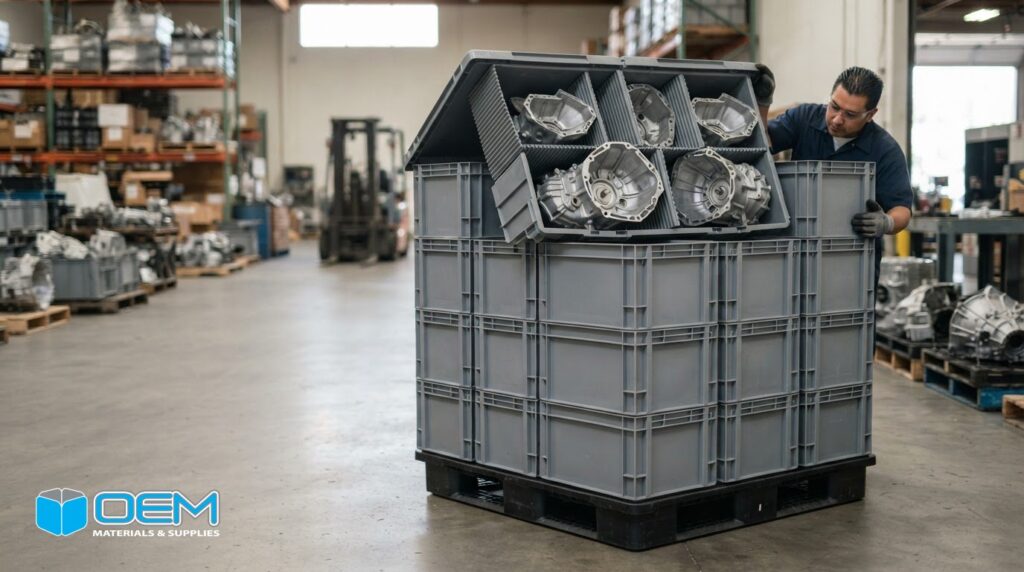
AIAG’s Global Transport Label Standard for the Automotive Industry is version 3, but the standard alone doesn’t determine every packaging decision. For returnable bulk packaging, AIAG labeling guidance supports part identification and traceability, while customer-specific requirements shape how suppliers apply it. AIAG’s automotive packaging standards provide a framework to use alongside those customer requirements.
That distinction matters: a label can follow a recognized format and still fail to meet a customer’s data, barcode, or container requirements. Consistent shipment information and repeatable packaging dimensions help prevent receiving and handling problems.
This article explains how AIAG guidance and customer contracts work together, what label and supplier-compliance checks involve, and why dimensional tolerances matter for returnable containers. It also covers packaging resources that can support a consistent program, helping you make decisions that fit your parts, shipping process, and customer requirements.
Key Takeaways
- Apply AIAG labeling guidance alongside each customer’s packaging and data requirements, not as a substitute for them.
- Match label content and hierarchy to the shipment so receiving teams can identify parts and trace container contents.
- Use the relevant AIAG packaging resources to structure container management, label implementation, and performance testing.
- Keep supplier compliance records organized, including transit-test evidence and corrective-action documentation.
- Assess dimensional consistency and stacking fit as part of returnable-container control to help prevent handling and storage problems.
AIAG packaging guidance and customer contract requirements
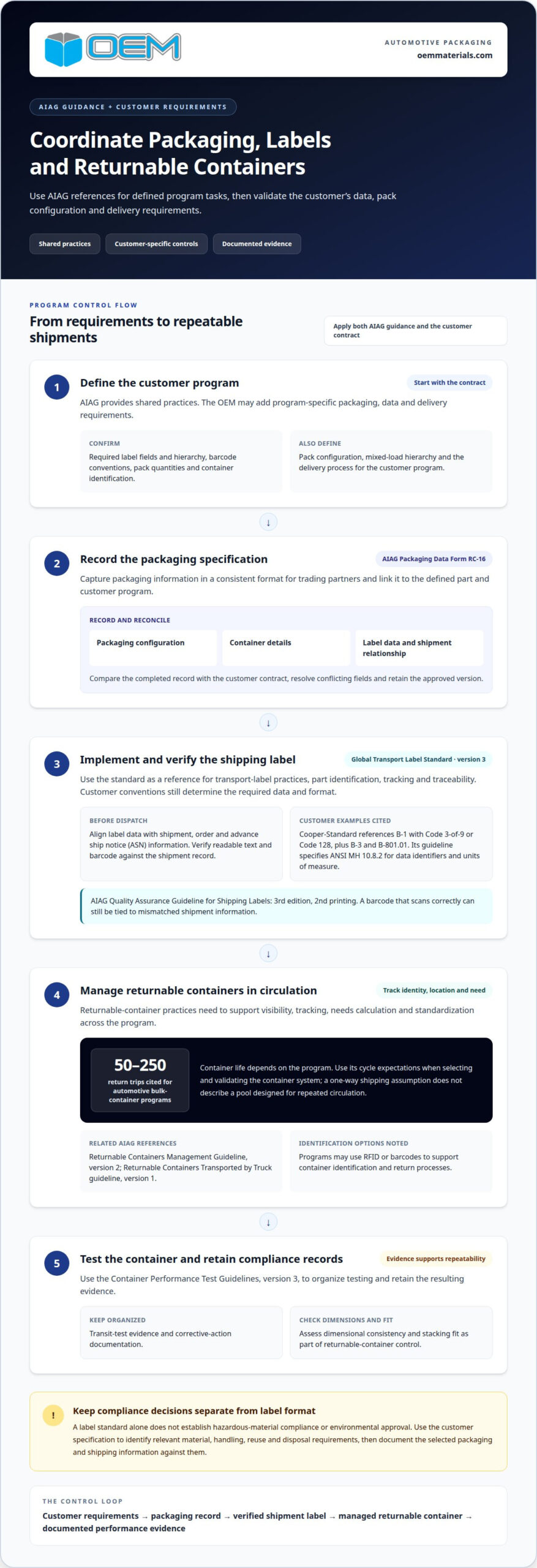
AIAG guidance establishes shared practices, while each original equipment manufacturer (OEM) can add contract-specific packaging requirements. Suppliers need to apply both: use the relevant AIAG reference, then validate the customer’s required data, pack configuration, and delivery process. An approved label format, for example, may still need customer-specific fields or a defined label hierarchy.
The AIAG Quality Assurance Guideline for Shipping Labels is listed as the 3rd edition, 2nd printing. Its practical purpose is consistent shipping-label use. Label data should align with shipment, order, and advance ship notice (ASN) information. A mismatch can delay identification at receiving, even when the barcode scans correctly. A scan-and-verify step before dispatch helps catch differences between the label and shipment record.
Customer requirements can identify barcode formats and label conventions. Cooper-Standard’s guideline references AIAG B-1 for Code 3-of-9 or Code 128 symbology. It also references B-3 02.00 12/90 and B-801.01 2/88. Those identifiers point suppliers toward the applicable label and barcode evaluation references. Data identifiers and units of measure must follow ANSI MH 10.8.2 in that customer guideline.
AIAG guidance addresses packaging practices for hazardous materials and environmental requirements, but a label standard alone does not establish hazardous-material compliance or environmental approval. The customer specification should identify relevant material, handling, reuse, and disposal requirements. Suppliers can then document the selected packaging and shipping information against those requirements. For a part needing impact protection, the packaging design can include cushioning without treating that choice as regulatory approval.
Shipping automotive parts to OEMs requires packaging and shipment information that meets the receiving customer’s specification. At minimum, align the label with shipment, order, and ASN data, then validate the barcode and readable text. The contract may also define pack quantities, container identification, and mixed-load hierarchy. Treat each requirement as a controlled record, not an informal dock instruction.
Suppliers can obtain AIAG publications directly from AIAG. Cost depends on the selected document and format. Useful references include the Shipping Labels guideline for label practices, the Packaging Data Form RC-16 for recording packaging information, and the Container Performance Test Guidelines for structuring container testing.
To complete a packaging specification, identify the part and customer program first. Record the packaging configuration, container details, label data, and shipment relationship in the applicable form. Then compare the completed document with the customer contract, resolve conflicting fields, and retain the approved version. If the specification calls for product cushioning, foam packaging can be considered as part of the protective design, alongside the customer’s documented requirements.
AIAG packaging systems
The Automotive Industry Action Group (AIAG) publishes tools for coordinating packaging, labeling, and container practices across automotive supply chains. AIAG automotive packaging standards provide references for specific program tasks, not one all-purpose packaging approval. Suppliers should link each document to a defined activity, such as identifying parts, managing returnable containers, recording packaging data, or evaluating container performance.
AIAG’s Global Transport Label Standard for the Automotive Industry is version 3. It supports standardized automotive barcode labels for part identification, tracking, and traceability. The Packaging Data Form, product code RC-16, provides a structured way to capture packaging information. A clear record helps trading partners use consistent container and shipment details across a defined program.
- Global Transport Label Standard, version 3: Use it as a reference for standardized transport-label practices and supply-chain identification.
- Packaging Data Form RC-16: Use this form to document packaging data in a consistent format for trading partners.
- Container Performance Test Guidelines, version 3: Use the guidelines to organize container performance testing and retain the resulting evidence.
- Returnable Containers Management Guideline, version 2: Use it to structure container-management practices, including visibility, tracking, and needs calculation.
- Trading Partner Labels Implementation Guideline, version 3: Use it to guide label implementation between partners working within an automotive program.
Returnable packaging adds a coordination requirement: containers must return to the right point and remain identifiable in circulation. AIAG’s returnable-container initiatives cover visibility, tracking, needs calculation, and standardization. The Returnable Containers Transported by Truck guideline is version 1. Programs may also use RFID or barcodes to support container identification and return processes.
Container life is program-specific. Automotive bulk-container programs may require containers to withstand 50 to 250 return trips, depending on the program. That range makes cycle expectations important when selecting and validating a container system. A one-way shipping assumption will not describe a pool designed for repeated circulation.
AIAG B-10 is another container-label standard referenced for automotive shipping. The Parts Identification & Tracking Application Standard is listed as the 4th edition, 2nd printing. It recommends Code 39 or Code 128 linear symbologies, or Data Matrix or QR Code 2-D symbologies. Those options support different identification approaches, so the customer’s defined labeling process should guide implementation.
When applying AIAG automotive packaging guidance, map each reference to a program requirement, record the selected container and label approach, and retain test evidence where applicable. This creates a traceable link between packaging design, labeling, and returnable-container management.
Common supplier compliance gaps
Supplier compliance can break down when packaging records, physical containers, and shipping documents no longer match. In an automotive supply chain, a correct part can still arrive with a faded label, outdated test evidence, or incomplete corrective-action records. These gaps complicate receiving and make it harder to demonstrate that the packaging process follows customer requirements.
Transit-test documentation needs active control. AIAG-aligned suppliers are advised to maintain an active transit-test report dated within 12 months. ISTA 3E and ASTM D4169-23 are commonly referenced methods for automotive bulk-container programs. The report should identify the tested configuration and preserve evidence tied to the relevant container program. A missing ISTA report can turn an audit into a two-week scramble, so assign ownership for maintaining and retrieving test records.
Labels create a different exposure. A returnable-container label that fades inside 18 months can break traceability, while label problems in bulk-container programs may appear in year three or four. A container can remain physically usable while its identification becomes difficult to read. Include label condition in routine container reviews, and record failures by container or pool. A manual note may help during inspection, but a consistent record makes recurring issues easier to identify and address.
Corrective-action evidence also needs a defined window. Records should cover nonconformances from the previous 12 months. For each issue, connect the finding to its cause, containment action, corrective action, and evidence of follow-through. This gives an audit trail rather than a collection of unrelated emails. IATF 16949 is relevant to automotive suppliers’ quality requirements and labeling-related nonconformances, alongside applicable customer-specific requirements.
Useful compliance tools serve distinct purposes:
- ISTA 3E: A commonly referenced transit-test method for automotive bulk-container programs.
- ASTM D4169-23: Another commonly referenced method for evaluating transit performance.
- Corrective-action records: Evidence the supplier uses to document nonconformances and responses across the previous 12 months.
- Container and label inspection records: Records that help connect legibility or physical issues to a specific pool or program.
Close each gap with a controlled action: assign an owner to the record, link evidence to the applicable program, and set a review trigger before documentation expires. Keep the current report accessible to quality and shipping teams. During container checks, record label condition and legibility, then escalate recurring failures before identification is lost. These steps make compliance easier to demonstrate across the automotive supply chain.
Dimensional repeatability and stacking tolerance
In returnable packaging, dimensional variation affects fit, stacking, and movement through production and logistics. A container may pass an initial review yet change after repeated use. In the AIAG context, repeatability is a program control issue: each container must remain compatible with the defined load and handling process.
A 1.5 mm deviation per container can become unacceptable when containers are stacked four high. Small differences may accumulate across the stack, affecting alignment and stability. The concern is not only one container’s measurement. It is how variation across a group affects the complete load on platforms, in storage, and during movement through the supply chain.
Dimensional problems in AIAG-aligned bulk containers can appear within 100 cycles. That makes inspection useful during production and after containers have entered circulation. A dimensional audit can commonly sample 30 or more containers quarterly. Inspection records should also be based on 30 or more samples per lot. These are distinct sampling contexts: quarterly audits monitor the active pool, while per-lot records capture production consistency.
For each inspection, record the container identifier, measured dimensions, lot or pool, and inspection date. Use a consistent measurement method and compare results with the program’s approved dimensions and tolerances. Separate out-of-range units from conforming containers, then document disposition and corrective action. This helps distinguish an isolated damaged container from a repeated production shift.
Useful tools support different decisions:
- Dimensional inspection records: Track results by lot or returnable pool and show whether measurements remain consistent over time.
- Approved dimensional specification: Defines the target dimensions and allowable tolerances for the container program.
- Stack-fit assessment: Shows whether measured variation affects alignment when containers are stacked in the customer’s intended configuration.
- Cycle history: Connects inspection findings to container use, helping identify changes that emerge during repeated circulation.
Escalate a measurement trend before it disrupts a shipment or storage pattern. For example, recurring width variation across a production lot may affect how containers seat on a platform, even when individual units appear usable. Record the finding, identify affected containers, and evaluate corrective action against the approved specification. Keep inspection evidence with the relevant program records.
Dimensional control works best when production and logistics use the same reference. A shared specification, repeatable measurement process, and traceable inspection record give teams a clear basis for release decisions. In a returnable program, this discipline helps keep container fit aligned with the customer’s stacking and handling requirements.
What are the requirements in the AIAG Packaging Guidelines?
AIAG packaging requirements depend on the document and customer program. Practical controls include label hierarchy, readable identification, and container performance. Suppliers should connect each requirement to a packaging specification, inspection method, and retained record. This ties the approved design to the way parts move through shipping and receiving.
For mixed loads, master and child labels can reflect shipment contents. The parent label identifies the broader load, while child labels identify its component containers. This relationship helps receiving teams see which parts and packages belong together. The label structure should match the actual shipment, not an assumed pack configuration.
Cooper-Standard’s master-label guideline provides a specific example: a master label for multiple common-item containers must show “MASTER LABEL” in letters 1.0 inch high. This is a customer-specific instruction, not a universal size rule for every automotive label. The applicable customer document determines the required heading, placement, and label content.
Returnable-container labels also need to remain readable through the pool’s service life. Automotive labels are typically expected to stay legible for five to seven years, matching the design life of the pool. Label tests may use an approximate thermal-cycling range of -20°C to +60°C. Temperature exposure can affect label materials and print, so validation should reflect the operating conditions defined for the program.
Useful AIAG and customer tools serve distinct purposes:
- Global Transport Label Standard: Provides a reference for automotive transport-label structure and identification.
- Trading Partner Labels Implementation Guideline: Helps partners implement labeling practices consistently across a program.
- Packaging Data Form RC-16: Captures packaging information in a structured document for program review.
- Container Performance Test Guidelines: Supports test planning and evidence for container performance.
Apply these references in a controlled sequence. First, identify the customer’s governing specification and the applicable AIAG document. Next, map each label field and container requirement to the packaging design. Then validate label readability and shipment hierarchy against representative loads. Finally, retain the approved specification, test evidence, and revision record together. A change to the part, container, or shipment configuration should trigger a review of affected requirements.
For packaging that needs to match a part’s shape and handling needs, share the part dimensions, weight, and shipping conditions through a packaging quote request. Those details help frame a packaging recommendation around the program’s documented requirements.
OEM Materials & Supplies: Foam Packaging
OEM Materials & Supplies provides foam packaging for parts that need organized cushioning and protection during handling and shipment. Foam is useful when a component’s shape, contact points, or movement inside its package call for a more controlled fit. Packaging kits can bring protective components together in a consistent configuration for repeat packing.
AIAG guidance and customer specifications define packaging and labeling requirements. Foam selection supports the physical-protection part of the design, but does not replace customer approval or required packaging documentation. Part dimensions, weight, and shipping conditions help determine a suitable packaging approach.
For a packaging recommendation based on your part and shipping needs, contact OEM Materials & Supplies.
Turn packaging requirements into an operating plan
The next step is to make packaging requirements usable across engineering, purchasing, and warehouse teams. Translate applicable AIAG guidance and customer specifications into one controlled working plan, with clear ownership for design decisions, revisions, and day-to-day use. This gives each team a shared reference as parts, schedules, or shipping conditions change.
AIAG automotive packaging standards provide a useful framework, while the packaging design must still fit the part and customer program. OEM Materials & Supplies offers Corrugated Boxes, Foam Packaging, and Packaging Kits for different packaging needs. The right combination depends on the part, protection requirements, and shipping process.
Bring your packaging requirements, product dimensions, weight, and shipping details together before the next design or sourcing decision. Contact OEM Materials & Supplies to discuss your packaging needs and identify a practical next step for your program.
Frequently Asked Questions
How Do AIAG Labeling and Identification Rules Work for Returnable Bulk Packaging?
These references provide a common framework for identifying parts and tracking packaging through trading-partner operations. In a returnable bulk program, the label process should work at dispatch and receipt: shipping teams associate the container with its contents, and receiving teams reconcile that information against the incoming load. A practical review should cover the scan workflow, exception handling, and responsibility for correcting discrepancies.
How Do AIAG Requirements Apply to Bulk Containers Specifically?
For bulk containers, apply relevant AIAG references to the container program, then translate customer requirements into operating instructions. Consider how containers are loaded, moved, emptied, and returned. The program also needs a way to identify damaged or unavailable containers so they do not re-enter circulation before disposition. These operating details connect the packaging specification to daily warehouse and transportation decisions.
How long must AIAG bulk container labels remain legible?
Labels are typically expected to remain legible for the returnable pool’s design life, commonly five to seven years. Define how legibility will be assessed throughout that period. Include the label’s exposure conditions and the customer’s acceptance criteria in the validation plan. This makes label durability a testable program requirement, rather than a judgment made only after a shipment arrives.
What Are AIAG Packaging Standards and Why Do Tier Suppliers Care?
AIAG references are shared automotive-industry resources that help suppliers align packaging processes with trading partners. Tier suppliers need to consider packaging because it affects part handling, shipment acceptance, and coordination with downstream operations. A supplier can use the relevant reference to structure its process, then map customer-specific instructions to it. This clarifies responsibilities when packaging changes or a program adds another receiving location.
What Documentation Do Tier Suppliers Need to Provide for AIAG Audits?
Prepare a controlled record set showing how the packaging process is defined and maintained. Useful items include the current approved specification, revision history, approval records, inspection results, and evidence that assigned corrective actions were closed. Organize records by customer program and part number, rather than keeping one unindexed file set. This structure helps an audit team trace a requirement to the responsible process and its supporting evidence.
What Material and Dimensional Requirements Do AIAG Specifications Cover?
Applicable packaging specifications can address material selection, container dimensions, and performance expectations, while customer requirements define the details for each program. Review the packaging against the part’s contact points, handling method, and intended container arrangement. Record the approved material and dimensional criteria together. If the design changes, assess whether the new configuration still fits the customer’s packaging and handling process.
What is the AIAG packaging standard for automotive parts?
No single AIAG standard covers every packaging decision for every automotive part. The appropriate reference depends on whether the task concerns transport labels, part identification, packaging data, or container management. Start with the function being controlled, then align the relevant AIAG publication with the customer’s part-specific instructions. This prevents suppliers from treating a label reference as a complete packaging specification.
What packaging data must be included in an AIAG packaging submission?
Include the information requested by the customer’s submission process, organized so reviewers can understand the proposed pack configuration. Useful categories often include part identification, packaging components, pack quantity, container dimensions, and handling or return details when applicable. Keep entries consistent with the current drawing and program instructions. Clear units, revision references, and descriptions help prevent reviewers from interpreting the same packaging setup differently.