

Strong packaging supplier audit questions go beyond certificates. They examine incoming materials, quality systems, traceability, change control, and validated production processes, then connect each control to supporting records. The goal is to understand how a supplier prevents, identifies, and addresses problems that could affect packaging performance or production.
It’s reasonable to expect a packaging supplier’s quality system to be documented. The practical challenge is verifying that procedures are followed consistently and that material or process changes are communicated before they affect your operation. Clear packaging supplier audit questions help purchasing, quality, and engineering teams assess performance using evidence rather than assumptions.
This guide provides a structured approach to reviewing material inspection, supplier approvals, batch records, change notifications, and production controls. It also explains how to tailor an audit to packaging use and supply-chain risks for operations in Orange County, Los Angeles County, San Diego County, and Riverside.
Key Takeaways
- Ask suppliers to explain how they inspect incoming packaging materials and document test results.
- Review quality procedures and applicable regulatory controls alongside the supplier’s supporting records.
- Confirm that batch identifiers connect materials to inspection results, production records, and corrective actions.
- Ask how suppliers assess and communicate changes to materials, processes, or production sites.
- Examine how critical equipment, production steps, and validation records support consistent packaging quality.
Incoming-material inspection, testing, and sampling
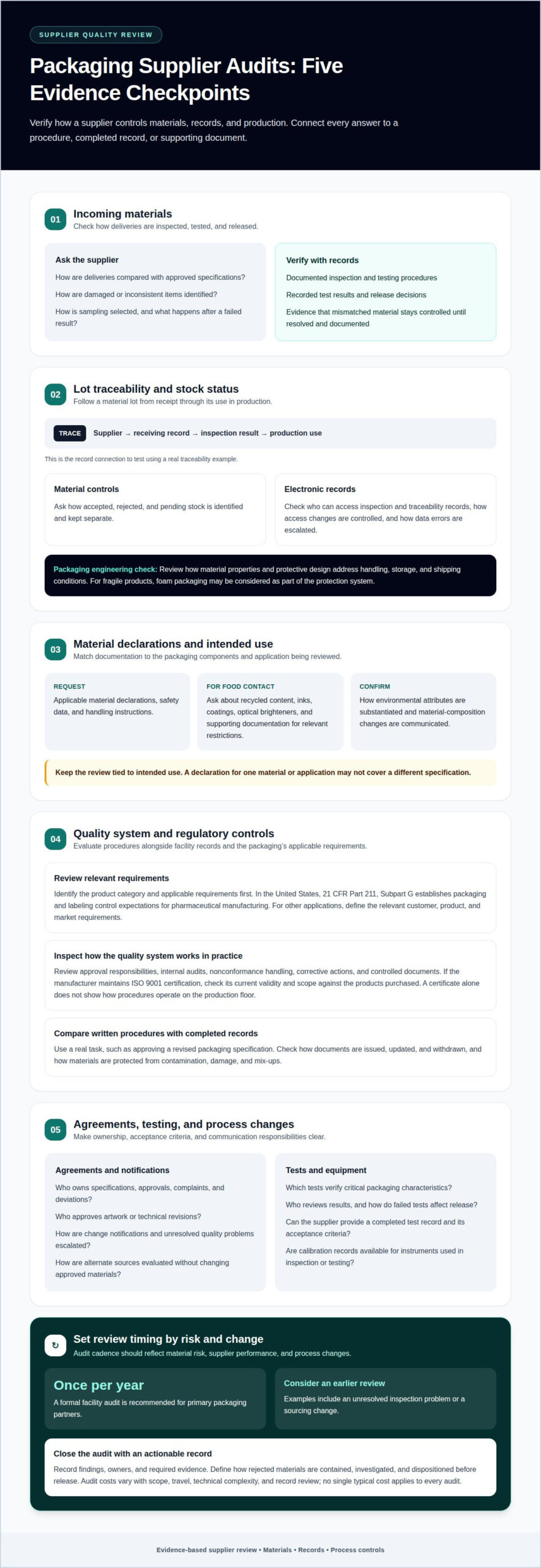
Use a supplier audit checklist to connect material specifications, inspection records, and release decisions. Start by asking how incoming packaging materials are controlled before they enter production.
-
Inspect and Sample Incoming Materials
Ask the supplier to show documented procedures for inspecting and testing incoming materials. Review how staff compare deliveries with approved specifications, identify damaged or inconsistent items, and record test results. Ask how sampling is selected and how a failed result affects release. For example, a lot with a mismatched material identification should remain controlled until the discrepancy is resolved and documented.
-
Test Material Protection and Traceability
Request a traceability example that connects an incoming material lot to its supplier, receiving record, inspection result, and production use. Ask how the supplier identifies material status and separates accepted, rejected, and pending stock. For packaging engineering, examine how material properties and protective design address handling, storage, and shipping conditions. For fragile products, foam packaging can be considered as part of a protection system.
Ask how the supplier monitors upstream sourcing risks, communicates shortages, and evaluates alternate sources without changing approved materials. For cybersecurity, ask who can access electronic inspection and traceability records, how access changes are controlled, and how data errors are escalated.
-
Check Hazardous-Material and Sustainability Compliance
Ask which material declarations, safety data, and handling instructions apply to the packaging components you purchase. For food-contact applications, include questions about recycled content, inks, coatings, and optical brighteners, and request supporting documentation for relevant restrictions. Ask how the supplier evaluates environmental attributes, substantiates sustainability claims, and notifies customers of changes to material composition.
Keep the questions tied to the intended use. A declaration for one material or application may not cover a different specification, though examining how specialized sustainable food packaging suppliers such as Goodies Distribution document compostability standards can offer a practical reference for sustainability vetting.
- Set audit timing according to material risk, supplier performance, and process changes. A formal facility audit once per year is recommended for primary packaging partners. Ask what events trigger an earlier review, such as an unresolved inspection problem or a sourcing change. Audit costs vary with scope, travel, technical complexity, and record review, so no single typical cost applies to every audit.
Close by recording findings, owners, and required evidence. Define how rejected materials are contained, investigated, and dispositioned before release. This makes inspection results actionable and gives purchasing and quality teams a clear record when supply-chain problems arise.
Quality management system and regulatory inspections
Use an audit checklist to connect applicable requirements with the supplier’s procedures and records. Review regulatory inspection history, quality controls, and technical agreements in light of the packaging’s intended use.
-
Review Packaging Standards and Regulatory Inspections
Identify the product category and applicable requirements before reviewing the supplier’s controls. In the United States, 21 CFR Part 211, Subpart G establishes packaging and labeling control expectations for pharmaceutical manufacturing, according to the Electronic Code of Federal Regulations.
Ask whether regulatory agencies have inspected the facility and request relevant findings and corrective-action records. Confirm that the supplier can explain how inspection results affect packaging and labeling controls. For pharmaceutical packaging, review how written procedures prevent mix-ups, control issued materials, and reconcile labeling. For other applications, define the relevant customer, product, and market requirements rather than applying pharmaceutical controls indiscriminately.
-
Verify Quality Systems and ISO Compliance
Review the supplier’s documented quality management system, including approval responsibilities, internal audits, nonconformance handling, and corrective actions. Ask whether the manufacturer maintains ISO 9001 certification and examine its current validity and scope against the products being purchased. A certificate alone doesn’t show how procedures operate on the production floor.
Request an example of a written procedure controlling a real task, such as approving a revised packaging specification. Compare the procedure with completed records and staff responsibilities. Check how controlled documents are issued, updated, and withdrawn so obsolete instructions don’t remain in use. Include storage controls in the audit: ask how the facility protects packaging materials from contamination, damage, and mix-ups.
-
Check Agreements, Testing, and Calibration
Review the quality or technical agreement for clear ownership of specifications, approvals, complaints, deviations, and change notifications. Define which party approves artwork or technical revisions and how unresolved quality problems are escalated. These packaging supplier audit questions should establish assigned responsibilities, not just elicit broad assurances.
Ask which tests verify the critical characteristics of the packaging you purchase, who reviews the results, and how failed tests affect release. Request a sample record of a completed test and its acceptance criteria. Review calibration records for instruments used in inspection or testing. Confirm that each instrument has an assigned status, documented results, and a process for addressing an out-of-calibration finding. A template can organize evidence, but tailor it to the product and process.
Batch identification and record retention
Review records against a specific production batch, not a blank form. Follow its identifiers through manufacturing, inspection, release, storage, and any later complaint. This on-site exercise shows whether the supplier’s records support compliance and help operations investigate problems without relying on memory.
- Select a completed batch and trace its identity through the supplier’s records. Match the batch number on production documentation with material issue records, inspection results, and final disposition. Ask staff to retrieve records using the identifier they would receive in a customer complaint. Note gaps, conflicting entries, or manual corrections without an explanation.
Then compare the batch record with the product specification and approved work instructions. For example, if a lot contains multiple material inputs, verify that each input has a recorded identifier. Ask how the supplier prevents unrelated batches from sharing labels or records. One useful packaging supplier audit question is how long record retrieval takes and who owns the response.
- Review the record-retention procedure and the systems used to store production evidence. Ask which records are retained, where authorized staff retrieve them, and how the supplier protects them from loss or unauthorized changes. Include paper logs, electronic files, and scanned forms in the review. File supplier replies with the supplier record so your team can find them during a future audit.
Check that inspection and testing records identify the item or batch, the test performed, the result, and the person responsible. A measurement without a linked specification or acceptance decision offers limited evidence. For example, compare a completed inspection entry with its associated production order. Confirm that corrections remain legible and show who made them.
- Examine how the supplier documents deviations, complaints, and corrective and preventive action. Select a closed case and trace it from the initial report through investigation, containment, assigned action, and documented closure. Ask how the supplier evaluates whether the action addressed the cause. Review the supporting evidence rather than treating a completed form as proof of effective action.
Compare the case history with related batches and customer records. If a complaint concerns damaged packaging, ask how the supplier identifies potentially affected production and records its disposition. Check whether recurring problems are reviewed for patterns. This connects batch-level evidence to the supplier’s broader quality process instead of relying on an isolated corrective-action record.
- Review cleaning procedures and records for equipment or work areas that could affect packaging quality. Ask which procedure applies to the process, how staff document completion, and how exceptions are escalated. For example, compare a dated cleaning log with the equipment’s production schedule. Check for missing entries, unclear sign-offs, or records that don’t identify the equipment cleaned.
Connect the cleaning evidence to inspection and testing results for the same production period. Ask how the supplier assesses product made after a missed or incomplete cleaning step. Where the supplier references ISO 9001, examine how its documented controls support consistent record handling. Keep the audit record focused on observed evidence, open findings, and follow-up ownership.
Change control and customer notifications
Assess how proposed changes move from review to approval, implementation, and customer notification. Focus on records showing who evaluated the impact and when affected specifications changed.
-
Review Change Control Procedures
Ask the supplier to explain its documented change-control procedure from proposal through implementation. Review how it evaluates changes to materials, processes, equipment, and production sites. A new resin, ink, or facility can affect a food-contact declaration. Ask how the supplier identifies affected specifications, determines customer impact, and obtains required approvals before making a change.
- Request a recent change record and trace its decision path. Check the reason for the change, technical review, risk assessment, approval status, and implementation evidence. Ask what has changed in materials or processes since the previous quarter. Compare the record with the current specification and customer notification. If a proposed change was rejected, check that the supplier documented the decision and prevented unapproved implementation.
Clarify which changes require advance notification and what information the notice includes. For example, a customer may need to assess a material substitution before using packaging covered by an existing declaration. Ask how the supplier identifies affected products, orders, and customers. Review how approval or objection is recorded, then confirm production controls prevent use until required approvals are complete.
-
Check Training for Change Control
Review how employees learn revised procedures and specifications before applying them. Ask the supplier to show training records tied to a specific change, such as a revised inspection method or material-handling instruction. Check whether affected roles are identified, training completion is recorded, and obsolete documents are removed from work areas. Staff should know where to find the current approved version.
- Trace one implemented change through the quality management system. Compare its approval record with training evidence, updated work instructions, production documentation, and any required customer notice. Ask how supervisors confirm that affected employees follow the revised method. For instance, inspect a completed production record created after a specification revision and verify that it references the approved version.
Ask how ongoing monitoring detects problems after implementation. Review complaint trends, inspection results, and rejected materials or production, where relevant to the change. Determine who evaluates adverse results and how the supplier decides whether further action is needed. If performance concerns arise, ask how the supplier contains affected product and communicates findings to customers.
- Close the review by recording open actions, responsible owners, and required evidence. Set clear expectations for customer notices, including the change description, affected specifications, planned timing, and approval status. Ask how the supplier handles urgent changes without bypassing documented controls. A consistent record helps purchasing and quality teams distinguish an approved revision from an unreviewed process variation.
Production equipment and process validation
Assess whether equipment, validated processes, and available capacity match your required packaging formats. Ask for operating evidence, not just capability statements.
-
Review Production Equipment and Capabilities
Ask the supplier which core substrates and formats its production lines handle well. Then review the equipment and methods used for your packaging requirements. For printed packaging, clarify whether digital, offset, or flexo printing applies. Ask whether foil, embossing, and coating are performed in-house or outsourced, since each arrangement affects process oversight.
Request a process flow showing how work moves from setup through finishing and final inspection. Compare each production stage with the specifications and approved sample. For outsourced finishing, ask how the supplier communicates job requirements and handles nonconforming output. Match the audit scope to the actual production route, not a general capability list.
-
Validate Processes and Plan for Surge Capacity
Ask which critical production processes are validated, what acceptance criteria apply, and where results are recorded. Review validation reports for the process and packaging format under consideration. Confirm that changes to equipment, setup, or operating methods trigger an appropriate review. For medical device packaging, ask whether the supplier supports validation testing relevant to the packaging process.
Examine how the supplier monitors production after validation. Ask how operators identify a process outside its approved range, contain affected work, and initiate corrective action. Review an example of a process exception and its disposition. Reports should connect the issue, investigation, decision, and follow-up evidence.
Discuss capacity using your expected volumes, order patterns, and required delivery windows. Ask which production steps constrain output and how planned maintenance, labor availability, or outsourced work affect scheduling. A useful scenario is whether the supplier can handle a 20% production-volume surge without extending lead times. Ask what assumptions support that response, including material availability and competing orders.
Request the supplier’s surge plan and review how it prioritizes orders, allocates equipment, and communicates schedule changes. Determine whether added capacity requires alternate shifts, different equipment, or outsourced finishing. Each approach can affect inspection points and process control. Ask how quality records remain linked to production during a capacity increase.
Close by documenting capability gaps, evidence reviewed, and actions required before approval. Separate demonstrated capacity from proposed capacity, and record any dependencies affecting production. This keeps purchasing and operations aligned on the supplier’s validated process, available equipment, and response to significant demand changes.
OEM Materials & Supplies: Foam Packaging
OEM Materials & Supplies helps manufacturers in Orange County, Los Angeles, San Diego, and Riverside choose packaging suited to a product and its handling needs. Foam Protective Packaging can cushion products during storage and shipment. Pairing foam with Corrugated Boxes & Mailers or Assembled Packaging Kits can create a coordinated setup around the product and its outer container.
Share the product’s dimensions, weight, and shipping requirements to discuss a suitable packaging approach. These details help determine how the product should be supported and protected during routine handling.
Contact OEM Materials & Supplies to discuss Foam Protective Packaging for your operation.
Put Audit Findings to Work
Use the audit outcome to set clear supplier approval conditions and assign ownership of open items. Record the decision rationale so purchasing, quality, and operations work from the same expectations. Revisit the assessment when business needs or supplier performance change.
Well-structured packaging supplier audit questions support consistent sourcing decisions. Apply the findings to the packaging requirements that matter most to your operation, then define the next action with your team.
Contact OEM Materials & Supplies to discuss your packaging requirements and procurement priorities. A focused conversation can help clarify a practical next step.
Frequently Asked Questions
What should a packaging supplier audit checklist include?
Build the checklist around the decisions your team must make: approve, conditionally approve, or reject the supplier. Separate critical requirements from routine documentation, and assign each item an evidence type, such as a record, observation, or staff explanation. Add space to note unresolved questions and the person responsible for follow-up. This structure helps an audit produce a decision-ready record rather than a completed form without clear consequences.
What quality management certifications should packaging suppliers have?
The appropriate certification depends on the packaging’s end use, your customer requirements, and the supplier’s role. For primary pharmaceutical packaging, ISO 15378:2017 is specifically applicable; ISO 9001 may be relevant to a broader quality management system. For medical device packaging, assess whether ISO 13485 applies to your requirements. Define the certification expectation before qualification, so it reflects the product and process rather than a preference applied uniformly.
How do you audit a packaging supplier’s manufacturing processes and quality controls?
Use a job-specific audit scenario to test whether controls work together. Select a packaging order with a defined print, finish, or assembly requirement, then ask how staff would respond to an incorrect setup or an inspection result outside acceptance criteria. Look for consistent decisions across production, quality, and supervision. This reveals whether employees understand escalation paths and whether routine work supports the intended control plan.
What questions should you ask about packaging materials, specifications, and traceability?
Make specifications operational by identifying the fields that distinguish an acceptable item from an unsuitable substitute. For a printed package, define the approved artwork revision, required material description, and any critical appearance criteria. Ask how purchasing and production systems present those requirements at order entry and setup. This helps prevent ambiguity when similar materials, designs, or customer versions move through the same facility.
How should packaging suppliers handle defects, nonconformances, and corrective actions?
Agree on how defects are classified and who can authorize a disposition. A cosmetic print variation, for example, may require a different decision path from packaging that cannot protect the product as intended. Ask the supplier to explain how it communicates the issue, records your decision when required, and prevents affected stock from shipping prematurely. Clear decision rights reduce delays and conflicting instructions during an active quality event.
How do you assess packaging supplier capacity, lead times, and business continuity?
Map the order path to identify dependencies that could disrupt delivery. Ask whether production relies on a particular substrate, finishing operation, or outside process, and how the supplier handles an interruption at that point. Discuss how forecast changes affect material purchasing and schedule commitments. For critical packaging, document which items need priority planning and what communication your team expects if supply conditions change.
What U.S. regulations apply to packaging suppliers, including FDA requirements?
Requirements depend on the packaging’s use and contact conditions. For food-contact packaging, assess controls aligned with 21 CFR Part 117 (FSMA) and relevant material safety standards in 21 CFR 174-190. California Proposition 65 may also be a consideration in U.S. packaging assessments. Define which requirements apply to the specific material and application, then document the basis for including them in supplier qualification.
How do you score and compare packaging suppliers after an audit?
Set scoring criteria before evaluating suppliers, then apply the same evidence standard to each. Separate mandatory acceptance conditions from comparative measures such as responsiveness or operational fit. Record both the rating and its rationale so a high score cannot obscure a critical unresolved issue. If several teams participate, agree on category definitions first; otherwise, purchasing and quality may interpret identical evidence differently.