
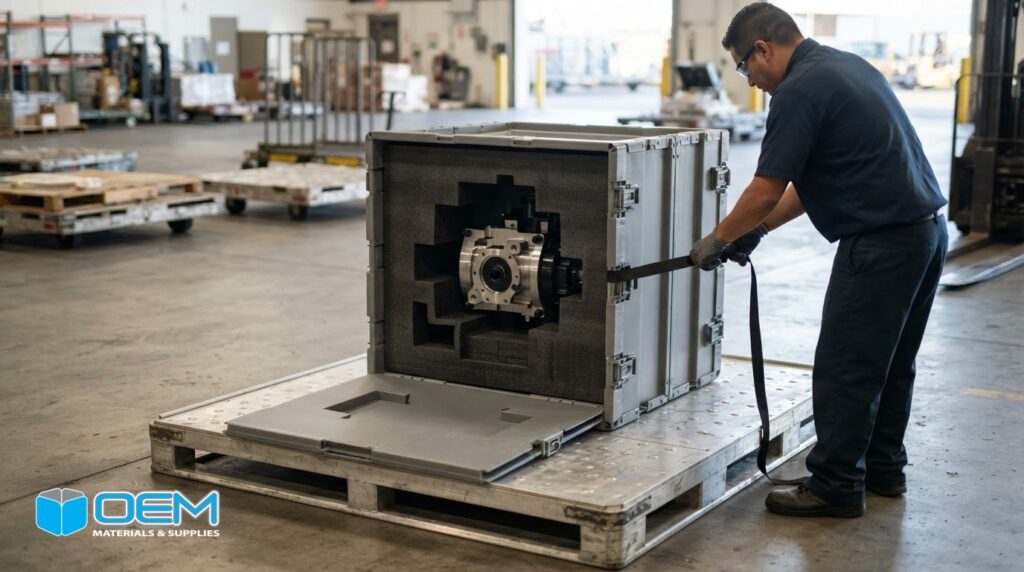
For shipments from San Diego, lightweight collapsible crates for air freight can help reduce empty-packaging volume when the crate is folded between uses. The design must balance cargo protection, crate weight, and packed dimensions, since each affects how the shipment is prepared and handled.
Air freight cost depends on more than packaging, but crate size and weight are part of the shipment plan. An oversized crate can use unnecessary cargo space, while a difficult assembly process can add labor. A design based on the product’s dimensions and handling needs can make packing more efficient. Any savings depend on the materials, shipment requirements, and return logistics.
This article explains how collapsible crates work, which measurements guide custom sizing, and what to consider when choosing materials and assembly features. It also covers reuse, storage, and return logistics, so you can assess packaging for your San Diego air freight operation.
Key Takeaways
- Compare collapsible crate designs by how they protect the product in transit and reduce storage needs when returned empty.
- Plan assembly around clear steps and repeatable handling to make packing more consistent.
- Assess freight savings through packed dimensions, crate weight, materials, and shipping requirements rather than crate price alone.
- Specify internal dimensions, payload needs, and tare weight from the product and shipment requirements.
- Use those requirements to guide supplier discussions and identify a crate solution suited to your San Diego shipping operation.
Collapsible and reusable crate designs
A collapsible crate is designed to protect cargo when assembled and occupy less space when empty. The right design depends on the product, route, handling method, and whether the crate will return for reuse.
Crate Material Comparisons
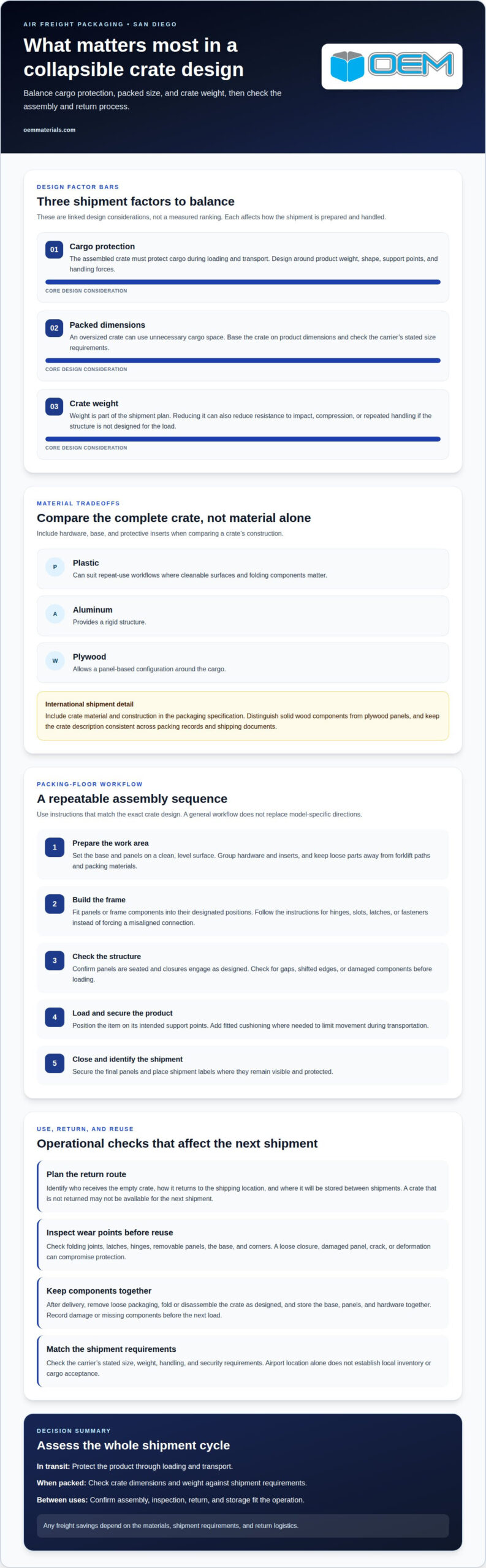
Plastic, aluminum, and plywood have different tradeoffs in weight, durability, and construction. Plastic can suit repeat-use workflows where cleanable surfaces and folding components matter. Aluminum provides a rigid structure, while plywood allows a panel-based configuration around the cargo. Compare the complete crate, including its hardware, base, and protective inserts, rather than judging by material alone.
Air freight acceptance depends on the shipment. Design the crate to meet the carrier’s stated size, weight, handling, and security requirements, and ensure the assembled package protects the cargo during loading and transport.
For international shipments, include the crate’s material and construction in the packaging specification. Distinguish solid wood components from plywood panels, and keep the crate description consistent across packing records and shipping documents.
Crates can support shipments moving through San Diego International Airport, but the airport’s location does not establish local inventory or cargo acceptance. Match crate dimensions and delivery arrangements to the shipment; crate packaging options provide a starting point for reviewing crate requirements.
Durability Limits and Risks
Reducing crate weight can also reduce resistance to impact, compression, or repeated handling if the structure is not designed for the load. Consider the product’s weight and shape, how it rests on the base, and where lifting forces act. A heavy component with a small contact area may require a stronger support surface than a broad, evenly distributed load.
Folding joints, latches, hinges, and removable panels are potential wear points. Inspect them before reuse, particularly after rough handling or storage conditions that could affect the material. A loose closure or damaged panel can compromise protection even if the crate body is intact.
Lightweight construction does not replace internal restraint. Foam packaging or cushioning materials can limit movement and protect vulnerable surfaces. Clear loading instructions also help operators position each item consistently.
Returns, Storage, and Reuse
Plan the return route before dispatch if you intend to reuse the crate. Identify who receives the empty crate, how it will return to the shipping location, and where it will be stored between shipments. Without a defined process, a collapsible design may save storage space but still leave the crate unavailable for the next shipment.
After delivery, remove loose packaging and inspect the panels and closures. Fold or disassemble the crate according to its design, then store its components together in a designated area. Keeping the base, panels, and hardware in one place makes them easier for the next packing team to locate.
Track crate condition and reuse with an identifier or shipment record if those methods suit your operation. Record damage and missing components before the next load. This gives warehouse teams a practical basis for deciding whether a crate is ready for reuse or needs repair.
Crate assembly and disassembly
Assembly affects packing time, load consistency, and the crate’s condition at dispatch. A repeatable sequence helps warehouse teams build the same configuration for each shipment, while clear instructions reduce missed connections and misplaced components.
Start with the crate configuration and the shipment it will carry. Check the base orientation, panel positions, closure points, and internal supports against the design instructions. For a compact component, for example, the protective insert may need to be installed before the product is loaded.
- Prepare the work area. Set the base and panels on a clean, level surface, with hardware and inserts grouped together. Keep loose parts away from forklift paths and packing materials.
- Build the frame. Fit each panel or frame component into its designated position. Follow the crate’s assembly instructions for hinges, slots, latches, or fasteners rather than forcing a connection that does not align.
- Check the structure. Confirm that panels are seated and closures engage as designed. Look for gaps, shifted edges, or damaged components before loading.
- Load and secure the product. Position the item so its weight rests on the intended support points. Add fitted cushioning where needed to limit movement during transportation.
- Close and identify the shipment. Secure the final panels and apply shipment labels where they remain visible and protected.
This sequence is a general workflow, not a replacement for model-specific instructions. Wooden crates made from separate panels require correct panel orientation and fastener placement. A folding crate with attached sides follows a different sequence. Use assembly instructions that match the exact design on the packing floor.
Disassembly also requires a defined order. After delivery, remove the product and loose cushioning first. Release closures as directed, then fold or separate panels without twisting hinges or prying at connection points. Keep reusable fasteners with the crate, and group components for storage or return transport.
Before reuse, inspect the base, corners, panels, hinges, and latches for visible wear or deformation. A cracked panel or closure that does not engage can affect the next load. Record the issue against the crate identifier and keep the damaged unit out of active packing until it has been assessed. This simple control helps prevent a compromised crate from returning to the shipment line.
For a smoother packing process, provide the crate dimensions, product weight, handling points, and expected reuse path when requesting a crate assembly recommendation. Those details help align the crate configuration with the work performed at the San Diego packing station.
Freight cost savings
A collapsible crate can affect several parts of an air freight budget, not just the packaging line. Its assembled dimensions, tare weight, protective materials, and return route all shape the shipment plan. For a San Diego exporter, compare the complete packed configuration with the current crate, including the space empty packaging occupies after delivery.
Air freight charges can reflect both shipment weight and the space cargo occupies. A lighter crate may reduce gross weight, while a closer-fitting design may reduce unused volume. The result depends on product dimensions, materials, and shipping requirements. Removing material may not lower overall cost if the design requires extra cushioning or increases the outer dimensions.
Begin with a dimensional review. Record the product’s length, width, and height, then measure the assembled crate with its protective inserts. Compare these figures with the current shipment configuration. A narrow machine component, for example, may leave excess space in a standard crate. A closer fit can reduce wasted packaging volume while preserving room for cushioning and secure handling.
Storage also matters. A cited warehouse comparison found that 48 standard wooden shipping crates measuring 48 x 48 x 48 inches, stacked three high, used 256 square feet of floor space. This example illustrates how empty-crate storage can consume valuable warehouse area. A collapsible design may reduce the space needed after delivery, depending on its folded dimensions and stacking method.
For reusable packaging, assess the return trip before choosing a crate. Compare the cost and coordination of returning empty units with shipment frequency and the value of keeping crates in circulation. A regular route between San Diego and an international destination may allow a different return plan than a one-way shipment without a practical backhaul.
- Compare packed dimensions: Include the crate, product, and cushioning in the shipment profile.
- Review total weight: Account for the complete assembled package, not the empty crate alone.
- Map empty returns: Identify the receiving location, return route, and warehouse storage needs.
- Include labor: Consider the time required to assemble, load, close, and prepare each crate.
Compare the full operating cost, not just one shipment metric. Product protection, replacement packaging, assembly labor, storage, and return transportation all contribute. A crate suited to repeated shipments may not make sense for a one-time export. Base the comparison on actual product dimensions, packed weight, shipment frequency, and route requirements.
What are the dimensions, payload capacity, and tare weight of collapsible air freight crates?
No single dimension, payload capacity, or tare weight suits every air freight crate. Each specification depends on the product, protective materials, handling method, and applicable cargo limits. For a San Diego shipment, start with the packed product and define the crate around its transportation needs.
Measure the product’s length, width, and height at its widest points, including any protrusions that cannot be removed. Note the required transport orientation and the space needed for foam or other cushioning. A machine with a projecting connector, for example, needs clearance around the connector, not just measurements of its main housing.
Keep internal and external dimensions separate. Internal dimensions describe usable cargo space; external dimensions include panels, the base, closures, and protective features. For a collapsible crate, folded dimensions also matter because they determine storage and return-shipment space when the crate is empty. Compare all three configurations before finalizing the design.
Payload capacity is the load the crate is designed to carry. It must account for the product’s weight and how that weight rests on the base. A compact, heavy component can concentrate force in one area, while a broad item may distribute its load differently. The design must also suit the handling method used for loading and unloading.
Tare weight is the weight of the empty crate provided by OEM Materials & Supplies. Gross shipment weight includes the crate, product, and internal protection. Record these values separately because they serve different purposes in shipment planning. Adding a foam insert, for example, changes packed weight but not the empty crate’s tare weight.
Use a specification sheet to keep measurements consistent across purchasing, engineering, and warehouse teams. Include:
- Product dimensions and required orientation
- Internal, external, and folded crate dimensions
- Product weight, payload capacity, tare weight, and gross packed weight
- Protective inserts, closures, and handling points
Before approving a crate for air freight, compare its loaded dimensions and gross weight with the shipment’s acceptance requirements. A crate may fit the product but exceed available cargo space once the base and panels are included. For repeat shipments, retain the approved measurements and configuration so each packing team builds the same load. Accurate dimensions, payload details, and tare weight give carrier and warehouse teams a consistent basis for planning.
When transporting live cargo, regulations offer a clear basis for checking whether an animal container suits the planned grouping. Puppies or kittens crated together must be no older than six months, weigh no more than 14 kg each, and number no more than three per container. A maximum of two compatible adult animals of comparable size may share an air travel container if each weighs no more than 14 kg.
Animals weighing more than 14 kg must be crated individually for air transport. Record the intended grouping alongside the container’s internal, external, and folded dimensions, payload capacity, and tare weight, so the specification reflects both the load and how animals may travel. Keep animal weights distinct from the empty-container tare weight and total packed weight when preparing shipment details. Check the planned configuration against these limits before settling on a shared or individual container.
Which suppliers sell or rent collapsible air cargo crates in San Diego?
San Diego businesses can look to industrial packaging suppliers and crate manufacturers for purchase options. Rental may also be available through providers that manage reusable shipping assets. Across Southern California, sourcing needs can differ between San Diego, Orange County, Los Angeles County, and the Inland Empire, depending on shipment routes and warehouse operations.
For a purchase, look for packaging designed around the cargo dimensions, product weight, and handling requirements. A crate for a one-time machine shipment may need a different configuration from one used for recurring shipments of smaller assemblies. Prepare the product dimensions, internal protection needs, destination, and expected shipment frequency for the design discussion.
Rental can work when there is a defined return route. Map who receives the empty crate, how it returns to the shipping location, and who manages storage between shipments. A recurring route from a San Diego facility to a receiving site in Los Angeles, for example, may make return logistics easier to plan than a shipment without an expected backhaul.
Discuss the complete specification, not only the crate’s folded form. Compare assembled and folded dimensions, tare weight, payload capacity, material, closure method, and handling points against the cargo plan and packing workflow. This applies to operations in Orange County, Los Angeles, San Diego, and Riverside.
Use a practical evaluation sequence:
- Define the shipment: Document product dimensions, weight, destination, and handling needs.
- Choose the supply model: Compare purchase for ongoing use with rental for a planned return cycle.
- Review the specification: Match crate capacity and dimensions to the loaded shipment.
- Plan reuse: Assign responsibility for inspection, storage, and return transportation.
Assembly instructions also matter. Request model-specific guidance and establish how workers will identify damaged panels, closures, or hardware before loading. For a wooden crate, clarify how panels and fasteners are managed. For a folding design, document how attached sections open and lock.
Keep the comparison tied to operating needs. A low tare weight alone does not show whether the crate protects the product, fits the shipment, or returns efficiently. Teams in San Diego, Los Angeles County, Orange County, and Riverside can compare purchase and rental options using the same cargo dimensions, payload requirements, packing steps, and return plan. This gives procurement a consistent basis for evaluating the supply arrangement.
For a crate recommendation based on your shipment and handling needs, request a crate quote with product dimensions, weight, and destination.
For purchases, contact industrial packaging suppliers or crate manufacturers; for rentals, ask providers that manage reusable shipping assets about availability and return logistics.
Animal shipments require a separate check: pet owners shipping an animal as air freight should confirm with the airline that the cargo facility will be open when the consignee needs to claim the animal. American Airlines Cargo prohibits knock-down, folding, and collapsible kennels for animal transport and requires kennels made from rigid plastic, metal, or wood, with a metal grated end that may serve as the door. For domestic animal flights, American Airlines Cargo requires ventilation on 3 sides; for international animal flights, it requires ventilation on 4 sides. American Airlines Cargo limits kennel ventilation openings for dogs to 1″ x 1″.
OEM Materials & Supplies: Crates
OEM Materials & Supplies can help San Diego businesses coordinate protective packaging around air freight requirements. Foam Packaging and Cushioning Materials can support products that need internal restraint during transport. Packaging Kits can bring related components together for a repeatable packing process.
Turn to OEM Materials & Supplies when reviewing product protection, packing efficiency, or the components used alongside a shipping crate. Product dimensions, weight, handling needs, and shipment requirements help guide packaging design, especially when a crate change affects how the product is restrained or packed.
Contact OEM Materials & Supplies to discuss your air freight packaging needs.
Put Your Next Air Freight Shipment on a Clear Path
Use your next packaging review to establish a crate specification that works across engineering, purchasing, and warehouse operations. For lightweight collapsible crates for air freight in San Diego, define how the product will be supported, packed, handled, and returned before selecting a configuration. A shared specification helps teams assess future shipments consistently.
OEM Materials & Supplies can help align crate requirements with protective packaging around the product. Consider how corrugated boxes, foam packaging, or packaging kits fit into the broader packing process. The right combination depends on the product and shipment requirements.
Share your product dimensions, weight, and shipping needs to begin a focused packaging discussion. Contact OEM Materials & Supplies about your crate requirements, and take the next step toward a more deliberate air freight packaging plan.
Frequently Asked Questions
What types of lightweight collapsible crates are suitable for air freight?
A suitable crate is designed for the cargo and accepted for the specific air shipment. For lightweight collapsible crates for air freight in San Diego, consider how the structure performs when assembled and whether its configuration suits the product’s shape. A crate carrying a component with exposed edges, for example, may need internal support to prevent contact with the panels during handling.