
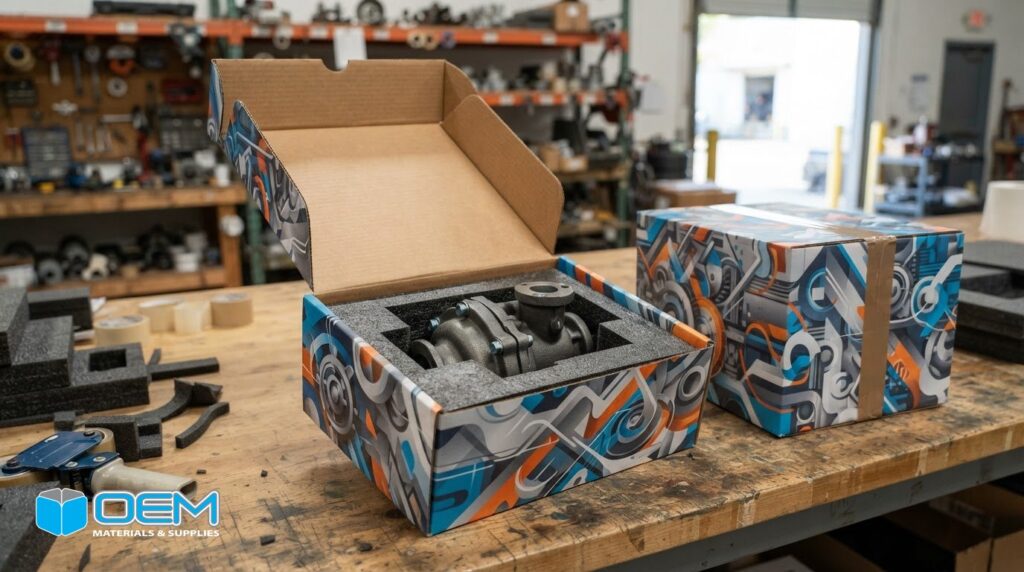
High-graphics litho-laminated boxes for industrial products pair a printed graphic sheet with corrugated board, combining product protection with a polished surface. The sheet is printed, laminated to corrugated material, then converted into a box. This construction helps maintain a clear, high-quality presentation through handling and distribution.
Industrial packaging must do more than look professional. It needs to fit the product, support shipping and warehouse operations, and protect printed faces from scuffs and edge damage. Litho-lamination can address these needs, but results depend on the board structure, print and finish, and how the box will be packed and shipped.
This article explains how litho-laminated boxes are made, what affects their strength and graphic quality, and where they suit industrial and consumer products. It also covers production and packaging considerations that help match the box to your product and distribution needs.
Key Takeaways
- See how a printed top sheet and corrugated board work together to balance product protection with a polished presentation.
- Identify industrial and consumer applications where this packaging can serve shipping, storage, or shelf-display needs.
- Follow the production sequence and understand why litho-lamination takes more setup than some printing methods.
- Learn which board structure, handling practices, and equipment considerations help protect box strength and printed surfaces.
- Compare finishing options such as coatings, varnishes, foil stamping, and embossing to determine what suits your packaging goals.
Industrial and consumer product applications
Litho-laminated packaging suits products that need a strong visual presentation alongside a corrugated shipping structure. A battery carton, for example, can display product identification and handling details while its corrugated construction supports distribution. The same approach can work for fabricated metal parts, small-to-medium car parts, and automotive components. Box dimensions, product weight, and the distribution route help determine the right format.
Industrial applications also include electronics, sound equipment, metal castings, and appliances. A printed exterior can distinguish product models or display brand artwork, while internal cushioning helps limit movement in transit. Delicate electronics may need foam packaging inside the carton, particularly when components require a fitted arrangement. For heavy products, consider the corrugated structure and how cartons will be packed, stacked, and handled.
In beverage packaging, litho-laminated corrugated formats include bottle cases, beverage can wraps, multipacks, and promotional packaging. These formats combine product graphics with a structure designed to carry weight and stack efficiently. A club or warehouse-store package can serve as both shipper and display, reducing the need to transfer products into separate presentation packaging. Wine, beer, and spirits are examples of premium beverages packaged in litho-mounted formats.
Consumer applications include cosmetics, personal care, household goods, toys, packaged foods, and consumer electronics. Cosmetics packaging can use a refined printed surface for shelf presentation, while food and beverage multipacks can make product information visible across the package. Gift and promotional formats also benefit from visual customization. Finishes such as foil stamping can highlight a logo or design detail without changing the box’s basic function.
Choose the format based on the job it must do. A shipping case for metal parts prioritizes product fit, stacking, and protection during warehouse handling. A shelf display for cosmetics or electronics also needs accessible product presentation and coordinated graphics. For high-volume beverage or consumer goods programs, the package may need to move from pallet to retail floor with minimal repacking. These handling steps shape both the structure and print layout.
Packaging teams can map the application by recording product dimensions, weight, packing orientation, and final destination. Then identify whether the package must ship, display, or perform both functions. For a corrugated structure, corrugated box packaging supports the outer package, while fitted foam can cushion fragile items inside. This separation helps align external graphics with the protection needs of products such as electronics or cast metal components.
Litho-laminated box definition and construction
A litho-laminated box combines a printed paper sheet with corrugated board. The paper provides a smooth surface for detailed printing, while the corrugated substrate gives the box its structure. The joined material is converted into a box suited to the product and its distribution needs. For example, a presentation carton for an electronic component can carry precise graphics outside and use corrugated board for support.
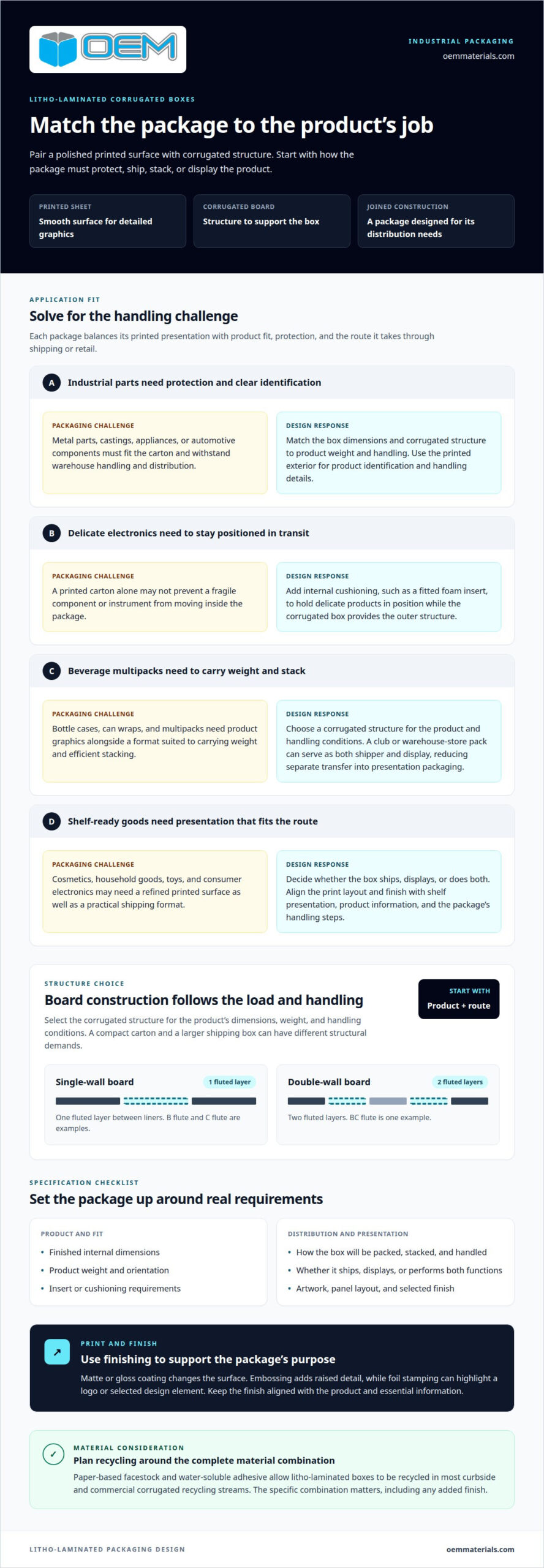
Construction starts with selecting the corrugated structure. Single-wall board has one fluted layer between liners, with B flute and C flute as examples. Double-wall board has two fluted layers, with BC flute as one example. Choose the structure based on the product’s dimensions, weight, and handling conditions. A compact carton and a larger shipping box have different structural demands, even if they use the same artwork.
The printed sheet is mounted onto single-face corrugated material to create a unified surface and board structure. The smooth sheet supports detailed printing more consistently than a textured corrugated face. The material can then be cut, folded, and assembled into a custom box. For medium-volume consumer packaging, this construction can pair a branded exterior with a practical shipping format.
Finish choices affect appearance and feel. Matte or gloss coating changes the surface, while embossing adds raised detail. Foil stamping can highlight a logo or selected design element. Luxury cosmetics packaging may emphasize these visual details; an industrial carton may use restrained graphics for product identification and a clean presentation. Each addition should serve the package’s purpose without competing with essential information.
Paper-based facestock and water-soluble adhesive allow litho-laminated boxes to be recycled in most curbside and commercial corrugated recycling streams. The specific material combination matters, so sustainability planning should account for the paper sheet, adhesive, and any added finish.
To specify artwork, dimensions, structure, and protective inserts, provide the finished internal dimensions, product orientation, and artwork files. Then match the board structure and insert layout to the product. For a delicate instrument, for example, a fitted foam insert can hold it in position while the outer box carries the graphics.
These decisions connect print quality with product fit and handling. When developing high-graphics litho-laminated boxes for industrial products, align the artwork, finished dimensions, flute structure, and insert design before production begins. This helps prevent a mismatch between the printed panel layout and the assembled package.
Litho-lamination process for corrugated boxes
Production planning for litho-laminated cartons begins before press time. The process coordinates artwork approval, plate creation, printing, lamination, converting, and final inspection. Each handoff affects scheduling and whether the finished cartons meet the approved specification.
- Release the artwork. Production begins with approved files and a defined print layout. Teams confirm panel artwork, color targets, and any finishing requirements before plates are prepared. A product label or logo that changes after approval can affect plates and scheduling.
- Prepare plates and schedule the run. Early artwork approval can help production teams coordinate plate preparation and scheduling. The production schedule also accounts for print quantity, finishing choices, and converting requirements. Coordinating these stages helps avoid treating press work and box production as separate jobs.
- Print, laminate, and convert. The approved design moves through printing and lamination before the material is converted to the specified box format. Cutting, scoring, and folding must follow the production layout. Finishing operations, such as applying a selected coating, also need to be scheduled with the run.
- Inspect finished cartons. Final review checks that the run matches the approved artwork and specified format. A formed carton can reveal issues that a flat production sheet may not show, such as an unintended shift in panel alignment or a finish that changes the appearance after folding.
Custom litho-laminated box pricing depends on dimensions, board structure, print coverage, finishes, quantity, and shipping requirements. A quote is based on those project details.
Minimum order quantities and total lead times vary by production route and project requirements. Litho-laminated packaging can become more economical per unit after approximately 5,000 units; digital printing is described as cost-effective for runs under a few thousand pieces because it has no plate costs. Litho plate creation takes weeks, so artwork readiness and production scheduling influence the overall timeline.
Order planning involves more than the press run. Align artwork approval with the required delivery window, then coordinate finishing and converting around the same schedule. Design or specification changes after plates are prepared can affect the production sequence. Clear release decisions help keep each stage on track.
For procurement planning, define the order quantity, approved artwork, required finishes, and delivery needs together. This gives production teams a practical basis for scheduling and quoting, while keeping the graphics connected to the box format they must serve.
Litho-laminated cartons are corrugated boxes printed using lithographic printing, also called litho or offset printing, before lamination and conversion.
Box strength and graphic integrity
A litho-laminated carton has two jobs: protect the product and preserve its printed face. Corrugated board provides the structure, while the mounted sheet carries the lithographic printing. Strength depends on the board construction, product weight and dimensions, and shipping conditions. A premium printed surface cannot make up for a box designed without these factors in mind.
Start with the package’s actual handling path. A carton shipped alone faces different demands from one stacked on a pallet or packed into a master case. For a heavy metal component, the board structure must support the load during storage and transport. For a delicate instrument, a fitted insert can limit movement while the outer carton carries quality graphics and product identification.
Graphic integrity depends on how cartons are handled after production. Palletizing with stretch film and corner protection helps prevent edge damage and scuffing on printed faces. This is useful when finished packages pass through warehouses, where contact with adjacent cartons can mark exposed panels. Apply wrap and corner protection securely without crushing or abrading the box edges.
Litho-laminated boxes offer a smoother, more detailed printed surface than direct-to-corrugate digital printing, which can follow the flute texture. Flexo-printed corrugated boxes print directly on the board, while litho-lamination mounts a separately printed sheet; the choice depends on the required print quality, structure, and production needs. Folding cartons suit different packaging demands, and the stated comparison notes that they contain 15% more fiber than corrugated boxes.
There are practical limitations. Laminated sheets can affect stiffness and folding, so the box must suit automated erectors and case packers. A crease across a logo or fine text can also affect the finished appearance. These factors make converting trials and equipment fit important parts of production planning.
Before production, align the structural design with the graphic layout. Keep critical text and logos clear of scores, folds, and glue areas. Confirm that the chosen board supports the product and intended stacking pattern. A retail-ready shoe-box example uses a 10-point coated litho facestock, showing how a specified sheet can support the presentation goal. That example is not a universal requirement; the product and distribution conditions guide the specification.
Inspect both package function and appearance. Check that panels fold cleanly, corners hold their shape, and printed colors align across major faces. For a premium carton with foil stamping or a large graphic, inspect those details after forming, not just on the flat sheet. The assembled box shows whether the design holds up through converting and handling.
What printing and finishing options produce high-quality graphics on litho-laminated boxes?
Lithographic printing produces photo-quality graphics and accurate color reproduction on the separate sheet mounted to corrugated board. This smooth print surface suits detailed product images, fine text, and brand colors that need a consistent appearance. For a beverage multipack, for example, product photography and color blocks can make the package easier to identify on a retail display.
Color consistency matters across large production runs. Litho printing can maintain consistent colors across hundreds of thousands of identical boxes. To support that result, keep the artwork, color specifications, and approved production sample aligned. Product labels, logos, and image placement should remain consistent across panels, particularly when cartons sit together on a shelf or pallet.
Coatings influence appearance and surface feel. Gloss coating gives graphics a reflective finish, while matte coating reduces shine for a more subdued look. A cosmetics carton might use gloss to emphasize product photography; an industrial electronics box might use matte for a restrained presentation. Choose a finish that suits the artwork and expected handling.
Additional embellishments draw attention to selected details rather than covering every panel. Spot varnish can add contrast to a logo or graphic area. Foil stamping adds a metallic accent, while embossing creates raised detail. A premium beverage carton, for example, could use foil stamping on its brand mark while keeping handling information easy to read elsewhere.
Choose finishes according to the package’s role. A box designed for repeated warehouse handling needs graphics that remain legible across visible panels. A promotional display may prioritize a large image or distinctive surface effect. Litho-mounted sheets can also incorporate moving elements for consumer engagement. Each embellishment should suit the artwork and box layout.
Before approving production, review the graphics on a formed carton, not only on a flat sheet. Check folds, panel transitions, coated areas, and logo placement. A design that looks balanced when flat may put an image across a crease after converting. This review also helps identify whether foil, embossing, or spot varnish interferes with nearby text.
For a high-graphics package, match the finish to the box’s job: clear color reproduction for product identification, selective embellishment for emphasis, and a coating that suits the visual direction. The combination affects the package’s surface and presentation. It should also work with the corrugated structure and finished format.
Share your artwork, box dimensions, product use, and preferred finishes to develop a packaging specification. Request a quote for your printed corrugated packaging with those details ready for review.
OEM Materials & Supplies: Corrugated Boxes
OEM Materials & Supplies can help industrial buyers address the corrugated structure and protective packaging needs behind a litho-laminated box program. Turn to its corrugated boxes when you’re specifying an outer package for product dimensions, weight, and distribution conditions. For delicate components, foam packaging can provide internal cushioning, while packaging kits can bring packaging components together for a defined packing task.
Share the product’s dimensions, weight, packing orientation, and annual usage to guide packaging decisions. Artwork, finish, and litho-lamination requirements can be considered alongside the box structure and protective inserts, addressing visual presentation and shipping needs together.
Contact OEM Materials & Supplies to discuss custom corrugated boxes, foam packaging, or packaging kits for your industrial application.
Plan the next packaging specification
Use your next packaging review to connect the product’s shipping needs with its presentation requirements. For high-graphics litho-laminated boxes for industrial products, start with a clear specification covering product dimensions, weight, handling conditions, artwork, and protective inserts. These details help align the printed package with how your team packs, stores, and ships the product.
OEM Materials & Supplies provides corrugated boxes, foam packaging, and packaging kits to support your packaging requirements. Share your application and relevant product details to begin a practical discussion about your needs.
Contact OEM Materials & Supplies to discuss your packaging requirements. A well-defined next step can help your team move from packaging concepts to a specification that fits the operation.
Frequently Asked Questions
What is Litho-Laminated Packaging?
It’s corrugated packaging with an exterior printed using lithographic printing. For purchasing teams, the key is to coordinate the graphics and package structure in the specification. Align panel artwork with product identification, handling instructions, and information operators need to find quickly. For a product family with several models, a consistent layout can help distinguish carton versions during receiving and inventory handling.
What are litho-laminated boxes and how are they made?
These corrugated boxes are made by printing and laminating a graphic sheet, then cutting and folding the material. In production planning, review artwork placement against the box dieline before approval. A formed sample helps show whether text, logos, and identification marks land where intended. This is especially useful when the same carton design serves several product versions or packing configurations.
What industrial products are best suited to litho-laminated packaging?
Products are good candidates when their packaging must combine a corrugated shipping format with prominent, consistent visual identification. This can suit product families with multiple models, replacement-part assortments, or kits assembled for manufacturing operations. Clear panel layouts help workers distinguish versions during picking and replenishment. The package must also suit the product’s handling and distribution needs; graphics cannot compensate for an unsuitable structure.
What materials, flute grades, and board thicknesses are available for litho-laminated boxes?
Options depend on the corrugated construction selected for the box. To prepare a specification, provide internal dimensions, product weight, closure style, and how cartons will be arranged during shipment. The selected board design determines the finished structure and thickness. A flute designation alone does not describe the complete package; the box layout and intended use also inform construction. These details help purchasing teams compare specifications consistently.
How durable are litho-laminated boxes for shipping, stacking, and warehouse handling?
Assess durability using a representative packed carton in its intended workflow. Run it through normal packing, pallet handling, storage, and shipping, then inspect the seams, corners, and printed panels on arrival. This practical review can show where the package needs a structural adjustment or added internal cushioning. It also reveals whether the finished carton maintains its form and legible graphics throughout your operation’s handling steps.
What are typical minimum order quantities and lead times for custom litho-laminated boxes in the United States?
Minimum order quantities vary by production route and project; litho-lamination can become more economical per unit after approximately 5,000 units. Plate creation takes weeks, and total lead time depends on artwork readiness and production scheduling.