
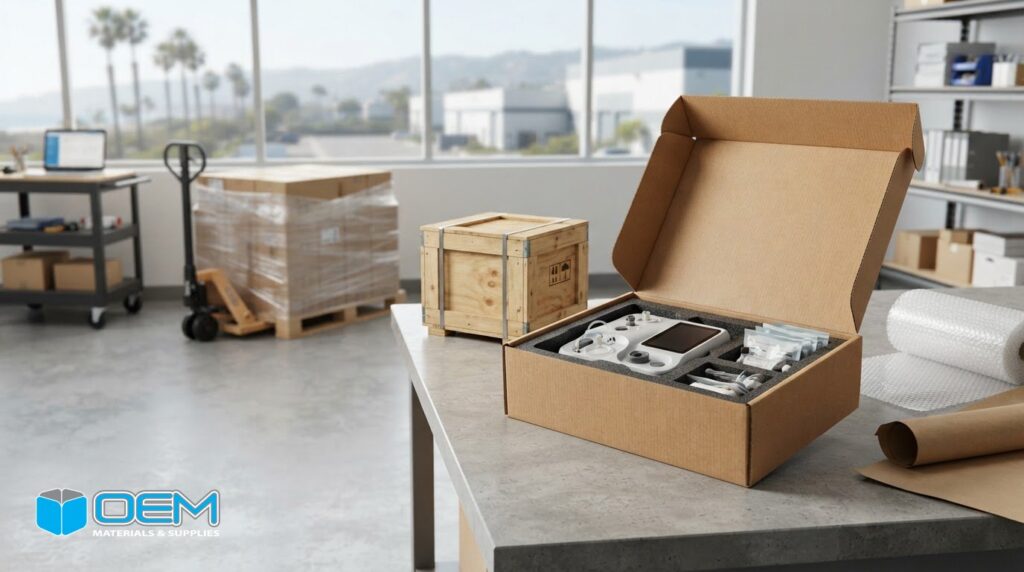
A Carlsbad life science packaging supplier can support pharmaceutical, medical device, and research shipments with packaging selected for the product and its shipping needs. Carlsbad has over 100 life sciences companies, including businesses in medical devices and pharmaceutical development, so packaging requirements can range from cushioning sensitive items to protecting shipments during handling and transit.
Choosing a Carlsbad life science packaging supplier starts with the product and the shipping task. The right materials depend on dimensions, fragility, handling requirements, and shipping method. This guide explains how corrugated boxes, foam, pallets, crates, stretch film, and other options support life science shipments, and what to consider when selecting packaging for pharmaceutical, medical device, and other life science products.
Key Takeaways
- Match protective packaging to the product, handling steps, and shipping conditions to reduce the risk of damage in transit.
- Compare custom packaging options by considering product dimensions, cushioning needs, and how the package moves through fulfillment.
- Understand how corrugated boxes, foam, pallets, crates, stretch film, and tape can work together in a shipping setup.
- Assess supplier fit by looking at packaging capabilities, life science requirements, and how well the solution supports your operation.
- Plan order quantities and replenishment around packaging design, production needs, and expected usage.
Packaging for pharmaceuticals and medical devices
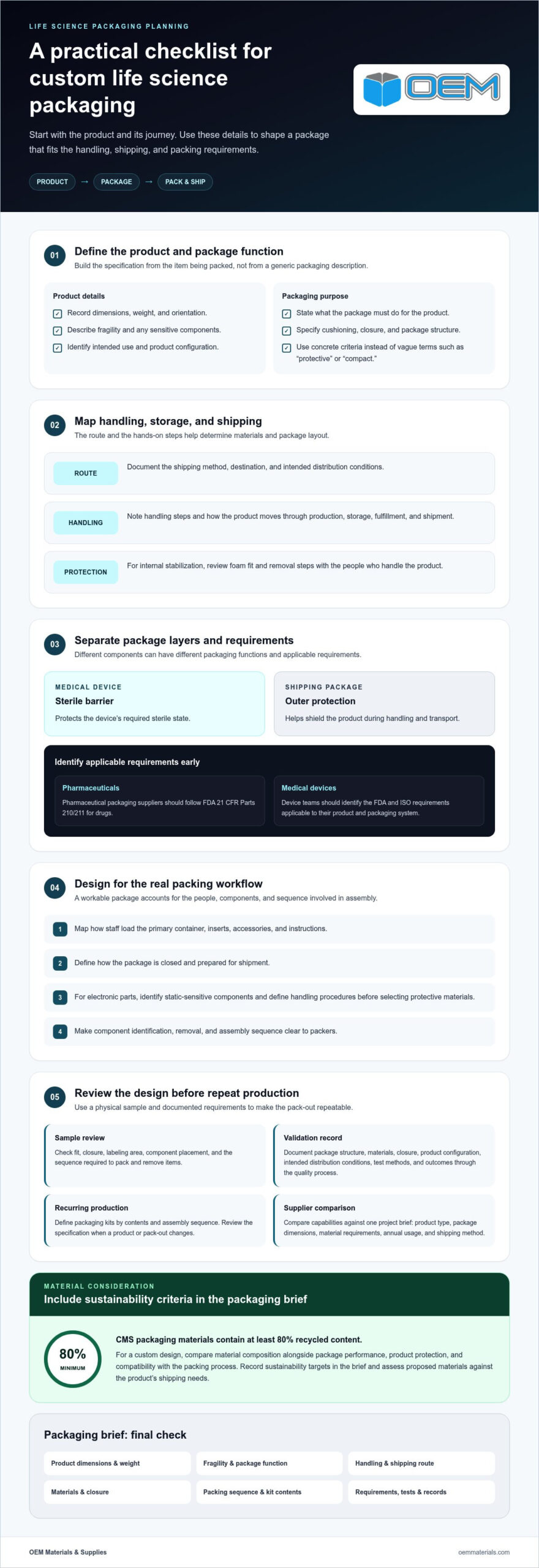
Pharmaceuticals and medical devices need packaging designed around the product, its intended use, and its shipping route. A sterile instrument, diagnostic device, and medicine container each have different requirements. Document the product’s fragility, handling steps, package function, and destination first. Those details guide material selection and help ensure the package supports both product protection and the packing workflow.
FDA and ISO requirements depend on the product category, intended use, and packaging function. Pharmaceutical packaging suppliers should follow FDA 21 CFR Parts 210/211 for drugs, while device teams should identify the applicable FDA and ISO requirements for their product and packaging system.
For medical devices, distinguish the sterile barrier from the outer shipping package. The sterile barrier protects the device’s required sterile state, while the outer package helps shield it during handling and transport. Nonsterile instruments and electronic components have different needs. For example, cushioning around a circuit board should prevent movement without pressing on connectors. The package should also let staff identify and remove components in the intended sequence.
Address design and validation early. Life Science Outsourcing reports that medical device packaging design and validation challenges are often the largest cause of FDA recalls. Package performance belongs in product risk management, not just shipping preparation. Document the package structure, materials, closure, product configuration, and intended distribution conditions. Evaluate the design for its intended use, and record test methods and outcomes through the organization’s quality process.
Packaging supplies and equipment should suit the actual packing workflow. A team assembling diagnostic kits, for example, may need an organized work surface and a clear sequence for loading the device, accessories, and instructions. Choose equipment with component handling and packing-station space in mind. For electronic parts, identify static-sensitive components and define appropriate handling procedures before selecting protective materials.
Carlsbad’s Bio, Tech and Beyond incubator provides 6,000 square feet of space for startups to rent bench space for research and development. Early-stage teams can benefit from recording packaging assumptions as product designs evolve. A practical brief identifies the product, packaging function, assembly sequence, shipping route, and applicable quality requirements. That record gives engineering, operations, and purchasing a shared reference as development moves toward shipment.
For device components requiring internal stabilization, foam packaging for protective support can be considered within the overall package design. Review fit and removal steps with the people who handle the product, then document the approved pack-out for repeat use.
Custom packaging for life science and pharmaceutical goods
Custom packaging starts with the product and its route through production, storage, and shipment. A pharmaceutical bottle, diagnostic instrument, and set of laboratory components each need a different layout and level of protection. Document every item’s dimensions, weight, orientation, handling sequence, and packaging function. Use those requirements to define the package structure, cushioning, and closure. A clear specification also helps purchasing and operations teams compare designs using concrete criteria instead of vague terms such as “protective” or “compact.”
Pharmaceutical development can change packaging needs as a product moves from research to production. A package designed for a small development batch may not suit contract manufacturing, where repeatable assembly and material availability matter. Map the packing steps before finalizing a design. Note how staff load the primary container, add inserts or instructions, close the carton, and prepare the shipment. Custom packaging design can translate those steps into a workable package layout.
A pharmaceutical packaging company directory is most useful when entries describe relevant capabilities, not just company names. Organize the search around the work required: custom box production, fitted cushioning, kit assembly, or recurring shipment support. In Carlsbad, purchasing teams can compare suppliers against one consistent project brief. Include the product type, package dimensions, material requirements, annual usage, and shipping method. This makes discussions specific and helps reveal any gap between a proposed package and the production workflow.
For contract manufacturers, consistency across batches is a practical packaging requirement. A packaging kit can group the box, insert, and other components needed for one product configuration. This can simplify staging and reduce selection errors when several product versions share a work area. Define each kit by its contents and assembly sequence, then make the instructions clear to packers. A product or pack-out change should trigger a review of the associated packaging specification.
Sustainable pharmaceutical packaging also needs measurable material criteria. CMS packaging materials contain at least 80% recycled content. For any custom design, compare material composition alongside package performance, product protection, and compatibility with the packing process. Replacing material without reviewing fit and handling can create new damage or assembly problems. Procurement teams can record sustainability targets in the packaging brief, then assess proposed materials against those targets and the product’s shipping needs.
Before approving a custom package, review a physical sample with the people who will pack and receive it. Confirm fit, closure, labeling area, component placement, and the sequence required to pack the product. Record revisions so purchasing, production, and quality teams work from the same design. To scope a project, share product dimensions, weight, configuration, and expected usage through a packaging quote request.
Another supplier review point is data exchange. The directory recommends confirming that suppliers can exchange serialization data via EPCIS for DSCSA compliance. Include this capability in the project brief alongside package design and production requirements, and confirm the exchange requirement before selecting a supplier. This keeps serialization support visible during comparison instead of leaving it until packaging workflows are finalized.
Corrugated boxes, foam, pallets, crates, stretch film, and tape
Packaging works as a system, with each layer addressing a different transport need. A corrugated box contains the shipment, while interior cushioning limits product movement. For a sensitive diagnostic instrument, a fitted foam insert can separate the instrument from accessories and keep components organized. Select the box and cushioning together, using product dimensions, weight, and packing orientation to define the interior layout. Aim for a pack-out that protects the item without making assembly unnecessarily difficult.
Corrugated boxes suit many life science shipments because they provide an outer enclosure sized to the contents. A box with too much open space may need extra cushioning and can let contents shift. A close-fitting design can reduce movement, but must still leave room for inserts and packing steps. For example, a box holding a device and a separate accessory tray should support both without forcing them into contact during handling.
Foam helps position products that need dedicated support inside the outer package. For a device with protruding controls, a shaped insert can hold the body without pressing on those features. Cushioning materials can also fill space around packaged components. Match the material and layout to the product’s shape and handling needs. Keep the packing sequence clear so staff place each part in its intended position before closing the box.
For larger loads, pallets and crates support unitization and handling. A pallet organizes multiple cartons into one load, while a crate encloses products that need a more substantial outer structure. Several equipment cartons, for example, can be arranged on a pallet and secured for warehouse handling. A single large or irregular item may call for a crate instead. The load’s footprint, weight distribution, and handling points help determine the right format.
Stretch film holds grouped cartons together on a pallet and helps keep the load arranged during transport. Apply it so cartons stay aligned and accessible for receiving. Packaging tape closes corrugated boxes and secures seams; choose an application suited to the box closure and packing process. Tape does not replace cushioning or load restraint. Each material has a distinct job, so do not rely on one layer to solve every protection or handling issue.
Build the pack-out in sequence: position the product, add internal supports, close the box, then unitize larger shipments. Review each step with the people who pack and receive the goods. Check that the product stays in place, accessories remain separated, and labels are visible after packing. For palletized cartons, inspect the finished load for shifting or unsupported edges. These practical checks help teams identify design changes before adopting packaging for routine shipments.
Carlsbad packaging supplier listing
When comparing Carlsbad life science packaging suppliers, assess the solutions they support and how they handle order fulfillment. Compare material scope, custom design capability, documentation practices, order coordination, and delivery model. A supplier focused on cartons may suit a standard outer-packaging need, while product-specific inserts require different capabilities. Delivery planning also depends on the package design, material inputs, order quantity, and receiving schedule.
A directory is more useful when it distinguishes supplier roles instead of treating every company as interchangeable. A packaging material supplier may provide cartons or cushioning, while a custom packaging partner can develop a package around a product’s geometry. A contract packager handles packing as part of production. These roles can overlap, but buyers should match each one to a defined operational need before comparing proposals.
Build a supplier comparison around the shipment and work process. Record the product configuration, packaging components, packing location, and destination, then identify which capabilities matter for the project. A team shipping a fragile instrument may prioritize insert design and pack-out instructions. A team shipping repeat product kits may focus on component grouping and replenishment coordination. This keeps a directory search tied to actual requirements rather than broad claims.
- Packaging scope: Note whether the supplier supports cartons, protective inserts, kits, or larger load formats.
- Design support: Identify whether the project needs a standard package or product-specific layout.
- Production fit: Compare proposed materials with the packing sequence and available work area.
- Delivery planning: Align order timing with production schedules, receiving capacity, and inventory needs.
For delivery comparisons, distinguish replenishment of a standard item from delivery of a newly designed package. A standard carton follows an established specification; a custom package requires design decisions and material coordination before repeat orders. For either, map the requested delivery date against approval steps, order processing, and receiving arrangements. This makes supplier comparisons practical without relying on a general lead-time estimate.
Carlsbad’s life sciences community includes pharmaceutical development and medical device activity, so supplier fit depends on the product and workflow. A receiving team handling multiple configurations may need clearly identified packaging components. A manufacturer shipping one device configuration may value repeatable pack-out instructions. Use the same project details when comparing providers, including product dimensions, weight, packaging function, and shipping destination.
Before selecting a partner, summarize the requirement in a concise project brief. Include the product, existing package, desired changes, order pattern, and delivery destination. Ask each candidate to describe its role, from material supply through design or packing support. Comparing responses against the same brief helps purchasing and operations teams identify the supplier whose services and delivery approach best match the work.
What are the minimum order quantities and lead times for life science packaging in Carlsbad?
Minimum order quantities and lead times vary by packaging type and production method. A standard stock carton differs from a custom package requiring dedicated dimensions, printing, or fitted components. Custom orders can involve material sourcing and production setup, while repeat orders may follow an established specification. Ask for the quantity and schedule for the exact package design rather than applying one estimate to every packaging item.
For minimum-order planning, consider how many product configurations share packaging components. If two device versions use the same outer box but different inserts, assess whether to order the boxes and inserts separately or as matched sets. Separate ordering can affect storage and assembly; matched sets can tie inventory to a specific product configuration. The right structure depends on how items are picked and packed.
Customization can affect both order size and timing. Printed cartons, a newly developed insert, or a kit with several components may require coordination across production steps. A package revision can also change materials or make existing stock incompatible with the new design. Record the revision status on the packaging specification and keep superseded versions separate. This helps prevent obsolete materials from entering current production.
Demand planning helps balance order quantity against inventory exposure. Compare forecast consumption with storage capacity, product change cycles, and the risk of packaging becoming outdated. A product team expecting a label or configuration change, for example, may avoid excess packaging tied to the old version. A stable, recurring pack-out may support a different replenishment approach. Review these factors with purchasing and engineering before setting a reorder point.
Lead-time estimates also depend on whether a package is established or still in development. A new configuration may require design work and sample evaluation; a repeat order follows a known specification. Changes to materials, artwork, component count, or production demand can affect the schedule. Identify which decisions are final and which remain open before planning the delivery date. This helps teams set a realistic internal purchasing schedule.
For a useful order discussion, prepare a packaging bill of materials, product configuration, forecasted usage, revision status, and target inventory level. Identify which components are shared across products and which are configuration-specific. These details help clarify the order quantity and expose potential obsolescence or storage concerns. To discuss packaging requirements and request a quote, send your packaging details, including dimensions, weight, and expected usage.
OEM Materials & Supplies: Corrugated Boxes
OEM Materials & Supplies helps life science teams select corrugated boxes for product dimensions, cushioning needs, and shipping workflows. Choose custom packaging when standard cartons do not fit the product or packing process. Foam Packaging adds interior support for sensitive items, while Packaging Kits group components for a defined pack-out. Mailing Tubes & Cores suit items that need a tube format rather than a box.
For a useful packaging recommendation, prepare the product’s dimensions, weight, configuration, and expected usage. Include how the item will be packed and shipped. These details help align the box and protective materials with operational needs.
Contact OEM Materials & Supplies to discuss corrugated packaging for your life science shipments.
Turn Packaging Requirements Into a Clear Next Step
Make packaging part of your operating plan as product configurations and workflows develop. Keep approved specifications current so engineering, purchasing, and warehouse teams work from the same requirements.
When evaluating a Carlsbad life science packaging supplier, focus on the product and the challenges your team needs to solve. A concise project brief clarifies priorities and guides the next discussion.
To start that conversation with OEM Materials & Supplies, send your packaging project details. Include relevant product and shipping requirements, and take the next step with confidence.
Frequently Asked Questions
Which packaging suppliers serve life science companies in Carlsbad, California?
OEM Materials & Supplies serves manufacturers across Southern California, including San Diego County and Carlsbad. For companies seeking a Carlsbad life science packaging supplier, OEM provides custom packaging solutions and packaging logistics for medical, electronics, and other industrial applications. The company also serves manufacturers across the United States. Start by identifying the product and packaging challenge, then discuss a solution suited to your shipping and production needs.
What life science packaging products do Carlsbad-area suppliers offer?
Available packaging products include corrugated boxes, foam packaging, packaging kits, mailing tubes and cores, cushioning materials, plastic pallets, crates, edge protectors, and stretch film. The right combination depends on the shipment. A manufacturer sending documents or long components, for example, may use mailing tubes, while a team shipping grouped cartons may need pallets and stretch film. Matching products to the shipment format helps avoid unnecessary materials and handling steps.
What should buyers consider when choosing a life science packaging supplier in Carlsbad?
Compare how each supplier’s products and services fit your operation, not just the individual material. Consider product protection, packing labor, storage space, order patterns, and coordination between purchasing and production. A manufacturer managing recurring component needs may benefit from vendor-managed inventory, while changing demand may make just-in-time replenishment relevant. OEM Materials & Supplies offers both services alongside packaging products for industrial manufacturers.