
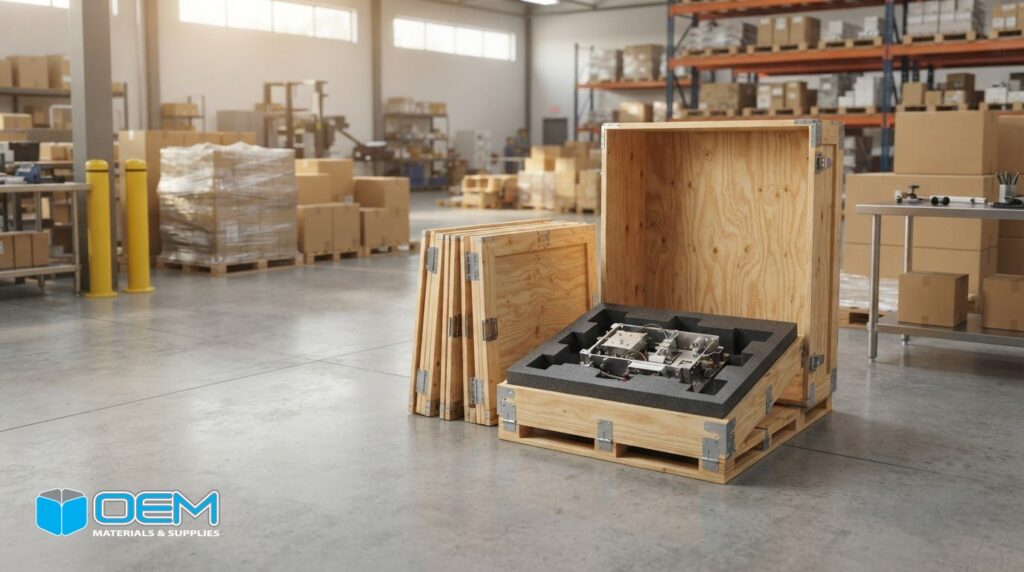
A crate that folds flat can still be the wrong choice for a shipment. If you’re searching for a “collapsible wood crate supplier riverside,” start with the product and its route, not foldability alone. The crate must protect the load and fit the way your team packs, handles, ships, and returns it.
Warehouse space matters, especially when empty packaging accumulates between shipments. But reducing storage volume only helps when the crate also suits the product’s dimensions and weight, the shipment conditions, and the handling steps at each stage. A mismatch can lead to product damage, slower packing, or extra labor.
This guide explains how to define crate requirements from product and shipping information, then compare protection and handling needs with storage and return logistics. You’ll also find the project details that help shape a practical recommendation. OEM Materials & Supplies serves Riverside and the wider Southern California market with wood crates and custom packaging design, supporting projects from prototypes through higher-volume programs.
Key Takeaways
- Choose a collapsible crate based on product protection, packing workflow, storage space, and return plans, not foldability alone.
- Document product dimensions, weight, fragility, and handling needs to guide crate design around the shipment.
- Compare reusable crates with fixed crates and one-way packaging using your actual storage, recovery, and reuse plans.
- Share shipment frequency and annual usage with a collapsible wood crate supplier in Riverside to help shape a project-specific packaging recommendation.
- OEM Materials & Supplies connects wood crate design with shipment conditions and operating needs for Riverside-area businesses.
When a Collapsible Wood Crate Makes Sense for Riverside Shipping
A collapsible wood crate is designed to take up less space when it is not assembled. That describes its storage purpose, not how well it protects a particular load. Match the crate specification to the product, shipment conditions, and handling process. Also consider what happens after delivery: packaging sent out once follows a different path from packaging that returns for reuse.
Consider the full cycle before selecting the format. A crate may need to be assembled for packing, moved through a facility, shipped, opened at its destination, taken apart, and stored or returned. Each step affects labor, staging space, and how consistently the operation can handle the packaging. A design that reduces empty storage needs may not suit an outbound-only flow with no practical recovery route.
What Does Collapsible Mean in a Wood Crate?
The term refers to a crate designed to take up less space in storage when it is not assembled. It does not specify a particular panel, fastener, or folding mechanism. Assess assembly, disassembly, storage, and handling as one workflow, then confirm that the crate suits the product’s dimensions, weight, protection needs, and shipment requirements.
For reusable packaging, map each handoff between your shipping point and the return destination. Identify who receives the crate, where it waits after unloading, and how it gets back to your operation. If customers or other facilities regularly return packaging, evaluate a collapsible format against the time and space needed to manage those returns. If the shipment is outbound-only, the expected return benefit may not apply.
Compare empty-crate storage with the space required for packed shipments. A warehouse with limited room for packaging may benefit from a smaller stored footprint, but the crate still has to fit the packing area and be accessible when needed. Decide where empty crates will be staged, how workers will prepare them for use, and whether those steps interrupt other warehouse activity. OEM Materials & Supplies provides wood crate packaging as part of its industrial packaging offering.
When Does the Riverside Supply Chain Benefit?
Riverside and Inland Empire operations may ship to nearby facilities, regional distribution points, or destinations farther away. Don’t assume a shipment is local simply because it starts in Riverside. Review the actual route and return path, including whether packaging comes back with a regular delivery or requires separate coordination.
A collapsible format is most relevant when the operation has a workable reuse loop and empty-crate storage is a constraint. Before specifying one, document:
- Whether packaging returns, and who coordinates the return.
- Where empty crates are stored and how much space is available.
- How often shipments occur and where packing takes place.
- Which handling steps the crate must accommodate at origin and destination.
These details help Riverside buyers decide whether storage and return logistics justify considering a collapsible format, while keeping product protection and daily handling at the center of the decision.
How Product and Shipping Requirements Shape Collapsible Wood Crate Design
Crate requirements follow the product, route, and handling conditions. A collapsible format addresses storage when the crate is not assembled, but the loaded crate still has to accommodate the product and the work required to pack and move it. Begin with the load, then map the shipment from the packing area to its destination. This gives packaging designers practical criteria instead of assumptions based on crate style alone.
Translate Product Data into Packaging Requirements
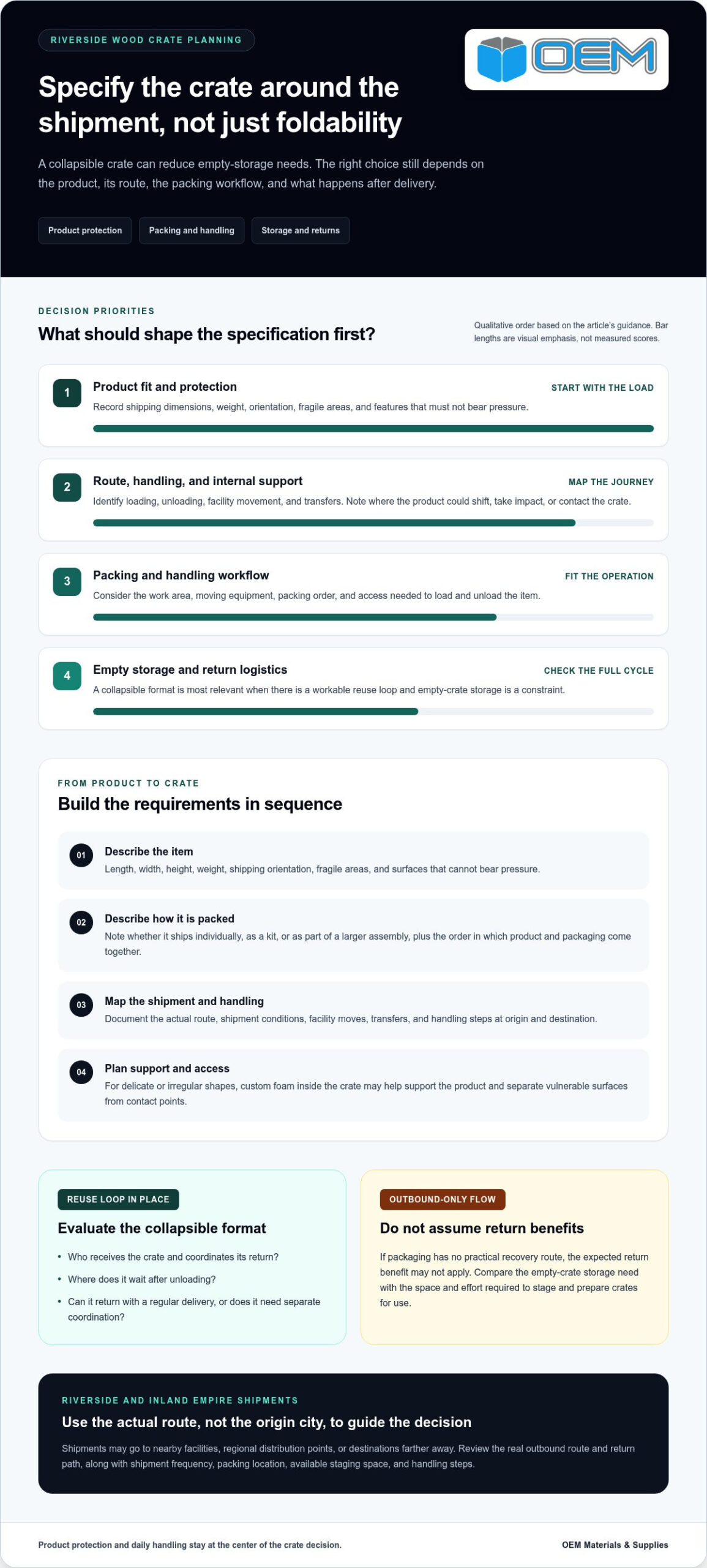
Record the product’s length, width, height, and weight in its shipping configuration. Note its intended orientation, fragile areas, and features that must not bear pressure. Also identify whether it ships individually, in a kit, or as part of a larger assembly. These details influence how the load is positioned, supported, and accessed during packing and unloading.
Next, document the actual packing process. Consider the work area, lifting or moving equipment, and the order in which the product and packaging are brought together. A load packed as a complete assembly may require a different access sequence than separate components packed together. The crate should fit the process employees use, not just the product’s outer dimensions.
Assess Handling, Protection, and Internal Support
Map each relevant handling point: loading, unloading, movement within a facility, and transfers between locations. Note where the product could shift, contact the crate, or be exposed to impact. Describe the route and shipment conditions accurately without assuming a specific transport mode. These details help determine what the outer crate must do and where internal support may be needed.
For a delicate or irregularly shaped item, the wood crate may need cushioning or foam inside to limit movement and separate vulnerable surfaces from contact points. Internal support should match the product’s shape and packing orientation. Custom foam packaging can provide product-shaped support inside an outer crate. The right combination depends on the item and its handling requirements, not on a universal insert design.
Share product data and route details with a collapsible wood crate supplier in Riverside so the recommendation can account for protective needs and the packing operation. Include drawings or photos when available, plus information about how the product is positioned and handled. PMMI, The Association for Packaging and Processing Technologies, provides broader industry context through its overview of the packaging and processing industry.
OEM Materials & Supplies connects crate design with product dimensions, shipment conditions, and operating needs for Riverside manufacturers. For a project-specific discussion, share your product dimensions, weight, and shipment details to establish a useful starting point.
Collapsible Wood Crates Compared with Fixed Crates and Other Packaging
No packaging format is right for every operation. Compare options against the product, packing workflow, available storage, shipment conditions, and what happens after delivery. A collapsible crate may reduce the space needed to store empty packaging, while a fixed crate may suit an operation that prioritizes a consistent format and has room to stage it. Neither option is automatically more efficient.
Collapsible Versus Fixed Wood Crates
Assess both formats across the full packing cycle. A collapsible crate requires a repeatable process for preparing it for use and returning it to storage after unloading. A fixed crate avoids that assembly step but occupies its assembled footprint while empty. The better fit depends on facility space, staff workflow, shipment frequency, and whether packaging returns to the shipper.
Include setup and handling in the comparison. Consider who prepares each crate, how it moves through the packing area, and whether the process is consistent across repeated runs or different shifts. If assembly adds complexity, weigh that against any storage advantage. If a fixed crate can be staged near the packing line without disrupting operations, its larger empty footprint may be manageable.
Reverse logistics matter. A collapsible format has limited operational value if the crate is not recovered, or if returning it requires a separate process the business cannot sustain. For a reusable program, map the destination, collection point, return method, and space for empty crates at both ends. Buyers comparing collapsible wood crate supplier options in Riverside should evaluate these practical steps, not just the stored package dimensions.
Wood Crates Versus Corrugated Packaging
Wood crates and corrugated packaging serve different needs, but material alone does not determine suitability. Product characteristics, shipment conditions, and handling requirements should guide the choice. A product’s shape, fragility, weight, and need for internal support all affect the packaging system, as do the route and the way the shipment will be handled.
Corrugated packaging may be appropriate when its structure and protective components suit the product and shipment. Wood crates may be considered for projects with different containment or handling requirements. Avoid choosing by material label alone. Compare the complete pack, including cushioning, preparation, how the product is loaded, and whether the package is intended for reuse or one-way shipment. OEM Materials & Supplies offers corrugated box packaging to evaluate alongside crates when the application allows.
For one-way packaging, focus on the outbound shipment and how the package will be handled at its destination. For reusable packaging, include recovery, inspection, storage, and reuse in the operating plan. If those steps are undefined, a reusable format may create coordination work without serving a clear return cycle. Compare packaging using your actual process, then select the option that balances product requirements with the labor and space your operation can support.
A Riverside Buyer’s Checklist for Specifying a Collapsible Wood Crate
A clear project brief helps align crate design with the product, shipping route, and daily packing process. Gather the information in sequence, from the load itself through shipment and return requirements. This gives OEM Materials & Supplies a practical basis for evaluating packaging and preparing a project-specific quote.
Gather the Information Needed for a Useful Quote
Start with the product as it will be packed. Record its dimensions, weight, intended orientation, and areas that need protection. Note whether it ships alone, as a kit, or as part of a larger assembly. Include drawings or photos when they clarify the product shape or show features that could affect packing and internal support.
- Describe the load. Provide product dimensions and weight in the shipping configuration, plus any orientation requirements, fragile areas, or other protection concerns.
- Map the shipment. List destinations or destination types, relevant handling points, and the steps involved in loading, unloading, and transferring the packaged product.
- Define the return flow. State whether the crate returns to your facility, where it will be collected, and how returned packaging is handled and stored.
- Estimate usage. Include shipment frequency and annual usage. Note expected changes in volume that could affect how packaging is purchased, staged, or replenished.
- Describe operating constraints. Identify available packing and storage space, equipment used, and any workflow steps that affect how the crate is prepared or handled.
Evaluate the Packaging Workflow Before Selecting a Design
Walk through a normal packing run from preparation to storage. Identify who assembles, packs, closes, moves, and stores the crate, and note where the process requires repeated manual steps. This helps distinguish a packaging design issue from a workflow issue. It also shows where project-specific design or assembly support could make packing more consistent.
Cost depends on the project, including materials, crate dimensions, shipment requirements, and the packaging workflow. A returnable program also depends on how packaging is recovered and reused. Compare these factors alongside product protection and labor requirements rather than treating the crate’s purchase cost as the only consideration.
OEM Materials & Supplies uses product and operating details to inform custom packaging design for Riverside-area manufacturers. Businesses in Riverside, Orange County, Los Angeles, and San Diego can provide this specification to help ensure the recommendation reflects actual product, route, and workflow needs.
Ready to scope a project? Request a packaging quote and include product dimensions, weight, shipment frequency, and annual usage.
How OEM Materials & Supplies Supports Wood Crate Projects for Riverside Businesses
Wood crate projects involve more than the outer package. Product protection, packing steps, shipment conditions, and supply requirements all affect how packaging fits an operation. OEM Materials & Supplies serves manufacturers in Riverside and across Southern California, including Orange County, Los Angeles, and San Diego, with wood crates and custom packaging design for projects from prototypes through higher-volume production programs.
The goal is to connect packaging decisions with the work happening on the production floor and in the warehouse. A crate recommendation should reflect the product and the way employees pack, stage, and ship it. This project-specific approach helps purchasing, engineering, and operations teams work from the same requirements instead of treating the crate as an isolated purchase.
Coordinate Crates with the Broader Packaging Program
OEM Materials & Supplies can consider a crate alongside related packaging components and packing processes. For example, product support inside the crate and the steps employees follow to prepare a shipment may influence the overall design. Explore wood crate packaging as part of a broader packaging discussion, with project details guiding how the packaging fits the application.
For recurring packaging requirements, vendor-managed inventory can support supply coordination. Kitting or assembly may also be relevant when a project involves repeatable preparation tasks. These services are useful to consider when they address a defined workflow need, such as coordinating packaging components or preparing recurring kits.
Prepare for a Project Discussion
Bring together the information that affects packaging selection: product dimensions and weight, protection concerns, shipment destinations and conditions, handling steps, and expected annual usage. Include workflow constraints, such as packing-area space or how employees prepare shipments. This gives the project discussion a practical starting point.
Those details matter because a recommendation depends on the product and its logistics, not simply on the crate format. A prototype project may call for a different evaluation process than a recurring production program. Sharing the project scope and usage pattern helps align design considerations with the operation.
Riverside businesses evaluating collapsible wood crate suppliers can work with OEM Materials & Supplies to connect crate design with operational requirements. The team considers the product, shipment conditions, and packaging workflow together to define a project scope suited to the application.
Request a quote for your crate project and include product dimensions, weight, annual usage, and shipping requirements.
Move Your Crate Project Toward a Clear Specification
Packaging needs can change as products, production plans, and shipping routes evolve. Treat the crate specification as a practical reference for the operation, and revisit it when those requirements shift. This keeps packaging decisions connected to the work being done rather than relying on assumptions from an earlier project stage.
As you evaluate a collapsible wood crate supplier Riverside project, bring the relevant product and logistics details into the conversation. A clear starting point helps align next steps with your operation’s priorities and provides a basis for a project-specific quote.
Request a quote for your Riverside-area crate project to start a discussion with OEM Materials & Supplies. Include the key project details to develop a packaging plan grounded in how your products are prepared and shipped.
Frequently Asked Questions
What is a collapsible wood crate, and how does it work?
A collapsible wood crate is designed to take up less space when it is not assembled. The assembly process depends on the design, so document the steps employees must follow and how the parts are kept together between uses. A clear work instruction helps employees handle the crate consistently, especially when more than one team or shift prepares shipments.
When should a business use a collapsible wood crate instead of a fixed crate?
Consider a collapsible format when reducing the space occupied by empty packaging addresses a real facility constraint. Before deciding, observe a representative packing run and account for the time and labor involved in preparing the crate. Compare that effort with the space required to stage a fixed crate. A small operational trial can help teams assess workflow fit before adopting a format across repeated shipments.
Can a collapsible wood crate be reused for return shipments?
Reuse is possible if the crate returns in suitable condition and the business has a process for assessing it before another shipment. Establish who reviews returned packaging and what condition is acceptable for reuse. Keep a record of crates removed from circulation and why. This gives operations teams a consistent way to manage the return loop instead of assuming every returned crate is ready for another shipment.
What information should I provide when requesting a wood crate quote in Riverside?
Along with core product and shipping information, explain whether the project is for a prototype, a limited run, or recurring production. Note product variations that may affect packaging, planned design changes, and any existing packaging the new crate needs to work with. These details help scope the request and distinguish a one-time packaging need from a continuing program.
How do I determine whether a wood crate provides enough protection for my product?
Use observed shipment outcomes to guide the evaluation. Review damage reports or recurring product issues, then inspect a representative packed shipment after delivery for movement or contact marks. Share those findings with the packaging team so the review focuses on actual concerns. This evidence can inform design adjustments, though it does not replace evaluating the product and shipment conditions for the specific project.
What factors affect the cost of a custom wood crate project?
To compare quotes meaningfully, make sure each one reflects the same project scope, expected order volume, and product configuration. A prototype request and a recurring production requirement may involve different design and supply considerations. Clarify anticipated product variations or revisions as well. These details help explain differences between proposals without relying on a price comparison that leaves important scope assumptions unstated.