
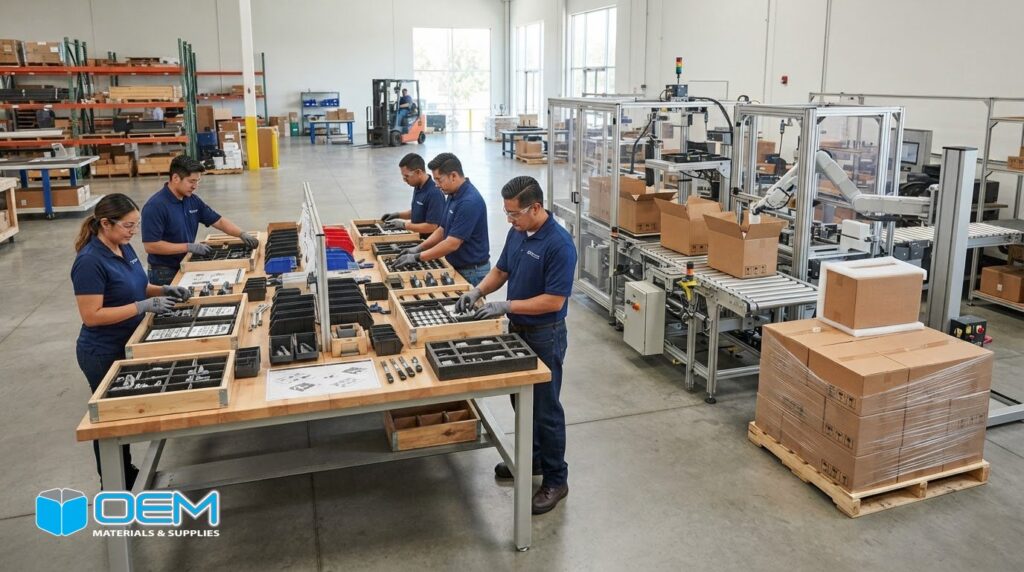
The best answer to a packaging bottleneck may not be a machine. In a packaging automation vs outsourced kitting decision, the right approach depends on how consistently work arrives, which tasks consume capacity, and what it takes to maintain quality. Equipment may fit when demand and tasks are stable. Outsourcing can move defined kitting and assembly work outside the facility without requiring the same internal equipment investment.
It’s reasonable to scrutinize both options. Manual packing can draw people and production space away from other work, while an equipment request needs to reflect actual labor, throughput, integration, and maintenance requirements. Outsourcing raises its own questions about process control, quality, and supply continuity. A useful comparison addresses those concerns instead of relying only on purchase price or a simple labor estimate.
This article provides a consistent way to evaluate operational fit, total cost, and risk. You’ll see which assumptions to document, what decision-makers need to assess, and how to build an approval case grounded in operating data. The goal is a practical next step, whether that means evaluating equipment, outsourcing kitting, or refining the project assumptions first. For manufacturers in Orange County, Los Angeles, Riverside, and San Diego, the same framework can help clarify how packaging work fits into local production and material flows.
Key Takeaways
- Compare packaging automation vs outsourced kitting against the same demand, product mix, and work scope.
- Build an equipment request from baseline process data, including labor, throughput, space, and process constraints.
- Assess control, quality ownership, changeovers, and flexibility alongside cost when comparing the two operating models.
- Use a risk register to document assumptions about staffing, scheduling, quality, and supply continuity.
- Define the target task and demand profile before choosing a next step, including whether kitting, assembly, VMI, or just-in-time delivery could inform the decision.
Packaging Automation vs. Outsourced Kitting: Define the Decision
Packaging work draws on resources that are already needed elsewhere: labor, floor space, and production capacity. The pressure may come from a repetitive task, such as forming and sealing cartons, or from assembling several components into one shipment-ready package. Before comparing options, define the work causing the constraint. Packaging automation vs outsourced kitting is a make-or-buy decision about a specific scope of work, not a universal verdict that equipment or outsourcing is always better.
Packaging automation uses equipment to perform selected tasks inside a facility. Outsourced kitting moves specified components and assembly steps to an external partner, which prepares production-ready or shipment-ready kits according to agreed work instructions. These approaches address different parts of a workflow. Automation changes how a task is performed in-house; outsourcing changes where and by whom defined work is completed.
What packaging automation changes inside a facility
An automated system can take on a particular operation, but it doesn’t necessarily eliminate every adjacent manual step. Employees may still prepare materials, load products, inspect output, or move completed packages. The Packaging machinery overview provides context on equipment types. For a business case, the key question is which specific task fits your operation.
Map the process boundary. Identify the task the equipment would perform, then document the work before and after it. Assess product mix, demand patterns, available space, and labor availability. A system suited to a stable, repeatable task may be less useful when product configurations or schedules change often. These conditions shape the workflow and equipment responsibilities, including setup, operation, and upkeep.
What outsourced kitting changes in the workflow
With outsourced kitting, your team defines the components, quantities, and assembly instructions for each kit. Materials must be made available to the kitting workflow, and finished kits must be scheduled and routed to where they are needed. Plan the handoffs: who supplies each component, how instructions are maintained, when kits are required, and how completed work returns to production or shipping.
OEM Materials & Supplies provides kitting and assembly for manufacturing customers. If packaging supply timing is also under review, just-in-time packaging delivery can be a related planning consideration, separate from the kitting decision itself.
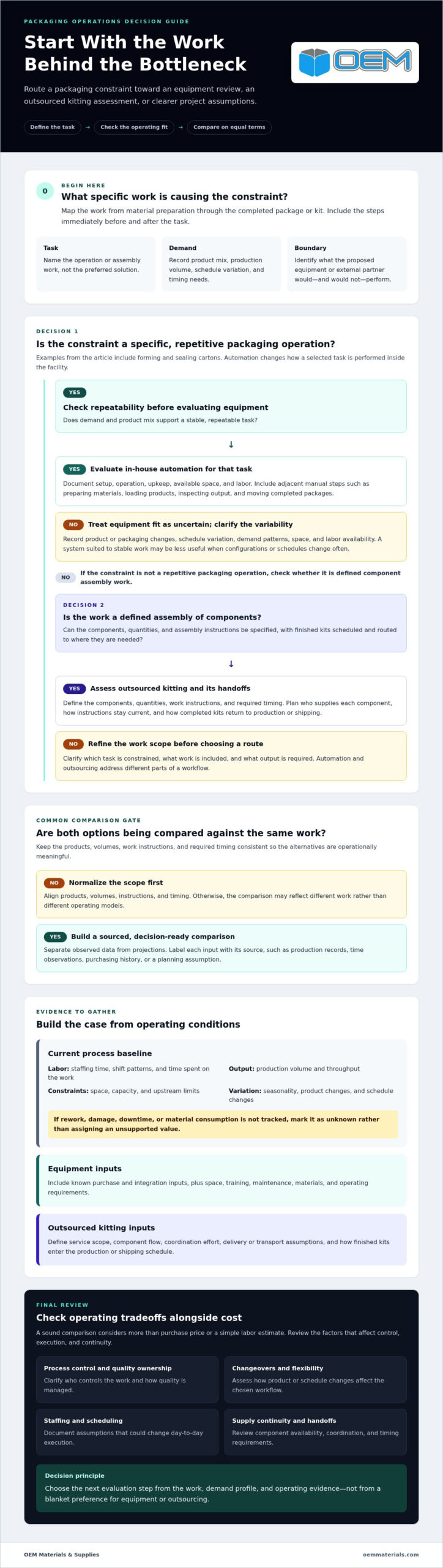
Start with the work, not the preferred solution. If the constraint is a repetitive packaging operation that fits the facility’s demand and product mix, evaluate equipment for that task. If the work is a defined assembly of components that can be prepared outside the facility, assess outsourced kitting and its handoffs. Keep the scope consistent: compare the same products, volumes, instructions, and required timing. That makes the alternatives operationally meaningful and gives you a sound basis for comparing costs.
Build the Evidence for a Packaging Equipment Budget Request
A capital request is only as credible as the operating evidence behind it. Start with the current process, not a vendor estimate or an assumed labor reduction. Record what the team does today, how often the work occurs, and where time or capacity is constrained. Then compare equipment and outsourced kitting against the same product scope, demand profile, and required output.
Keep observed data separate from projections. Label each input with its source, such as production records, time observations, purchasing history, or a planning assumption. This gives finance and operations a clear way to review the case, question uncertain inputs, and see which conclusions depend on estimates.
Collect a baseline for labor, volume, and process performance
Map the task from material preparation through the completed package or kit. Note staffing time, shift patterns, production volume, and how much of each person’s time goes to the work. Use records where available. If the team doesn’t track rework, damage, downtime, or material consumption, identify those items as unknown rather than assigning unsupported values.
Capture conditions that could change the forecast: seasonal demand, product or packaging changes, schedule variation, and upstream constraints. A task that appears consistent during one production period may look different across the full demand cycle. Mark which inputs are measured and which are estimates, and assign an owner to verify important assumptions before approval.
Present a decision-ready comparison to finance and operations
Use one comparison framework for both options. For equipment, include known purchase and integration inputs, along with space, training, maintenance, materials, and operating requirements. For outsourcing, define the service scope, component flow, coordination effort, delivery or transport assumptions, and how finished kits enter the production or shipping schedule. Include only project-specific figures that can be sourced and reviewed.
Model more than one demand case instead of relying on a single forecast. For example, show how the comparison changes if actual volume is below plan, matches plan, or rises. Keep the work scope constant in each scenario. If equipment handles carton forming but people still load products and inspect packages, include those remaining tasks. If outsourced kitting covers component assembly but materials still require internal staging, include that work too.
Research can help frame questions, but it cannot replace site data. For example, MIT research on robotics in packaging examines robotic systems in packaging operations. Use references like this to understand technical possibilities, then verify throughput, labor, quality, and implementation assumptions for your own process. Don’t treat payback or savings as guaranteed: results depend on project scope, product dimensions, materials, shipping requirements, and operating conditions.
A concise approval packet should show the baseline, shared assumptions, cost categories, scenario results, and unresolved questions. If you’re evaluating outsourced kitting alongside packaging materials, share your project requirements to start a focused discussion.
Compare Automation and Outsourced Kitting on the Same Criteria
A useful comparison focuses on how each option performs against the same operating requirements. For packaging automation vs outsourced kitting, keep the product scope and expected output consistent, then examine who controls each step, what resources it uses, and how it handles change. Use the table as a starting framework, and fill it with project-specific evidence rather than assumed savings or industry averages.
| Criterion | In-house automation | Outsourced kitting |
|---|---|---|
| Demand | Assess whether volume and schedule support use of the equipment across the planning period. | Assess how variable demand affects kit scheduling, order quantities, and coordination. |
| Control | Internal teams direct the task and manage equipment operation and upkeep. | Control depends on clear specifications, agreed handoffs, and communication about changes. |
| Labor | Account for operators, setup, material handling, inspection, and maintenance responsibilities. | Account for internal time spent preparing components, coordinating work, and receiving kits. |
| Space | Include the equipment footprint, access, material staging, and movement through the work area. | Consider space for inbound components and receiving, storing, or staging completed kits. |
| Flexibility | Evaluate changeover needs and the effect of product variation on equipment use. | Evaluate how instructions, kit contents, and schedules can accommodate product or demand changes. |
Quality ownership needs the same direct treatment. For an internal system, identify who maintains settings, checks output, and updates procedures. For an external workflow, define who supplies approved instructions, communicates revisions, and reviews kit accuracy. In both cases, specify how defects or deviations are recorded and resolved. Changeovers and product variation can affect labor, schedule, and material use, so include them rather than treating the process as one fixed task.
When in-house automation may fit the operating case
Repeatable work and sustained demand may support an equipment case, but they don’t prove it on their own. Assess whether the facility has suitable space and the technical capacity to operate and maintain the system. Then test the case against forecast uncertainty and product changes. If demand shifts or configurations vary, expected equipment utilization and changeover requirements may differ from the original plan.
When outsourced kitting may fit the operating case
Outsourcing may merit evaluation when workloads vary or assembly steps don’t justify dedicated internal capacity. The case depends on clear kit specifications, dependable material handoffs, workable schedules, and timely communication about quality or instruction changes. OEM Materials & Supplies provides kitting and assembly service for manufacturing customers as an alternative workflow to assess.
The choice doesn’t have to be all-or-nothing. A facility might automate a stable packaging task while outsourcing a variable assembly workload. Compare each workstream against its own requirements, then account for shared materials, labor, floor space, and scheduling. The strongest operating model is the one whose responsibilities and total inputs fit the actual work, not simply the one that keeps every task inside the facility.
Model the Risks, Costs, and Operational Tradeoffs Before Approval
A sound comparison accounts for more than equipment ownership or a service quote. It should show what could disrupt each operating model, who owns the response, and which assumptions drive the financial result. For packaging automation vs outsourced kitting, document risks alongside costs so decision-makers can see where the plan is robust and where it depends on conditions that may change.
Build a risk register with a named owner, a likelihood or impact assessment based on your team’s method, and a planned response. Keep entries specific to the process under review. For example:
- Demand: Could lower volume leave equipment underused or create scheduling changes for outsourced work?
- Staffing: What happens if trained operators or employees coordinating external work are unavailable?
- Quality: Who checks output, records defects, and communicates corrective actions?
- Scheduling: How would downtime, schedule changes, or a delayed handoff affect production?
- Supply continuity: Which materials, inbound components, or facility dependencies could interrupt the workflow?
Separate ownership costs from operating assumptions
For automation, include project-specific capital and ongoing inputs available from the project team or equipment supplier, such as installation, integration, training, maintenance, space, and operating needs. For outsourcing, document the defined service scope, materials, handling, transport, coordination, and internal oversight. Identify the source of each input and flag estimates for review. Avoid generalized savings or payback claims; outcomes depend on the actual process, product dimensions, materials, and shipping requirements.
Include transition work in both cases. An internal system may require workflow changes, staff preparation, and revised procedures. Outsourcing may require component staging, documented instructions, revised handoffs, and receiving checks. These efforts take time and attention even when they don’t appear as separate line items. Record who will complete each task and how its effect on production will be assessed.
Plan for control, quality, and continuity
Define acceptance criteria, current work instructions, escalation paths, and records for either model. Then map dependencies: facility uptime and staffing for an owned process; material readiness, scheduling, and supplier coordination for an external workflow. A limited-scope pilot may help test assumptions before a broader commitment, provided the team defines what it will measure and what result would change the decision.
Add a sensitivity case for lower-than-planned demand, a product mix change, or reduced labor availability. Don’t alter several assumptions at once without showing their individual effects. This makes the tradeoffs easier to review and helps distinguish a stable operating case from one that works only under a narrow forecast. Keep unresolved risks visible rather than burying them in a single projected total.
For a project-specific discussion of packaging or kitting requirements, share your project details, including the task, product mix, and demand assumptions.
Choose a Practical Next Step for Your Packaging Operation
The evaluation should lead to a defined next action, not an open-ended equipment request. Before advancing the packaging automation vs outsourced kitting decision, document the task, demand profile, product mix, and current process constraints. Include what the team knows, what remains an estimate, and what evidence would change the recommendation. This gives stakeholders a shared basis for reviewing the operating options.
Prepare a concise decision brief for stakeholders
A one-page brief can keep the discussion focused. Summarize the operational problem, the options under review, the assumptions behind each scenario, and the criteria for approval. Note unresolved risks and the information needed to address them. Keep the brief specific to the work being evaluated, such as a defined kit assembly or packaging step, rather than describing a broad goal to “improve efficiency.”
Assign input owners so key perspectives are represented. Finance can review cost assumptions; operations can validate workflow and schedule; engineering can assess process and facility constraints; procurement can document material and service inputs; and quality can define acceptance criteria and records. If the team is considering a limited trial, state what it will measure and how the results will inform the broader decision.
Discuss packaging and kitting requirements with a solutions partner
A partner discussion is most useful when the project scope is clear. OEM Materials & Supplies supports manufacturing customers with kitting and assembly, packaging design, vendor-managed inventory, and just-in-time delivery. These capabilities can inform alternatives to managing every packaging or assembly step inside the facility. Packaging design may also be relevant when package configuration or material choices affect the workflow.
If inventory coordination is part of the decision, vendor-managed inventory is one model to include in the review. VMI connects packaging supply planning with usage and replenishment coordination, but it should be assessed against the operation’s actual demand, inventory practices, and delivery requirements. Just-in-time delivery may also be relevant when timing and storage are central considerations. Neither approach should be treated as guaranteed savings.
Bring the information that makes a project discussion actionable: the target task, product dimensions and weight, annual usage, product mix, current materials, and known scheduling or handling constraints. Note which requirements are fixed and which could change. This helps keep recommendations grounded in the product and operating conditions, since cost and process outcomes depend on project-specific dimensions, materials, and shipping requirements.
With a defined scope and useful operating details in hand, request a quote or project discussion with OEM Materials & Supplies to review packaging, kitting, and related workflow requirements.
Move Forward With a Defined Operating Case
The decision doesn’t have to lock your operation into one model indefinitely. Start with the workstream that creates the clearest capacity constraint, set criteria for acceptable performance, and review the results as demand or product requirements change. That gives your team a disciplined way to revisit the packaging automation vs outsourced kitting choice as operating conditions evolve.
Bring the decision criteria and project assumptions to a packaging partner for a practical discussion. OEM Materials & Supplies can help assess packaging and kitting requirements in the context of your workflow, without treating equipment ownership or outsourcing as the default answer. A clear scope makes the next conversation more useful and keeps recommendations tied to your operation.
Start a project discussion with OEM Materials & Supplies to review your packaging and kitting requirements. Include the task, product dimensions and weight, product mix, and annual usage to make the discussion specific to your operation.
Frequently Asked Questions
Is packaging automation better than outsourced kitting?
Neither option is automatically better; the right choice depends on the task and operating conditions. A repeatable operation with a steady schedule may warrant evaluating equipment, while assembly work that changes across orders may be better suited to an external workflow. In a packaging automation vs outsourced kitting review, compare how each model handles your actual product mix, responsibilities, and schedule instead of choosing based on ownership preference alone.
How do you compare the cost of packaging automation and outsourced kitting?
Compare the cost of completing the same work at the same expected output, using a common time period and unit of measure, such as cost per completed package or kit. Include materials and handling in both cases, then account for costs specific to each model, such as equipment upkeep or external coordination. Separate recorded expenses from estimates so a lower projected total isn’t mistaken for a verified result.
What information should a capital equipment request include?
A useful request identifies the operation the equipment would perform, expected demand, and the work that would remain outside the machine. Include source-backed cost inputs, space and utility requirements available to the project team, and who will own training, upkeep, and operating procedures. State the assumptions behind the projection and define how the team will verify performance after implementation, such as checking output against the approved task scope.
Can outsourced kitting reduce labor requirements?
It can move defined assembly steps outside the facility, but it doesn’t automatically eliminate internal labor. Employees may still prepare components, coordinate schedules, receive kits, and handle quality checks. Before projecting a labor change, list the activities being transferred and those that remain, then estimate internal time for each. This distinction helps operations assess capacity effects without treating outsourced work as a guaranteed headcount reduction.
What should manufacturers evaluate before outsourcing kitting?
Define kit contents, quantities, packaging requirements, and approved instructions for each configuration. Map how components reach the assembly workflow and how completed kits return to production or shipping. Manufacturers in Orange County, Los Angeles, San Diego, and Riverside should also account for their receiving schedules and material flow when assessing the handoff. Clear specifications and a documented change process help teams manage revisions without relying on informal instructions.
Can a manufacturer combine packaging automation with outsourced kitting?
Yes. A manufacturer can assign different workstreams to different models, such as using in-house equipment for a stable packaging step while outsourcing assembly for kits with changing component combinations. Define where one process ends and the other begins, including who supplies materials, releases work, and checks the handoff. This division can preserve internal control over selected tasks while giving variable work a separate workflow to evaluate.