
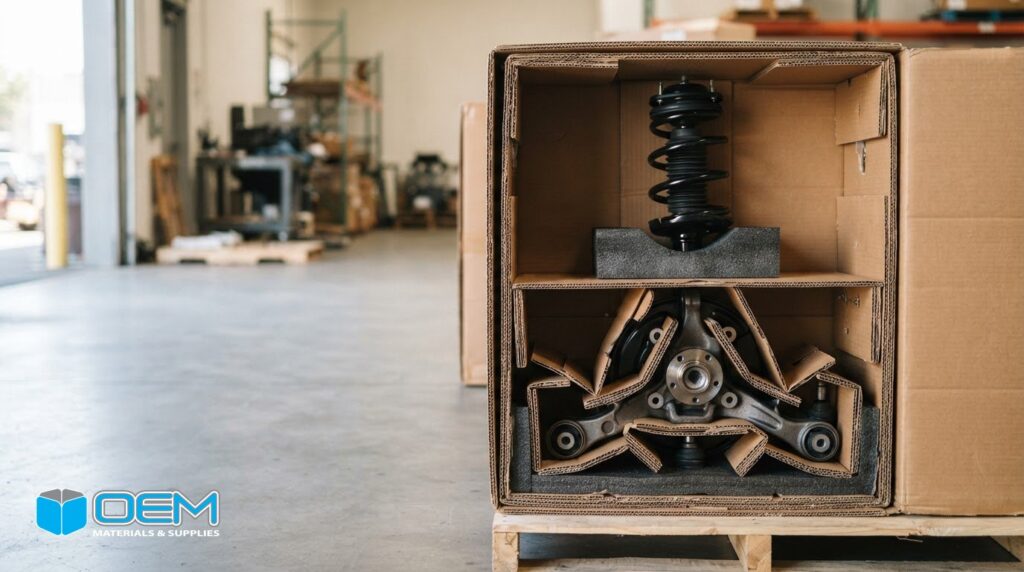
Corrugated packaging can protect heavy automotive components when the box structure and internal cushioning are designed for the part’s weight, shape, and transit demands. Custom automotive packaging in Southern California can combine corrugated boxes with protective dunnage to help limit movement, scratches, and dents during shipping, handling, and storage. The right design depends on the component and how it moves through your supply chain.
It’s reasonable to ask whether corrugated packaging can handle demanding automotive shipments. It can, when engineered for the component’s load and handling conditions rather than chosen by box size alone. This guide explains how to assess protection for engine blocks, transmissions, and suspension assemblies, and how to choose between expendable and returnable dunnage. You’ll also learn which design considerations affect fit, cushioning, and reuse so your packaging supports reliable movement from production to delivery.
Key Takeaways
- Corrugated packaging can protect heavy automotive parts when the box structure and cushioning are matched to the component and its transit conditions.
- Custom foam inserts help secure irregular shapes and limit movement that can cause scratches or dents.
- For engine blocks, transmissions, and suspension assemblies, packaging fit and load support are key design considerations.
- Choose expendable or returnable dunnage based on shipping routes, handling needs, and whether the packaging will make repeat trips.
- The U.S. Environmental Protection Agency reports that recycled polyethylene foam retained cushioning properties through repeated shock impacts, with as little as 12 percent decay.
Can corrugated packaging meet automotive industry durability requirements?
Yes. Corrugated packaging can protect automotive parts when its construction and cushioning suit the component, handling, and transit conditions. Custom foam inserts help control movement and protect contact points inside heavy-duty boxes.
Custom Foam and Heavy-Duty Corrugated Protection
A heavy component needs support at its load-bearing points, not just a box that fits around it. Custom foam inserts can cradle irregular shapes, separate adjacent parts, and reduce contact that can cause scratches or dents. For an engine component with protruding features, the insert should support stable surfaces while leaving vulnerable areas clear. The foam packaging options can be considered alongside the corrugated outer container.
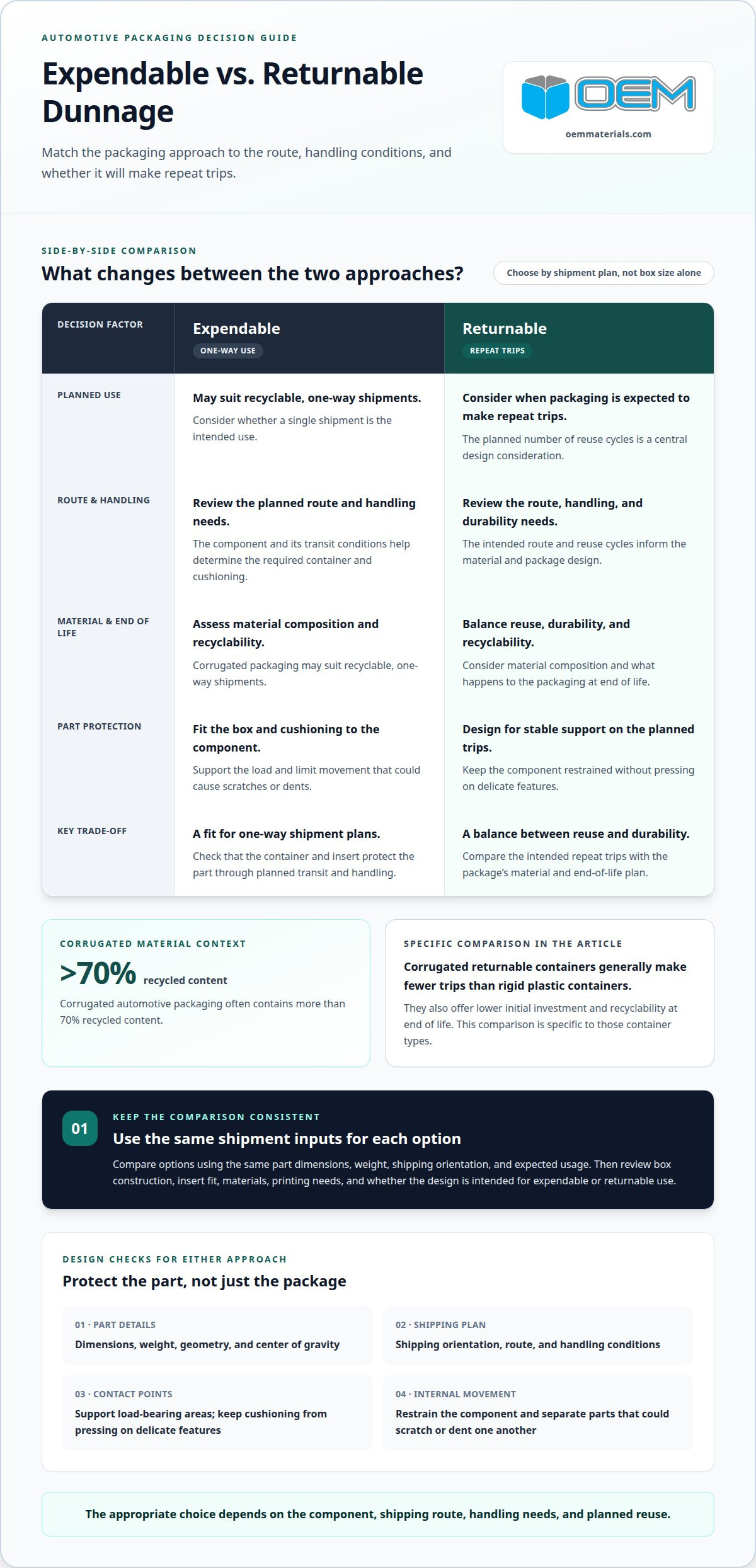
Corrugated automotive packaging often contains more than 70% recycled content. Corrugated returnable containers generally make fewer trips than rigid plastic containers, while offering lower initial investment and recyclability at end of life. That tradeoff makes the intended route and number of reuse cycles central design considerations.
Corrugated Packaging Design
Custom design starts with the part’s dimensions, weight, geometry, and shipping orientation. The package should restrain the component without forcing pressure onto delicate features. For car mats, a fitted corrugated box can keep folded or stacked mats together and reduce exposure to handling damage. Corrugated cardboard is one packaging material identified by the U.S. Environmental Protection Agency, alongside plastic and metal.
For automotive parts shipped in the United States, packaging should meet the buyer’s applicable OEM specifications and protect parts through planned handling and transit. The component, route, and shipping method determine the cushioning and container structure required.
Businesses looking for custom automotive packaging in Southern California can work with OEM Materials & Supplies for custom corrugated boxes and protective foam inserts. The team designs packaging around the part and its handling requirements, serving manufacturers in Orange County, Los Angeles, San Diego, and Riverside.
OEM Materials & Supplies provides custom packaging design, corrugated packaging, foam protection, and kitting and assembly. Structural design, printing, and fulfillment are distinct requirements, so define which services your operation needs.
For a useful quote comparison, provide the same part dimensions, weight, shipping orientation, and expected usage for each packaging option. Compare box construction, insert fit, materials, printing needs, and whether the design supports expendable or returnable use.
To assess sustainability, compare material composition, recyclability, and plans for reuse. Corrugated packaging may suit recyclable, one-way shipments, while returnable systems may call for a different balance of materials and durability.
The company says its engineered packaging solutions are designed to meet OEM specifications and withstand long-haul transit. Buyers can use those stated aims as points to discuss when reviewing a package for a particular automotive part. The claim does not replace checking whether the proposed structure and cushioning suit the component, handling, and transit conditions.
Before approving a design, confirm that it fits the part’s dimensions, weight, geometry, and shipping orientation, and that the insert restrains the component without pressing on delicate features. Review how the corrugated container and protective insert work together along the planned route. This keeps durability decisions tied to the specific part and shipment.
Heavy-duty protection for automotive components
Heavy automotive parts create two linked challenges: their mass loads the package, and movement can damage the part or surrounding materials. Transit damage can lead to returns and production line stops. Packaging must support the component during shipping, handling, and storage, including lifts and repositioning that could shift the load.
Start with the component’s weight, dimensions, center of gravity, and contact surfaces. A heavy machined housing, for example, needs stable support to prevent it sliding against the container wall. Irregular shapes may not sit securely in a standard box. Structural support and fitted cushioning address these different demands.
Fragility isn’t limited to lightweight parts. A heavy assembly may have exposed edges, finished surfaces, or attached features that can be scratched or dented. Identify these areas first, then position cushioning to separate them from the box and other components. Foam can provide shaped support around the part, while corrugated packaging contains the load.
Handling conditions matter as much as the component itself. A package may be lifted, staged, transferred, and stored before reaching its destination. Each transition can change how the part rests inside the container. Design internal supports to limit shifting and keep the load balanced in its intended shipping orientation.
Automotive applications vary in geometry and surface sensitivity. A suspension assembly may need clearance around projecting arms, while a finished trim component needs protection from abrasion. A sensor module has different handling needs from a metal bracket. Match the cushioning layout to the specific part instead of relying on one generic interior for different components.
For mixed shipments, separate components rather than allowing metal parts to contact finished surfaces. A fitted insert can organize parts by position and keep each item from moving into another. Custom foam packaging can support shaped or sensitive components, while the outer container provides containment for the shipment.
A useful design review follows the part through its shipping path. Confirm its orientation, support points, and likely handling steps. Then check that the packed component stays secure without pressure on vulnerable features. If the shipment includes several parts, assess every contact point, not just the outer dimensions.
These checks make protection a component-specific decision. Engineers and purchasing teams can provide part dimensions, weight, surface concerns, and shipping orientation for a packaging review. This information helps define a package around actual handling challenges rather than assumptions based on a catalog box.
Packaging for engine blocks, transmissions, and suspension assemblies
Engine blocks, transmissions, and suspension assemblies differ in shape, support points, and exposed surfaces. A package designed for one component may not safely fit another. Custom-engineered packaging, rather than a generic stock size, can reduce excess shipping air and help limit transit damage.
For an engine block, identify stable support areas and exposed machined surfaces. The internal layout should keep the block from shifting without putting pressure on delicate edges or openings. Clear separation between the component and corrugated walls helps prevent direct contact during routine handling.
A transmission often has an uneven profile, with protrusions and surfaces that need clearance. Its packaging should support the main body while leaving room around vulnerable features. A fitted insert can hold the transmission in position instead of relying on loose cushioning to fill empty space.
Suspension assemblies present a different design challenge. Control arms, brackets, and other projecting shapes can create contact points inside a container. Map those points before choosing the package layout. Add support where the assembly bears weight and maintain clearance around areas that could catch or rub during movement.
Packaging design should account for the shipment’s orientation and handling path. Operations teams can identify how a part enters the package, how workers move it, and how it is staged for shipment. These steps inform access, closure, and placement without adding unnecessary handling motions.
Fit also affects the environmental and material profile of a shipment. Oversized packaging uses space that does not support the component, while a close-fitting design can reduce unused volume. The right balance still needs adequate cushioning and structural support for the part’s shape and movement through the supply chain.
For mixed shipments, separate an engine component from adjacent hardware that could contact its finish. A transmission and a bagged mounting bracket, for example, need distinct positions within the package. Dividers or fitted cushioning can organize the parts and make their intended placement clear during packing.
Before production, evaluate the design using the actual component and packing sequence. Confirm that support points align, vulnerable features have clearance, and the part remains in position after closure. A design review can also reveal whether workers can load and remove the assembly without awkward repositioning.
Provide the component’s dimensions, weight, orientation, and surface concerns when developing a package. Include known handling steps and whether the shipment travels alone or with related parts. These details give packaging engineers a practical basis for designing around engine blocks, transmissions, and suspension assemblies.
Automotive packaging options
Automotive parts vary in weight, surface finish, and sensitivity, so packaging materials serve different roles. The U.S. Environmental Protection Agency identifies plastic, metal, and corrugated cardboard among materials used in packaging. Selection should reflect the component, its handling path, and whether the shipment is expendable or intended for reuse.
Corrugated boxes provide an outer container for parts such as brackets, trim pieces, and replacement components. They can be paired with internal cushioning to limit movement and separate adjacent items. Corrugated packaging also suits car mats, which can be grouped in a carton sized to their packed shape and shipping orientation.
Foam inserts suit components with irregular profiles or surfaces that need separation from the box and other parts. For example, an insert can create individual positions for a group of small automotive parts, keeping them organized during handling. The design should support each part without pressing on sensitive features.
Plastic packaging may suit operations that need durable containers for repeated handling, while metal containers can serve applications requiring a rigid enclosure. Each material affects package weight, handling, and end-of-life considerations. Compare those factors with the component and route rather than treating one material as right for every shipment.
Some shipments need a combination of materials. A corrugated outer box with fitted foam can protect a delicate sensor housing, while a larger assembly may need a crate and cushioning. The package’s layers should work together: the outer container contains the load, and interior protection controls contact and movement.
Automotive packaging often contains more than 70% recycled content, according to International Paper. Recycled content is one consideration, not the only measure of a suitable package. Buyers can also consider whether the material can be recycled locally, how the package is handled after delivery, and whether the design supports reuse.
Consider tracking needs separately from protective materials. A label or shipment identifier can help operations teams match a package to its order or destination, while the box, insert, or container protects the contents. Consistent identification, for example, can help warehouse staff route cartons containing different automotive parts.
To compare options, document each part’s dimensions, weight, surface concerns, shipping orientation, and handling sequence. Then assess the container, cushioning, and materials together. For a mixed shipment, note which components need individual separation. This information helps define packaging that fits actual supply chain operations.
Expendable and returnable dunnage
Dunnage holds automotive parts in position and cushions them during shipping and handling. Expendable dunnage travels with the part and is discarded or recycled after delivery. Returnable dunnage is collected and sent back for another shipment. The right system depends on the route, return process, storage space, and protection the component needs.
Expendable options can suit one-way deliveries where packaging does not return to the shipper. Corrugated partitions, cushioning materials, and foam inserts can separate parts inside a box. For example, an insert can keep a finished bracket from rubbing against other components. The design should also make packing and removal straightforward at the receiving location.
Returnable dunnage can make sense for repeat shipments between known locations. A fitted insert can travel with a component through delivery, then return for reuse. Recycled polyethylene foam retained its cushioning properties through repeated shock impacts, with as little as 12 percent decay, according to the U.S. Environmental Protection Agency. That performance makes it suitable for reusable or returnable packaging.
Reuse depends on the operating system around the package. Teams need a defined return path, space to store empty dunnage, and a process for inspecting it before reuse. A returnable insert left at the receiving plant can interrupt the cycle. Map the movement of both the automotive part and its dunnage before choosing a reusable design.
Compare the two approaches against delivery patterns and protection needs. A one-way shipment to a customer may favor expendable materials, while recurring transfers between facilities can support returns. Also consider whether the package must protect a sensitive finish, organize several parts, or accommodate different component shapes. These requirements influence insert design and material selection.
Inspection criteria help keep reuse consistent. Define what damage, compression, contamination, or loss of fit means an insert should be removed from circulation. For example, replace a foam cradle that no longer holds a sensor module securely. A clear inspection step helps warehouse teams distinguish serviceable dunnage from material that no longer supports the part properly.
Trial the chosen setup with the actual component and packing sequence. Confirm that workers can load the part, close the package, and remove it without shifting or snagging. For returnable systems, include empty-package returns and storage in the trial. Record issues such as difficult handling or missing dunnage, then adjust the process before wider use.
For help matching cushioning to a one-way or returnable shipment, request a packaging quote with the component dimensions, weight, route, and expected reuse pattern. Those details help define the dunnage around the part and its delivery cycle.
OEM Materials & Supplies
OEM Materials & Supplies helps industrial buyers match corrugated boxes, foam packaging, and packaging kits to automotive parts and shipping needs. Turn to the team when a standard package doesn’t suit a component’s shape, handling requirements, or dunnage plan. Coordinated packaging brings the outer container and internal cushioning together around the shipment.
For a focused recommendation, share the part’s dimensions, weight, shipping orientation, delivery route, and whether the dunnage is expendable or returnable. Those details help narrow the options to the component and its supply chain requirements. Contact OEM Materials & Supplies to discuss packaging for your automotive components.
Set Up the Next Packaging Review
A packaging decision is most useful when it reflects the part’s actual journey, from the packing station through delivery and receiving. Bring engineering, purchasing, and warehouse teams into the same review so the design accounts for component protection and day-to-day handling. For custom automotive packaging in Southern California, start with the part dimensions, weight, shipping orientation, route, and expected annual usage. Include details about surface sensitivity and whether dunnage needs to return.
These details give the packaging discussion a practical starting point. They also help align the package with your handling process and supply chain requirements, rather than treating the container as a standalone item. OEM Materials & Supplies can discuss your application and suitable packaging options.
Contact OEM Materials & Supplies to discuss your automotive packaging needs. A clear set of shipment details can help move the conversation toward a workable next step.
Frequently Asked Questions
What is the typical lead time for custom automotive packaging design?
Lead time depends on the package design, materials, and production scope. A prototype or short run follows a different process from a high-volume program. Design complexity also matters, especially when a package needs custom corrugated components and engineered foam inserts. For planning, share part specifications, packaging requirements, and expected usage early. This gives the team a clearer basis for coordinating design and production.
What size and weight limits exist for corrugated automotive packaging?
There isn’t one size or weight limit that applies to every corrugated package. The appropriate design depends on the part’s dimensions, load, handling, and box construction. OEM Materials & Supplies offers single-wall, double-wall, and triple-wall corrugated boxes, along with custom-sized boxes. A compact accessory and a large automotive assembly, for example, call for different structural approaches. Provide the component’s dimensions and weight to guide package selection.
What types of custom automotive packaging are available for parts and accessories?
Custom options include corrugated boxes, die-cut packaging, foam inserts, and packaging kits. A kit can combine a box with fitted cushioning or partitions to organize related parts for packing. Foam inserts can be shaped around a component, while corrugated dividers separate items within a shared container. Anti-static and ESD foam options are available for automotive electronics. The right configuration depends on the parts and how they’re handled.
What are typical minimum order quantities and lead times for custom automotive packaging?
Minimum quantities and lead times depend on packaging design and production scope. OEM Materials & Supplies supports prototypes, short runs, and high-volume programs, so buyers can discuss needs at different stages of a program. A prototype for a new component differs from recurring production packaging with established specifications. Include anticipated order volume, design requirements, and timing needs when discussing a project to help define a suitable production plan.
What custom automotive packaging companies serve Southern California?
Great Northern and OEM Materials & Supplies are identified as automotive packaging providers. Great Northern offers anti-static and ESD foam inserts for automotive electronics and sensor modules in Los Angeles.